Thank you for visiting SNEWPapers!
Sign up free
The Daily Union
Washington, District Of Columbia
What is this article about?
Hon. Robert J. Walker writes to Southampton's town clerk supporting a banquet for Louis Kossuth, praising it as a stand against despotism. He highlights shared Anglo-American values of constitutional liberty, defends Kossuth from agrarian accusations, and affirms American readiness to aid England against absolutism.
Clipping
OCR Quality
Full Text
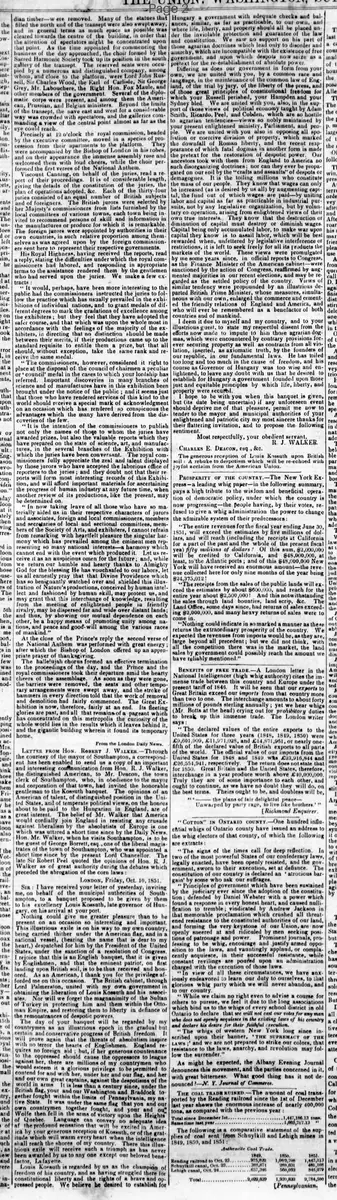
LETTER FROM HON. ROBERT J. WALKER.—Through the courtesy of the mayor of Southampton, a correspondent has been enabled to send us a copy of an important and interesting communication from Hon. R. J. Walker, the distinguished American, to Mr. Deacon, the town clerk of Southampton, who, in obedience to the mayor and corporation of that town, had invited the honorable gentleman to the Kossuth banquet. The opinions of an American of talent, of distinguished position in the United States, and of temperate political views, on the honors about to be paid to the Hungarian in England, are of great interest. The belief of Mr. Walker that America would cordially join England in resisting any crusade against liberalism by the absolutists of Europe is one which was uttered a short time since by the Daily News. Hon. Mr. Walker, when he visits Southampton, is to be the guest of George Borrett, esq., one of the liberal magistrates of the town of Southampton, who was appointed a short time since by the present Lord Chancellor. The late Sir Robert Peel quoted the opinions of Hon. R. J. Walker as of great authority during the debates which preceded the abrogation of the corn laws:
LONDON, Friday, Oct. 10, 1851.
Sir: I have received your letter of yesterday, inviting me, on behalf of the municipal authorities of Southampton, to a banquet proposed to be given by them to his excellency Louis Kossuth, late governor of Hungary, on his arrival at your port.
Nothing could give me greater pleasure than to be present on an occasion so interesting and important. This illustrious exile is on his way to my own country, being carried thither under the American flag, and in a national vessel, (bearing the name that is dear to my heart,) despatched for him by the President of the United States, under the sanction of a resolution of Congress.
I rejoice that this is an English banquet, that it is given by Englishmen, and that the eminent patriot, on first landing upon British soil, is to be thus received and honored. As an American, I thank you for the privilege afforded me on this occasion. The British cabinet, through Lord Palmerston, united with my own government in obtaining the liberation of Louis Kossuth and his associates. Nor will we forget the magnanimity of the Sultan of Turkey in protecting him and them within the Ottoman Empire, and restoring them to liberty in defiance of the remonstrances of despotic powers.
The day of your banquet will be regarded by my countrymen as an illustrious epoch in the gradual but certain and conservative progress of British freedom. It will prove again that the threats of absolutism inspire with no terror the hearts of Englishmen.
England requires no foreign aid; but, if her generous countenance to the oppressed should cause the oppressors to league against her, there are millions of my countrymen who would esteem it a glorious privilege to be permitted to contend for and with her, under her and our flag, and her and our own great captains, against the despotisms of the world in arms.
It is less than a century since, under the British flag, your and our Washington and Braddock together fought within the limits of Pennsylvania, my native State. It was under the same flag that you and our own countrymen together fought, and your and our Wolfe then fell in the arms of victory upon the Heights of Quebec. Language can convey no adequate idea of the profound sensation that will be excited in America by your generous reception of Kossuth or of the gratitude which will warm every heart when the intelligence shall reach the shores of my country. There this illustrious exile will receive such triumph as has never been awarded by us to any one except our beloved benefactor, Lafayette.
Louis Kossuth is regarded by us as the champion of freedom of his country, and as having struggled there for constitutional liberty and the rights of a brave and oppressed people. We believe he desired to establish for Hungary a government with adequate checks and balances, similar, as far as practicable, to our own, and where life, liberty, and property should all be placed under the inviolable protection and guarantee of the law and constitution. We saw no support on his part of those agrarian doctrines which lead only to disorder and anarchy, which are incompatible with the existence of free government, and upon which despots now seize as a pretext for the re-establishment of absolute power.
Differing as does our government in form from your own, we are united with you, by a common race and language, in the maintenance of the common law of England, of the trial by jury, of the liberty of the press, and of those great principles of constitutional freedom for which your Russell perished, your Hampden and your Sydney bled. We are united with you, also, in the support of those views of political economy taught by Adam Smith, Ricardo, Peel, and Cobden, which are so hostile to agrarian tendencies—views so nobly maintained by your present enlightened ministry, Parliament, and people. We are united with you also in opposing all spoliation or coercive division of property, which marked the downfall of Roman liberty, and the recent reappearance of which fatal dogmas in another form is made the pretext for the restoration of despotic power. Our ancestors took with them from England to America no such disorganizing doctrines; nor can they ever be propagated on our soil by the "crafts and assaults" of despots or demagogues. It is the toiling millions who constitute the mass of our people. They know that wages can only be increased (as is desired by us all) by augmenting capital, the fund out of which wages are paid—by uniting labor and capital as far as practicable in industrial pursuits, not by any legislative organization, but by voluntary co-operation, arising from enlightened views of their own true interests. They know that the destruction or diminution of capital must destroy or diminish wages. Capital being only accumulated labor, to make war upon capital they know is to assail labor, which will be best rewarded when, unfettered by legislative interference or restrictions, it is left to seek freely for all its products the markets of the world. These views were promulgated by me some years since, in official reports to Congress as the Finance Minister of the American cabinet—were sanctioned by the action of Congress, reaffirmed by augmented majorities in our recent elections, and may be regarded as the settled policy of the country. Views of similar tendency were propounded by an illustrious departed British Prime Minister, whose measures, simultaneous with our own, enlarged the commerce and cemented the friendly relations of England and America, and who will ever be remembered as a benefactor of both countries and of mankind.
I deem it due to myself and my country, and to your illustrious guest, to state my respectful dissent from the efforts now made to impute to him those agrarian dogmas, which were encountered by contrary provisions forever securing property as well as contracts from all violation, inserted, as axiomatic truth, by the founders of our republic, in our fundamental laws. He has toiled too long and too much in the cause of freedom, and his course as Governor of Hungary was too wise and enlightened, to leave any doubt with us that he desired to establish for Hungary a government founded upon those just and equitable principles by which life, liberty, and property were secured.
I hope to be with you when this banquet is given, but (its date being uncertain) if any unforeseen event should deprive me of that pleasure, permit me now to tender to the mayor and municipal authorities of your enlightened and patriotic city my most sincere thanks for their flattering invitation, and to propose the following sentiment.
Most respectfully, your obedient servant,
R. J. WALKER.
Charles E. Deacon, esq., &c.
The generous reception of Louis Kossuth upon British soil: A rebuke to despotism which will be re-echoed with joyful acclaim from the American Union.
What sub-type of article is it?
What themes does it cover?
What keywords are associated?
What entities or persons were involved?
Letter to Editor Details
Author
R. J. Walker
Recipient
Charles E. Deacon, Esq.
Main Argument
the letter supports the southampton banquet for louis kossuth as a symbol of british resistance to despotism, defends kossuth's commitment to constitutional liberty against agrarian accusations, and emphasizes anglo-american unity in principles of freedom, political economy, and opposition to absolutism, offering american solidarity if needed.
Notable Details