Thank you for visiting SNEWPapers!
Sign up free
The Enquirer
Richmond, Henrico County, Virginia
What is this article about?
Diplomatic correspondence (Nov 1812-Mar 1813) between US agent Beasley and British officials on treating impressed American seamen in Royal Navy as POWs post-war declaration, urging release to avoid combat against US; Britain agrees conditionally on proof, bans correspondence.
Merged-components note: These components form a single continued document titled 'DOCUMENTS (Continued.)' detailing diplomatic correspondence on the detention of American mariners as prisoners of war by Britain; the final component was mislabeled as domestic_news but belongs to this foreign affairs topic.
Clippings
1 of 2
OCR Quality
Full Text
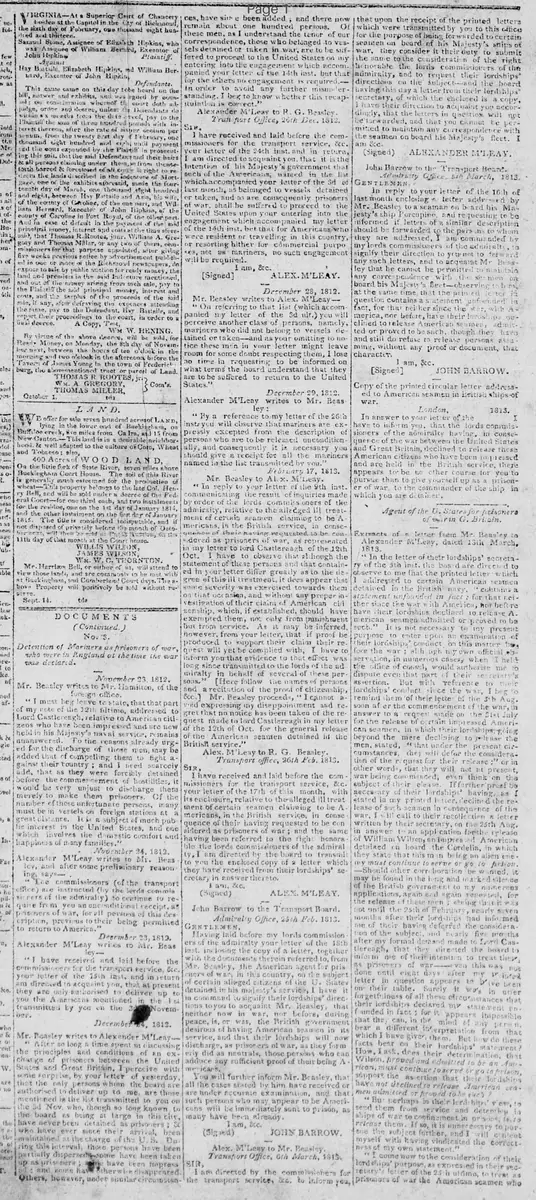
(Continued.)
No. 3.
Detention of Mariners as prisoners of war, who were in England at the time the war was declared.
November 23, 1812.
Mr. Beasley writes to Mr. Hamilton, of the foreign office.
" I must beg leave to state, that that part of my note of the 9th ultimo, addressed to Lord Castlereagh, relative to American citizens who have been impressed and are now held in his Majesty's naval service, remains unanswered. To the reasons already urged for the discharge of those men, may be added that of compelling them to fight against their country; and I need scarcely add, that as they were forcibly detained before the commencement of hostilities, it would be very unjust to discharge them merely to make them prisoners. Of the number of those unfortunate persons, many must be in vessels on foreign stations at a great distance. It is a subject of much public interest in the United States, and one which involves the domestic comfort and happiness of many families."
November 24, 1812.
Alexander M'Leay writes to Mr. Beasley, and after some preliminary reasoning, says---
"The commissioners (of the transport office) are instructed (by the lords commissioners of the admiralty) to continue to require from you an unconditional receipt, as prisoners of war, for all persons of this description, previous to their being permitted to return to America."
December 23,1812.
Alexander M'Leay writes to Mr. Beasley-
"I have received and laid before the commissioners for the transport service, &c. your letter of the 15th inst. and in return am directed to acquaint you, that at present they are only authorised to deliver up to you the Americans mentioned in the list transmitted by you on the 3d November."
December 4, 1812.
Mr. Beasley writes to Alexander M'Leay--
" After so long a time spent in discussing the principles and conditions of an exchange of prisoners between the United States and Great Britain, I perceive with some surprise, by your letter of yesterday, that the only persons whom the board are authorised to deliver up to me. are those mentioned in the list transmitted to you on the 3d Nov. who, though so long known to the board as being at large in this city, have never been detained as prisoners ; who have ever since their arrival, been maintained at the charge of the U. S. During this interval, those persons have been partially dispersed-some have been taken up as prisoners ; some have been impressed ; and some have otherwise disappeared. Others, however, under similar circumstances, have since been added ; and there now remain about one hundred persons. Of these men, as I understand the tenor of our correspondence, those who belonged to vessels detained or taken in war, are to be suffered to proceed to the United States on my entering into the engagement which accompanied your letter of the 14th inst. but that for the others no engagement is required.-- In order to avoid any farther misunderstanding, I beg to know whether this recapitulation is correct."
Alexander M'Leay to R. G. Beasley.
Transport Office, 20th Dec. 1812.
SIR,
I have received and laid before the commissioners for the transport service, &c. your letter of the 24th inst. and in return, I am directed to acquaint you, that it is the intention of his Majesty's government that such of the Americans, named in the list which accompanied your letter of the 3d of last month, as belonged to vessels detained or taken, and as are consequently prisoners of war, shall be suffered to proceed to the United States upon your entering into the engagement which accompanied my letter of the 14th inst. but that for Americans who were resident or travelling in this Country, or resorting hither for commercial purposes, not as mariners, no such engagement will be required.
I am, &c.
[SIGNED]
ALEX. M'LEAY.
December 28, 1812.
Mr. Beasley writes to Alex. M'Leay--
" On referring to that list (which accompanied my letter of the 3d ult.) you will perceive another class of persons, namely, mariners who did not belong to vessels detained or taken--and as your omitting to notice these men in your letter might leave room for some doubt respecting them, I lose no time in requesting to be informed on what terms the board understand that they are to be suffered to return to the United States."
December 29, 1812.
Alexander M'Leay writes to Mr. Beasley :
"By a reference to my letter of the 26th inst. you will observe that mariners are expressly excepted from the description of persons who are to be released unconditionally, and consequently it is necessary you should give a receipt for all the mariners named in the list transmitted by you."
February 17, 1813.
Mr. Beasley to Alex. M'Leay.
" In reply to your letter of the 9th inst. communicating the result of inquiries made by order of the lords commissioners of the admiralty, relative to the alledged ill treatment of certain seamen claiming to be Americans. in the British service, in consequence of their having requested to be considered as prisoners of war, as represented in my letter to lord Castlereagh of the 12th Oct. I have to observe that although the statement of those persons and that contained in your letter differ greatly as to the degree of this ill treatment, it does appear that some severity was exercised towards them on that occasion, and without any proper investigation of their claim of American citizenship, which, if established, should have exempted them, not only from punishment but from service. As it may be inferred, however, from your letter, that if proof be produced to support their claim their request will yet be complied with, I have to inform you that evidence to that effect was long since transmitted to the lords of the admiralty in behalf of several of these persons," [Here follow the names of persons and a recitation of the proof of citizenship, &c.] Mr. Beasley proceeds, " I cannot avoid expressing my disappointment and regret that no notice has been taken of the request made to lord Castlereagh in my letter of the 12th of Oct. for the general release of the American seamen detained in the British service."
Alex. M'Leay to R. G. Beasley.
Transport office, 26th Feb. 1813.
SIR,
I have received and laid before the commissioners for the transport service, &c. your letter of the 17th of this month, with its enclosure, relative to the alleged ill treatment of certain seamen claiming to be Americans, in the British service. in consequence of their having requested to be considered as prisoners of war; and the same having been referred to the right honorable the lords commissioners of the admiralty, I am directed by the board to transmit to you the enclosed copy of a letter which they have received from their lordships' secretary in answer thereto.
I am, &c.
(Signed)
ALEX. M'LEAY.
John Barrow to the Transport Board.
Admiralty Office, 25th Feb. 1813.
GENTLEMEN,
Having laid before my lords commissioners of the admiralty your letter of the 18th inst. inclosing the copy of a letter, together with the documents therein referred to, from Mr. Beasley, the American agent for prisoners of war, in this country, on the subject of certain alleged citizens of the U. States detained in his majesty's service, I have it in command to signify their lordships' directions to you to acquaint Mr. Beasley, that neither now in war, nor before, during peace, is, or was, the British government desirous of having American seamen in its service, and that their Lordships will now discharge, as prisoners of war, as they formerly did as neutrals, those persons who can adduce any sufficient proof of their being Americans.
You will further inform Mr. Beasley, that all the cases stated by him have received or are under accurate examination, and that such persons who may appear to be Americans will be immediately sent to prison, as many have been already.
I am, &c.
(Signed)
JOHN BARROW.
Alex. M'Leay to Mr. Beasley.
Transport Office, 6th March, 1813.
SIR,
I am directed by the commissioners for the transport service, &c, to inform you, that upon the receipt of the printed letters which were transmitted by you to this office for the purpose of being forwarded to certain seamen on board of his Majesty's ships of war, they consider it their duty to submit the same to the consideration of the right honorable the lords commissioners of the admiralty, and to request their lordships directions on the Subject--and the board having this day a letter from their lordships secretary. of which the enclosed is a copy. I have their direction to acquaint you accordingly, that the letters in question will not be forwarded, and that you Cannot be permitted to maintain any correspondence with the seamen on board his Majesty's fleet. I am &c.
(Signed)
ALEXANDER M'LEAY.
John Barrow to the Transport Board.
Admiralty Office, 8th March, 1813.
GENTLEMEN.
In reply to your letter of the 16th of last month enclosing a letter addressed by Mr. Beasley to a seaman on board his Majesty's ship Porcupine, and requesting to be informed if letters of a similar description should be forwarded to the persons to whom they are addressed, I am commanded by my lords commissioners of the admiralty, to signify their direction to you not to forward any such letters, and to acquaint Mr. Beasley that he cannot be permitted to maintain any correspondence with the seamen on board his Majesty's fleet--observing to him at the same time, that the printed letter in question contains a statement unfounded in fact, for that neither since the war with America, nor before, have their lordships declined to release American seamen, admitted or proved to be such. though they have and still do refuse to release persons assuming, without any proof or document, that character.
I am, &c.
[SIGNED]
JOHN BARROW.
Copy of the printed circular letter addressed to American seamen in british ships-of war.
London, 1813.
In answer to your letter of the
have to inform you, that the lords commissioners of the admiralty having, in consequence of the war between the United States and Great Britain, declined to release those American citizens who have been impressed and are held in the British service, there appears to be no other course for you to pursue than to give yourself up as a prisoner of war. to the commander of the ship in which you are detained'.
Agent of the United States for prisoners of war in Great Britain.
Extracts of a letter from Mr. Beasley to Alexander M'Leay, dated 18th March, 1813.
" In the letter of their lordships' secretary of the 8th inst. the board are directed to inform me that the printed letter which I addressed to certain American seamen detained in the British navy, "contains a statement unfounded in fact : for that neither since the war with America, nor before have their lordships declined to release A. merican seamen admitted or proved to be such." It is not necessary to my present purpose to enter upon an examination of their lordships' conduct on this matter before the war; although my own official observation, in numerous cases, when I held the office of consul, would authorise me to dispute even that part of their secretary's assertion. But with reference to their lordships' conduct since the war, I beg to remind them of their letter of the 1st Aug. soon after the commencement of the war, in answer to a request made on the 31st July for the release of certain impressed American seamen, in which their lordships, going beyond the mere declining to release the men, stated, " that under the present circumstances, they will defer the consideration of the request for their release :" or in other words, that they will not at present, war being commenced, even think on the subject of their release. If further proof be necessary of their Lordships' having, as I stated in my printed letter, declined the release of such seamen in consequence of the war, I will call to their recollection a letter written by their secretary, on the 28th Aug. in answer to an application for the release of William Wilson, an impressed American detained on board the Cordelia, in which they state that this man being an alien enemy must continue to serve or go to prison. --Should other corroboration be wanted, it may be found in the long and marked silence of the British government to my numerous applications, again and again repeated, for the release of these men ; showing that it was not until the 25th of February, nearly seven months after their lordships had informed me of their having deferred the consideration of the subject. and nearly five months after my formal demand made to Lord Castlereagh, that they directed the board to inform me of their intention to treat them as prisoners of war-- even this was not done until eight days after my printed letter in question appears to have been on their table. Surely it was in utter forgetfulness of all these circumstances that their lordships denied my statement founded in fact ; for it appears impossible that they can, in the mind of any person, bear a different interpretation from that which I have given them. But how do these facts bear on their lordships' statement? How, I ask, does their determination, that Wilson, proved and admitted to be an American, must continue to serve or go to prison, support the assertion that their lordships have not declined to release American seamen admitted or proved to be such? " But perhaps in their lordships' view, to send them from service and detention in ships of war to confinement in prisons, is to release them. If so, it is unnecessary to pursue the subject farther, and I will content myself with having vindicated the correctness of my own statement."
" I come now to the consideration of their lordships' purpose, as expressed in their secretary's letter of the 25th ultimo, to treat as prisoners of war the American seamen who
have been impressed and are held in the British service. Taking into view the manner in which these unfortunate persons came into the power of the British government, that their own rights and inclinations, the rights of their country, the law of nations, and every principle of justice were violated in the very act by which each of these men remain in its power, I do maintain that the wrong accumulates so long as any of them was brought within its power, and that this are on every ground entitled to, and the British government is bound to grant their immediate and complete release. It acquired them only as the spoils of unlawful violence; how then can it retain them as the fruits of lawful war? Its right of control over them can only arise from the lawfulness of their detention; but that which was unlawfully taken cannot be rightfully held, and to acknowledge the pretension to such control as their lordships' purpose implies, would be to legitimatize the act by which they came into their power. The British government disclaims all right and all intention to take them, and this disavowal is an acknowledgement of its obligation to restore them to the same condition, and to the same freedom from which they were taken. Upon what ground is it, then, that they are to be treated as prisoners of war? Not many years have elapsed since all Europe resounded with the complaints of Great Britain against France for detaining as prisoners of war certain British subjects who, having entered the French territories in time of peace, were found there at the breaking out of the war. But if that were regarded in England as an outrage, what will be thought of this detention, as prisoners of war, of American seamen, who, having been wrongfully taken on the high seas and forcibly carried into the British service in time of peace, are found therein at the breaking out of a war doing her service and fighting her battles? The conduct of France was attempted to be justified by certain acts of England, which were alleged to be equally contrary to the law of nations. But what justification, what excuse, can be set up for this conduct of Great Britain towards the impressed American seamen? What infraction of the law of nations is, what violence or injustice exercised towards British subjects, or what outrage is this cruel act to retaliate? It cannot be the free and spontaneous permission given by the U. S. at the commencement of the war, for every British subject, of every class and description, found within their territories or in their power to return to his country, that this imprisonment of American seamen is to requite. And surely this cannot be the indemnification which Great Britain offers these unfortunate men for the wrongs which she has inflicted on them, or the reward which she bestows for the service she has received at their hands.
To the unqualified prohibition of all correspondence between myself and the impressed American seamen in his Britannic majesty's fleet, so unreservedly stated in the letter of their lordships' secretary of the 6th instant, I must conform whatever may be my sentiments and feelings respecting it. The situation in which these unfortunate men and myself stood towards each other, appeared not only to invite, but to authorize a communication between us. On their part the object of this correspondence was to obtain information and counsel as to the proper manner of conducting themselves under circumstances the most difficult, and on an occasion the most important and solemn, namely, how to act while forcibly held to service in ships of war belonging to a state engaged in actual hostilities against their country; a situation which their own good sense and proper feelings taught them was alike incompatible with their rights & their duties. My part has been, after having waited five months in vain for a communication of their lordships' intentions, to recommend them, since there appeared no means of obtaining their release, to give themselves up as prisoners of war; an evil comparatively light to that which they suffer. In other instances their letters have related the rejection of their offer and the threats of punishment, and all contain complaints of the unexampled hardships of their situation."
(To be continued.)
What sub-type of article is it?
What keywords are associated?
What entities or persons were involved?
Where did it happen?
Foreign News Details
Primary Location
England
Event Date
November 1812 March 1813
Key Persons
Outcome
british government agrees to discharge impressed american seamen as prisoners of war upon proof of citizenship; refuses to forward correspondence to seamen; denies prior refusal to release proven americans.
Event Details
Series of letters between American agent R. G. Beasley and British officials Alexander M'Leay and John Barrow regarding the treatment of impressed American mariners in British naval service after the US declaration of war. Beasley urges release or POW status to avoid forcing them to fight against their country. British respond by requiring receipts as POWs for exchange, limiting releases to specific lists, and eventually directing discharge as POWs with proof. They prohibit Beasley's correspondence with seamen and contest his claims of prior refusals.