Thank you for visiting SNEWPapers!
Sign up free
Literary
July 18, 1826
Rhode Island American And Providence Gazette
Providence, Providence County, Rhode Island
What is this article about?
An informative essay on the history and techniques of painting on porcelain and earthenware, covering origins from ancient times to modern English methods, including colors from metallic oxides, blue printing, and lustreware production. Attributed to Mr. Parke, reprinted from New York Times.
Clipping
OCR Quality
98%
Excellent
Full Text
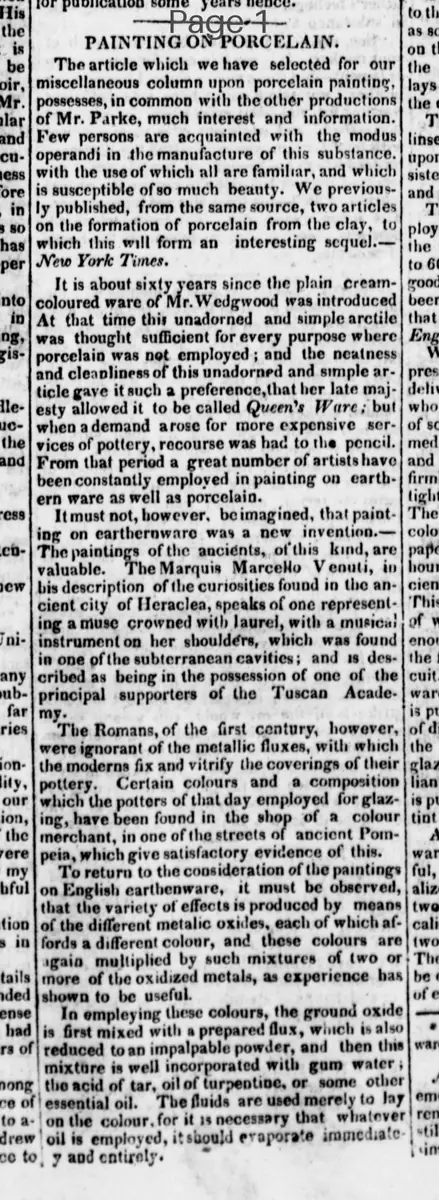
PAINTING ON PORCELAIN
The article which we have selected for our miscellaneous column upon porcelain painting, possesses, in common with the other productions of Mr. Parke, much interest and information. Few persons are acquainted with the modus operandi in the manufacture of this substance, with the use of which all are familiar, and which is susceptible of so much beauty. We previously published, from the same source, two articles on the formation of porcelain from the clay, to which this will form an interesting sequel.—New York Times.
It is about sixty years since the plain cream-coloured ware of Mr. Wedgwood was introduced. At that time this unadorned and simple article was thought sufficient for every purpose where porcelain was not employed; and the neatness and cleanliness of this unadorned and simple article gave it such a preference, that her late majesty allowed it to be called Queen's Ware; but when a demand arose for more expensive services of pottery, recourse was had to the pencil. From that period a great number of artists have been constantly employed in painting on earthen ware as well as porcelain.
It must not, however, be imagined, that painting on earthenware was a new invention. The paintings of the ancients, of this kind, are valuable. The Marquis Marcelo Venuti, in his description of the curiosities found in the ancient city of Heraclea, speaks of one representing a muse crowned with laurel, with a musical instrument on her shoulders, which was found in one of the subterranean cavities; and is described as being in the possession of one of the principal supporters of the Tuscan Academy.
The Romans, of the first century, however, were ignorant of the metallic fluxes, with which the moderns fix and vitrify the coverings of their pottery. Certain colours and a composition which the potters of that day employed for glazing, have been found in the shop of a colour merchant, in one of the streets of ancient Pompeia, which give satisfactory evidence of this.
To return to the consideration of the paintings on English earthenware, it must be observed, that the variety of effects is produced by means of the different metallic oxides, each of which affords a different colour, and these colours are again multiplied by such mixtures of two or more of the oxidized metals, as experience has shown to be useful.
In employing these colours, the ground oxide is first mixed with a prepared flux, which is also reduced to an impalpable powder, and then this mixture is well incorporated with gum water; the acid of tar, oil of turpentine, or some other essential oil. The fluids are used merely to lay on the colour, for it is necessary that whatever oil is employed, it should evaporate immediately and entirely.
The preparations which are commonly used are the metallic oxides, and their combinations with acids. Thus, cobalt yields a blue; antimony and silver give yellows and orange: platinum a silver colour; gold, violet and purple: copper, the greens; while the reds, the browns and the blacks are derived from iron.
The oxide of cobalt employed in pottery is usually prepared from zaffre; which is an expensive article, imported from Saxony, though a few years ago it was procured from Cornwall. For preparing antimonial yellows, the crude antimony is first calcined with four times its weight of nitre, and then mixed with a certain portion of vitrified lead. Oxide of gold, precipitated by copper, makes the finest purple. A small portion of copper mixed with oxide of iron greatly increases the intensity of the blacks on earthenware. It is here necessary to remark, that in painting on the biscuit* no oil is used; the colours are mixed with water only. For certain purposes, the painting is performed upon the glaze, as some colours would be injured, and others destroyed by the heat of the gloss oven. Thus, when iron is employed to produce black or brown, the painting is always done upon the glaze, the ware is then finished in an enamel oven, at about 6 deg. of Wedgwood's Pyrometer.
Lustreware is produced by being covered entirely on the exterior, as is the case when the sulphuret of antimony is employed for producing a common kind of yellow ware. Gold lustre is effected by means of gold, and silver lustre by the oxide of Platinum.
For preparing the lustre ware, the oxide of whatever kind it may be, is mixed with one of the essential oils, and in that state is brushed upon the surface after the ware is glazed. For gold lustre the ware is made of a red clay, which when burnt and glazed, shows so much of its colour through the covering of gold, as is sufficient to give the goods that peculiar brown tint, which is always observable on this singular kind of pottery. When the metallic oxide has been applied to the surface of the goods, they are carried to an enamelling-oven where the heat dissipates the oxygen, and restores those precious metals to their metallic state—I cannot say quite to their primitive brilliancy, because this is often injured by the fluid menstruum employed in the operation. The great difference which there is in the appearance of this ware, especially in that which is covered with platinum can only be thus accounted for. Some of it looks like silver, while from other manufactories, the articles look like steel.
For gilding porcelain the metal is used in its metallic state. To procure it in a pulverized form, it is first dissolved in aqua regia, and then the acid is driven off by heat, and the gold remains; this is then mixed with borax and gum-water, and applied in that state to the goods;—after this it is baked, and finished by burnishing.
Blue Printing.—The potters of England have derived great advantage from the introduction of the printing press.
The use of this valuable machine which is comparatively of late date, has enabled these manufacturers to produce a greater variety of patterns, and of neater execution than could possibly have been done at the same expense, by the pencil. As this is a curious branch of the business, it will be proper to describe it minutely.
The intended pattern is first printed with some metallic color, chiefly oxide of cobalt, on what is called silver paper, and then the colour is transferred from the paper to the surface of the porcelain.
This style of ware is a very successful imitation of the old blue porcelain china, and of late years has been the means of extending the consumption of British pottery throughout Europe. The potters in china are totally unacquainted with the printing press, and consequently, all their designs are produced by the pencil alone.
This mode of imparting designs to the surface of porcelain, and which is known in the trade by the appellation of Blue Printing, is managed in the following manner.
One man attends the press, which is similar to the common copper plate printing press; and as soon as he has applied the colour, which is laid on the copper plate in the same manner which the copper plate printers apply the ink—he lays it upon a hot iron to thin the oil with which the colour is mixed.
The oil is a peculiar preparation of boiled linseed oil for this purpose. When the colour upon the plate is thus reduced to a proper consistence, a sheet of silver paper is laid over it, and passed through the press.
The oxide of cobalt is the only mineral employed for the blue, and is largely prepared in the Staffordshire Potteries. It sells from 40s to 60s the pound, according to its intensity and goodness. Indeed such improvements have been made in the manufacture of this colour that the Chinese potters are now supplied from England with all the cobalt they consume.
When the paper comes from the printing press, stamped with the required pattern, it is delivered, while wet with the colour, to a girl, who cuts off the superfluous paper, with a pair of scissors, and passes it to another girl, who immediately applies it to a piece of biscuit ware, and then hands it to a third, who fixes it more firmly by rubbing it hard with a piece of flannel tightly rolled up in the form of a short cylinder.
The design of this hard rubbing is to force the colour into the pores of the ware. When the papers thus applied have lain on for about an hour, the colour is generally found to be sufficiently fixed to admit of their being detached.
This is effected by putting the articles into a tub of water, where the paper soon becomes soft enough to allow of its being rubbed off, leaving the full impression of the pattern upon the biscuit. The papers having been removed the ware is suffered to stand and dry, after which it is put into an oven at a low heat, for the purpose of dissipating the oil, and preparing it to receive the glaze. It is obvious that a transparent glaze is necessary to give full effect to the brilliant colour of the cobalt. A little of the oxide is put in the glaze to subdue any lurking yellow tint which might impair its lustre.
An idea occurs to me respecting printed ware, which, although it may now appear fanciful, will, I doubt not, be some time or other realized. I refer to the possibility of printing two or three colours at once. The Lancashire calico printers employ a machine which imparts two or three distinct colours by one impression. The application of the same principle would be of immense importance to the manufacturer of earthen ware and porcelain.
* Biscuit is a term used in potteries to denote the ware after it is once baked, and is unglazed.
The article which we have selected for our miscellaneous column upon porcelain painting, possesses, in common with the other productions of Mr. Parke, much interest and information. Few persons are acquainted with the modus operandi in the manufacture of this substance, with the use of which all are familiar, and which is susceptible of so much beauty. We previously published, from the same source, two articles on the formation of porcelain from the clay, to which this will form an interesting sequel.—New York Times.
It is about sixty years since the plain cream-coloured ware of Mr. Wedgwood was introduced. At that time this unadorned and simple article was thought sufficient for every purpose where porcelain was not employed; and the neatness and cleanliness of this unadorned and simple article gave it such a preference, that her late majesty allowed it to be called Queen's Ware; but when a demand arose for more expensive services of pottery, recourse was had to the pencil. From that period a great number of artists have been constantly employed in painting on earthen ware as well as porcelain.
It must not, however, be imagined, that painting on earthenware was a new invention. The paintings of the ancients, of this kind, are valuable. The Marquis Marcelo Venuti, in his description of the curiosities found in the ancient city of Heraclea, speaks of one representing a muse crowned with laurel, with a musical instrument on her shoulders, which was found in one of the subterranean cavities; and is described as being in the possession of one of the principal supporters of the Tuscan Academy.
The Romans, of the first century, however, were ignorant of the metallic fluxes, with which the moderns fix and vitrify the coverings of their pottery. Certain colours and a composition which the potters of that day employed for glazing, have been found in the shop of a colour merchant, in one of the streets of ancient Pompeia, which give satisfactory evidence of this.
To return to the consideration of the paintings on English earthenware, it must be observed, that the variety of effects is produced by means of the different metallic oxides, each of which affords a different colour, and these colours are again multiplied by such mixtures of two or more of the oxidized metals, as experience has shown to be useful.
In employing these colours, the ground oxide is first mixed with a prepared flux, which is also reduced to an impalpable powder, and then this mixture is well incorporated with gum water; the acid of tar, oil of turpentine, or some other essential oil. The fluids are used merely to lay on the colour, for it is necessary that whatever oil is employed, it should evaporate immediately and entirely.
The preparations which are commonly used are the metallic oxides, and their combinations with acids. Thus, cobalt yields a blue; antimony and silver give yellows and orange: platinum a silver colour; gold, violet and purple: copper, the greens; while the reds, the browns and the blacks are derived from iron.
The oxide of cobalt employed in pottery is usually prepared from zaffre; which is an expensive article, imported from Saxony, though a few years ago it was procured from Cornwall. For preparing antimonial yellows, the crude antimony is first calcined with four times its weight of nitre, and then mixed with a certain portion of vitrified lead. Oxide of gold, precipitated by copper, makes the finest purple. A small portion of copper mixed with oxide of iron greatly increases the intensity of the blacks on earthenware. It is here necessary to remark, that in painting on the biscuit* no oil is used; the colours are mixed with water only. For certain purposes, the painting is performed upon the glaze, as some colours would be injured, and others destroyed by the heat of the gloss oven. Thus, when iron is employed to produce black or brown, the painting is always done upon the glaze, the ware is then finished in an enamel oven, at about 6 deg. of Wedgwood's Pyrometer.
Lustreware is produced by being covered entirely on the exterior, as is the case when the sulphuret of antimony is employed for producing a common kind of yellow ware. Gold lustre is effected by means of gold, and silver lustre by the oxide of Platinum.
For preparing the lustre ware, the oxide of whatever kind it may be, is mixed with one of the essential oils, and in that state is brushed upon the surface after the ware is glazed. For gold lustre the ware is made of a red clay, which when burnt and glazed, shows so much of its colour through the covering of gold, as is sufficient to give the goods that peculiar brown tint, which is always observable on this singular kind of pottery. When the metallic oxide has been applied to the surface of the goods, they are carried to an enamelling-oven where the heat dissipates the oxygen, and restores those precious metals to their metallic state—I cannot say quite to their primitive brilliancy, because this is often injured by the fluid menstruum employed in the operation. The great difference which there is in the appearance of this ware, especially in that which is covered with platinum can only be thus accounted for. Some of it looks like silver, while from other manufactories, the articles look like steel.
For gilding porcelain the metal is used in its metallic state. To procure it in a pulverized form, it is first dissolved in aqua regia, and then the acid is driven off by heat, and the gold remains; this is then mixed with borax and gum-water, and applied in that state to the goods;—after this it is baked, and finished by burnishing.
Blue Printing.—The potters of England have derived great advantage from the introduction of the printing press.
The use of this valuable machine which is comparatively of late date, has enabled these manufacturers to produce a greater variety of patterns, and of neater execution than could possibly have been done at the same expense, by the pencil. As this is a curious branch of the business, it will be proper to describe it minutely.
The intended pattern is first printed with some metallic color, chiefly oxide of cobalt, on what is called silver paper, and then the colour is transferred from the paper to the surface of the porcelain.
This style of ware is a very successful imitation of the old blue porcelain china, and of late years has been the means of extending the consumption of British pottery throughout Europe. The potters in china are totally unacquainted with the printing press, and consequently, all their designs are produced by the pencil alone.
This mode of imparting designs to the surface of porcelain, and which is known in the trade by the appellation of Blue Printing, is managed in the following manner.
One man attends the press, which is similar to the common copper plate printing press; and as soon as he has applied the colour, which is laid on the copper plate in the same manner which the copper plate printers apply the ink—he lays it upon a hot iron to thin the oil with which the colour is mixed.
The oil is a peculiar preparation of boiled linseed oil for this purpose. When the colour upon the plate is thus reduced to a proper consistence, a sheet of silver paper is laid over it, and passed through the press.
The oxide of cobalt is the only mineral employed for the blue, and is largely prepared in the Staffordshire Potteries. It sells from 40s to 60s the pound, according to its intensity and goodness. Indeed such improvements have been made in the manufacture of this colour that the Chinese potters are now supplied from England with all the cobalt they consume.
When the paper comes from the printing press, stamped with the required pattern, it is delivered, while wet with the colour, to a girl, who cuts off the superfluous paper, with a pair of scissors, and passes it to another girl, who immediately applies it to a piece of biscuit ware, and then hands it to a third, who fixes it more firmly by rubbing it hard with a piece of flannel tightly rolled up in the form of a short cylinder.
The design of this hard rubbing is to force the colour into the pores of the ware. When the papers thus applied have lain on for about an hour, the colour is generally found to be sufficiently fixed to admit of their being detached.
This is effected by putting the articles into a tub of water, where the paper soon becomes soft enough to allow of its being rubbed off, leaving the full impression of the pattern upon the biscuit. The papers having been removed the ware is suffered to stand and dry, after which it is put into an oven at a low heat, for the purpose of dissipating the oil, and preparing it to receive the glaze. It is obvious that a transparent glaze is necessary to give full effect to the brilliant colour of the cobalt. A little of the oxide is put in the glaze to subdue any lurking yellow tint which might impair its lustre.
An idea occurs to me respecting printed ware, which, although it may now appear fanciful, will, I doubt not, be some time or other realized. I refer to the possibility of printing two or three colours at once. The Lancashire calico printers employ a machine which imparts two or three distinct colours by one impression. The application of the same principle would be of immense importance to the manufacturer of earthen ware and porcelain.
* Biscuit is a term used in potteries to denote the ware after it is once baked, and is unglazed.
What sub-type of article is it?
Essay
What themes does it cover?
Commerce Trade
What keywords are associated?
Porcelain Painting
Earthenware
Metallic Oxides
Blue Printing
Lustreware
Pottery Techniques
Wedgwood
Cobalt Blue
What entities or persons were involved?
Mr. Parke
Literary Details
Title
Painting On Porcelain
Author
Mr. Parke
Subject
On The History And Techniques Of Painting Porcelain And Earthenware
Form / Style
Informative Prose Essay On Pottery Manufacturing