Thank you for visiting SNEWPapers!
Sign up free
Virginia Argus
Richmond, Virginia
What is this article about?
This editorial, part of a series opposing 'War in Disguise,' argues that European states under Napoleon can surpass British naval power by recruiting sailors, reviews historical maritime empires like Phoenicians and Romans to show naval dominance is transient, and condemns Britain's violation of the Treaty of Amiens by refusing to evacuate Malta, quoting relevant articles.
Merged-components note: This is a continuation of the same editorial article (No. VII) spanning from page 1 to page 2, discussing historical and political topics related to naval power, the Treaty of Amiens, and British policy.
Clippings
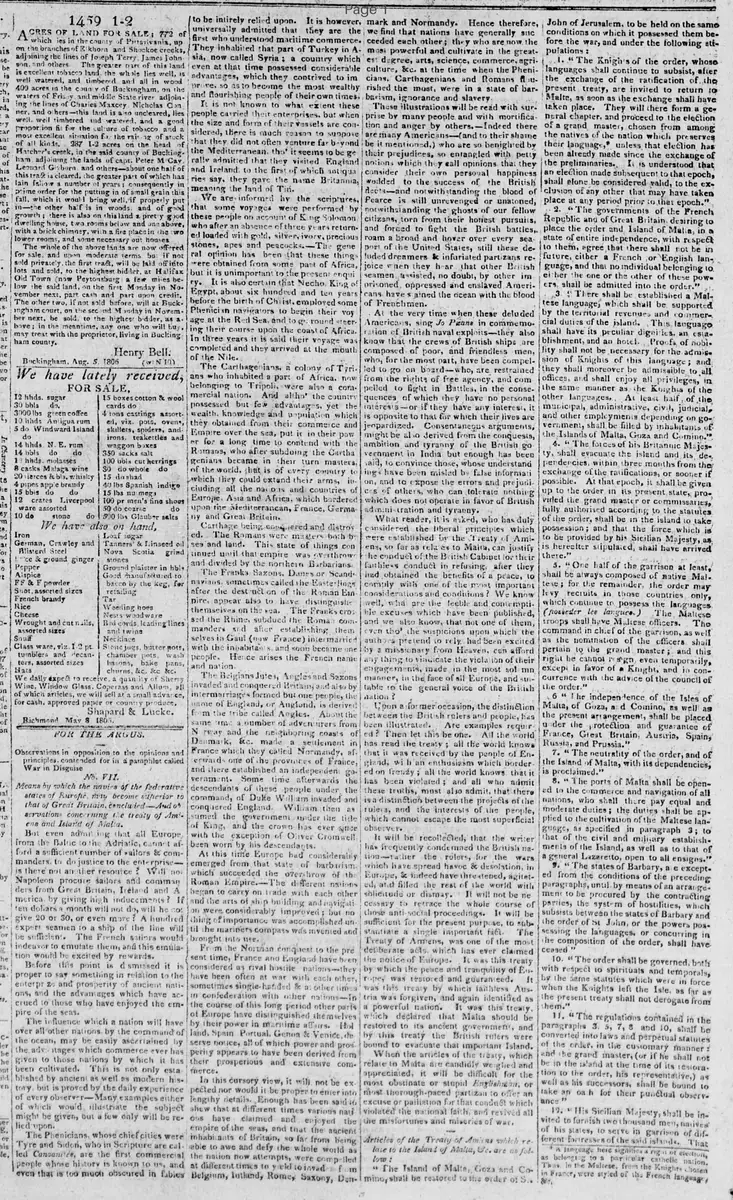
1 of 2
OCR Quality
Full Text
Observations in opposition to the opinions and principles, contended for in a pamphlet called War in Disguise
No. VII.
Means by which the navies of the federative states of Europe, may become superior to that of Great Britain, concluded--And observations concerning the treaty of Amiens and Island of Malta.
But even admitting that all Europe from the Baltic to the Adriatic, cannot afford a sufficient number of sailors & commanders, to do justice to the enterprize-- is there not another resource? Will not Napoleon procure sailors and commanders from Great Britain, Ireland and America, by giving high inducements? If ten dollars a month will not do, will he not give 20 or 30, or even more? A hundred expert seamen to a ship of the line will be sufficient. The French sailors would endeavor to emulate them, and this emulation would be excited by rewards.
Before this point is dismissed it is proper to say something in relation to the enterprize and prosperity of ancient nations, and the advantages which have accrued to those who have enjoyed the empire of the seas.
The influence which a nation will have over all other nations, by the command of the ocean, may be easily ascertained by the advantages which commerce ever has given to those nations by which it has been cultivated. This is not only established by ancient as well as modern history, but is proved by the daily experience of every observer. Many examples either of which would illustrate the subject might be given, but a few only will be relied upon.
The Phenicians, whose chief cities were Tyre and Sidon, who in Scripture are called Canaanites, are the first commercial people whose history is known to us, and even that is too much obscured in fables to be intirely relied upon. It is however universally admitted that they are the first who understood maritime commerce. They inhabited that part of Turkey in Asia, now called Syria; a country which even at that time possessed considerable advantages, which they contrived to improve, so as to become the most wealthy and flourishing people of their own times. It is not known to what extent these people carried their enterprises, but when the size and form of their vessels are considered, there is much reason to suppose that they did not often venture far beyond the Mediterranean, tho' it seems to be generally admitted that they visited England and Ireland, to the first of which antiquaries say, they gave the name Britannia, meaning the land of Tin. We are informed by the scriptures, that some voyages were performed by these people on account of King Solomon, who after an absence of three years returned loaded with gold, silver, ivory, precious stones, apes and peacocks. The general opinion has been that these things were obtained from some part of Africa, but it is unimportant to the present enquiry. It is also certain that Necho, King of Egypt, about six hundred and ten years before the birth of Christ, employed some Phenician navigators to begin their voyage at the Red Sea, and to go round steering their course upon the coast of Africa. In three years it is said their voyage was completed and they arrived at the mouth of the Nile.
The Carthagenians, a colony of Tyrians who inhabited a part of Africa, now belonging to Tripoli, were also a commercial nation. And altho' the country possessed but few advantages, yet the wealth, knowledge and population which they obtained from their commerce and Empire over the sea, put it in their power for a long time to contend with the Romans, who after subduing the Carthagenians became in their turn masters, of the world, that is of every country to which they could extend their arms, including all the nations and countries of Europe, Asia and Africa, which bordered upon the Mediterranean, France, Germany and Great Britain.
Carthage being conquered and destroyed, The Romans were masters both by sea and land. This state of things continued until that empire was overthrown and divided by the northern Barbarians. The Franks Saxons, Danes or Scandinavians, sometimes called the Easterlings after the destruction of the Roman Empire, appear also to have distinguished themselves on the sea. The Franks crossed the Rhine, subdued the Roman commanders and after establishing themselves in Gaul (now France) intermarried with their inhabitants, and soon became one people. Hence arises the French name and nation.
The Belgians Jutes, Angles and Saxons invaded and conquered Britain, and also by intermarriages formed but one people, the name of England, or Angleland, is derived from the tribe called Angles. About the same time a number of adventurers from Norway and the neighboring coasts of Denmark, &c. made a settlement in France which they called Normandy, afterwards one of the provinces of France, and there established an independent government. Some time afterwards the descendants of these people under the command, of Duke William invaded and conquered England. William then assumed the government under the title of King, and the crown has ever since with the exception of Oliver Cromwell been worn by his descendants.
At this time Europe had considerably emerged from that state of barbarism, which succeeded the overthrow of the Roman Empire. The different nations began to carry on trade with each other and the arts of ship building and navigation were considerably improved; but no thing of importance was accomplished until the mariner's compass was invented and brought into use.
From the Norman conquest to the present time, France and England have been considered as rival hostile nations--they have been often at war with each other, sometimes single-handed & at other times in confederation with other nations--in the course of this long period other parts of Europe have distinguished themselves by their power in maritime affairs. Holland, Spain Portugal, Genoa & Venice, deserve notice, all of which power and prosperity appears to have been derived from their prosperous and extensive commerce.
In this cursory view, it will not be expected nor would it be proper to enter into lengthy details. Enough has been said to shew that at different times various nations have claimed and enjoyed the empire of the seas, and that the ancient inhabitants of Britain, so far from being able to awe and defy the whole world as the nation now attempts, were compelled at different times to yield to invaders from Belgium, Jutland, Rome, Saxony, Denmark and Normandy. Hence therefore we find that nations have generally succeeded each other; they who are now the most powerful and cultivated in the greatest degree, arts, science, commerce, agriculture, &c. at the time when the Phenicians, Carthagenians and Romans flourished the most, were in a state of barbarism, ignorance and slavery.
These illustrations will be read with surprise by many people and with mortification and anger by others. Indeed there are many Americans--(and to their shame be it mentioned,) who are so benighted by their prejudices, so entangled with petty notions which they call opinions that they consider their own personal happiness wedded to the success of the British fleets--and notwithstanding the blood of Pierce is still unrevenged or unatoned, notwithstanding the ghosts of our fellow citizens, torn from their honest pursuits, and forced to fight the British battles, roam abroad and hover over every seaport of the United States, still these deluded dreamers & infuriated partizans rejoice when they hear that other British seamen assisted, no doubt, by other imprisoned, oppressed and enslaved Americans, have stained the ocean with the blood of Frenchmen.
At the very time when these deluded Americans, sing Jo Peans in commemoration of British naval exploits--they also know that the crews of British ships are composed, of poor, and friendless men, who, for the most part, have been compelled to go on board--who, are restrained from the rights of free agency, and compelled to fight in Battles, in the consequences of which they have no personal interest--or if they have any interest, it is opposite to that for which their lives are jeopardized. Consonant arguments, might be also derived from the conquests, ambition and tyranny of the British government in India but enough has been said, to convince those, whose understandings have been misled be false information, and to expose the errors and prejudices of others, who can tolerate nothing which does not operate in favor of British administration and tyranny.
What reader, it is asked, who has duly considered the liberal principles which were established by the Treaty of Amiens, so far as relates to Malta, can justify the conduct of the British Cabinet for their faithless conduct in refusing, after they had obtained the benefits of a peace, to comply with one of the most important considerations and conditions? We know well, what are the feeble and contemptible excuses which have been published, and we also know, that not one of them, even tho the suspicions upon which the authors pretend to rely, had been excited by a missionary from Heaven, can afford any thing to vindicate the violation of their engagements, made in the most solemn manner, in the face of all Europe, and suitable to the general voice of the British nation?
Upon a former occasion, the distinction between the British rulers and people, has been illustrated. Are examples required? Then let this be one. All the world has read the treaty: all the world knows that it was received by the people of England, with an enthusiasm which bordered on frenzy; all the world knows that it has been violated; and all who admit these truths, must also admit, that there is a distinction between the projects of the rulers, and the interests of the people, which cannot escape the most superficial observer.
It will be recollected, that the writer has frequently condemned the British nation--rather the rulers, for the wars which have spread havoc & desolation, in Europe, & indeed have threatened, agitated, and filled the rest of the world with solicitude or dismay. It will not be necessary to retrace the whole course of those anti-social proceedings. It will be sufficient for the present purpose, to substantiate a single important fact. The Treaty of Amiens, was one of the most deliberate acts, which has ever claimed the notice of Europe. It was this treaty by which the peace and tranquility of Europe, was restored and guaranteed. It was this treaty by which faithless Austria was forgiven, and again identified as a powerful nation. It was this treaty, which declared that Malta should be restored to its ancient government, and by this treaty the British rulers were bound to evacuate that important Island.
When the articles of the treaty, which relate to Malta are candidly weighed and appreciated, it will be difficult for the most obstinate or stupid Englishman, or most thorough-paced partizan to offer an excuse or palliation for that conduct which violated the national faith, and revived all the misfortunes and miseries of war.
Articles of the Treaty of Amiens which relate to the Island of Malta, &c. are as follow:
"The Island of Malta, Gozo and Comino shall be restored to the order of St. John of Jerusalem, to be held on the same conditions on which it possessed them before the war, and under the following stipulations:
I. "The Knights of the order, whose languages shall continue to subsist, after the exchange of the ratification of the present treaty, are invited to return to Malta, as soon as the exchange shall have taken place, They will there form a general chapter, and proceed to the election of a grand master, chosen from among the natives of the nation which preserves their language," unless that election has been already made since the exchange of the preliminaries. It is understood that an election made subsequent to that epoch, shall alone be considered valid, to the exclusion of any other that may have taken place at any period prior to that epoch."
"2. "The governments of the French Republic and of Great Britain, desiring to place the order and Island of Malta, in a state of entire independence, with respect to them, agree that there shall not be in future, either a French or English language, and that no individual belonging to either the one or the other of these powers, shall be admitted into the order."
3. There shall be established a Maltese language) which shall be supported by the territorial revenues and commercial duties of the island. This language shall have its peculiar dignities, an establishment, and an hotel. Proofs, of nobility shall not be necessary for the admission of Knights of this language; and they shall moreover be admissible to all offices, and shall enjoy all privileges, in the same manner as the Knights of the other languages. At least half, of the municipal, administrative, civil, judicial, and other employments depending on government, shall be filled by inhabitants of the Islands of Malta, Gozo and Comino."
4. "The forces of his Britannic Majesty, shall evacuate the island and its dependencies, within three months from the exchange of the ratifications, or sooner if possible. At that epoch, it shall be given up to the order in its present state, provided the grand master or commissaries, fully authorised according to the statutes of the order, shall be in the island to take possession; and that the force, which is to be provided by his Sicilian Majesty, as is hereafter stipulated, shall have arrived there."
5. "One half of the garrison at least, shall be always composed of native Maltese: for the remainder, the order may levy recruits in those countries, only, which continue to possess the languages (possedent les langues.) The Maltese troops shall have Maltese officers. The command in chief of the garrison, as well as the nomination of the officers shall pertain to the grand master; and this right he cannot resign, even temporarily, except in favor of a Knight, and in concurrence with the advice of the council of the order."
6. "The independence of the Isles of Malta, of Gozo, and Comino, as well as the present arrangement, shall be placed under the protection and guarantee of France, Great Britain, Austria, Spain, Russia, and Prussia."
7. "The neutrality of the order, and of the Island of Malta, with its dependencies, is proclaimed."
8. "The ports of Malta shall be opened to the commerce and navigation of all nations, who shall there pay equal and moderate duties; the duties shall be applied to the cultivation of the Maltese language, as specified in paragraph 3; to that of the civil and military establishments of the Island, as well as to that of a general Lazaretto, open to all ensigns."
9. "The states of Barbary, are excepted from the conditions of the preceding paragraphs, until, by means of an arrangement to be procured by the contracting parties, the system of hostilities, which subsists between the states of Barbary and the order of St John, or the powers possessing the languages, or concurring in the composition of the order, shall have ceased"
10. "The order shall be governed, both with respect to spirituals and temporals, by the same statutes which were in force when the Knights left the Isle, as far as the present treaty shall not derogate from them."
11. "The regulations contained in the paragraphs 3, 5, 7, 8 and 10, shall be converted into laws and perpetual statutes of the order, in the customary manner: and the grand master, (or if he shall not be in the island at the time of its restoration to the order, his representative,) as well as his successors, shall be bound to take an oath for their punctual observance"
12. "His Sicilian Majesty, shall be invited to furnish two thousand men, natives of his states, to serve in garrison of different fortresses of the said islands. That A language here signifies a right of election, as belonging to a particular catholic nation. Thus in the old order, the Knights chosen in France, were styled of the French language, &c."
force shall remain one year, to bear their restitution to the King's: and if at the expiration of this term, the order should not have raised a force sufficient, in the judgment of the guaranteeing powers to garrison the island and its dependencies, such as is specified in the paragraph, the Neapolitan troops shall continue there, until they shall be replaced by a force deemed sufficient by the said powers."
Every reader who has allowed his mind to take an unfettered range; who has not "been entangled by old and petty prejudices, or duped by the dogmas of a popular demagogue, must be satisfied that the foregoing illustrations are unanswerably true. He will even in despite of his own wishes and habits, be compelled to imbibe new opinions upon questions which have been heretofore obscured and perplexed by the most malignant misrepresentations. If all readers were of this description, there would be no rational inducement for adding to the force of what has been said, or to give additional lustre to those things which appear, as resplendent as the meridian sun, or as pellucid as the limpid stream. Unfortunately for the cause of truth and political science, there are other persons, who are either too stupid to understand, too proud to acknowledge, or too indolent to reflect; who like magpies, parrots, & monkeys, chatter and prate, what they have heard, chattered and prated by others. Who either do not, or will not comprehend the most positive facts, or most plain propositions--and fill up, by degrading and disgraceful clamor and vociferation, that vacancy which is occasioned by ignorance and obstinacy. It is to repel the impressions made by these and their confederates, that the writer has found it necessary to descend from that elevated position from which his mind has taken into its scope, the wide range of historical and political science, from whence he has viewed at a glance, the grand national ties and the great, just and benevolent relations by which Civilized man should every where identify the high attributes of his nature, by alliances with his fellow man. Yet it is to such as these that it is necessary to use repelling testimony. It is that the deluders may be driven into the shades of obscurity or overwhelmed by resistless truths. It is to compel them to fly for refuge, or to extort some honorable confessions, that quotations have been made and established authorities have been referred to.
This exalted and triumphing style will be imputed by some, either to arrogance or vanity. Be it so. It was well known, before the first sentence of these discussions was written, that the subject was unpopular, that the style and tendencies of the writings would be equally so, and that it would be impossible, to obtain general approbation, and particularly with those casts of characters which have been noticed if the truth should be revealed: And as well known that thousands would gladly embrace an opportunity of exposing every transgression. Let them cavil.
Answers to the following interrogatories will show the absurdity of their conduct.
Will the temporary circulation of a few plausible falsehoods in relation to the events of Europe, change their consequences? Will not the great revolutions and changes of the eastern hemisphere, go on without interruption in spite of all that can be said or done by the united forces of all America? What are the benefits which can be expected by propagating what never happened, or believing whatever existed? Is it good that the Americans should be deceived and misled, that they may be entangled in the feud of Europe? Let those whose hearts are devoted to such miserable shifts, offer some sort of justification. Tis impossible. Even hardihood itself has not yet arrived at such a height. Oh no! Coffee houses, taverns, court houses, or other public places, where every one says what he chooses are the theatres where these chatterers and praters repeat, the vile lessons which they have either imbibed, or been instructed to retail. Do they believe themselves? Then let their opinions be defended. Do they utter what they disbelieve? Then let honesty & candor prevail; let the mask be taken off; let them throw themselves upon the mercy of an offended and injured public, and by the candor and sincerity of their recantations entitle themselves to the benefits of forgiveness.
PACIFICATOR.
(To be Continued)
What sub-type of article is it?
What keywords are associated?
What entities or persons were involved?
Editorial Details
Primary Topic
Opposition To British Naval Supremacy And Violation Of Treaty Of Amiens On Malta
Stance / Tone
Strongly Anti British Rulers, Supportive Of Napoleonic Naval Potential And Historical Relativism
Key Figures
Key Arguments