Thank you for visiting SNEWPapers!
Sign up free
Story
November 10, 1902
Aberdeen Herald
Aberdeen, Grays Harbor County, Washington
What is this article about?
In a New York custody dispute, a judge awards a young boy to his mother, emphasizing her loving care over the father's wealth, prioritizing child welfare in divorce cases.
Clipping
OCR Quality
95%
Excellent
Full Text
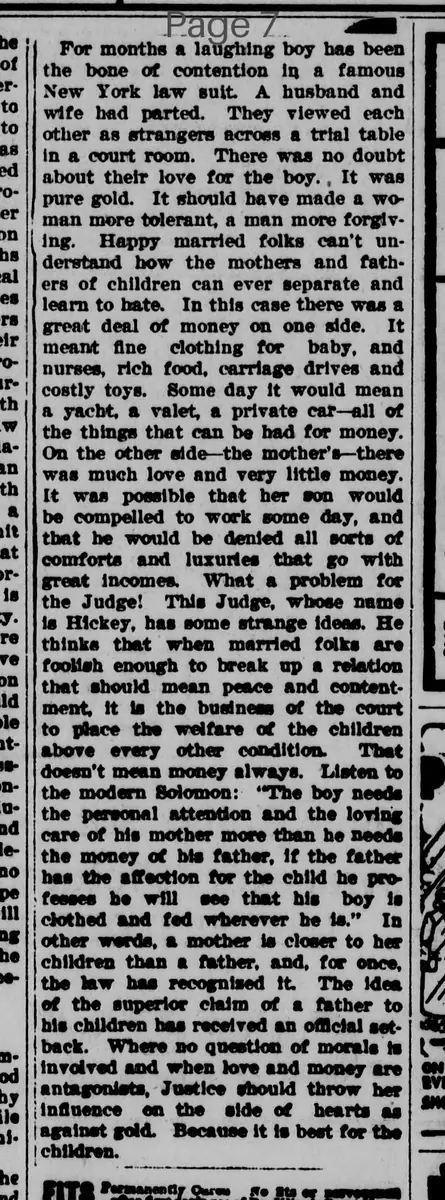
For months a laughing boy has been the bone of contention in a famous New York law suit. A husband and wife had parted. They viewed each other as strangers across a trial table in a court room. There was no doubt about their love for the boy. It was pure gold. It should have made a woman more tolerant, a man more forgiving. Happy married folks can't understand how the mothers and fathers of children can ever separate and learn to hate. In this case there was a great deal of money on one side. It meant fine clothing for baby, and nurses, rich food, carriage drives and costly toys. Some day it would mean a yacht, a valet, a private car - all of the things that can be had for money.
On the other side the mother's - there was much love and very little money. It was possible that her son would be compelled to work some day, and that he would be denied all sorts of comforts and luxuries that go with great incomes. What a problem for the Judge! This Judge, whose name is Hickey, has some strange ideas. He thinks that when married folks are foolish enough to break up a relation that should mean peace and contentment, it is the business of the court to place the welfare of the children above every other condition. That doesn't mean money always. Listen to the modern Solomon: "The boy needs the personal attention and the loving care of his mother more than he needs the money of his father, if the father has the affection for the child he professes he will see that his boy is clothed and fed wherever he is." In other words, a mother is closer to her children than a father, and, for once, the law has recognized it. The idea of the superior claim of a father to his children has received an official set-back. Where no question of morale is involved and when love and money are antagonists, Justice should throw her influence on the side of hearts as against gold. Because it is best for the children.
On the other side the mother's - there was much love and very little money. It was possible that her son would be compelled to work some day, and that he would be denied all sorts of comforts and luxuries that go with great incomes. What a problem for the Judge! This Judge, whose name is Hickey, has some strange ideas. He thinks that when married folks are foolish enough to break up a relation that should mean peace and contentment, it is the business of the court to place the welfare of the children above every other condition. That doesn't mean money always. Listen to the modern Solomon: "The boy needs the personal attention and the loving care of his mother more than he needs the money of his father, if the father has the affection for the child he professes he will see that his boy is clothed and fed wherever he is." In other words, a mother is closer to her children than a father, and, for once, the law has recognized it. The idea of the superior claim of a father to his children has received an official set-back. Where no question of morale is involved and when love and money are antagonists, Justice should throw her influence on the side of hearts as against gold. Because it is best for the children.
What sub-type of article is it?
Family Drama
What themes does it cover?
Family
Justice
Moral Virtue
What keywords are associated?
Custody Battle
Child Welfare
Mother's Rights
Judge Hickey
New York Lawsuit
Divorce
Family Law
What entities or persons were involved?
Laughing Boy
Husband
Wife
Judge Hickey
Where did it happen?
New York Court Room
Story Details
Key Persons
Laughing Boy
Husband
Wife
Judge Hickey
Location
New York Court Room
Story Details
A divorced couple battles over custody of their son; wealthy father offers luxuries, but Judge Hickey awards the boy to the loving but poor mother, prioritizing maternal care over money for the child's welfare.