Thank you for visiting SNEWPapers!
Sign up free
Editorial
June 30, 1949
The Potters Herald
East Liverpool, Columbiana County, Ohio
What is this article about?
Editorial discusses growing congressional sentiment for federal spending cuts amid economic decline and public complaints, highlights pressure groups' hypocrisy, reports Omaha World-Herald poll showing strong voter support for economy measures, and urges adoption of Hoover Commission's waste-reduction blueprint.
Clipping
OCR Quality
96%
Excellent
Full Text
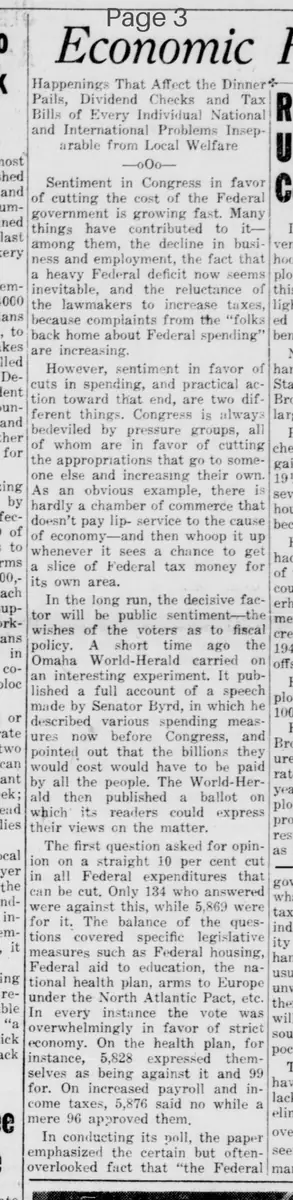
Economic
Happenings That Affect the Dinner
Pails, Dividend Checks and Tax
Bills of Every Individual National
and International Problems Insep-
arable from Local Welfare
—000—
Sentiment in Congress in favor
of cutting the cost of the Federal
government is growing fast. Many
things have contributed to it
among them, the decline in busi-
ness and employment, the fact that
a heavy Federal deficit now seems
inevitable, and the reluctance of
the lawmakers to increase taxes,
because complaints from the "folks
back home about Federal spending"
are increasing.
However. sentiment in favor of
cuts in spending, and practical ac-
tion toward that end. are two dif-
ferent things. Congress is always
bedeviled by pressure groups, all
of whom are in favor of cutting
the appropriations that go to some-
one else and increasing their own.
As an obvious example. there is
hardly a chamber of commerce that
doesn't pay lip- service to the cause
of economy-and then whoop it up
whenever it sees a chance to get
a slice of Federal tax money for
its own area.
In the long run. the decisive fac-
tor will be public sentiment--the
wishes of the voters as to fiscal
policy. A short time ago the
Omaha World-Herald carried on
an interesting experiment. It pub-
lished a full account of a speech
made by Senator Byrd. in which he
described various spending meas-
ures now before Congress, and
pointed out that the billions they
would cost would have to be paid
by all the people. The World-Her-
ald then published a ballot on
which its readers could express
their views cn the matter.
The first question asked for opin-
ion on a straight 10 per cent cut
in all Federal expenditures that
can be cut. Only 134 who answered
were against this. while 5.869 were
for it. The balance of the ques-
tions covered specific legislative
measures such as Federal housing,
Federalaid to education. the na-
tional health plan. arms to Europe
under the North Atlantic Pact, etc.
In every instance the vote was
overwhelmingly in favor of striet
economy. On the health plan, for
instance, 5,828 expressed them-
themselves as being against it and 99
for. On increased payroll and in-
come taxes, 5,876 said no while a
mere 96 approved them.
In conducting its poll, the paper
emphasized the certain but often-
overlooked fact that "the Federal
government hasn't a cent except
what it takes from all of us in
taxes." It is true that some polls
indicate that a substantial major-
ity of the people want Federal
handouts. However, such polls are
usually so worded as to make the
unwary believe that they will get
them for nothing-that the money
will come from some mysterious
source other than the people's
pockets.
The Hoover Commission reports
have given Congress what it long
lacked-a detailedblueprint for
eliminating w a s t e, duplication,
overlapping. Now it remains to be
seen whether the people will de-
mand its acceptance.
Happenings That Affect the Dinner
Pails, Dividend Checks and Tax
Bills of Every Individual National
and International Problems Insep-
arable from Local Welfare
—000—
Sentiment in Congress in favor
of cutting the cost of the Federal
government is growing fast. Many
things have contributed to it
among them, the decline in busi-
ness and employment, the fact that
a heavy Federal deficit now seems
inevitable, and the reluctance of
the lawmakers to increase taxes,
because complaints from the "folks
back home about Federal spending"
are increasing.
However. sentiment in favor of
cuts in spending, and practical ac-
tion toward that end. are two dif-
ferent things. Congress is always
bedeviled by pressure groups, all
of whom are in favor of cutting
the appropriations that go to some-
one else and increasing their own.
As an obvious example. there is
hardly a chamber of commerce that
doesn't pay lip- service to the cause
of economy-and then whoop it up
whenever it sees a chance to get
a slice of Federal tax money for
its own area.
In the long run. the decisive fac-
tor will be public sentiment--the
wishes of the voters as to fiscal
policy. A short time ago the
Omaha World-Herald carried on
an interesting experiment. It pub-
lished a full account of a speech
made by Senator Byrd. in which he
described various spending meas-
ures now before Congress, and
pointed out that the billions they
would cost would have to be paid
by all the people. The World-Her-
ald then published a ballot on
which its readers could express
their views cn the matter.
The first question asked for opin-
ion on a straight 10 per cent cut
in all Federal expenditures that
can be cut. Only 134 who answered
were against this. while 5.869 were
for it. The balance of the ques-
tions covered specific legislative
measures such as Federal housing,
Federalaid to education. the na-
tional health plan. arms to Europe
under the North Atlantic Pact, etc.
In every instance the vote was
overwhelmingly in favor of striet
economy. On the health plan, for
instance, 5,828 expressed them-
themselves as being against it and 99
for. On increased payroll and in-
come taxes, 5,876 said no while a
mere 96 approved them.
In conducting its poll, the paper
emphasized the certain but often-
overlooked fact that "the Federal
government hasn't a cent except
what it takes from all of us in
taxes." It is true that some polls
indicate that a substantial major-
ity of the people want Federal
handouts. However, such polls are
usually so worded as to make the
unwary believe that they will get
them for nothing-that the money
will come from some mysterious
source other than the people's
pockets.
The Hoover Commission reports
have given Congress what it long
lacked-a detailedblueprint for
eliminating w a s t e, duplication,
overlapping. Now it remains to be
seen whether the people will de-
mand its acceptance.
What sub-type of article is it?
Economic Policy
Taxation
What keywords are associated?
Federal Spending
Fiscal Economy
Public Poll
Taxes
Government Waste
Hoover Commission
What entities or persons were involved?
Congress
Senator Byrd
Omaha World Herald
Hoover Commission
Editorial Details
Primary Topic
Public Support For Federal Spending Cuts
Stance / Tone
Advocates For Fiscal Economy And Reduced Government Spending
Key Figures
Congress
Senator Byrd
Omaha World Herald
Hoover Commission
Key Arguments
Sentiment In Congress Favors Cutting Federal Government Costs Due To Declining Business, Inevitable Deficit, And Reluctance To Raise Taxes
Pressure Groups Support Cuts For Others But Seek More Funding For Themselves
Public Sentiment Will Decide Fiscal Policy
Omaha World Herald Poll Shows Overwhelming Support For 10% Cut In Federal Expenditures And Against Specific Spending Measures Like Health Plan And Tax Increases
Federal Government Funds Come Solely From Taxes
Hoover Commission Provides Blueprint For Eliminating Waste And Duplication