Thank you for visiting SNEWPapers!
Sign up free
The New York Journal, And Daily Patriotic Register
New York, New York County, New York
What is this article about?
In a speech to the Maryland Assembly, Mr. Martin argues that the proposed US Constitution's Senate structure makes senators independent of their states for six years, unable to be recalled, and paid by the federal government, potentially leading to the destruction of state governments. He highlights the Senate's role as a privy council to the President and critiques the convention's intent for a national rather than federal system.
Merged-components note: These components are a continuation of Mr. Martin's speech to the Assembly of Maryland, reported as a narrative article. Merged across pages due to sequential reading order and textual continuation; label adjusted from editorial to story for consistency with the dominant content.
Clippings
1 of 2
OCR Quality
Full Text
[Continued from Wednesday's paper.]
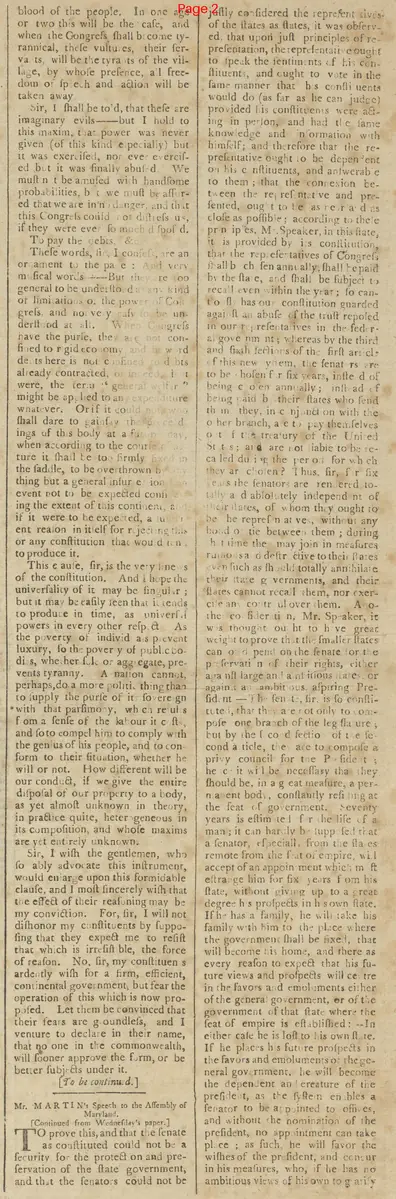
To prove this, and that the senate as constituted could not be a security for the protection and preservation of the state government, and that the senators could not be trustees or representatives of the states as states, it was observed, that upon just principles of representation, the representative ought to speak the sentiments of his constituents, and ought to vote in the same manner that his constituents would do (as far as he can judge) provided his constituents were acting in person, and had the same knowledge and information with himself; and therefore that the representative ought to be dependent on his constituents, and answerable to them; that the connexion between the representative and represented, ought to be as near and as close as possible; according to these principles, Mr. Speaker, in this state, it is provided by its constitution, that the representatives of Congress shall be chosen annually, shall be paid by the state, and shall be subject to recall even within the year; so cannot has our constitution guarded against an abuse of the trust reposed in our representatives in the federal government; whereas by the third and sixth sections of the first article of this new system, the senators are to be chosen for six years, instead of being chosen annually; instead of being paid by their states who send them, they, in conjunction with the other branch, are to pay themselves out of the treasury of the United States; and are not liable to be recalled during the period for which they are chosen? Thus, sir, for six years the senators are rendered totally and absolutely independent of their states, of whom they ought to be the representatives, without any bond or tie between them; during which time they may join in measures ruinous and destructive to their states even such as should totally annihilate their state governments, and their states cannot recall them, nor exercise any control over them.
And the consideration, Mr. Speaker, it was thought ought to have great weight to prove that the smaller states can ill depend on the senate for the preservation of their rights, either against large and ambitious states, or against an ambitious, aspiring President --The senate, sir, is so constituted, that they are not only to compose one branch of the legislature; but by the second section of the second article, they are to compose a privy council for the President: he certainly will be necessary that they should be, in a great measure, a permanent body, constantly residing at the seat of government. Seventy years is estimated for the life of a man; it can hardly be supposed that a senator, especially, from the states remote from the seat of empire, will accept of an appointment which must estrange him for six years from his state, without giving up to a great degree his prospects in his own state.
If he has a family, he will take his family with him to the place where the government shall be fixed, that will become his home, and there as every reason to expect that his future views and prospects will centre in the favors and emoluments either of the general government, or of the government of that state where the seat of empire is established: --In either case he is lost to his own state.
If he places his future prospects in the favors and emoluments of the general government, he will become the dependent and creature of the president, as the constitution enables a senator to be appointed to offices. and without the nomination of the president, no appointment can take place; as such, he will favor the wishes of the president, and concur in his measures, who, if he has no ambitious views of his own to gratify will
may be too favorable to the ambitious views of the large states, who will have an undue share in his original appointment, and on whom he will be more dependent afterwards than on the states which are smaller. If the senator places his future prospects on that state where the seat of empire is fixed; from that time he will be in every question wherein its particular interest may be concerned the representative of that state, not of his own. But even this provision apparently for the security of the state governments, inadequate as it is, is entirely left at the mercy of the general government, for by the fourth section of the first article, it is expressly provided, that the Congress shall have a power to make and alter all regulations concerning the time and manner of holding elections for senators: a provision expressly looking forward to, and I have no doubt designed for the utter extinction and abolition of all state governments; nor will this be doubted by any person, when I inform you that some of the warm advocates and patrons of the system in convention, strenuously opposed the choice of the senators by the state legislatures, insisting that the state governments ought not to be introduced in any manner so as to be component parts of instruments for carrying into execution the general government; nay, so far were the friends of the system from pretending that they meant it or considered it as a federal system, that on the question being proposed, that a union of the states, merely federal, ought to be the sole object of the exercise of the powers vested in the convention; it was negatived by a majority of the members, and it was resolved, "that a national government ought to be formed;" afterwards the word, national, was struck out by them, because they thought the word might tend to alarm; and although, now, they who advocate the system, pretend to call themselves federalists; in convention the distinction was just the reverse; those who opposed the system, were there considered and styled the federal party, those who advocated it, the anti-federal.
[To be continued.]
What sub-type of article is it?
What themes does it cover?
What keywords are associated?
What entities or persons were involved?
Where did it happen?
Story Details
Key Persons
Location
Assembly Of Maryland
Story Details
Mr. Martin critiques the Senate's six-year terms, federal payment, and lack of recall, arguing it severs ties to states, enables ruinous measures, and reveals the convention's intent for a national government over a federal one, undermining state protections.