Thank you for visiting SNEWPapers!
Sign up free
The Gary American
Gary, Lake County, Indiana
What is this article about?
The 'New Orleans City Guide,' a WPA publication, highlights the history, culture, and contributions of the Negro community in New Orleans, covering topics from early massacres and education to jazz, art, and folk traditions. It includes contributions from Black writers and NYA workers.
Clipping
OCR Quality
Full Text
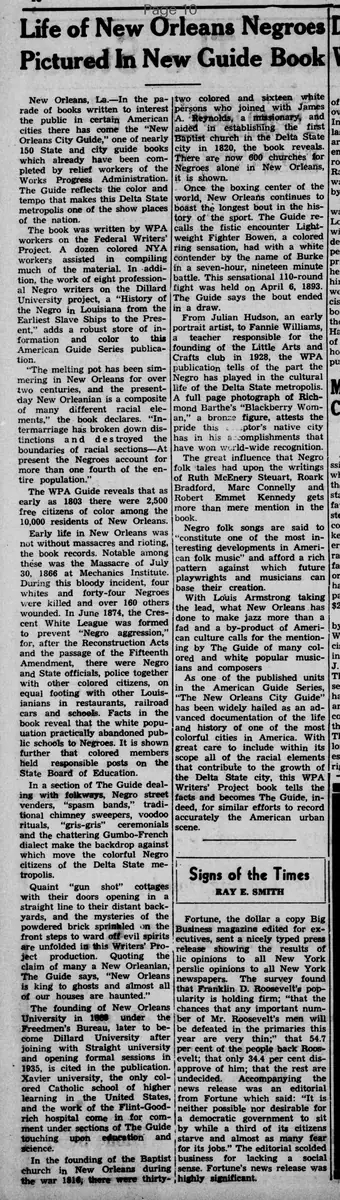
Pictured In New Guide Book
New Orleans, La. In the parade of books written to interest the public in certain American cities there has come the "New Orleans City Guide," one of nearly 150 State and city guide books which already have been completed by relief workers of the Works Progress Administration.
The Guide reflects the color and tempo that makes this Delta State metropolis one of the show places of the nation.
The book was written by WPA workers on the Federal Writers' Project. A dozen colored NYA workers assisted in compiling much of the material. In addition, the work of eight professional Negro writers on the Dillard University project, a "History of the Negro in Louisiana from the Earliest Slave Ships to the Present," adds a robust store of information and color to this American Guide Series publication.
"The melting pot has been simmering in New Orleans for over two centuries, and the present-day New Orleanian is a composite of many different racial elements," the book declares. "Intermarriage has broken down distinctions and destroyed the boundaries of racial sections. At present the Negroes account for more than one fourth of the entire population."
The WPA Guide reveals that as early as 1803 there were 2,500 free citizens of color among the 10,000 residents of New Orleans.
Early life in New Orleans was not without massacres and rioting, the book records. Notable among these was the Massacre of July 30, 1866 at Mechanics Institute. During this bloody incident, four whites and forty-four Negroes were killed and over 160 others wounded. In June 1874, the Crescent White League was formed to prevent "Negro aggression," for, after the Reconstruction Acts and the passage of the Fifteenth Amendment, there were Negro and State officials, police together with other colored citizens, on equal footing with other Louisianians in restaurants, railroad cars and schools. Facts in the book reveal that the white population practically abandoned public schools to Negroes. It is shown further that colored members held responsible posts on the State Board of Education.
In a section of The Guide dealing with folkways, Negro street venders, "spasm bands," traditional chimney sweepers, voodoo rituals, "gris-gris" ceremonials and the chattering Gumbo-French dialect make the backdrop against which move the colorful Negro citizens of the Delta State metropolis.
Quaint "gun shot" cottages with their doors opening in a straight line to their distant backyards, and the mysteries of the powdered brick sprinkled on the front steps to ward off evil spirits are unfolded in this Writers' Project production. Quoting the claim of many a New Orleanian, The Guide says, "New Orleans is king to ghosts and almost all of our houses are haunted."
The founding of New Orleans University in 1860s under the Freedmen's Bureau, later to become Dillard University after joining with Straight university and opening formal sessions in 1935, is cited in the publication.
Xavier university, the only colored Catholic school of higher learning in the United States, and the work of the Flint-Goodrich hospital come in for comment under sections of The Guide touching upon education and science.
In the founding of the Baptist church in New Orleans during the war 1812, there were thirty-two colored and sixteen white persons who joined with James A. Reynolds, a missionary and aided in establishing the first Baptist church in the Delta State city in 1820, the book reveals.
There are now 600 churches for Negroes alone in New Orleans, it is shown.
Once the boxing center of the world, New Orleans continues to boast the longest bout in the history of the sport. The Guide recalls the fistic encounter Lightweight Fighter Bowen, a colored ring sensation, had with a white contender by the name of Burke in a seven-hour, nineteen minute battle. This sensational 110-round fight was held on April 6, 1893. The Guide says the bout ended in a draw.
From Julian Hudson, an early portrait artist, to Fannie Williams, a teacher responsible for the founding of the Little Arts and Crafts club in 1928, the WPA publication tells of the part the Negro has played in the cultural life of the Delta State metropolis.
A full page photograph of Richmond Barthe's "Blackberry Woman," a bronze figure, attests the pride this sculptor's native city has in his accomplishments that have won world-wide recognition.
The great influence that Negro folk tales had upon the writings of Ruth McEnery Steuart, Roark Bradford, Marc Connelly and Robert Emmet Kennedy gets more than mere mention in the book.
Negro folk songs are said to "constitute one of the most interesting developments in American folk music" and afford a rich pattern against which future playwrights and musicians can base their creation.
With Louis Armstrong taking the lead, what New Orleans has done to make jazz more than a fad and a by-product of American culture calls for the mentioning by The Guide of many colored and white popular musicians and composers.
As one of the published units in the American Guide Series, "The New Orleans City Guide" has been widely hailed as an advanced documentation of the life and history of one of the most colorful cities in America. With great care to include within its scope all of the racial elements that contribute to the growth of the Delta State city, this WPA Writers' Project book tells the facts and becomes The Guide, indeed, for similar efforts to record accurately the American urban scene.
What sub-type of article is it?
What keywords are associated?
What entities or persons were involved?
Where did it happen?
Domestic News Details
Primary Location
New Orleans, La.
Key Persons
Outcome
the guide book has been widely hailed as advanced documentation of new orleans' life and history, including racial elements. historical massacre: 4 whites and 44 negroes killed, over 160 wounded.
Event Details
The 'New Orleans City Guide' by WPA Federal Writers' Project, assisted by colored NYA workers and Negro writers from Dillard University, documents the history, culture, education, religion, arts, and contributions of Negroes in New Orleans, from early free citizens and massacres to modern jazz and sculptures.