Thank you for visiting SNEWPapers!
Sign up free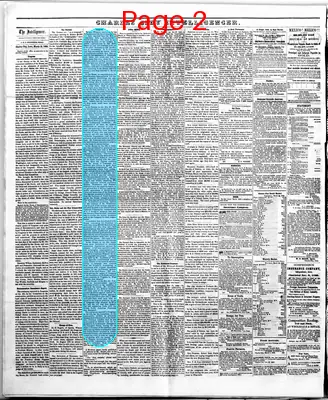
Charles City Intelligencer
Charles City, Floyd County, Iowa
What is this article about?
Summary of U.S. Congress activities on Reconstruction, including resolutions to disband rebel militias, amendments on payments to unqualified officials, conditions for rebel states' readmission, and reports on Southern disloyalty.
Clipping

OCR Quality
Full Text
Senator Wilson's resolution for the disbandment of the Rebel State Militia has been reported from the Military Committee, with a recommendation that it pass. We trust it may come up speedily, for we believe the militia organizations in the Rebel States are and will continue to be one of the chief obstacles to the pacification of the country. It is notorious that they are made up almost wholly of Confederate soldiers, that they are used for the oppression of thousands, both white and black, and that in some cases they even adopt the Confederate uniform and flag, and exclude all who have not served against the Union. They have frequently been in collision with the United States troops still remaining in the States, and it is amazing that they continue to be tolerated.
In the House, an amendment to the Miscellaneous Appropriation bill has been adopted, prohibiting the payment of any money under it to persons holding office in violation of the laws—especially of the law prescribing a Test Oath. Such an amendment might seem superfluous, were it not for the fact, testified to by Secretary Stanton, that sundry Provisional Governors had been appointed by the President and paid by his order, who could not take the oath, and who, under the law, were not entitled to a cent. Indeed, had the law been obeyed, they never could have been appointed.
In the Senate, on the 5th, Mr. Wilson introduced joint resolutions, which were referred to the Reconstruction Committee, declaring that any of the rebel States shall be entitled to resume complete practical relations with the United States whenever its Legislature shall adopt, irrepealably, these fundamental conditions; the abrogation of all laws, &c, making distinctions on account of color or race; the granting of the right of suffrage to negroes who have served in the army or navy, who pay taxes on property, and who can read the United States Constitution; and the repudiation of all rebel debts or obligations. Mr. Pomeroy made a speech on the constitutional amendment relative to the basis of representation.
In the House, on the 5th, a resolution was introduced to guarantee the Mexican Republican loan of $50,000,000. The Reconstruction Committee reported a resolution, "That the State of Tennessee is hereby declared to be one of the United States of America on an equal footing with the other States, upon the express condition that the people of Tennessee will maintain and enforce in good faith their existing Constitution," and the laws excluding rebels from voting; shall exclude rebels from eligibility to office; and shall never pay any rebel debt, or claim or pay any compensation for emancipated slaves. A minority report was presented by Messrs. Rogers and Grider, admitting Tennessee members without conditions. Messrs. Washburne and Boutwell dissented from the majority report, on the ground that it did not require sufficient guarantees of fidelity to the Union and protection of the freedmen. The Speaker presented a letter to him from the Governor of North Carolina which the House refused to receive. The army appropriation bill was passed. It contains a provision, inserted at the instance of Mr. Washburne, that no part of the moneys appropriated shall be paid to the Illinois Central Railroad Company for transportation of U. S. troops or property, and that the Attorney-General shall commence suit to recover the money heretofore paid to the Company for such transportation.
A resolution was adopted in the House requesting the President to state how many $20,000 Rebels he has pardoned, and who they are; how much property has been confiscated and how much confiscated property had been restored by displacing freedmen who by act of Congress had been allotted the same—with other particulars of like nature. The reply of Mr. Johnson will be awaited with interest.
In the Senate, on the 6th, resolutions were introduced to establish quarantine regulations against the cholera. A bill was reported to establish telegraphic communication between New York and the West Indies. The bill to reimburse Missouri for militia expenses was passed. A speech was made by Mr. Saulsbury of Delaware upon the constitutional amendment relative to the basis of representation. A message was received from the President, transmitting, in accordance with request, documents relative to the provisional governments of the rebel States. The resolution giving the assent of Congress to the annexation of Berkeley and Jefferson counties, in Virginia, to West Virginia, was adopted.
In the House, on the 6th, the Committee on Reconstruction reported testimony relative to the condition of affairs at the South. Mr. Schenck's amendment to the Military Academy bill—that none of the money appropriated should be applied toward the pay or subsistence of cadets appointed from any rebel State after Jan. 1, 1866, until such State shall have been restored to its original relations by act of Congress—was adopted by 89 to 39; and the bills was then passed. The bill regulating trade with the British North American Provinces was discussed.
The testimony reported to Congress on the 6th, by the Committee on Reconstruction, exhibits an extremely disloyal state of sentiment at the South. Gen. Grierson testifies that he has good reasons to believe that an organization is in existence throughout the insurgent States, having for its object a renewal of the rebellion; and that a strong desire is evinced to have the United States involved in hostilities with France,—the intention being in such an event, to seize an opportunity of uniting with the enemy. Maj. Gen. Thomas corroborates the existence of the organization referred to by Gen. Grierson. More testimony will be reported to day.
What sub-type of article is it?
What themes does it cover?
What keywords are associated?
What entities or persons were involved?
Where did it happen?
Story Details
Key Persons
Location
United States Congress
Event Date
On The 5th And 6th
Story Details
Reports on congressional actions including resolution to disband rebel militias, amendment prohibiting payments to unqualified officials, joint resolutions on conditions for rebel states' readmission such as suffrage for certain negroes and repudiation of rebel debts, resolution on Tennessee's readmission with conditions, inquiry into presidential pardons of rebels, quarantine and other bills, testimony on Southern disloyalty and potential rebellion renewal.