Thank you for visiting SNEWPapers!
Sign up free
Editorial
September 2, 1844
Alexandria Gazette
Alexandria, Alexandria County, District Of Columbia
What is this article about?
Virginius defends Henry Clay's historical opposition to the 1828 Tariff's protective features, recounts Clay's permission for a letter's publication, and accuses the Richmond Enquirer of misrepresentation, bias, and withholding information to harm Adams in a 1827 East Room letter controversy.
Clipping
OCR Quality
98%
Excellent
Full Text
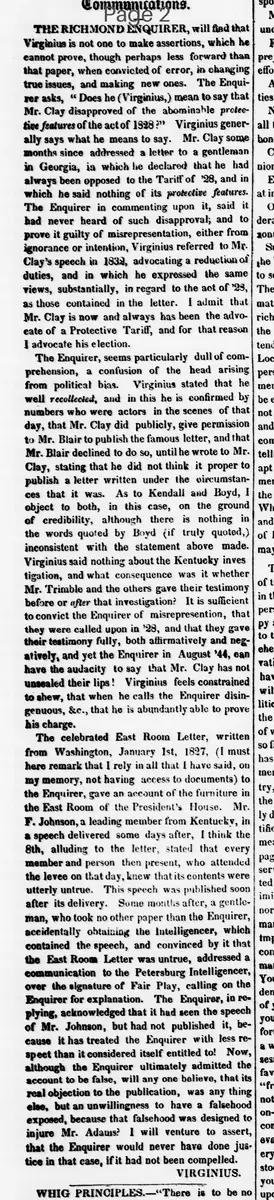
THE RICHMOND ENQUIRER, will find that Virginius is not one to make assertions, which he cannot prove, though perhaps less forward than that paper, when convicted of error, in changing true issues, and making new ones. The Enquirer asks, "Does he (Virginius,) mean to say that Mr. Clay disapproved of the abominable protective features of the act of 1828?" Virginius generally says what he means to say. Mr. Clay some months since addressed a letter to a gentleman in Georgia, in which he declared that he had always been opposed to the Tariff of '28, and in which he said nothing of its protective features. The Enquirer in commenting upon it, said it had never heard of such disapproval; and to prove it guilty of misrepresentation, either from ignorance or intention, Virginius referred to Mr. Clay's speech in 1833, advocating a reduction of duties, and in which he expressed the same views, substantially, in regard to the act of '28, as those contained in the letter. I admit that Mr. Clay is now and always has been the advocate of a Protective Tariff, and for that reason I advocate his election.
The Enquirer, seems particularly dull of comprehension, a confusion of the head arising from political bias. Virginius stated that he well recollected, and in this he is confirmed by numbers who were actors in the scenes of that day, that Mr. Clay did publicly, give permission to Mr. Blair to publish the famous letter, and that Mr. Blair declined to do so, until he wrote to Mr. Clay, stating that he did not think it proper to publish a letter written under the circumstances that it was. As to Kendall and Boyd, I object to both, in this case, on the ground of credibility, although there is nothing in the words quoted by Boyd (if truly quoted,) inconsistent with the statement above made. Virginius said nothing about the Kentucky investigation, and what consequence was it whether Mr. Trimble and the others gave their testimony before or after that investigation? It is sufficient to convict the Enquirer of misrepresentation, that they were called upon in '28, and that they gave their testimony fully, both affirmatively and negatively, and yet the Enquirer in August '44, can have the audacity to say that Mr. Clay has not unsealed their lips! Virginius feels constrained to show, that when he calls the Enquirer disingenuous, &c., that he is abundantly able to prove his charge.
The celebrated East Room Letter, written from Washington, January 1st, 1827, (I must here remark that I rely in all that I have said, on my memory, not having access to documents) to the Enquirer, gave an account of the furniture in the East Room of the President's House. Mr. F. Johnson, a leading member from Kentucky, in a speech delivered some days after, I think the 8th, alluding to the letter, stated that every member and person then present, who attended the levee on that day, knew that its contents were utterly untrue. This speech was published soon after its delivery. Some months after, a gentleman, who took no other paper than the Enquirer, accidentally obtaining the Intelligencer, which contained the speech, and convinced by it that the East Room Letter was untrue, addressed a communication to the Petersburg Intelligencer, over the signature of Fair Play, calling on the Enquirer for explanation. The Enquirer, in replying, acknowledged that it had seen the speech of Mr. Johnson, but had not published it, because it had treated the Enquirer with less respect than it considered itself entitled to! Now, although the Enquirer ultimately admitted the account to be false, will any one believe, that its real objection to the publication, was any thing else, but an unwillingness to have a falsehood exposed, because that falsehood was designed to injure Mr. Adams? I will venture to assert, that the Enquirer would never have done justice in that case, if it had not been compelled.
VIRGINIUS.
The Enquirer, seems particularly dull of comprehension, a confusion of the head arising from political bias. Virginius stated that he well recollected, and in this he is confirmed by numbers who were actors in the scenes of that day, that Mr. Clay did publicly, give permission to Mr. Blair to publish the famous letter, and that Mr. Blair declined to do so, until he wrote to Mr. Clay, stating that he did not think it proper to publish a letter written under the circumstances that it was. As to Kendall and Boyd, I object to both, in this case, on the ground of credibility, although there is nothing in the words quoted by Boyd (if truly quoted,) inconsistent with the statement above made. Virginius said nothing about the Kentucky investigation, and what consequence was it whether Mr. Trimble and the others gave their testimony before or after that investigation? It is sufficient to convict the Enquirer of misrepresentation, that they were called upon in '28, and that they gave their testimony fully, both affirmatively and negatively, and yet the Enquirer in August '44, can have the audacity to say that Mr. Clay has not unsealed their lips! Virginius feels constrained to show, that when he calls the Enquirer disingenuous, &c., that he is abundantly able to prove his charge.
The celebrated East Room Letter, written from Washington, January 1st, 1827, (I must here remark that I rely in all that I have said, on my memory, not having access to documents) to the Enquirer, gave an account of the furniture in the East Room of the President's House. Mr. F. Johnson, a leading member from Kentucky, in a speech delivered some days after, I think the 8th, alluding to the letter, stated that every member and person then present, who attended the levee on that day, knew that its contents were utterly untrue. This speech was published soon after its delivery. Some months after, a gentleman, who took no other paper than the Enquirer, accidentally obtaining the Intelligencer, which contained the speech, and convinced by it that the East Room Letter was untrue, addressed a communication to the Petersburg Intelligencer, over the signature of Fair Play, calling on the Enquirer for explanation. The Enquirer, in replying, acknowledged that it had seen the speech of Mr. Johnson, but had not published it, because it had treated the Enquirer with less respect than it considered itself entitled to! Now, although the Enquirer ultimately admitted the account to be false, will any one believe, that its real objection to the publication, was any thing else, but an unwillingness to have a falsehood exposed, because that falsehood was designed to injure Mr. Adams? I will venture to assert, that the Enquirer would never have done justice in that case, if it had not been compelled.
VIRGINIUS.
What sub-type of article is it?
Partisan Politics
Economic Policy
What keywords are associated?
Henry Clay
Tariff 1828
Richmond Enquirer
Political Bias
East Room Letter
Mr Adams
What entities or persons were involved?
Mr. Clay
Richmond Enquirer
Virginius
Mr. Blair
Kendall
Boyd
Mr. Trimble
Mr. F. Johnson
Mr. Adams
Editorial Details
Primary Topic
Defense Of Henry Clay's Tariff Positions And Critique Of Richmond Enquirer
Stance / Tone
Supportive Of Clay, Accusatory Of Enquirer Misrepresentation
Key Figures
Mr. Clay
Richmond Enquirer
Virginius
Mr. Blair
Kendall
Boyd
Mr. Trimble
Mr. F. Johnson
Mr. Adams
Key Arguments
Clay Opposed The 1828 Tariff And Expressed This In 1833 Speech And Georgia Letter
Clay Permitted Blair To Publish A Letter But Blair Declined
Enquirer Misrepresented Clay's Actions And Withheld Exposing Falsehoods To Harm Adams
Testimony From Trimble And Others In 1828 Convicts Enquirer Of Ongoing Misrepresentation
Enquirer Biased And Disingenuous In Political Reporting