Thank you for visiting SNEWPapers!
Sign up free
The East Hartford Gazette
New Britain, Hartford County, Connecticut
What is this article about?
In East Hartford, rationing board manager Frank Thuer announces 13 active rationing programs for essentials like tires, sugar, and gasoline, up from 2 last year. Upcoming rationing for canned goods via points system starts March 1, with meats to follow. Explains evolution since Pearl Harbor and types of rationing.
Merged-components note: Continuation of rationing announcement from page 1 to page 10; relabeled to domestic_news as it covers local rationing programs.
Clippings
1 of 2
OCR Quality
Full Text
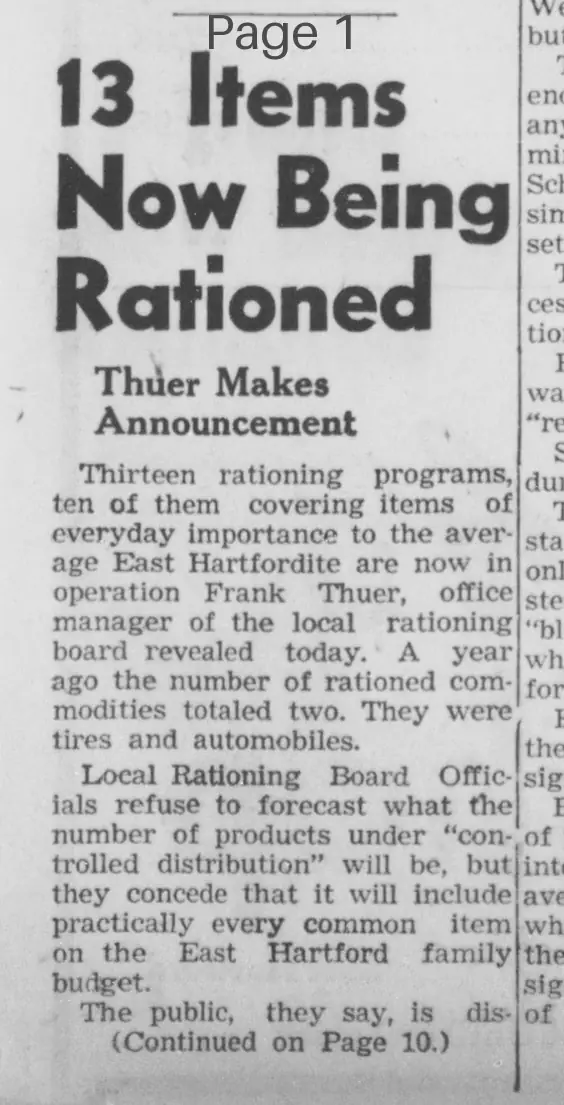
Thuer Makes Announcement
Thirteen rationing programs, ten of them covering items of everyday importance to the average East Hartfordite are now in operation, Frank Thuer, office manager of the local rationing board revealed today. A year ago the number of rationed commodities totaled two. They were tires and automobiles. Local Rationing Board Officials refuse to forecast what the number of products under "controlled distribution" will be, but they concede that it will include practically every common item on the East Hartford family budget.
The public, they say, is dis
(Continued on Page 10.)
13 ITEMS NOW
RATIONED
(Continued from Page 1.)
Covering that demands of total warfare grow progressively greater each day and month that the world conflict lasts. As time goes on the average civilian will comprehend that such demands spread in ever widening circles, drawing into the area of scarcity, items which have been "surplus commodities" of the country for years.
Mr. Thuer pointed out that the first taste of rationing came on December 11, 1941, four days after Pearl Harbor when officials of the country realized that future supplies of crude rubber from the Far East would be cut off and the sale of tires was "frozen" by OPA order. On January 5 the formal rationing of tires began.
Cars Were Frozen
On New Year's day the country awoke to discover that sales of new automobiles also had been "frozen." They continued in that state until March 2, when a program of distribution for essential uses was evolved.
Sporadically, thereafter, rationing programs were introduced for sugar, gasoline, bicycles, typewriters, fuel oil, farm machinery, wire fencing for farms, milk cans, rubber boots and rubber-soled work shoes, coffee and, finally, leather footwear.
This week, a "freeze," inevitably preliminary to rationing will go into effect on a wide variety of canned goods. Sales to consumers of canned fruits and vegetables most commonly in use will be outlawed until March 1 when stores will again retail them in exchange for coupons from the War Ration Book 2.
According to present estimates, "red" meats—that is lamb, veal, pork, beef and mutton, will go under the discipline of rationing on April 1, canned milk a month later.
Up to the present time the public has learned the "ropes" of two types of rationing, "coupon" and "certificate."
In the first instance, rationing by coupon, they have received a book of coupons and been advised that each coupon was exchangeable for a pound of sugar or coffee, so many gallons of gasoline or fuel oil, or for a pair of shoes.
Under "certificate" rationing they have been told to apply to the local war price and rationing board for a certificate entitling them to purchase a new tire, new automobile, a bicycle or a new pair of hip boots.
Having familiarized itself with the two elementary forms of rationing control, the local public beginning March 1 will be introduced to the last, and most complicated system—"point rationing."
Under this plan, an entirely new set of values, distinct from monetary systems, will have to be mastered. "Point" rationing will be used in controlling the distribution of several items, many of them interchangeable, which are grouped in general classifications. Canned vegetables present an example. A buyer shopping for canned spinach may discover that a store is out of that product and will switch to canned corn, canned succotash or to canned string beans instead.
On dealing with one line of such products, which may be in short supply at the moment, the government cannot afford to impose rationing because it will create public demand for substitute items creating a shortage in those and force rationing in one type of product after another, Mr. William Manniere, acting chairman of the local board disclosed.
Anticipating such an eventuality, the government imposes rationing on all canned vegetables which are in short supply and upon the substitute items also, which would be bought up rapidly in place of the rationed items, if those too were not controlled.
To keep in balance the call for products in greatest demand and therefore scarce, and those in light demand and in food supply, every one is to have an "allowance" of forty-eight points a month for canned goods, according to present plans. Intelligent spending of the allowed points may bring an individual as many as ten cans of various products a month, whereas "spendthrift" individuals may get four or fewer cans in the same period.
Now that the ice has been broken in the apparel field with the establishment of rationing of shoes some consumers are looking for restrictions on the sale of clothing and accessories.
Last week, the public of East Hartford was assured that no immediate plans for the rationing of clothes are in prospect. It appears to be a foregone conclusion, however, that sales restrictions on clothing will come before the close of the year.
Although there is no shortage of wool, nor of raw cotton, a shortage of cotton piece goods is likely to grow up as the year wears on.
Once cotton goods are rationed, wool will have to be bracketed with them because in too many instances wool can be used as a substitute for cotton and a swing of demand from rationed cotton to unrationed wool goods would inevitably create a shortage in the latter.
What sub-type of article is it?
What keywords are associated?
What entities or persons were involved?
Where did it happen?
Domestic News Details
Primary Location
East Hartford
Key Persons
Outcome
thirteen rationing programs now in operation, including tires, automobiles, sugar, gasoline, bicycles, typewriters, fuel oil, farm machinery, wire fencing, milk cans, rubber boots, rubber-soled work shoes, coffee, and leather footwear. upcoming: canned goods on march 1, red meats on april 1, canned milk in may. point rationing to begin for canned goods.
Event Details
Frank Thuer announced that thirteen rationing programs are now active in East Hartford, up from two a year ago (tires and automobiles). Officials expect more items to be controlled. History of rationing starts from December 11, 1941, with tires frozen post-Pearl Harbor, followed by automobiles, and others sporadically. This week, a freeze on canned fruits and vegetables precedes rationing on March 1 via coupons. Point rationing explained for interchangeable items like canned vegetables, with 48 points monthly allowance. No immediate clothing rationing, but expected later due to shortages.