Thank you for visiting SNEWPapers!
Sign up free
Norfolk Gazette And Publick Ledger
Norfolk, Virginia
What is this article about?
Commentary on Napoleon's return to France, establishing a military government and expelling Louis XVIII, criticizing Allied Powers' imprudence, and discussing the Vienna Declaration's implications for potential war. Includes Paris news on appointments, military events, and civic festivals in early April 1815.
Clipping
OCR Quality
Full Text
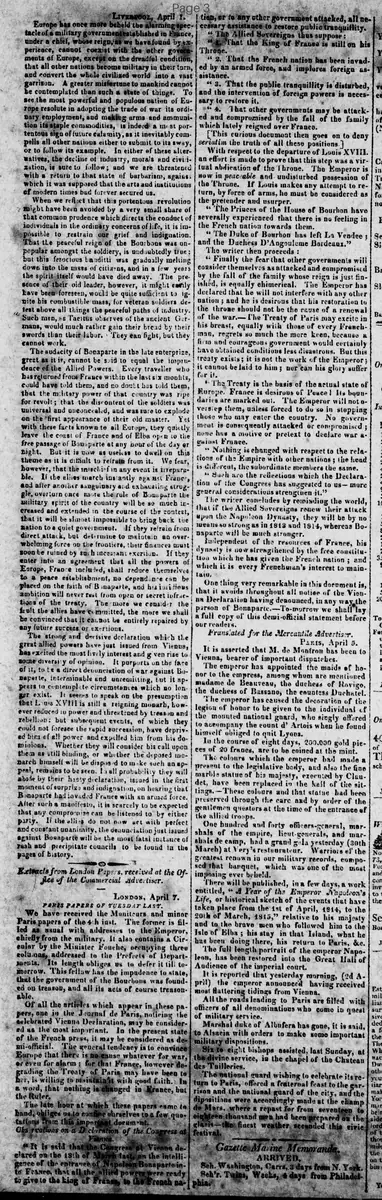
When we reflect that this portentous revolution might have been avoided by a very small share of that common prudence which directs the conduct of individuals in the ordinary concerns of life, it is impossible to restrain our grief and indignation. That the peaceful reign of the Bourbons was unpopular amongst the soldiery, is undoubtedly true: but this ferocious banditti was gradually melting down into the mass of citizens, and in a few years the spirit itself would have died away. The presence of their old leader, however, it might easily have been foreseen, would be quite sufficient to ignite his combustible mass, for veteran soldiers detest above all things the peaceful paths of industry. Such men, as Tacitus observes of the ancient Germans, would much rather gain their bread by their swords than their labor. They can fight, but they cannot work.
The audacity of Bonaparte in this late enterprise, great as it is, cannot be said to equal the imprudence of the Allied Powers. Every traveller who has returned from France within the last six months, could have told them, and no doubt has told them, that the military power of that country was ripe for revolt; that the discontent of the soldiers was universal and unconcealed, and was sure to explode on the first appearance of their old master. Yet with these facts known to all Europe, they quietly leave the coast of France and of Elba open to the free passage of Bonaparte at any hour of the day or night. But it is now as useless to dwell on this theme as it is difficult to restrain from it. We fear, however, that the mischief in any event is irreparable. If the allies march instantly against France, and after another sanguinary and exhausting struggle, overturn once more the rule of Bonaparte the military spirit of the country will be so much increased and extended in the course of the contest, that it will be almost impossible to bring back the nation to a quiet government. If they refrain from direct attack, but determine to maintain an overwhelming force on the frontiers, their finances cannot soon be ruined by such incessant exertion. If they enter into an agreement that all the powers of Europe, France included, shall reduce themselves to a peace establishment, no dependence can be placed on the faith of Bonaparte, and his insidious ambition will never rest from open or secret infractions of the treaty. The more we consider the fault the allies have committed, the more we shall be convinced that it cannot be entirely repaired by any future success or exertions.
The strong and decisive declaration which the great allied powers have just issued from Vienna, has excited the most lively interest and given rise to some diversity of opinion. It purports on the face of it, to be a direct denunciation of war against Bonaparte, interminable and unrequitting, but it appears to contemplate circumstances which no longer exist. It seems to speak on the presumption that Louis XVIII is still a reigning monarch, however reduced in power and threatened by treason and rebellion: but subsequent events, of which they could not foresee the rapid succession, have deprived him of all power and expelled him from his dominions. Whether they will consider his call upon them as still binding, or whether the deposed monarch himself will be disposed to make such an appeal, remains to be seen. In all probability they will abide by their hasty declaration, issued in the first moment of surprise and indignation, on hearing that Bonaparte had invaded France with an armed force. After such a manifesto, it is scarcely to be expected that any compromise can be listened to by either party. If the allies do not now act with perfect and constant unanimity, the denunciation just issued against Bonaparte will be the most fatal instance of rash and precipitate councils to be found in the pages of history.
Extracts from London Papers, received at the Office of the Commercial Advertiser.
London, April 7.
PARIS PAPERS OF TUESDAY LAST.
We have received the Moniteurs and minor Paris papers of the 4th inst. The former is filled as usual with addresses to the Emperor, chiefly from the military. It also contains a Circular by the Minister Fouche, occupying three columns, addressed to the Prefects of Departments. Its length obliges us to defer it till to-morrow. This fellow has the impudence to state, that the government of the Bourbons was founded on treason, and all its acts of course treasonable.
Of all the articles which appear in these papers, one in the Journal de Paris, noticing the celebrated Vienna Declaration, may be considered as the most important. In the present state of the French press, it may be considered as demi-official. The general tendency is to convince Europe that there is no cause whatever for war, or even for alarm; for that France, however degrading the Treaty of Paris may have been to her, is willing to maintain it with good faith. In a word, that nothing is changed in France, but the Ruler.
The late hour at which these papers came to hand obliges us to confine ourselves to a few quotations from this important document.
Observations on a Declaration of the Congress at Vienna.
"It is said that the Congress at Vienna declared on the 13th of March last on the intelligence of the entrance of Napoleon Bonaparte into France, that all the allied powers were ready to give to the king of France, to the French nation",
Translated for the Mercantile Advertiser.
Paris, April 5.
It is asserted that M. de Monttron has been to Vienna, bearer of important dispatches.
The emperor has appointed the maids of honor to the empress, among whom are mentioned madame de Beauveau, the duchess of Rovigo, the duchess of Bassano, the countess Duchatel.
The emperor has caused the decoration of the legion of honor to be given to the individual of the mounted national guard, who singly offered to accompany the count d'Artois when he found himself obliged to quit Lyons.
In the course of eight days, 200,000 gold pieces of 20 francs, are to be coined at the mint.
The colours which the emperor had made a present to the legislative body, and also the fine marble statue of his majesty, executed by Claudet, have been replaced in the hall of the sittings. These colours and that statue had been preserved through the care and by order of the gentlemen quaestors at the time of the entrance of the allied troops.
One hundred and forty officers-general, marshals of the empire, lieut-generals, and marshals de camp, had a grand gala yesterday (30th March) at Very's restaurateur. Warriors of the greatest renown in our military records, composed that banquet, which was one of the most imposing ever beheld.
There will be published, in a few days, a work entitled, "A Year of the Emperor Napoleon's Life, or historical sketch of the events that have taken place from the 1st of April, 1814, to the 20th of March, 1815," relative to his majesty and to the brave men who followed him to the Isle of Elba; his stay in that Island, what he has been doing there, his return to Paris, &c.
The full length portrait of the emperor Napoleon, has been restored into the Great Hall of Audience of the imperial court.
It is reported that yesterday morning, (2d April) the emperor announced having received most flattering tidings from Vienna.
All the roads leading to Paris are filled with officers of all denominations who come in quest of military service.
Marshal duke of Albufera has gone, it is said, to Alsacia with orders to make some important military dispositions.
Six to eight bishops assisted, last Sunday, at the divine service, in the chapel of the Chateau des Tuilleries.
The national guard wishing to celebrate its return to Paris, offered a fraternal feast to the garrison and the national guard of the city, and the dispositions were accordingly made at the champ de Mars, where a repast for from seventeen to eighteen thousand men had been prepared on the glacis the finest weather seconded this civic festival.
What sub-type of article is it?
What keywords are associated?
What entities or persons were involved?
Where did it happen?
Foreign News Details
Primary Location
France
Event Date
March April 1815
Key Persons
Outcome
expulsion of louis xviii from france; potential renewed european war; increased military spirit in france; vienna declaration denouncing bonaparte.
Event Details
Napoleon Bonaparte returns from Elba, establishes military government in France, expels Louis XVIII and the Bourbons. Allied Powers criticized for allowing his escape; Vienna Declaration issues war threat against him. Paris reports include appointments, military galas, civic festivals, and assurances of maintaining Treaty of Paris.