Thank you for visiting SNEWPapers!
Sign up free
Editorial
September 10, 1806
The National Intelligencer And Washington Advertiser
Washington, District Of Columbia
What is this article about?
An editorial from London on July 16 predicts the outline of a potential peace with France, emphasizing the restoration of Hanover but likely loss of other territories like the Cape and Malta. It critiques the ministry, argues for peace only with safety, and urges major reductions in public expenses to sustain the nation amid heavy taxes and war costs.
Clipping
OCR Quality
95%
Excellent
Full Text
LONDON, July 16.
PEACE.
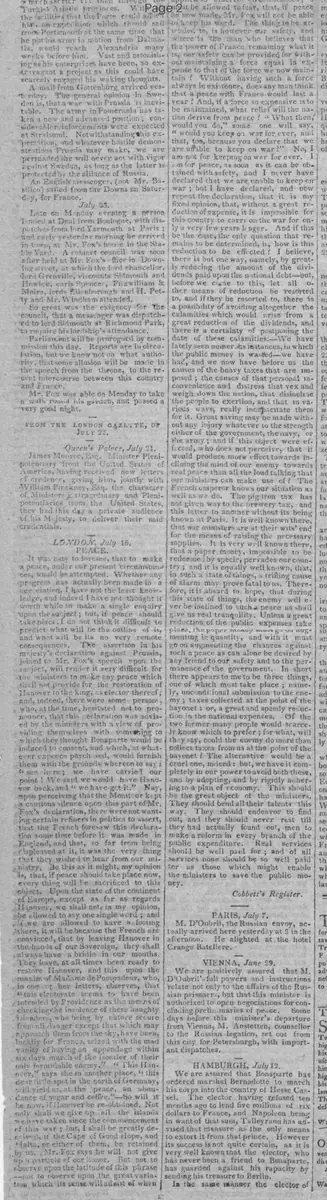
It was easy to foresee, that to make a peace, under our present circumstances, would be attempted. Whether any progress has actually been made in a negotiation, I have not the least knowledge, and indeed I have not thought it worth while to make a single enquiry upon the subject; but, if peace should take place, I do not think it difficult to predict what will be the outline of it, and what will be its no very remote consequences. The assertion in his majesty's declaration against Prussia, joined to Mr. Fox's speech upon the subject, will render it very difficult for the ministers to make any peace which shall not provide for the restoration of Hanover to the king, as elector thereof; and, indeed, there were some persons, who, at the time, hesitated not to pronounce, that this declaration was advised by the ministers with a view of providing themselves with something to which they thought Bonaparte would be induced to consent, and which, at whatever expense purchased, would furnish them with the grounds whereon to say: "see here; we have carried our point! We said we would have Hanover back, and we have got it." Nay, upon perceiving that the Moniteur kept a cautious silence upon this part of Mr. Fox's declaration, there were not wanting certain refiners in politics to assert, that the French foresaw this declaration some time before it was made in England, and that, so far from being displeased at it, it was the very thing that they wished to hear from our ministry. Be this as it might, my opinion is, that, if peace should take place now, every thing will be sacrificed to this object. Upon the state of the continent of Europe, except as far as regards Hanover, we shall not, in my opinion, be allowed to say one single word; and if we are allowed to have a footing there, it will be because the French are convinced, that by leaving Hanover in the hands of our Sovereign, they shall always have a bridle in our mouths. They have, at all times been ready to restore Hanover, and this upon the maxim of Madame de Pompadour, who, in one of her letters, observes, that "this electorate seems to have been intended by Providence as the means of checking the insolence of these haughty islanders, who being by nature secure from all danger except that which may approach them from the sky, have been, luckily for France, seized with the mad vanity of having an appendage within six days march of the frontier of their only formidable enemy." "This Hanover," says she in another place, "this dear little spot in the north of Germany, will yield us, at the peace, an abundance of sugar and coffee."-So will it be now, if Hanover be re-obtained. Not only shall we give up all the islands we have taken since the commencement of this war; but, I shall be greatly deceived, if the Cape of Good Hope, and Malta, or either of them, be retained by us. Mr. Fox says he will not give up a particle of our honor. But not to observe upon the latitude of this phrase --not to observe upon the great variation which its sense will admit of when he now made, Mr. Fox will not be able to keep his word. The thing to be attended to, is however our safety, and where is the man who believes that the power of France remaining what it is, our safety can be provided for without maintaining a force equal in expense to that of the force we now maintain? Without having such a force always in existence, does any man think that a peace with France would last a year? And, if a force so expensive is to be maintained, what relief will the nation derive from peace? "What then, would you do," some one will say, "would you keep on war for ever, and that, too, because you declare that we are unable to keep on war?" No, I am not for keeping on war for ever. I am for peace, as soon as it can be obtained with safety, and I never have declared that we are unable to keep on war; but I have declared, and now repeat the declaration, that it is my fixed opinion, that, without a great reduction of expense, it is impossible for this country to carry on the war for only a very few years longer. And if this be the case, the only question that remains to be determined, is, how is this reduction to be effected? I believe, there is but one way, namely, by greatly reducing the amount of the dividends paid upon the national debt—but, before we come to this, let all other means of reduction be resorted to, and if they be resorted to, there is a possibility of avoiding altogether the calamities which would arise from a great reduction of the dividends, and there is a certainty of postponing the date of these calamities.--We have lately seen numerous instances, in which the public money is wasted—we have had, and we now have before us the causes of the heavy taxes that are imposed; the causes of that personal inconvenience and distress that vex and weigh down the nation, that disincline the people to exertion, and that in various ways, really incapacitate them for it. Great saving may be made without any injury whatever to the strength either of the government, the navy, or the army; and if this object were effected, who does not perceive, that it would produce more effect towards inclining the mind of our enemy towards real peace than all the loud talking that our ministers can make use of? The French emperor knows our situation as well as we do. The pig iron tax has not given way to the brewery tax, and this latter to another without its being known at Paris. It is well known there, that our ministers are at their wits' end for the means of raising the necessary supplies. It is very well known there, that a paper money, impossible to be redeemed by specie, pervades our country; and it is equally well known, that, in such a state of things, a trifling cause of alarm may prove fatal to us. Therefore, it is absurd to hope, that during this state of things, the enemy will ever be inclined to such a peace as shall give us real tranquility. Unless a great reduction of the public expenses take place, the paper money must soon augmenting in quantity, and with it must go on augmenting the chances against such a peace as can alone be desired by any friend to our safety and to the permanence of the government. In short there appears to me to be three things, one of which must take place; namely, unconditional submission to the enemy; taxes collected at the point of the bayonet: or, a great and speedy reduction in the national expenses. Of the two former many people would scarcely know which to prefer; for what, will they say, could the enemy do more than collect taxes from us at the point of the bayonet? The alternative would be a cruel one, indeed: but, we have it completely in our power to avoid both these, and by adopting, and by rigidly adhering to a plan of economy. This should be the great object of the ministers. They should bend all their talents this way. They should endeavor to find out, and they should never rest till they had actually found out, men to make a reform in every branch of the public expenditure. Real services should be well paid for; and of all services none should be so well paid for as those which might enable the ministers to save the public money.
PEACE.
It was easy to foresee, that to make a peace, under our present circumstances, would be attempted. Whether any progress has actually been made in a negotiation, I have not the least knowledge, and indeed I have not thought it worth while to make a single enquiry upon the subject; but, if peace should take place, I do not think it difficult to predict what will be the outline of it, and what will be its no very remote consequences. The assertion in his majesty's declaration against Prussia, joined to Mr. Fox's speech upon the subject, will render it very difficult for the ministers to make any peace which shall not provide for the restoration of Hanover to the king, as elector thereof; and, indeed, there were some persons, who, at the time, hesitated not to pronounce, that this declaration was advised by the ministers with a view of providing themselves with something to which they thought Bonaparte would be induced to consent, and which, at whatever expense purchased, would furnish them with the grounds whereon to say: "see here; we have carried our point! We said we would have Hanover back, and we have got it." Nay, upon perceiving that the Moniteur kept a cautious silence upon this part of Mr. Fox's declaration, there were not wanting certain refiners in politics to assert, that the French foresaw this declaration some time before it was made in England, and that, so far from being displeased at it, it was the very thing that they wished to hear from our ministry. Be this as it might, my opinion is, that, if peace should take place now, every thing will be sacrificed to this object. Upon the state of the continent of Europe, except as far as regards Hanover, we shall not, in my opinion, be allowed to say one single word; and if we are allowed to have a footing there, it will be because the French are convinced, that by leaving Hanover in the hands of our Sovereign, they shall always have a bridle in our mouths. They have, at all times been ready to restore Hanover, and this upon the maxim of Madame de Pompadour, who, in one of her letters, observes, that "this electorate seems to have been intended by Providence as the means of checking the insolence of these haughty islanders, who being by nature secure from all danger except that which may approach them from the sky, have been, luckily for France, seized with the mad vanity of having an appendage within six days march of the frontier of their only formidable enemy." "This Hanover," says she in another place, "this dear little spot in the north of Germany, will yield us, at the peace, an abundance of sugar and coffee."-So will it be now, if Hanover be re-obtained. Not only shall we give up all the islands we have taken since the commencement of this war; but, I shall be greatly deceived, if the Cape of Good Hope, and Malta, or either of them, be retained by us. Mr. Fox says he will not give up a particle of our honor. But not to observe upon the latitude of this phrase --not to observe upon the great variation which its sense will admit of when he now made, Mr. Fox will not be able to keep his word. The thing to be attended to, is however our safety, and where is the man who believes that the power of France remaining what it is, our safety can be provided for without maintaining a force equal in expense to that of the force we now maintain? Without having such a force always in existence, does any man think that a peace with France would last a year? And, if a force so expensive is to be maintained, what relief will the nation derive from peace? "What then, would you do," some one will say, "would you keep on war for ever, and that, too, because you declare that we are unable to keep on war?" No, I am not for keeping on war for ever. I am for peace, as soon as it can be obtained with safety, and I never have declared that we are unable to keep on war; but I have declared, and now repeat the declaration, that it is my fixed opinion, that, without a great reduction of expense, it is impossible for this country to carry on the war for only a very few years longer. And if this be the case, the only question that remains to be determined, is, how is this reduction to be effected? I believe, there is but one way, namely, by greatly reducing the amount of the dividends paid upon the national debt—but, before we come to this, let all other means of reduction be resorted to, and if they be resorted to, there is a possibility of avoiding altogether the calamities which would arise from a great reduction of the dividends, and there is a certainty of postponing the date of these calamities.--We have lately seen numerous instances, in which the public money is wasted—we have had, and we now have before us the causes of the heavy taxes that are imposed; the causes of that personal inconvenience and distress that vex and weigh down the nation, that disincline the people to exertion, and that in various ways, really incapacitate them for it. Great saving may be made without any injury whatever to the strength either of the government, the navy, or the army; and if this object were effected, who does not perceive, that it would produce more effect towards inclining the mind of our enemy towards real peace than all the loud talking that our ministers can make use of? The French emperor knows our situation as well as we do. The pig iron tax has not given way to the brewery tax, and this latter to another without its being known at Paris. It is well known there, that our ministers are at their wits' end for the means of raising the necessary supplies. It is very well known there, that a paper money, impossible to be redeemed by specie, pervades our country; and it is equally well known, that, in such a state of things, a trifling cause of alarm may prove fatal to us. Therefore, it is absurd to hope, that during this state of things, the enemy will ever be inclined to such a peace as shall give us real tranquility. Unless a great reduction of the public expenses take place, the paper money must soon augmenting in quantity, and with it must go on augmenting the chances against such a peace as can alone be desired by any friend to our safety and to the permanence of the government. In short there appears to me to be three things, one of which must take place; namely, unconditional submission to the enemy; taxes collected at the point of the bayonet: or, a great and speedy reduction in the national expenses. Of the two former many people would scarcely know which to prefer; for what, will they say, could the enemy do more than collect taxes from us at the point of the bayonet? The alternative would be a cruel one, indeed: but, we have it completely in our power to avoid both these, and by adopting, and by rigidly adhering to a plan of economy. This should be the great object of the ministers. They should bend all their talents this way. They should endeavor to find out, and they should never rest till they had actually found out, men to make a reform in every branch of the public expenditure. Real services should be well paid for; and of all services none should be so well paid for as those which might enable the ministers to save the public money.
What sub-type of article is it?
War Or Peace
Foreign Affairs
Economic Policy
What keywords are associated?
Peace Negotiations
Hanover Restoration
Public Expenses
National Debt
War Sustainability
Economic Reform
French Leverage
Ministerial Critique
What entities or persons were involved?
Mr. Fox
Bonaparte
His Majesty
Ministers
French Emperor
Madame De Pompadour
Editorial Details
Primary Topic
Predictions On Peace Negotiations With France And The Need For Public Expense Reduction
Stance / Tone
Critical Of Ministry's Approach, Advocating Conditional Peace And Economic Reform
Key Figures
Mr. Fox
Bonaparte
His Majesty
Ministers
French Emperor
Madame De Pompadour
Key Arguments
Peace Will Prioritize Restoring Hanover At The Cost Of Other Territories Like The Cape And Malta.
France Uses Hanover As Leverage Against Britain.
Peace Without Safety Is Impossible; Military Force Must Be Maintained, Offering No Expense Relief.
War Cannot Continue Indefinitely Without Reducing Public Expenses, Especially National Debt Dividends.
Wasteful Spending And Heavy Taxes Weaken The Nation; Reforms Can Save Money Without Harming Defense.
Enemy Knows Britain's Financial Desperation, Making Favorable Peace Unlikely Without Reforms.
Alternatives Are Submission, Bayonet Enforced Taxes, Or Rapid Expense Cuts; Economy Is The Solution.