Thank you for visiting SNEWPapers!
Sign up free
The Enquirer
Richmond, Henrico County, Virginia
What is this article about?
A letter criticizes Judge Joseph Prentis for directing a jury to acquit a prisoner in a criminal trial during the King & Queen district election, arguing it undermines jury independence, encroaches on their rights as judges of law and fact, and risks judicial overreach. The writer defends the sanctity of trial by jury as a bulwark of liberty.
Clipping
OCR Quality
Full Text
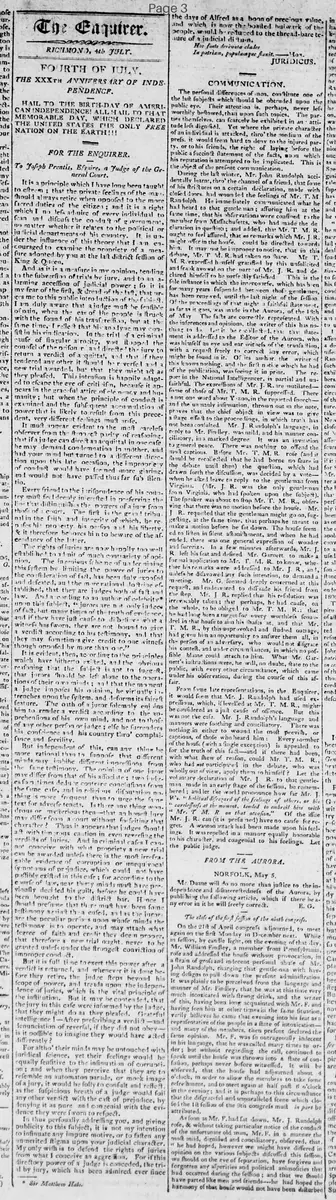
To Joseph Prentis, Esquire, a Judge of the General Court.
It is a principle which I have long been taught to esteem: that the private feelings of the magistrate should always retire when opposed to the more sacred duties of the citizen: and it is a right which I no less admire of every individual to scan and discuss the conduct of government, no matter whether it relates to the political or judicial departments of his country. It is under the influence of this theory that I am encouraged to examine the propriety of a measure adopted by you at the last district election of King & Queen.
And as it is a measure in my opinion, tending to the subversion of trials by jury, and to an alarming accession of judicial power: so it is my fear of the first, & dread of the last, that urges me to this public introduction of the subject. I am duly aware that a judge must be sensible of pain, when the ear of the people is struck with the sound of his transgression, but at the same time,- I reflect that his anodyne must consist in his vindication. In the trial of a criminal cause of singular atrocity, you stopped the counsel of the prisoner and directed the jury to return a verdict of acquittal, and that if they tendered any other it should be reversed and a new trial awarded, but that they might act as they pleased. This intrusion is happily adapted to escape the eye of criticism, because it appears in the graceful attire of clemency and humanity; but when the principle of conduct is examined and the subsequent accumulation of power that is likely to result from this precedent, very different feelings must arise.
It most appear evident to the most careless observer from the strong est purity of reasoning, that if a judge can direct an acquittal in one case he may demand condemnation in another, and had your mind but turned to a different direction upon this late occasion, the impropriety of conduct would have seemed more glaring, and would not have passed thus far unobserved.
Every friend to the jurisprudence of his country must be deeply interested in preserving the line that distinguishes the powers of a jury from those of a court. The first is the grand tribunal in the faith and integrity of which, he reposes his property his person and his liberty. & it therefore behoves him to beware of the ascendancy of the latter.
The rights of juries are now happily too well established to admit of much contrariety of opinion. The ingenious scheme of undermining this system by limiting the power of juries to the consideration of fact, has been duly exposed and defeated, and the more rational doctrine established, that they are judges both of fact and law. And according to an author of celebrity* upon this subject, "jurors are not only judges of fact, but many times of the truth of evidence. and if they have just cause to disbelieve what a witness has sworn, they are not bound to give a verdict according to his testimony. and that they may sometimes give credit to one witness though opposed by more than one."
It is evident, then, according to the principles which have hitherto existed, and the obvious reasoning that the subject is apt to suggest, that jurors should be left alone to the operations of their own minds: and that the moment a judge imposes his opinion, he virtually intrenches upon the system, and deforms its fairest feature. The oath of a juror solemnly enjoins him to render a verdict according to the apprehensions of his own mind, and not to those of any other person or judge; else he surrenders his conscience and his country thro' complaisance and servility.
But independent of this, can anything be more rational than to suppose that different minds may imbibe different impressions from the same testimony. The opinion of one juror may differ from that of his associate: two judges sometimes deduce contrary conclusions from the same case, and in religious disputation nothing is more frequent than to urge the same text for adverse tenets. Is there anything wondrous or mysterious then-that an honest jury may differ from a court without forfeiting that character? Thus it appears that judges should act with the most cautious in even reversing the verdicts of juries. And in criminal cases I cannot conceive with what propriety a new trial can be awarded unless there is the most irref ragable evidence of corruption or unequivocal symptoms of prejudice, which could not have possibly existed in this case; for according to the worst case of law, nor thirty minds must have previously decided his guilt, before he could have been brought to the district bar. Hence I should presume that there must have been some testimony against the accused, unless the jurors are the peculiar persons upon whose minds the testimony is to operate, and may attach what degree of faith and credit they deem proper, that therefore a new trial ought never to be granted unless under the strongest conviction of improper conduct.
But it is full time to exert this power after a verdict is returned, and whenever it is done before they retire, the judge steps beyond his scope of power, and treads upon the independence of juries, which is the vital principle of the institution. But it may be contended, that the jury in this case were informed by the judge, that they might do as they pleased. (Grateful intelligence !-After prescribing a verdict --and renunciation of reversal, if they did not obey- is it possible to imagine they would have acted differently?
For altho' their minds may be untouched with juridical science, yet their feelings would be- equally sensitive to the insinuation of corruption; and when they perceive that they are to resemble an automaton parade, or mock image of a jury, it would be folly to consult and reflect. as the suspicious breath of a judge would soil any other verdict with the cast of prejudice, by denying it as pure and congenial with the evidence they weresworn to respect.
In thus personally addressing you, and giving publicity to this subject, it is not my intention to insinuate any impure motive, or to fasten any unmerited stigma upon your judicial character. My only wish is to defend the rights of juries from what I conceive an aggression. For if this directory power of a judge is conceded, the trial by jury, which has been admired ever since the days of Alfred as a boon of precious value. and which is now the boasted bulwark of the people, would be reduced to the thread-bare te-
Hæc funt derivala clades
In partem, populumque fuit.-- Hor.
JURIDICUS.
What sub-type of article is it?
What themes does it cover?
What keywords are associated?
What entities or persons were involved?
Letter to Editor Details
Author
Juridicus
Recipient
To Joseph Prentis, Esquire, A Judge Of The General Court.
Main Argument
judge prentis improperly directed the jury to acquit in a criminal trial, subverting the independence of juries as judges of both fact and law, and risking an alarming increase in judicial power that threatens the vital principle of trial by jury.
Notable Details