Thank you for visiting SNEWPapers!
Sign up free
Virginia Argus
Richmond, Virginia
What is this article about?
Report from New York Columbian details the April 6 massacre at Dartmoor Prison, England, where British Captain Shortland ordered troops to fire on unarmed American prisoners, killing 7 and wounding over 50. Eyewitness account from Mr. Andrews describes the unprovoked attack, prisoners' retreat, and subsequent investigation yielding 'justifiable homicide' verdict.
Merged-components note: Continuation of the detailed extract on the Dartmoor prison massacre across pages; relabeled from 'story' to 'foreign_news' to match the international event focus.
Clippings
1 of 2
OCR Quality
Full Text
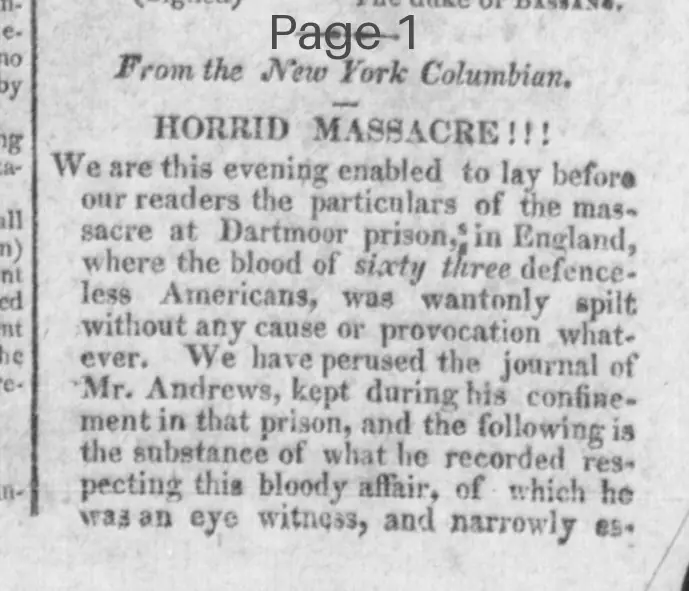
HORRID MASSACRE!!!
We are this evening enabled to lay before our readers the particulars of the massacre at Dartmoor prison, in England, where the blood of sixty three defenceless Americans, was wantonly spilt without any cause or provocation whatever. We have perused the journal of Mr. Andrews, kept during his confinement in that prison, and the following is the substance of what he recorded respecting this bloody affair, of which he was an eye witness, and narrowly escaped.
EXTRACT.
Massacre of American Prisoners.
"On the 6th of April, at 9 o'clock, P. M. captain T. G. Shortland, keeper of the Dartmoor prison, happened to discover a small hole which had been picked through one of the inner walls of the prison, by some of our boys, who preferred any employment to idleness. Upwards of a thousand prisoners were, at this time, civilly walking in the yards of the different prisons, not dreaming of the approaching tragedy, and wholly unconscious of the existence of the little hole from which it was to originate. Instantly the ringing of an alarm bell, saluted their astonished ears; and scarcely had they time to look their surprise, when the drum beat to arms.
"Curiosity alone prompted them to turn their attention to the gate, as the only avenue, through which they might learn the cause of this extraordinary alarm. Each one was eager to get nearest to the source of information, till from the pressure of some thousands, the gate gave way, the crowd with it, and those in the rear pressed forward so rapidly, the foremost found it impossible to resist the current, but were pushed entirely through the passage.
"At this moment, captain Shortland, at the head of the troops of the garrison, entered the inner square of the prison, and drew up his men in a position to charge the prisoners, who were gazing with wonder on this military movement, not dreaming that themselves were its object. The officers of the garrison perceiving the bloody intention of the keeper would have no hand in the business, declined giving any orders, and resigned their power to captain Shortland. After viewing, in speechless astonishment, a manoeuvre that at length seemed to menace their own safety, the prisoners, though unconscious of blame, began to think it most prudent to retire, and every one hastened towards their respective prisons, with all possible alacrity.
"The order to fire was now given by the keeper, and promptly obeyed. A full volley of musketry was discharged into a body of several thousand men, all retreating in the most peaceable manner:
"Through the gates and iron paling that separated the troops from the prisoners, were these vollies repeated, for several rounds! while the defenceless victims, dead and wounded, fell thick on every side. Their flight was in disorder, and the doors of the cells they were seeking to regain, were soon clogged with the wounded, who had fallen in the passages, and the unwounded who were flying over them.
"Their murderous pursuers had now entered the yards of each prison, making a general charge on man and boy, sheathing their ruthless bayonets in the bodies of the retreating prisoners, and completing the work of destruction by the discharge of another volley of musketry in the backs of the hindmost who were forcing their passage, over the wounded, into their prison.
Nor did they stop here; but patrolled the yard to find some solitary fugitive who had sought safety in flight. One poor affrighted wretch had fled close to the wall of one of the prisons, fearing to move, lest he should meet his death. Him those demons of hell discovered, and the bloody Shortland gave the fatal order. In vain the trembling victim fell upon his knees, and in that imploring attitude besought their compassion, begged them to spare a life almost exhausted by suffering and confinement. He pleaded to brutes--he appealed to tigers. "Fire!" cried Shortland, and several balls were discharged into his bosom!
"This inhuman monster, having now glutted his Nero appetite with blood, retired with the troops, leaving the scene of his heroism slippery with the life-blood of defenceless freemen! Sixty three Americans bled to gratify the spleen of a British turnkey! Seven of them were relieved by death from the task of telling the degrading tale.
"The wounded were removed from the scene of slaughter, as soon as practicable, and placed in the hospital, under the direction of Doctor McGrath, head surgeon of the department, who used every exertion in his power to alleviate their sufferings and restore them to health. He demanded admittance into the prisons, and received the wounded who had escaped thither previous to the doors being closed. His tenderness and humanity are acknowledged with gratitude by his patients.
"A dispatch was immediately sent to Plymouth, to inform the admiral and the military commandants of the tragical events. On the following morning, a strong reinforcement arrived from Plymouth, under the command of a colonel, who took charge of the garrison; information of which was immediately given to the prisoners, accompanied with a request that a committee be appointed from among them to receive an explanation respecting the transactions of the preceding evening.
But the survivors, smarting under a painful sense of their unparalleled wrongs, unanimously answered (by letter) that as citizens of the United States of America, they should conceive it a disgrace and degradation of their national character, to hold any correspondence with the murderer of their countrymen. But that if the colonel desired a conference with the prisoners, it would be met on their part with pleasure, and the most satisfactory explanation of every part of their conduct should be given.
"Accordingly, the colonel attended, at the gate of the prison, accompanied by captain Shortland, with a visage overspread with gloom, and glowing with conscious guilt. He faintly attempted to justify his conduct, and pleaded necessity! He feared the prisoners were attempting to escape!
"The colonel patiently heard the stories on both sides of the question, and promised that it should be submitted to the decision of a coroner's inquest, next day, and that a thorough investigation of every relative circumstance should then take place.
"The prisoners then hoisted the colors half-mast on every prison, and visited the wounded in the hospital department. But here a scene was presented too shocking for humanity. Tables were spread and covered with fractured legs and arms, that had just been severed from the bodies of our groaning fellow-captives. There lay seven of our countrymen, marked with horrid wounds and bereft of life--here above fifty were expressing their anguish in half-smothered complaints or audible groans. Our feelings can better be conceived than described.
"A committee of six was then appointed to take the depositions of those best acquainted with the facts relating to this affair, and make every proper arrangement for furnishing the coroner with the most material evidence. All these depositions exactly agreed with the statement here given.
"In the afternoon an admiral arrived at the prison, attended by the captain of a seventy-four. After politely introducing themselves, they informed the prisoners that they came, sanctioned by the proper authority, to make inquiries into the past conduct of captain Shortland, during his agency, and promised that he should be strictly interrogated on the subject. They left us with many fair assurances that a strict and impartial investigation should take place with respect to his conduct.
"One circumstance that occurred during the massacre ought not to be omitted. One of the soldiers that belonged to the same regiment that performed this work of blood, was lighting a lamp at the door of No. 3 [one of the prisons] when the carnage commenced, and, in the hurry to retreat, was forced inside among the wounded and exasperated prisoners. In the height of their resentment, the eye of vengeance was for a moment directed to the only enemy which chance had thus thrown in their power. It was but for a moment. The dignity of the American character was not thus to be sullied. To the astonishment of this affrighted soldier, who was every moment expecting to be immolated on the altar of vengeance, as some atonement to the manes of our murdered countrymen, he received assurances of safety and protection. "Americans never murder their prisoners; rest easy, Your life shall be preserved to distinguish between the humanity of a British soldier, and that of an American sailor." Accordingly, when the doors were opened to discharge the wounded, this man was delivered up to his astonished comrades, in perfect safety. This was a triumph of sentiment, that might have filled the British soldiers with admiration at its sublimity, and the deepest shame for their own littleness.
"On the eighth, the coroner's jury arrived, consisting of sixteen farmers, and commenced taking the different depositions of each party.--The evidence on the part of the keeper of the prison, consisted of the very soldiers who committed the murder by his orders. The verdict of the jury, to the dismay and astonishment of every unprejudiced man, was--Justifiable homicide!!!
"The following facts were fully and completely proved, on the part of the prisoners, and comprise the substance of their evidence before the jury of inquest: viz.
"That the hole in the wall was unknown to more than three-fourths of those confined in the yard where it was made, and not a person belonging to No. 1, 2, 3, and 4, knew that such a thing was ever made or intended.
"That no kind of combination for the purpose of escape had ever existed or even been thought of; and nothing had ever been said or done, directly or indirectly, to give color to such a charge or suspicion. That curiosity, and nothing else, urged them to the gate, and that this curiosity was excited by the sudden ringing of the alarm bell.
"That the lock on the gate was broken by a man in a state of intoxication, and done without the knowledge of the prisoners.
"That the few prisoners that were forced through the inner gate, could not resist the pressure of the crowd behind, who were pressing forward to learn the cause of the alarm.
"That no violence was offered by the prisoners: but every one commenced retiring, when they saw the troops advancing--
That captain Shortland took sole charge of the troops, and was heard to order them to fire.
That the prisoners were all that while running before the soldiers to gain the inside of their prison.
"That the soldiers followed up the few last prisoners, and shot them as they were entering the door.
"That two men were actually killed inside the prison,
"That some few, who were unable to gain the inside of the prison, were deliberately aimed at and shot by the soldiers from the ramparts, while striving to get in.
"That a subaltern officer, who assisted captain S. was seen to be assisting in the killing of a boy not more than 16 years old.
"That a prisoner applied to captain Shortland to stop the horrid massacre, as the prisoners were retiring, but received in answer, "return, you damned rascal!"
"And, lastly that a singular circumstance preceded the affair, that leaves no room for conjecture, but carries conviction at once to the mind, that the whole was a cool premeditated and deliberate murder; which circumstance is this:--Each prison contained four doors, which were always kept open, until the sound of a horn warned the prisoners to retire for the night, after which the doors were closed. But on this memorable evening, no horn had sounded, the prisoners were walking in the yard of their prisons, and yet the turnkeys had been in and locked all the doors of each prison, save one. Thus the bloody wretch, who was meditating his evening's amusement, first gave orders to cut off their retreat, and then began his "attack," in front.
Instead of four doors, the hunted wretches had all to fly to one--choked the passages and were slaughtered there. Others were hunted singly about the yard, and wantonly butchered by the bayonet or bullet.
It was also proved, that captain S. had hold of one of the muskets, in conjunction with a soldier, at the commencement of the firing.
"Mr. Beasley, the American agent, was immediately made acquainted with all the particulars herein stated;" upon which an investigation of the subject took place at Plymouth, under the direction of Mr. B. attended by Mr. Williams and other agents, and further depositions were to be taken previous to the prisoners' leaving England," &c.
The names of the killed, wounded; &c. were published in the Argus of Wednesday last.]
What sub-type of article is it?
What keywords are associated?
What entities or persons were involved?
Where did it happen?
Foreign News Details
Primary Location
Dartmoor Prison, England
Event Date
6th Of April
Key Persons
Outcome
7 americans killed, over 50 wounded; coroner's jury verdict of justifiable homicide; further investigation promised by admiral and american agent.
Event Details
Captain Shortland discovered a small hole in the prison wall and sounded an alarm. Curious prisoners pressed against the gate, which gave way. Shortland ordered troops to fire on the retreating, unarmed prisoners, resulting in volleys, bayonet charges, and killings inside the prisons. Troops pursued and shot fugitives. An inquest followed, but ruled the massacre justifiable.