Thank you for visiting SNEWPapers!
Sign up free
Literary
June 3, 1789
Gazette Of The United States
New York, New York County, New York
What is this article about?
An 1788 essay by a Philadelphia citizen explores raising public revenue for the U.S. union government through merchandise taxation, advocating burdens on luxuries over necessities, and protecting staples like husbandry, fisheries, and manufactures to foster trade and avoid oppression.
Clipping
OCR Quality
95%
Excellent
Full Text
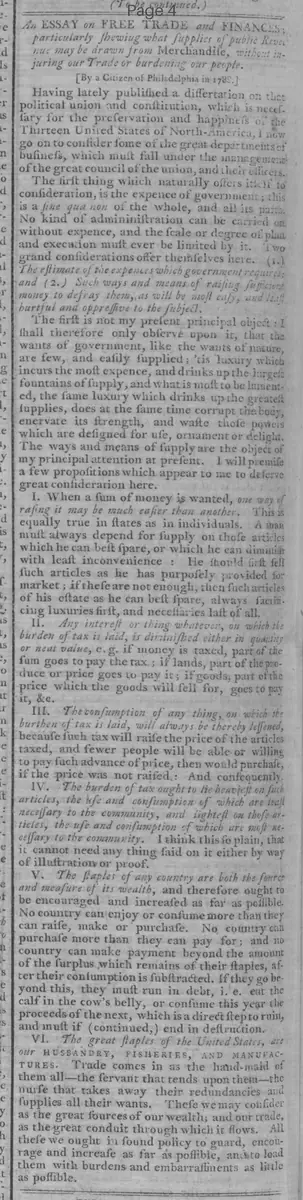
An ESSAY on FREE TRADE and FINANCE;
particularly shewing what supplies of public Revenue may be drawn from Merchandise, without injuring our Trade or burdening our people.
[By a Citizen of Philadelphia in 1788.]
Having lately published a dissertation on the political union and constitution, which is necessary for the preservation and happiness of the Thirteen United States of North-America, I now go on to consider some of the great departments of business, which must fall under the management of the great council of the union, and their officers. The first thing which naturally offers itself to consideration, is the expense of government; this is a sine qua non of the whole, and all its parts. No kind of administration can be carried on without expense, and the scale or degree of plan and execution must ever be limited by it. Two grand considerations offer themselves here. (1.) The estimate of the expenses which government requires; and (2.) Such ways and means of raising sufficient money to defray them, as will be most easy, and least burdensome and oppressive to the subject. The first is not my present principal object: I shall therefore only observe upon it, that the wants of government, like the wants of nature, are few, and easily supplied; 'tis luxury which incurs the most expense, and drinks up the largest fountains of supply, and what is most to be lamented, the same luxury which drinks up the greatest supplies, does at the same time corrupt the body, enervate its strength, and waste those powers which are designed for use, ornament or delight. The ways and means of supply are the object of my principal attention at present. I will premise a few propositions which appear to me to deserve great consideration here.
I. When a sum of money is wanted, one way of raising it may be much easier than another. This is equally true in states as in individuals. A man must always depend for supply on those articles which he can best spare, or which he can diminish with least inconvenience: He should first sell such articles as he has purposely provided for market; if these are not enough, then such articles of his estate as he can best spare, always accusing luxuries first, and necessaries last of all.
II. Any interest or thing whatever, on which the burden of tax is laid, is diminished either in quantity or neat value, e. g. if money is taxed, part of the sum goes to pay the tax; if lands, part of the produce or price goes to pay it; if goods, part of the price which the goods will sell for, goes to pay it, &c.
III. The consumption of any thing, on which the burden of tax is laid, will always be thereby lessened, because such tax will raise the price of the articles taxed, and fewer people will be able or willing to pay such advance of price, than would purchase, if the price was not raised: And consequently
IV. The burden of tax ought to lie heaviest on such articles, the use and consumption of which are least necessary to the community, and lightest on those articles, the use and consumption of which are most necessary to the community. I think this so plain, that it cannot need any thing said on it either by way of illustration or proof.
V. The staples of any country are both the source and measure of its wealth, and therefore ought to be encouraged and increased as far as possible. No country can enjoy or consume more than they can raise, make or purchase. No country can purchase more than they can pay for; and no country can make payment beyond the amount of the surplus which remains of their staples, after their consumption is subtracted. If they go beyond this, they must run in debt, i. e. eat the calf in the cow's belly, or consume this year the proceeds of the next, which is a direct step to ruin, and must if continued, end in destruction.
VI. The great staples of the United States, are Our HUSBANDRY, FISHERIES, AND MANUFACTURES. Trade comes in as the hand-maid of them all-the servant that tends upon them-the nurse that takes away their redundancies and supplies all their wants. These we may consider as the great sources of our wealth; and our trade, as the great conduit through which it flows. All these we ought in sound policy to guard, encourage and increase as far as possible, and to load them with burdens and embarrassments as little as possible.
particularly shewing what supplies of public Revenue may be drawn from Merchandise, without injuring our Trade or burdening our people.
[By a Citizen of Philadelphia in 1788.]
Having lately published a dissertation on the political union and constitution, which is necessary for the preservation and happiness of the Thirteen United States of North-America, I now go on to consider some of the great departments of business, which must fall under the management of the great council of the union, and their officers. The first thing which naturally offers itself to consideration, is the expense of government; this is a sine qua non of the whole, and all its parts. No kind of administration can be carried on without expense, and the scale or degree of plan and execution must ever be limited by it. Two grand considerations offer themselves here. (1.) The estimate of the expenses which government requires; and (2.) Such ways and means of raising sufficient money to defray them, as will be most easy, and least burdensome and oppressive to the subject. The first is not my present principal object: I shall therefore only observe upon it, that the wants of government, like the wants of nature, are few, and easily supplied; 'tis luxury which incurs the most expense, and drinks up the largest fountains of supply, and what is most to be lamented, the same luxury which drinks up the greatest supplies, does at the same time corrupt the body, enervate its strength, and waste those powers which are designed for use, ornament or delight. The ways and means of supply are the object of my principal attention at present. I will premise a few propositions which appear to me to deserve great consideration here.
I. When a sum of money is wanted, one way of raising it may be much easier than another. This is equally true in states as in individuals. A man must always depend for supply on those articles which he can best spare, or which he can diminish with least inconvenience: He should first sell such articles as he has purposely provided for market; if these are not enough, then such articles of his estate as he can best spare, always accusing luxuries first, and necessaries last of all.
II. Any interest or thing whatever, on which the burden of tax is laid, is diminished either in quantity or neat value, e. g. if money is taxed, part of the sum goes to pay the tax; if lands, part of the produce or price goes to pay it; if goods, part of the price which the goods will sell for, goes to pay it, &c.
III. The consumption of any thing, on which the burden of tax is laid, will always be thereby lessened, because such tax will raise the price of the articles taxed, and fewer people will be able or willing to pay such advance of price, than would purchase, if the price was not raised: And consequently
IV. The burden of tax ought to lie heaviest on such articles, the use and consumption of which are least necessary to the community, and lightest on those articles, the use and consumption of which are most necessary to the community. I think this so plain, that it cannot need any thing said on it either by way of illustration or proof.
V. The staples of any country are both the source and measure of its wealth, and therefore ought to be encouraged and increased as far as possible. No country can enjoy or consume more than they can raise, make or purchase. No country can purchase more than they can pay for; and no country can make payment beyond the amount of the surplus which remains of their staples, after their consumption is subtracted. If they go beyond this, they must run in debt, i. e. eat the calf in the cow's belly, or consume this year the proceeds of the next, which is a direct step to ruin, and must if continued, end in destruction.
VI. The great staples of the United States, are Our HUSBANDRY, FISHERIES, AND MANUFACTURES. Trade comes in as the hand-maid of them all-the servant that tends upon them-the nurse that takes away their redundancies and supplies all their wants. These we may consider as the great sources of our wealth; and our trade, as the great conduit through which it flows. All these we ought in sound policy to guard, encourage and increase as far as possible, and to load them with burdens and embarrassments as little as possible.
What sub-type of article is it?
Essay
What themes does it cover?
Commerce Trade
Political
Taxation Oppression
What keywords are associated?
Free Trade
Finance
Public Revenue
Merchandise
Taxation
Luxury
Staples
Husbandry
Fisheries
Manufactures
What entities or persons were involved?
[By A Citizen Of Philadelphia In 1788.]
Literary Details
Title
An Essay On Free Trade And Finance; Particularly Shewing What Supplies Of Public Revenue May Be Drawn From Merchandise, Without Injuring Our Trade Or Burdening Our People.
Author
[By A Citizen Of Philadelphia In 1788.]
Subject
What Supplies Of Public Revenue May Be Drawn From Merchandise, Without Injuring Our Trade Or Burdening Our People
Key Lines
The Burden Of Tax Ought To Lie Heaviest On Such Articles, The Use And Consumption Of Which Are Least Necessary To The Community, And Lightest On Those Articles, The Use And Consumption Of Which Are Most Necessary To The Community.
The Great Staples Of The United States, Are Our Husbandry, Fisheries, And Manufactures.
'Tis Luxury Which Incurs The Most Expense, And Drinks Up The Largest Fountains Of Supply, And What Is Most To Be Lamented, The Same Luxury Which Drinks Up The Greatest Supplies, Does At The Same Time Corrupt The Body, Enervate Its Strength, And Waste Those Powers Which Are Designed For Use, Ornament Or Delight.