Thank you for visiting SNEWPapers!
Sign up free
Gazette Of The United States
New York, New York County, New York
What is this article about?
U.S. House of Representatives proceedings from May 15-19, 1789: Debate on Madison's amendment to limit the Impost Bill's duration passed 41-8, effective until June 1796; bill sent to Senate. Other business included petitions, committee appointments, and unanimous resolution for three executive departments: Foreign Affairs, Treasury, and War.
Merged-components note: These components form a continuous report on congressional proceedings, with sequential reading orders and flowing text from Friday's debate through Saturday's adjournment and the joint committee report on newspapers.
Clippings
1 of 2
OCR Quality
Full Text
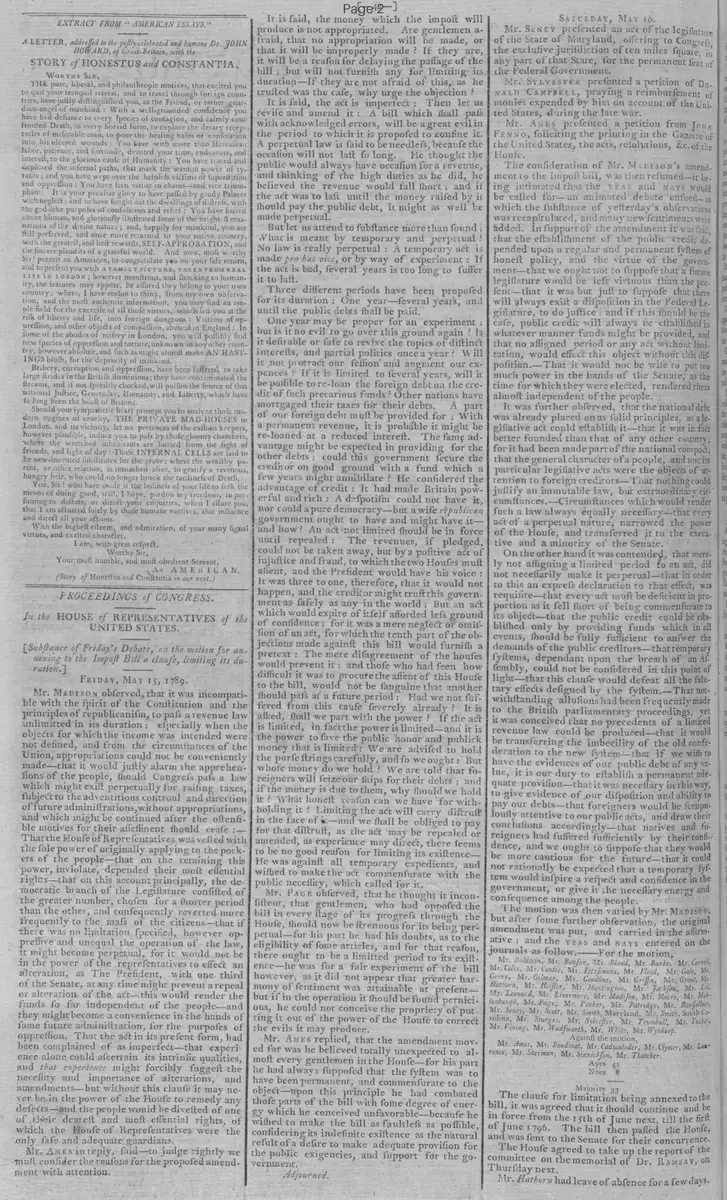
In the HOUSE of REPRESENTATIVES of the UNITED STATES.
[Substance of Friday's Debate, on the motion for annexing to the Impost Bill a clause, limiting its duration.]
FRIDAY, MAY 15, 1789.
Mr. Madison observed, that it was incompatible with the spirit of the Constitution and the principles of republicanism, to pass a revenue law unlimited in its duration; especially when the objects for which the income was intended were not defined, and from the circumstances of the Union, appropriations could not be conveniently made—that it would justly alarm the apprehensions of the people, should Congress pass a law which might exist perpetually for raising taxes, subject to the adventitious controul and direction of future administrations, without appropriations, and which might be continued after the ostensible motives for their assessment should cease:—That the House of Representatives was vested with the sole power of originally applying to the pockets of the people—that on the retaining this power, inviolate, depended their most essential rights—that on this account principally, the democratic branch of the Legislature consisted of the greater number, chosen for a shorter period than the other, and consequently reverted more frequently to the mass of the citizens—that if there was no limitation specified, however oppressive and unequal the operation of the law, it might become perpetual, for it would not be in the power of the representatives to effect an alteration, as The President, with one third of the Senate, at any time might prevent a repeal or alteration of the act—this would render the funds so far independent of the people—and they might become a convenience in the hands of some future administration, for the purposes of oppression. That the act in its present form, had been complained of as imperfect—that experience alone could ascertain its intrinsic qualities, and that experience might forcibly suggest the necessity and importance of alterations, and amendments—but without this clause it may never be in the power of the House to remedy any defects—and the people would be divested of one of their dearest and most essential rights, of which the House of Representatives were the only safe and adequate guardians.
Mr. Ames in reply, said—to judge rightly we must consider the reasons for the proposed amendment with attention.
It is said, the money which the impost will produce is not appropriated. Are gentlemen afraid, that no appropriation will be made, or that it will be improperly made? If they are, it will be a reason for delaying the passage of the bill; but will not furnish any for limiting its duration—If they are not afraid of this, as he trusted was the case, why urge the objection?
It is said, the act is imperfect: Then let us revise and amend it: A bill which shall pass with acknowledged errors, will be a great evil in the period to which it is proposed to confine it.
A perpetual law is said to be needless, because the occasion will not last so long. He thought the public would always have occasion for a revenue, and thinking of the high duties as he did, he believed the revenue would fall short; and if the act was to last until the money raised by it should pay the public debt, it might as well be made perpetual.
But let us attend to substance more than sound; What is meant by temporary and perpetual?
No law is really perpetual: A temporary act is made pro hac vice, or by way of experiment: If the act is bad, several years is too long to suffer it to last.
Three different periods have been proposed for its duration: One year—several years, and until the public debts shall be paid.
One year may be proper for an experiment; but is it no evil to go over this ground again? Is it desirable or safe to revive the topics of distinct interests, and partial politics once a year? Will it not protract our session and augment our expenses? If it is limited to several years, will it be possible to re-loan the foreign debt on the credit of such precarious funds? Other nations have mortgaged their taxes for their debts. A part of our foreign debt must be provided for; With a permanent revenue, it is probable it might be re-loaned at a reduced interest. The same advantage might be expected in providing for the other debts; could this government secure the creditor on good ground with a fund which a few years might annihilate? He considered the advantage of credit: It had made Britain powerful and rich: A despotism could not have it, nor could a pure democracy—but a wise republican government ought to have and might have it— and how? An act not limited should be in force until repealed: The revenues, if pledged, could not be taken away, but by a positive act of injustice and fraud, to which the two Houses must assent, and the President would have his voice: It was three to one, therefore, that it would not happen, and the creditor might trust this government as safely as any in the world; But an act which would expire of itself afforded less ground of confidence; for it was a mere neglect or omission of an act, or which the tenth part of the objections made against this bill would furnish a pretext: The mere disagreement of the houses would prevent it; and those who had seen how difficult it was to procure the assent of this House to the bill, would not be sanguine that another should pass at a future period: Had we not suffered from this cause severely already? It is asked, shall we part with the power? If the act is limited, in fact the power is limited—and it is the power to save the public honor and public money that is limited: We are advised to hold the purse strings carefully, and so we ought: But whose money do we hold? We are told that foreigners will seize our ships for their debts; and if the money is due to them, why should we hold it? What honest reason can we have for withholding it? Limiting the act will carry distrust in the face of—and we shall be obliged to pay for that distrust, as the act may be repealed or amended, as experience may direct, there seems to be no good reason for limiting its existence— He was against all temporary expedients, and wished to make the act commensurate with the public necessity, which called for it.
Mr. Page observed, that he thought it inconsistent, that gentlemen, who had opposed the bill in every stage of its progress through the House, should now be strenuous for its being perpetual—for his part he had his doubts, as to the eligibility of some articles, and for that reason, there ought to be a limited period to its existence—he was for a fair experiment of the bill however, as it did not appear that greater harmony of sentiment was attainable at present— but if in the operation it should be found pernicious, he could not conceive the propriety of putting it out of the power of the House to correct the evils it may produce.
Mr. Ames replied, that the amendment moved for was he believed totally unexpected to almost every gentleman in the House—for his part he had always supposed that the system was to have been permanent, and commensurate to the object—upon this principle he had combated those parts of the bill with some degree of energy which he conceived unfavorable—because he wished to make the bill as faultless as possible. considering its indefinite existence as the natural result of a desire to make adequate provision for the public exigencies, and support for the government.
Adjourned
SATURDAY, MAY 16.
Mr. Seney presented an act of the legislature of the State of Maryland, offering to Congress, the exclusive jurisdiction of ten miles square, in any part of that State, for the permanent seat of the Federal Government.
Mr. Sylvester presented a petition of Donald Campbell, praying a reimbursement of monies expended by him on account of the United States, during the late war.
Mr. Ames presented a petition from John Fenno, soliciting the printing in the Gazette of the United States, the acts, resolutions, &c. of the House.
The consideration of Mr. Madison's amendment to the impost bill, was then resumed—it being intimated that the Yeas and Nays would be called for—an animated debate ensued—in which the substance of yesterday's observations was recapitulated, and many new sentiments were added. In support of the amendment it was said, that the establishment of the public credit depended upon a regular and permanent system of honest policy, and the virtue of the government—that we ought not to suppose that a future legislature would be less virtuous than the present—that it was but just to suppose that there will always exist a disposition in the Federal Legislature, to do justice; and if this should be the case, public credit will always be established in whatever manner funds might be provided, and that no assigned period or any act without limitation, would effect this object without this disposition.—That it would not be wise to put too much power in the hands of the Senate, as the time for which they were elected, rendered them almost independent of the people.
It was further observed, that the national debt was already placed on as solid principles, as any legislative act could establish it—that it was in fact better founded than that of any other country; for it had been made part of the national compact; that the general character of a people, and not its particular legislative acts were the objects of attention to foreign creditors—That nothing could justify an immutable law, but extraordinary circumstances.—Circumstances which would render such a law always equally necessary—that every act of a perpetual nature, narrowed the power of the House, and transferred it to the executive and a minority of the Senate.
On the other hand it was contended, that merely not assigning a limited period to an act, did not necessarily make it perpetual—that in order to this an express declaration to that effect, was requisite—that every act must be deficient in proportion as it fell short of being commensurate to its object—that the public credit could be established only by providing funds which in all events, should be fully sufficient to answer the demands of the public creditors—that temporary systems, dependant upon the breath of an Assembly, could not be considered in this point of light—that this clause would defeat all the salutary effects designed by the system.—That notwithstanding allusions had been frequently made to the British parliamentary proceedings, yet it was conceived that no precedents of a limited revenue law could be produced—that it would be transferring the imbecility of the old confederation to the new system—that if we wish to have the evidences of our public debt of any value, it is our duty to establish a permanent adequate provision—that it was necessary in this way, to give evidence of our disposition and ability to pay our debts—that foreigners would be scrupulously attentive to our public acts, and draw their conclusions accordingly—that natives and foreigners had suffered sufficiently by their confidence, and we ought to suppose that they would be more cautious for the future—that it could not rationally be expected that a temporary system would inspire a respect and confidence in the government, or give it the necessary energy and consequence among the people.
The motion was then varied by Mr. Madison, but after some further observation, the original amendment was put, and carried in the affirmative; and the YEAS and NAYs entered on the journals as follow.—For the motion,
Mr. Baldwin, Mr. Benson, Mr. Bland, Mr. Burke, Mr. Carroll, Mr. Coles, Mr. Contee, Mr. Fitzsimons, Mr. Floyd, Mr. Gale, Mr. Gerry, Mr. Gilman, Mr. Griffin, Mr. Grout, Mr. Hathorn, Mr. Heister, Mr. Huntington, Mr. Jackson, Mr. Lee, Mr. Leonard, Mr. Livermore, Mr. Madison, Mr. Moore, Mr. Muhlenbergh, Mr. Page, Mr. Parker, Mr. Partridge, Mr. Rensselaer, Mr. Seney, Mr. Scott, Mr. Smith, Maryland, Mr. Smith, South Carolina, Mr. Sturges, Mr. Sylvester, Mr. Trumbull, Mr. Tucker, Mr. Vining, Mr. Wadsworth, Mr. White, Mr. Wynkoop.
Against the motion,
Mr. Ames, Mr. Boudinot, Mr. Cadwalader, Mr. Clymer, Mr. Lawrence, Mr. Sherman, Mr. Sinnickson, Mr. Thatcher.
Ayes 41
Noes 8
Majority 33
The clause for limitation being annexed to the bill, it was agreed that it should continue and be in force from the 15th of June next, till the first of June 1796. The bill then passed the House, and was sent to the Senate for their concurrence.
The House agreed to take up the report of the committee on the memorial of Dr. Ramsay, on Thursday next.
Mr. Hathorn had leave of absence for a few days.
MONDAY, MAY 18.
The House resolved itself into a committee of the whole, on the second reading of the bill to regulate the collection of the impost.
The object of this bill being a temporary arrangement, applying the revenue systems already extant in the several States to the purposes of the Union—and in those States where no such regulations existed, directing the adoption of the laws of a neighboring State.
Messrs. Lawrence, Huntington, Jackson, White and Vining, severally objected to the bill, as incompetent to the purposes intended—as radically bad—as creating insurmountable difficulties, owing to various rates and modes of impost, and its collection in the several States—It would cause an interference with the pre-conceived maxims of particular States, by making the laws of one, the rule of conduct for another—it would sanction the receiving a depreciated paper medium, and other regulations of some of the States, which were inconsistent with the Constitution.
It was therefore moved, that the committee should rise, and the bill lie on the table—this motion was seconded, and carried in the affirmative.
On motion of Mr. Parker, a committee was appointed to bring in a Bill for laying a tax on slaves imported into the United States, prior to the year 1808.
On motion of Mr. Goodhue, a committee was appointed to bring in a bill, providing for the enumeration of the inhabitants of the United States, agreeably to the Constitution.
The House, agreeably to the order of the day, resolved itself into a committee of the whole, on the report of the joint committee respecting the rules to be observed by the two Houses for the enrollment, attestation, publication and preservation of the acts of Congress, and regulating the mode of presenting addresses, &c. to THE PRESIDENT of the United States—and having discussed and amended several paragraphs, the committee rose, and the Chairman having reported progress, the House adjourned.
TUESDAY, MAY 19.
A message was read from the Senate, informing that they had appointed Mr. Lee a committee, to join with a committee on the part of the House, to present to THE PRESIDENT, the engrossed bill, regulating the taking certain oaths.
The House voted a concurrence, and Mr. Parker, and Mr. Floyd were appointed.
In committee of the whole on the State of the Union, Mr. Trumbull in the chair.
Mr. Boudinot, according to previous notice, introduced a resolve in which the first object was the establishment of an office of Finance, agreeably to the Constitution; the superintendence and direction of which should be committed to an officer, to be entitled "The Secretary of Finance for the United States."
Mr. Benson proposed a resolve as an amendment, that it should first be determined how many departments there should be, and proposed a resolution, that there should be three, viz.
The Department of Foreign Affairs,
The Department of the Treasury, and
The War Department—
To these it was proposed by Mr. Vining, to add a fourth, viz. The Secretary of the United States for the Domestic Department.
After some conversation upon the amendment, Mr. Boudinot withdrew his proposition for the present, after which Mr. Madison proposed a resolution, which Mr. Benson consented should supersede that introduced by him—it was to this effect—That to aid the Supreme Executive in the discharge of his important trust, there should be three subordinate departments established, viz.
The Secretary of the United States for the Department of Foreign Affairs.
The Secretary of the United States for the Department of the Treasury.
The Secretary of the United States for the War Department.
The respective heads of these departments to be nominated by THE PRESIDENT, and appointed by him with the advice and consent of the Senate, and to be removed by The PRESIDENT alone—The addition of the Domestic Department, was again proposed.
The question whether there should be three departments passed unanimously in the affirmative.
It was then proposed to strike out the words "with the advice and consent of the Senate," as an unnecessary clause—This was voted in the affirmative—The last clause "to be removed by the President," occasioned a very long and interesting debate which we have not room this day to insert, but a sketch of which shall appear in our next. It was then moved, that "with the advice and consent of the Senate" should be added after the word "PRESIDENT,"—in the last clause; this was negatived, and the vote being taken on the whole as amended, it passed in the affirmative.
The second article, viz. "Secretary of the United States for the department of the Treasury." was the next in order: when it was moved that the further consideration of the resolve, should be postponed—This being seconded the committee rose, and the Chairman reported progress.
The joint committee appointed to determine upon the subject of news-papers, and to receive proposals for executing the public printing, reported in part to this effect—That it was expedient to diminish the number of papers which it had been customary to have handed in to the members of Congress, and therefore, that every member be furnished with one paper only, at the public charge, each member to take such paper as he may think proper—This report to lie on the table.
Adjourned.
What sub-type of article is it?
What keywords are associated?
What entities or persons were involved?
Domestic News Details
Event Date
May 15 To May 19, 1789
Key Persons
Outcome
madison's amendment to limit impost bill duration passed 41-8; bill effective june 15, 1789, to june 1, 1796, sent to senate. bill to regulate impost collection tabled. committees appointed for slave tax bill and census. resolution for three executive departments (foreign affairs, treasury, war) passed unanimously, with president appointing and removing heads.
Event Details
The House debated and passed an amendment by Mr. Madison to limit the Impost Bill's duration to avoid perpetual taxation without review. Debate focused on public credit, republican principles, and debt repayment. Petitions presented from Maryland for federal seat, Campbell for reimbursement, Fenno for printing. Objections raised to impost collection bill, leading to it being tabled. Motions for committees on slave import tax and population enumeration. Senate message on oaths bill. Resolutions introduced and passed for establishing three executive departments to aid the President.