Thank you for visiting SNEWPapers!
Sign up free
The Recorder
Richmond, Virginia
What is this article about?
In a Richmond, Virginia trial, George Hay's speech defends binding libelous publishers Callender and Pace to keep the peace, emphasizing press liberty for public matters but not private slander. He counters accusations and notes public disdain. The court discharges them as illegal.
Clipping
OCR Quality
Full Text
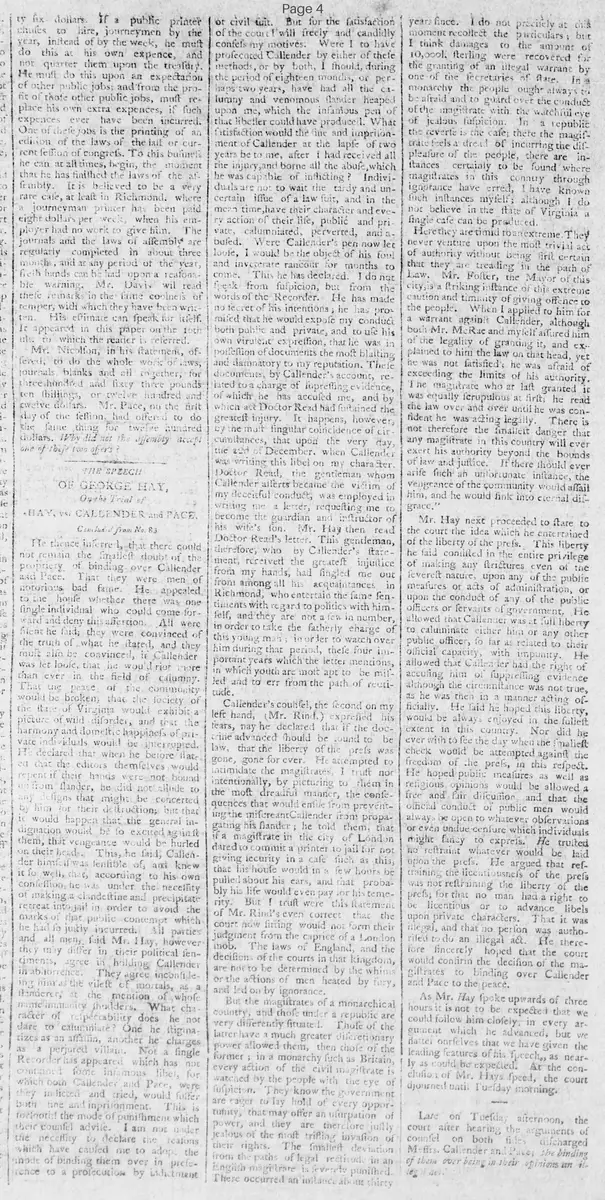
On the Trial of HAY, VS. CALLENDER and PACE.
Continued from No. 83
He thence infers, that there could not remain the smallest doubt of the propriety of binding over Callender and Pace. That they were men of notorious bad fame. He appealed to the house whether there was one single individual who could come forward and deny this assertion. All were silent he said; they were convinced of the truth of what he stated, and they must also be convinced, if Callender was let loose, that he would riot more than ever in the field of calumny. That the peace of the community would be broken, that the society of the state of Virginia would exhibit a picture of wild disorder, and that the harmony and domestic happiness of private individuals would be interrupted.
He declared that when he before stated that the editors themselves would repent if their hands were not bound in from slander, he did not allude to any designs that might be concerted by him for their destruction; but that it would happen that the general indignation would be so excited against them, that vengeance would be hurled on their heads. This, he said, Callender himself was sensible of, and knew it so well, that, according to his own confession, he was under the necessity of making a clandestine and precipitate retreat into jail in order to avoid the marks of that public contempt which he had so justly incurred. All parties and all men, said Mr. Hay, however they may differ in their political sentiments, agree in holding Callender in abhorrence. They agree in considering him as the vilest of mortals, as a murderer, at the mention of whose name humanity shudders. What character of respectability does he not dare to calumniate? One he stigmatizes as an assassin, another he charges as a perjured villain. Not a single number has appeared which has not contained some infamous libel, for which both Callender and Pace, were they indicted and tried, would suffer both fine and imprisonment. This is doubtless! the mode of punishment which their counsel advise. I am not under the necessity to declare the reasons which have caused me to adopt the mode of binding them over in preference to a prosecution by indictment or by civil suit. But for the satisfaction of the court I will freely and candidly confess my motives. Were I to have prosecuted Callender by either of these methods, or by both, I should, during the period of eighteen months, or perhaps two years, have had all the calumny and venomous slander heaped upon me, which the infamous pen of that libeller could have produced. What satisfaction would the fine and imprisonment of Callender at the lapse of two years be to me, after I had received all the injury, and borne all the abuse, which he was capable of inflicting? Individuals are not to wait the tardy and uncertain issue of a law suit, and in the mean time, have their character and every action of their life, public and private, calumniated, perverted, and abused. Were Callender's pen now let loose, I would be the object of his foul and inveterate rancour for months to come. This he has declared. I speak from suspicion, but from the words of the Recorder. He has made no secret of his intentions; he has promised that he would expose my conduct both public and private, and to use his own virulent expression, that he was in possession of documents the most blasting and damnatory to my reputation. These documents, by Callender's account, related to a charge of suppressing evidence, of which he has accused me, and by which act Doctor Read had sustained the greatest injury. It happens, however, by the most singular coincidence of circumstances, that upon the very day, the 22d of December, when Callender was writing this libel on my character, Doctor Read, the gentleman whom Callender asserts became the victim of my deceitful conduct, was employed in writing me a letter, requesting me to become the guardian and instructor of his wife's son. Mr. Hay then read Doctor Read's letter. This gentleman, therefore, who by Callender's statement, received the greatest injustice from my hands, had singled me out from among all his acquaintances in Richmond, who entertain the same sentiments with regard to politics with himself, and they are not a few in number, in order to take the fatherly charge of this young man; in order to watch over him during that period, these four important years which the letter mentions, in which youth are most apt to be misled and to err from the path of rectitude.
Callender's counsel, the second on my left hand, (Mr. Rind,) expressed his fears, nay he declared that if the doctrine advanced should be found to be law, that the liberty of the press was gone, gone for ever. He attempted to intimidate the magistrates, I trust not intentionally, by picturing to them in the most dreadful manner, the consequences that would ensue from preventing the miscreant Callender from propagating his slander; he told them, that if a magistrate in the city of London dared to commit a printer to jail for not giving security in a case such as this, that his house would in a few hours be pulled about his ears, and that probably his life would even pay for his temerity. But I trust were this statement of Mr. Rind's even correct then the court now sitting would not form their judgment from the caprice of a London mob. The laws of England, and the decisions of the courts in that kingdom, are not to be determined by the whims or the actions of men heated by fury and led on by ignorance.
But the magistrates of a monarchical country, and those under a republic are very differently situated. Those of the latter have a much greater discretionary power allowed them, than those of the former; in a monarchy such as Britain, every action of the civil magistrate is watched by the people with the eye of suspicion. They know the government are eager to lay hold of every opportunity, that may offer an usurpation of power, and they are therefore justly jealous of the most trifling invasion of their rights. The smallest deviation from the paths of legal rectitude in an English magistrate is severely punished. There occurred an instance about thirty years since. I do not precisely at this moment recollect the particulars: but I think damages to the amount of 10,000l. sterling were recovered for the granting of an illegal warrant by one of the secretaries of state. In a monarchy the people ought always to be afraid and to guard over the conduct of the magistrate with the watchful eye of jealous suspicion. In a republic the reverse is the case; there the magistrate feels a dread of incurring the displeasure of the people, there are instances certainly to be found where magistrates in this country through ignorance have erred, I have known such instances myself; although I do not believe in the state of Virginia a single case can be produced. Here they are timid to extreme. They never venture upon the most trivial act of authority without being first certain that they are treading in the path of Law. Mr. Foster, the Mayor of this city, is a striking instance of this extreme caution and timidity of giving offence to the people. When I applied to him for a warrant against Callender, although both Mr. McRae and myself assured him of the legality of granting it, and explained to him the law on that head, yet he was not satisfied; he was afraid of exceeding the limits of his authority. The magistrate who at last granted it was equally scrupulous at first; he read the law over and over until he was confident he was acting legally. There is not therefore the smallest danger that any magistrate in this country will ever exert his authority beyond the bounds of law and justice. If there should ever arise such an unfortunate instance, the vengeance of the community would assail him, and he would sink into eternal disgrace.
Mr. Hay next proceeded to state to the court the idea which he entertained of the liberty of the press. This liberty he said consisted in the entire privilege of making any strictures even of the severest nature, upon any of the public measures or acts of administration, or upon the conduct of any of the public officers or servants of government. He allowed that Callender was at full liberty to calumniate either him or any other public officer, so far as related to their official capacity, with impunity. He allowed that Callender had the right of accusing him of suppressing evidence although the circumstance was not true, as he was then in a manner acting officially. He said he hoped this liberty, would be always enjoyed in the fullest extent in this country. Nor did he ever wish to see the day when the smallest check would be attempted against the freedom of the press, in this respect. He hoped public measures as well as religious, opinions would be allowed a free and fair discussion, and that the official conduct of public men would always be open to whatever observations or even undue censure which individuals might fancy to express. He trusted no restraint whatever would be laid upon the press. He argued that restraining the licentiousness of the press was not restraining the liberty of the press; for that no man had a right to be licentious or to advance libels upon private characters. That it was illegal, and that no person was authorized to do an illegal act. He therefore sincerely hoped that the court would confirm the decision of the magistrates to binding over Callender and Pace to the peace.
As Mr. Hay spoke upwards of three hours it is not to be expected that we could follow him closely, in every argument which he advanced, but we flatter ourselves that we have given the leading features of his speech, as nearly as could be expected. At the conclusion of Mr. Hay's speech, the court adjourned until Tuesday morning.
Late on Tuesday afternoon, the court after hearing the arguments of counsel on both sides discharged Messrs. Callender and Pace; the binding of them over being in their opinions an illegal act.
What sub-type of article is it?
What themes does it cover?
What keywords are associated?
What entities or persons were involved?
Where did it happen?
Story Details
Key Persons
Location
Richmond, Virginia
Event Date
22d Of December
Story Details
George Hay delivers a speech defending the binding over of Callender and Pace for slandering private characters, distinguishing press liberty from licentiousness, and arguing against full prosecution to avoid prolonged abuse. He refutes Callender's accusations and highlights public abhorrence. The court later discharges Callender and Pace, deeming the binding illegal.