Thank you for visiting SNEWPapers!
Sign up free
Story
February 21, 1892
The Anaconda Standard
Anaconda, Deer Lodge County, Montana
What is this article about?
Article on kitchen chemistry explains scientific cleaning methods: using hemmed linen cloths, soap's emulsification of grease, soda's role, hot water and sunshine for purification, and preventing microbial spread for orderly housekeeping.
Clipping
OCR Quality
95%
Excellent
Full Text
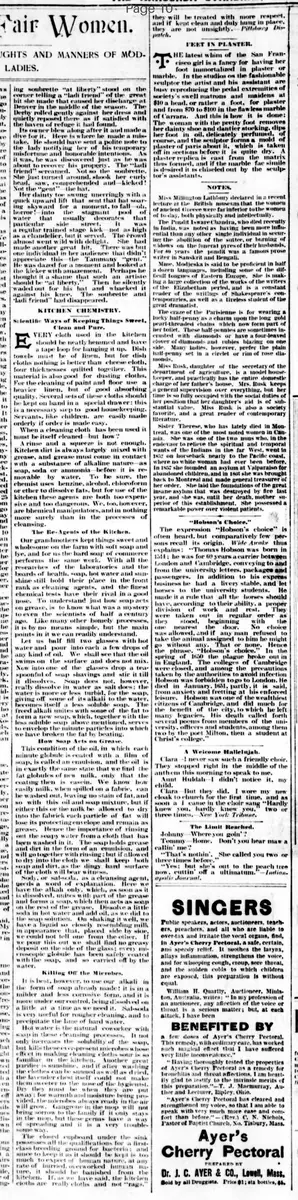
KITCHEN CHEMISTRY.
Scientific Ways of Keeping Things Sweet, Clean and Pure.
Every cloth used in the kitchen should be neatly hemmed and have a tape loop for hanging it up. Dish towels must be of linen, but for dish cloths nothing is better than cheese cloth, four thicknesses quilted together. This material is also good for dusting cloths. For the cleaning of paint and floor use a heavier linen, but of good absorbing quality. Several sets of these cloths should be kept on hand in a special drawer; this is a necessary step to good housekeeping. Servants, like children, are easily made orderly if order is made easy. When a cleaning cloth has been used it must be itself cleaned—but how? A rinse and a squeeze is not enough. Kitchen dirt is always largely mixed with grease, and grease must come in contact with a substance of alkaline nature as soap, soda or ammonia—before it is removable by water. To be sure, the chemist uses benzine, alcohol, chloroform or ether to dissolve fats, but for use of the kitchen these agents are both too expensive and too dangerous. We, too, however, are chemical manipulators, and in nothing more surely than in the processes of cleansing.
The Re-Agents of The Kitchen.
Our grandmothers kept things sweet and wholesome on the farm with soft soap and lye, and for us the hard soap of commerce performs the same work. With all the researches of the laboratories and the boards of health, soap, hot water and sunshine still hold their place in the front rank as cleaning agents, and the finest chemical tests have their rival in a good nose. To understand just how soap acts on grease, is to know what was a mystery to even the scientists of half a century ago. Like many other homely processes, it is by no means simple, but the main points in it we can readily understand. Let us half fill two glasses with hot water and pour into each a few drops of any kind of oil. We shall see that the oil swims on the surface and does not mix. Now into one of the glasses drop a teaspoonful of soap shavings and stir it till it dissolves. Soap does not, however, really dissolve in water as salt does; the water is more or less turbid, for the soap, giving off some of its alkali to the water, becomes itself a less soluble soap. The freed alkali unites with some of the fat to form a new soap, which, together with the less soluble soap above mentioned, serves to envelop the minute particles into which we have broken the fat by beating.
Now Soap Acts on Grease,
This condition of the oil, in which each minute globule is coated with a film of soap, is called an emulsion, and the oil is in exactly the same state that we find the fat globules of new milk, only that the coating then is casein. We know how easily milk, when spilled on a fabric, can be washed out, leaving no stain of fat, and so with this oil and soap mixture, but if either this or the milk be allowed to dry into the fabric each particle of fat will lose its protecting envelope and remain as grease. Hence the importance of rinsing out the soapy water from a cloth that has been washed in it. The soap holds grease and dirt in the form of an emulsion, and will go together with rinsing; but if allowed to dry into the cloth we shall keep both soap and dirt, as the dingy hard surface of the cloth will bear witness. Soda, or sal-soda, as a cleansing agent, needs a word of explanation. Here we have the alkali only, which, as soon as it is dissolved, unites with part of the grease and forms a soap, which then acts as soap on the rest of the grease. Dissolve a little soda in hot water and add oil, as we did to the soap solution. On shaking it well, we have a liquid so closely resembling milk in appearance, that, placed side by side, we could not tell one from the other. If we pour this out we shall find no greasy deposit on the side of the glass; every microscopic globule has been safely coated with the soap, and so carried off by the water.
Killing Off the Microbes.
It is best, however, to use our alkali in the form of soap already made; it is in a milder and less corrosive form, and it is more under our control, being dissolved on a little at a time as we need it. Sal-soda is very useful for rougher cleaning, and to precipitate the lime of hard water. Hot water is the natural coworker with soap in these cleansing processes. It not only increases the solubility of the soap, but kills these ever-present microbes whose effect in making cleaning cloths sour is so familiar in the kitchen. Another great purifier is sunshine, and if after washing the clothes can be sunned as well as dried, the lavender chest itself could not make them sweeter to the nose of the hygienist. Yet they must be when they are put away; for warmth and moisture being provided, the microbes always ready in the air will grow. Gangrene in the mop will not bring sorrow to the family if it only stays in the mop, but these germs have a way of spreading and it is a very troublesome way. The closed cupboard under the sink possesses all the qualifications for a first class breeding ground for bacteria; and since to keep it as it should be kept is too much to expect of human nature, at any rate of hurried, overworked human nature, it should be banished from the kitchen. If, as we have said, the kitchen cloths are really cloths and not "rags," they will be treated with more respect, and if kept clean and duly hung in place, they are not unsightly.—Pittsburgh Dispatch.
Scientific Ways of Keeping Things Sweet, Clean and Pure.
Every cloth used in the kitchen should be neatly hemmed and have a tape loop for hanging it up. Dish towels must be of linen, but for dish cloths nothing is better than cheese cloth, four thicknesses quilted together. This material is also good for dusting cloths. For the cleaning of paint and floor use a heavier linen, but of good absorbing quality. Several sets of these cloths should be kept on hand in a special drawer; this is a necessary step to good housekeeping. Servants, like children, are easily made orderly if order is made easy. When a cleaning cloth has been used it must be itself cleaned—but how? A rinse and a squeeze is not enough. Kitchen dirt is always largely mixed with grease, and grease must come in contact with a substance of alkaline nature as soap, soda or ammonia—before it is removable by water. To be sure, the chemist uses benzine, alcohol, chloroform or ether to dissolve fats, but for use of the kitchen these agents are both too expensive and too dangerous. We, too, however, are chemical manipulators, and in nothing more surely than in the processes of cleansing.
The Re-Agents of The Kitchen.
Our grandmothers kept things sweet and wholesome on the farm with soft soap and lye, and for us the hard soap of commerce performs the same work. With all the researches of the laboratories and the boards of health, soap, hot water and sunshine still hold their place in the front rank as cleaning agents, and the finest chemical tests have their rival in a good nose. To understand just how soap acts on grease, is to know what was a mystery to even the scientists of half a century ago. Like many other homely processes, it is by no means simple, but the main points in it we can readily understand. Let us half fill two glasses with hot water and pour into each a few drops of any kind of oil. We shall see that the oil swims on the surface and does not mix. Now into one of the glasses drop a teaspoonful of soap shavings and stir it till it dissolves. Soap does not, however, really dissolve in water as salt does; the water is more or less turbid, for the soap, giving off some of its alkali to the water, becomes itself a less soluble soap. The freed alkali unites with some of the fat to form a new soap, which, together with the less soluble soap above mentioned, serves to envelop the minute particles into which we have broken the fat by beating.
Now Soap Acts on Grease,
This condition of the oil, in which each minute globule is coated with a film of soap, is called an emulsion, and the oil is in exactly the same state that we find the fat globules of new milk, only that the coating then is casein. We know how easily milk, when spilled on a fabric, can be washed out, leaving no stain of fat, and so with this oil and soap mixture, but if either this or the milk be allowed to dry into the fabric each particle of fat will lose its protecting envelope and remain as grease. Hence the importance of rinsing out the soapy water from a cloth that has been washed in it. The soap holds grease and dirt in the form of an emulsion, and will go together with rinsing; but if allowed to dry into the cloth we shall keep both soap and dirt, as the dingy hard surface of the cloth will bear witness. Soda, or sal-soda, as a cleansing agent, needs a word of explanation. Here we have the alkali only, which, as soon as it is dissolved, unites with part of the grease and forms a soap, which then acts as soap on the rest of the grease. Dissolve a little soda in hot water and add oil, as we did to the soap solution. On shaking it well, we have a liquid so closely resembling milk in appearance, that, placed side by side, we could not tell one from the other. If we pour this out we shall find no greasy deposit on the side of the glass; every microscopic globule has been safely coated with the soap, and so carried off by the water.
Killing Off the Microbes.
It is best, however, to use our alkali in the form of soap already made; it is in a milder and less corrosive form, and it is more under our control, being dissolved on a little at a time as we need it. Sal-soda is very useful for rougher cleaning, and to precipitate the lime of hard water. Hot water is the natural coworker with soap in these cleansing processes. It not only increases the solubility of the soap, but kills these ever-present microbes whose effect in making cleaning cloths sour is so familiar in the kitchen. Another great purifier is sunshine, and if after washing the clothes can be sunned as well as dried, the lavender chest itself could not make them sweeter to the nose of the hygienist. Yet they must be when they are put away; for warmth and moisture being provided, the microbes always ready in the air will grow. Gangrene in the mop will not bring sorrow to the family if it only stays in the mop, but these germs have a way of spreading and it is a very troublesome way. The closed cupboard under the sink possesses all the qualifications for a first class breeding ground for bacteria; and since to keep it as it should be kept is too much to expect of human nature, at any rate of hurried, overworked human nature, it should be banished from the kitchen. If, as we have said, the kitchen cloths are really cloths and not "rags," they will be treated with more respect, and if kept clean and duly hung in place, they are not unsightly.—Pittsburgh Dispatch.
What sub-type of article is it?
Curiosity
What themes does it cover?
Moral Virtue
What keywords are associated?
Kitchen Chemistry
Cleaning Cloths
Soap Action
Emulsion
Microbes
Hygiene
Housekeeping
Where did it happen?
Kitchen
Story Details
Location
Kitchen
Story Details
The article details scientific principles for kitchen cleaning, including proper cloths, how soap emulsifies grease, the role of alkali like soda, hot water, and sunshine in purification, and preventing microbial growth through order and hygiene.