Thank you for visiting SNEWPapers!
Sign up free
Wilmington Journal
Wilmington, New Hanover County, North Carolina
What is this article about?
President James K. Polk requests $2,000,000 appropriation to fund peace negotiations and boundary settlement with Mexico amid the ongoing war. Includes his message, letters from Secretary Buchanan to Mexican officials via Commodore Connor, and Senate proceedings approving related resolutions on August 4-6, 1846.
Merged-components note: These components form a continuous article on the President's message regarding peace negotiations with Mexico and related Senate proceedings; changing 'story' label to 'foreign_news' for the final segment to match the overall content.
Clippings
1 of 2
OCR Quality
Full Text
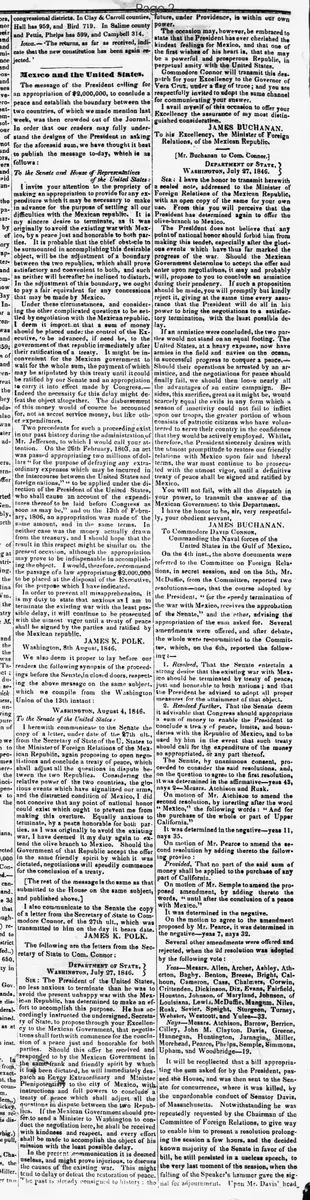
The message of the President calling for an appropriation of $2,000,000, to conclude a peace and establish the boundary between the two countries, of which we made mention last week, was then crowded out of the Journal. In order that our readers may fully understand the designs of the President in asking for the aforesaid sum, we have thought it best to publish the message to-day, which is as follows:
To the Senate and House of Representatives of the United States :
I invite your attention to the propriety of making an appropriation to provide for any expenditure which it may be necessary to make in advance for the purpose of settling all our difficulties with the Mexican republic, It is my sincere desire to terminate, as it was originally to avoid the existing war with Mexico,by a peace just and honorable to both parties. It is probable that the chief obstacle to be surmounted in accomplishing this desirable object, will be the adjustment of a boundary between the two republics, which shall prove satisfactory and convenient to both, and such as neither will hereafter be inclined to disturb. In the adjustment of this boundary, we ought to pay a fair equivalent for any concessions that may be made by Mexico.
Under these circumstances, and considering the other complicated questions to be settled by negotiation with the Mexican republic. I deem it important that a sum of money should be placed under the control of the Executive, to be advanced, if need be, to the government of that republic immediately after their ratification of a treaty. It might be inconvenient for the Mexican government to wait for the whole sum, the payment of which may be stipulated by this treaty until it could be ratified by our Senate and an appropriation to carry it into effect made by Congress.— Indeed the necessity for this delay might defeat the object altogether.
The disbursement of this money would of course be accounted for, not as secret service money, but like other expenditures.
Two precedents for such a proceeding exist in our past history during the administration of Mr. Jefferson, to which I would call your attention. On the 26th February, 1803, an act was passed appropriating two millions of dollars "for the purpose of defraying any extraordinary expenses which may be incurred in the intercourse between the United States and foreign nations," "to be applied under the direction of the President of the United States, who shall cause an account of the expenditures thereof to be laid before Congress as soon as may be,"and on the 14th of February, 1806, an appropriation was made of the same amount, and in the same terms. In neither case was the money actually drawn from the treasury. and I should hope that the result in this respect might be similar on the present occasion, although the appropriation may prove to be indispensable in accomplishing the object. I would, therefore. recommend the passage of a law appropriating $2,000,000 to be placed at the disposal of the Executive, for the purpose which I have indicated.
In order to prevent all misapprehension, it is my duty to state that anxious as I am to terminate the existing war with the least possible delay, it will continue to be prosecuted with the utmost vigor until a treaty of peace shall be signed by the parties and ratified by the Mexican republic.
JAMES K. POLK.
Washington, 8th August, 1846.
We also deem it proper to lay before our readers the following synopsis of the proceedings before the Senate,in closed doors, respecting the above message on the same subject, which we compile from the Washington Union of the 13th instant :
WASHINGTON, August 4, 1846,
To the Senate of the United States :
I herewith communicate to the Senate the copy of a letter, under date of the 7th ult.., from the Secretary of State of the U. States to the Minister of Foreign Relations of the Mexican Republic, again proposing to open negotiations and conclude a treaty of peace, which shall adjust all the questions in dispute between the two Republics. Considering the relative power of the two countries, the glorious events which have signalized our arms, and the distracted condition of Mexico. I did not conceive that any point of national honor could exist which ought to prevent me from making this overture. Equally anxious to terminate, by a peace honorable for both parties, as I was originally to avoid the existing war, I have deemed it my duty again to extend the olive branch to Mexico. Should the Government of that Republic accept the offer in the same friendly spirit by which it was dictated, negotiations will speedily commence for the conclusion of a treaty.
[The rest of the message is the same as that submitted to the House on the same subject, and published above.]
I also communicate to the Senate the copy of a letter from the Secretary of State to Com. Connor, of the 27th ult., which was transmitted to him on the day it bears date.
JAMES K. POLK.
The following are the letters from the Secretary of State to Com. Connor :
DEPARTMENT OF STATE,
WASHINGTON, July 27, 1846.
SIR: The President of the United States, no less anxious to terminate than he was to avoid the present unhappy war with the Mexican Republic, has determined to make an effort to accomplish this purpose. He has accordingly instructed the undersigned,Secretary of State, to propose through your Excellency to the Mexican Government, that negotiations shall forthwith commence for the conclusion of a peace just and honorable for both parties. Should this offer be received and responded to by the Mexican Government in the same frank and friendly spirit by which it has been dictated, he will immediately despatch an Envoy Extraordinary and Minister Plenipotentiary to the city of Mexico, with instructions and full powers to conclude a treaty of peace which shall adjust all the questions in dispute between the two Republics. If the Mexican Government should prefer to send a Minister to Washington to conduct the negotiation here, he shall be received with kindness and respect, and every effort shall be made to accomplish the object of his mission with the least possible delay.
In the present communication it is deemed useless, and might prove injurious, to discuss the causes of the existing war. This might tend to delay or defeat the restoration of peace. The past is already consigned to history : the future, under Providence, is within our own power.
The occasion may, however, be embraced to state that the President has ever cherished the kindest feelings for Mexico, and that one of the first wishes of his heart is, that she may be a powerful and prosperous Republic, in perpetual amity with the United States.
Commodore Connor will transmit this despatch for your Excellency to the Governor of Vera Cruz, under a flag of truce; and you are respectfully invited to adopt the same channel for communicating your answer.
I avail myself of this occasion to offer your Excellency the assurance of my most distinguished consideration.
JAMES BUCHANAN.
To his Excellency, the Minister of Foreign Relations, of the Mexican Republic.
[Mr. Buchanan to Com. Connor.]
Department of State,
WASHINGTON, July 27, 1846.
Sir : I have the honor to transmit herewith a sealed note, addressed to the Minister of Foreign Relations of the Mexican Republic, with an open copy of the same for your own use From this you will perceive that the President has determined again to offer the olive-branch to Mexico.
The President does not believe that any point of national honor should forbid him from making this tender especially after the glorious events which have thus far marked the progress of the war. Should the Mexican Government determine to accept the offer and enter upon negotiations, it may and probably will, propose to you to conclude an armistice during their pendency. If such a proposition should be made, you will promptly but kindly reject it, giving at the same time every assurance that the President will do all in his power to bring the negotiations to a satisfactory termination, with the least possible delay.
If an armistice were concluded, the two parties would not stand on an equal footing. The United States, at a heavy expense, now have armies in the field and navies on the ocean in successful progress to conquer a peace. Should their operations be arrested by an armistice, and the negotiations for peace should finally fail, we should then lose nearly all the advantages of an entire campaign. Besides, this sacrifice, great as it might be, would scarcely equal the evils in any form which a season of inactivity could not fail to inflict upon our troops, the greater portion of whom consists of patriotic citizens who have volunteered to serve their country in the confidence that they would be actively employed. Whilst, therefore, the President sincerely desires with the utmost promptitude to restore our friendly relations with Mexico upon fair and liberal terms, the war must continue to be prosecuted with the utmost vigor, until a definitive treaty of peace shall be signed and ratified by Mexico.
You will not fail, with all the dispatch in your power, to transmit the answer of the Mexican Government to this Department.
I have the honor to be, sir, very respectfully, your obedient servant,
JAMES BUCHANAN
To Commodore David Connor,
Commanding the Naval forces of the United States in the Gulf of Mexico.
On the 4th inst., the above documents were referred to the Committee on Foreign Relations, in secret session, and on the 5th, Mr. McDuffie, from the Committee, reported two resolutions—one, that the course adopted by the President."for the speedy termination of the war with Mexico, receives the approbation of the Senate," and the other, advising the appropriation of the sum asked for. Several amendments were offered, and after debate, the whole were re-committed to the Committee, which, on the 6th, reported the following:
I. Resolved, That the Senate entertain a strong desire that the existing war with Mexico should be terminated by treaty of peace, just and honorable to both nations: and that the President be advised to adopt all proper measures for the attainment of that object.
2. Resolved further. That the Senate deem it advisable that Congress should appropriate a sum of money to enable the President to conclude a treaty of peace, limits, and boundaries with the Republic of Mexico, and to be used by him in the event that such treaty should call for the expenditure of the money so appropriated, or any part thereof.
The Senate, by unanimous Consent, proceeded to consider the said resolutions, and, on the question to agree to the first resolution. It was determined in the affirmative—yeas 43. nays 2—Messrs. Atchison and Rusk.
On motion of Mr. Atchison to amend the second resolution, by inserting after the word "Mexico,"the following words:" And for the purchase of the whole or part of Upper California."
It was determined in the negative—yeas 11, nays 35.
On motion of Mr. Pearce to amend the second resolution by adding thereto the following proviso :
Provided, 'That no part of the said sum of money shall be applied to the purchase of any part of California.'
On motion of Mr. Semple to amend the proposed amendment, by adding thereto the words, " until after the conclusion of a peace with Mexico."
It was determined in the negative.
On the motion to agree to the amendment proposed by Mr. Pearce, it was determined in the negative—yeas 7, nays 32.
Several other amendments were offered and rejected, when the 2d resolution was adopted by the following vote:
Yeas—Messrs, Allen, Archer, Ashley, Atherton, Bagby,.Benton, Breese,Bright, Calhoun, Cameron, Cass, Chalmers, Corwin, Crittenden, Dickinson, Dix, Evans, Fairfield, Houston, Johnson, of Maryland, Johnson, of Louisiana, Lewis, McDuffie, Mangum, Niles, Rusk, Sevier, Speight, Sturgeon, Turney, Webster,Westcott, and Yulee—33.
Nays—Messrs. Atchison, Barrow, Berrien, Cilley, John M. Clayton, Davis, Greene, Hannegan, Huntington, Jarnagin, Miller, Morehead, Pearce, Phelps, Semple, Simmons, Upham, and Woodbridge—19.
It will be recollected that a bill appropriating the sum asked for by the President, passed the House, and was then sent to the Senate for concurrence, where it was killed, by the unpardonable conduct of Senator Davis, of Massachusetts. Notwithstanding he was repeatedly requested by the Chairman of the Committee of Foreign Relations, to give way to enable him to present a resolution prolonging the session a few hours, and the decided known majority of the Senate in favor of the bill, he still persisted in a useless speech, to the very last moment of the session, when the falling of the Speaker's hammer gave the signal for adjournment. Upon Mr. Davis' head
rests the responsibility of arresting from the President the power of bringing the war to a close, and establishing peace between the two nations, as early as he probably would have been enabled to do, had the bill passed.
What sub-type of article is it?
What keywords are associated?
What entities or persons were involved?
Where did it happen?
Foreign News Details
Primary Location
Mexico
Event Date
August 8, 1846
Key Persons
Outcome
senate adopted resolutions approving president's peace efforts and appropriation of $2,000,000; house bill failed due to senator davis' filibuster.
Event Details
President Polk's message requests $2M for peace negotiations and boundary adjustment with Mexico. Includes letters from Secretary Buchanan proposing talks via Commodore Connor. Senate in secret session on August 4-6, 1846, approved resolutions supporting peace treaty and appropriation after debates and rejected amendments on California purchase.