Thank you for visiting SNEWPapers!
Sign up free
Literary
December 31, 1822
The Rhode Island American, And General Advertiser
Providence, Providence County, Rhode Island
What is this article about?
This essay from The Idle Man praises domestic life as a source of virtue, serenity, and moral growth, contrasting youthful idealism with the steady joys of family, marriage, and child-rearing that foster ethical development and emotional balance.
Merged-components note: Continuation of the essay 'DOMESTICK LIFE' across pages 1 and 2, with sequential reading order.
Clippings
1 of 2
OCR Quality
95%
Excellent
Full Text
FROM THE IDLE MAN.
DOMESTICK LIFE.
O friendly to the best pursuits of man,
Friendly to thought, to virtue, and to peace,
Domestick life!
COWPER,
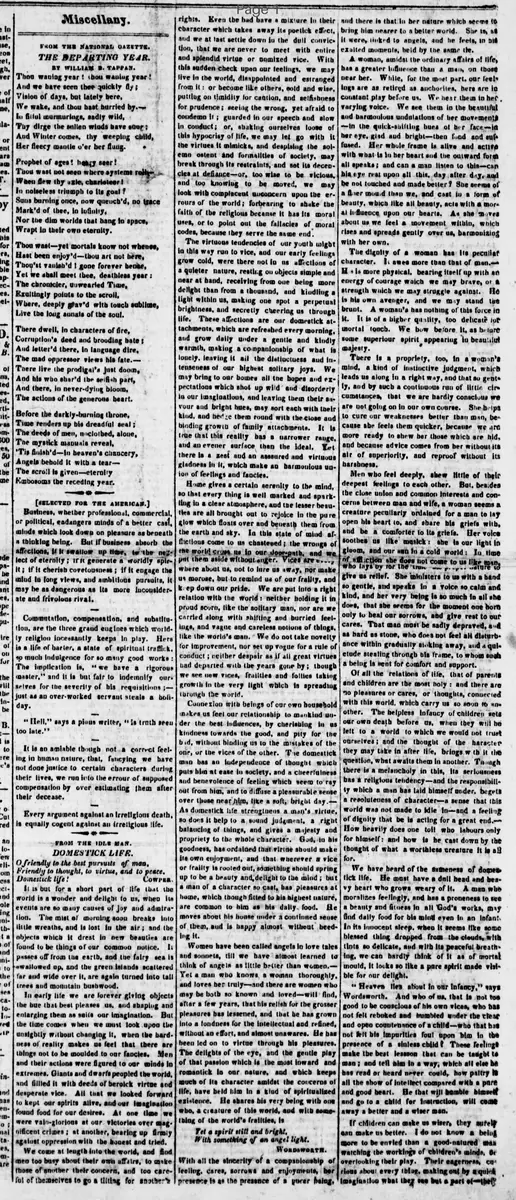
It is but for a short part of life that the world is a wonder and delight to us, when its events are so many causes of joy and admiration. The mist of morning soon breaks into little wreaths, and is lost in the air; and the objects which it drest in new beauties are found to be things of our common notice. It passes off from the earth, and the fairy sea is swallowed up, and the green islands scattered far and wide over it, are again turned into tall trees and mountain bushwood.
In early life we are forever giving objects the hue that best pleases us, and shaping and enlarging them to suit our imagination. But the time comes when we must look upon the world visibly without changing it, when the hardness of reality makes us feel that there are things not to be moulded to our fancies. Men and their actions were figured to our minds in extremes. Giants and dwarfs peopled the world, and filled it with deeds of heroick virtue and desperate vice. All that we looked forward to kept our spirits alive, and our imagination found food for our desires. At one time we were vain-glorious at our victories over magnificent crimes; at another, bearing up firmly against oppression with the honest and tried.
We come at length into the world, and find men too busy about their own affairs, to make those of another their concern, and too careful of themselves to go a tilting for another's rights. Even the bad have a mixture in their character which takes away its poetick effect, and we at last settle down in the dull conviction, that we are never to meet with entire and splendid virtue or unmixed vice. With this sudden check upon our feelings, we may live in the world, disappointed and estranged from it: or become like others, cold and wise, putting on timidity for caution, and selfishness for prudence; seeing the wrong, yet afraid to condemn it; guarded in our speech and slow in conduct; or, shaking ourselves loose of this hypocrisy of life, we may let go with it the virtues it mimics, and despising the solemn ostent and formalities of society, may break through its restraints, and set its decencies at defiance—or, too wise to be vicious, and too knowing to be moved, we may look with complacent unconcern upon the errors of the world; forbearing to shake the faith of the religious because it has its moral uses, or to point out the fallacies of moral codes, because they serve the same end.
The virtuous tendencies of our youth might in this way run to vice, and our early feelings grow cold, were there not in us affections of a quieter nature, resting on objects simple and near at hand, receiving from one being more delight than from a thousand, and kindling a light within us, waking one spot a perpetual brightness, and secretly cheering us through life. These affections are our domestick attachments, which are refreshed every morning, and grow daily under a gentle and kindly warmth, waking companionship of what is lonely, leaving it all the distinctness and intenseness of our highest solitary joys. We may bring to our house all the hopes and expectations which shot up wild and disorderly in our imaginations, and leaving them their savour and bright hues, may sort each with their kind, and bed them round with the close and binding growth of family attachments. It is true that this reality has a narrower range and an evener surface than the ideal. Yet there is a zest and an assured and virtuous gladness in it, which make harmonious union of feelings and fancies.
Home gives a certain serenity to the mind, so that every thing is well marked and sparkling in a clear atmosphere, and the lesser beauties are all brought out to rejoice in the pure glow which floats over and beneath them from the earth and sky. In this state of mind afflictions come to us chastened; the wrongs of the world cross us in our door-path, and we put them aside without anger. Vices are crying where about us, not to lure us away, nor make us morose, but to remind us of our frailty, and keep down our pride. We are put into a right relation with the world: neither holding it in proud scorn, like the solitary man, nor are we carried along with shifting and hurried feelings, and vague and careless notions of things, like the world's man. We do not take novelty for improvement, nor set up vogue for a rule of conduct; neither despair as if all great virtues had departed with the years gone by; though we see new vices, frailties and follies taking growth in the very light which is spreading through the world.
Connexion with beings of our own household makes us feel our relationship to mankind under the best influences, by cherishing in us kindness towards the good, and pity for the bad, without binding us to the mistakes of the one, or the vices of the other. The domestick man has an independence of thought which puts him at ease in society, and a cheerfulness and benevolence of feeling which seem to ray out from him, and to diffuse a pleasurable sense over those near him, like a soft, bright day.—
As domestick life strengthens a man's virtue, so does it help to a sound judgment, a right balancing of things, and gives a majesty and propriety to the whole character. God, in his goodness, has ordained that virtue should make its own enjoyment, and that wherever a vice or frailty is rooted out, something should spring up to be a beauty and delight to the mind; but a man of a character so cast, has pleasures at home, which though fitted to his highest nature, are common to him as his daily-food. He moves about his house under a continued sense of them, and is happy almost without heeding it.
Women have been called angels in love tales and sonnets, till we have almost learned to think of angels as little better than women.—Yet a man who knows a woman thoroughly, and loves her truly—and there are women who may be both so known and loved—will find, after a few years, that his relish for the grosser pleasures has lessened, and that he has grown into a fondness for the intellectual and refined, without an effort, and almost unawares. He has been led on to virtue through his pleasures.
The delights of the eye, and the gentle play of that passion which is the most inward and romantick in our nature, and which keeps much of its character amidst the concerns of life, have held him in a kind of spiritualized existence. He shares his very being with one who, a creature of this world, and with something of the world's frailties, is
Yet a spirit still and bright,
With something of an angel light.
WORDSWORTH.
With all the sincerity of a companionship of feeling, cares, sorrows and enjoyments, her presence is as the presence of a purer being, and there is that in her nature which seems to bring him nearer to a better world. She too, as it were, linked to angels, and he feels, in his exalted moments, held by the same tie.
Woman, amidst the ordinary affairs of life has a greater influence than a man, on those near her. While, for the most part, our feelings are as retired as anchorites, here are in constant play before us. We hear them in her varying voice. We see them in the beautiful and harmonious undulations of her movements—in the quick-shifting hues of her face—in her eye, glad and bright—then fond and confused. Her whole frame is alive and active with what is in her heart and the outward form all speaks; and can a man listen to this—can his eye rest upon all this, day after day, and be not touched and made better? She seems of a finer mould than we, and cast in a form of beauty, which like all beauty, acts with a moral influence upon our hearts. As she moves about us we feel a movement within, which rises and spreads gently over us, harmonizing with her own.
The dignity of a woman has its peculiar character. It arises more than that of man. His is more physical, bearing itself up with an energy of courage which we may brave, or a strength which we may struggle against. He is his own avenger, and we may stand the brunt. A woman's has nothing of this force in it. It is of a higher quality, too delicate for mortal touch. We bow before it, as before some superior spirit appearing in beautiful majesty.
There is a propriety, too, in a woman's mind, a kind of instinctive judgment, which leads us along in a right way, and that so gently, and by such a continued run of little circumstances, that we are hardly conscious we are not going on in our own course. She helps to cure our weaknesses better than man, because she feels them quicker, because we are more ready to shew her those which are hid, and because advice comes from her without its air of superiority, and reproof without its harshness.
Men who feel deeply, shew little of their deepest feelings to each other. But, besides the close union and common interests and concern betweed man and wife, a woman seems a creature peculiarly ordained for a man to lay open his heart to, and share his griefs with, and be a comforter to its griefs. Her voice soothes us like musick: she is our light in gloom, and our sun in a cold world: In time of affliction she does not come to us like man, who lays on for the one way p.-r.. udlure to give us relief. She ministers to us with a hand so gentle, and speaks in a voice so calm and kind, and her very being is so much in all she does, that she seems for the moment one born only to heal our sorrows, and give rest to our cares. That man must be sadly depraved, and as hard as stone, who does not feel a disturbance within gradually sinking away, and a quietude stealing through his frame, to whom such a being is sent for comfort and support.
Of all the relations of life, that of parent and children are the most holy: and there are no pleasures or cares, or thoughts, connected with this world, which carry us so soon to another. The helpless infancy of children sets our own death before us, when they will be left to a world to which we would not trust ourselves; and the thought of the character they may take in after life, brings with it the question, what awaits them in another. Though there is a melancholy in this, its seriousness has a religious tendency—and the responsibility by which a man has laid himself under, begets a resoluteness of character—a sense that this world was not made to idle in—and a feeling of dignity that he is acting for a great end.—
How heavily does one toil who labours only for himself: and how is he cast down by the thought of what a worthless creature it is all for.
We have heard of the Sameness of domestick life. He must have a dull head and heavy heart who grows weary of it. A man who moralizes feelingly, and has a proneness to see a beauty and fitness in all God's works, may find daily food for his mind even in an infant. In its innocent sleep, when it seems like some blessed thing dropped from the clouds, with tints so delicate, and with its peaceful breathing, we can hardly think of it as of mortal mould, it looks so like a pure spirit made visible for our delight.
" Heaven lies about us in our infancy." says Wordsworth. And who of us, that is not too good to be conscious of his own vices, who has not felt rebuked and humbled under the clear and open countenance of a child—who that has not felt his impurities foul upon him in the presence of a sinless child? These Feelings make the best lesson that Can be taught to man; and tell him in a way, which all else he has read or heard never could, how paltry is all the show of intellect compared with a pure and good heart. He that will humble himself and go to a child for instruction, will come away a better and a wiser man.
If children can make us wiser, they surely can make us better. I do not know a being more to be envied than a good-natured man watching the workings of children's minds, On overlooking their play. Their eagerness, curious about every thing, making out by quick Imagination what they see but a part of—their Fanciful combinations and magic inventions creating out of ordinary circumstances, and the common things which surround them. Strange events and little ideal worlds, and these all working in mystery to form matured thought, is study enough for the most acute minds, and should teach us not too officiously to regulate what we so little understand. The quiet musing and deep abstraction in which they sometimes sit, affect us as a playful working of older heads. These little philosophers have no foolish system with all its pride and jargon confusing their brains. Theirs is the natural movement of the soul, intense with new life, and busy after truth, working to some purpose, though without a poise.
When children are lying about seemingly idle and dull, we, who have become case-hardened by time and satiety, forget that they are all sensation—that their out-stretched bodies are drinking in from the common sun and air—that every sound is taken note of by their ear—and that every floating shadow and passing form come and touch at the sleepy eye. The little circumstances and material world about them make their best school, and will be their instructors and the former of their characters through life. And it is delightful to look on and see how busily the whole acts with its countless parts fired to each other and moving in harmony. There are none of us who have stolen softly behind a child when, labouring in a sunny corner, digging a lilliputian well or fencing in a six-inch barn-yard, to listen to his soliloquies, and dialogues with some imaginary being, without our hearts being touched. Nor have we observed the flash which crossed his face when finding himself betrayed without seeing in it the delicacy and propriety of the after man.
A man may have many vices upon him, and have walked long in a bad course, yet if he has a love of children, and can take pleasure in their talk and play, there is something still left in him for virtue to act upon—something which can still love simplicity and truth. I have seen one in whom some low vice had become a habit, make himself the play-thing of a set of vicious children, with as much delight in his countenance as if nothing but goodness had ever been expressed in it; and have felt as much of kindness and sympathy towards him as I have of revolting towards another, who has gone through life with all due propriety, with a cold and supercilious bearing towards children which makes them shrinking and still.
I have known one like this last attempt, with unaccustomed condescension, to court an open-hearted child, who would draw back with an instinctive dislike. I felt as if there were a curse upon him. Better to be driven out from amongst men, than to be hated of children.
When my heart has been full of joy and good will at the thought of the blessings of home—at the remembrance that the little which is right within me was learned there—when I have reflected upon the nature of my enjoyments abroad, and cast them up, and found them so few, and have then turned home again, and have found that its pleasures were my best lessons of virtue, and as countless as good, I have thought that I could talk of it for ever. It is not so. Though the feeling of home never wearies, because kind offices, and the thousand little ways in which home attachments are always altering themselves, keep it fresh and full in its course; yet the feeling itself, and that which feeds it have a simplicity and unity of character of which little is to be told, though they are always with us.
It may be thought that something should be said of the influence of domestic associations on a child, and on its filial attachments. I would not overcast the serenity I now feel by calling up the days when I was a boy—when the spirits were unbroken, and the heart pure—when the past was unheeded and the future bright. I would not do this; I would not do this, to be paid with all that has gone amiss in my later days—to remember how poorly I have borne the ills of life, and how thankless has been my spirit for its good.
It is needless to talk of the afflictions of domestic life. Those which Providence sends, come for our good, and their best consolations are found in the abode into which they enter. Of the troubles which we make to ourselves we have no right to complain. Ill-sorted marriages will hardly bring agreement: and from those of convenience will hardly come love. But when the deep and tranquil enjoyment, the light and playful cheerfulness, the exaltation of feeling and the clear calm of thought, which belong to those who know each other entirely, and have by nature something of the romance of love in them, are all told, then will I speak of the troubles of home.
DOMESTICK LIFE.
O friendly to the best pursuits of man,
Friendly to thought, to virtue, and to peace,
Domestick life!
COWPER,
It is but for a short part of life that the world is a wonder and delight to us, when its events are so many causes of joy and admiration. The mist of morning soon breaks into little wreaths, and is lost in the air; and the objects which it drest in new beauties are found to be things of our common notice. It passes off from the earth, and the fairy sea is swallowed up, and the green islands scattered far and wide over it, are again turned into tall trees and mountain bushwood.
In early life we are forever giving objects the hue that best pleases us, and shaping and enlarging them to suit our imagination. But the time comes when we must look upon the world visibly without changing it, when the hardness of reality makes us feel that there are things not to be moulded to our fancies. Men and their actions were figured to our minds in extremes. Giants and dwarfs peopled the world, and filled it with deeds of heroick virtue and desperate vice. All that we looked forward to kept our spirits alive, and our imagination found food for our desires. At one time we were vain-glorious at our victories over magnificent crimes; at another, bearing up firmly against oppression with the honest and tried.
We come at length into the world, and find men too busy about their own affairs, to make those of another their concern, and too careful of themselves to go a tilting for another's rights. Even the bad have a mixture in their character which takes away its poetick effect, and we at last settle down in the dull conviction, that we are never to meet with entire and splendid virtue or unmixed vice. With this sudden check upon our feelings, we may live in the world, disappointed and estranged from it: or become like others, cold and wise, putting on timidity for caution, and selfishness for prudence; seeing the wrong, yet afraid to condemn it; guarded in our speech and slow in conduct; or, shaking ourselves loose of this hypocrisy of life, we may let go with it the virtues it mimics, and despising the solemn ostent and formalities of society, may break through its restraints, and set its decencies at defiance—or, too wise to be vicious, and too knowing to be moved, we may look with complacent unconcern upon the errors of the world; forbearing to shake the faith of the religious because it has its moral uses, or to point out the fallacies of moral codes, because they serve the same end.
The virtuous tendencies of our youth might in this way run to vice, and our early feelings grow cold, were there not in us affections of a quieter nature, resting on objects simple and near at hand, receiving from one being more delight than from a thousand, and kindling a light within us, waking one spot a perpetual brightness, and secretly cheering us through life. These affections are our domestick attachments, which are refreshed every morning, and grow daily under a gentle and kindly warmth, waking companionship of what is lonely, leaving it all the distinctness and intenseness of our highest solitary joys. We may bring to our house all the hopes and expectations which shot up wild and disorderly in our imaginations, and leaving them their savour and bright hues, may sort each with their kind, and bed them round with the close and binding growth of family attachments. It is true that this reality has a narrower range and an evener surface than the ideal. Yet there is a zest and an assured and virtuous gladness in it, which make harmonious union of feelings and fancies.
Home gives a certain serenity to the mind, so that every thing is well marked and sparkling in a clear atmosphere, and the lesser beauties are all brought out to rejoice in the pure glow which floats over and beneath them from the earth and sky. In this state of mind afflictions come to us chastened; the wrongs of the world cross us in our door-path, and we put them aside without anger. Vices are crying where about us, not to lure us away, nor make us morose, but to remind us of our frailty, and keep down our pride. We are put into a right relation with the world: neither holding it in proud scorn, like the solitary man, nor are we carried along with shifting and hurried feelings, and vague and careless notions of things, like the world's man. We do not take novelty for improvement, nor set up vogue for a rule of conduct; neither despair as if all great virtues had departed with the years gone by; though we see new vices, frailties and follies taking growth in the very light which is spreading through the world.
Connexion with beings of our own household makes us feel our relationship to mankind under the best influences, by cherishing in us kindness towards the good, and pity for the bad, without binding us to the mistakes of the one, or the vices of the other. The domestick man has an independence of thought which puts him at ease in society, and a cheerfulness and benevolence of feeling which seem to ray out from him, and to diffuse a pleasurable sense over those near him, like a soft, bright day.—
As domestick life strengthens a man's virtue, so does it help to a sound judgment, a right balancing of things, and gives a majesty and propriety to the whole character. God, in his goodness, has ordained that virtue should make its own enjoyment, and that wherever a vice or frailty is rooted out, something should spring up to be a beauty and delight to the mind; but a man of a character so cast, has pleasures at home, which though fitted to his highest nature, are common to him as his daily-food. He moves about his house under a continued sense of them, and is happy almost without heeding it.
Women have been called angels in love tales and sonnets, till we have almost learned to think of angels as little better than women.—Yet a man who knows a woman thoroughly, and loves her truly—and there are women who may be both so known and loved—will find, after a few years, that his relish for the grosser pleasures has lessened, and that he has grown into a fondness for the intellectual and refined, without an effort, and almost unawares. He has been led on to virtue through his pleasures.
The delights of the eye, and the gentle play of that passion which is the most inward and romantick in our nature, and which keeps much of its character amidst the concerns of life, have held him in a kind of spiritualized existence. He shares his very being with one who, a creature of this world, and with something of the world's frailties, is
Yet a spirit still and bright,
With something of an angel light.
WORDSWORTH.
With all the sincerity of a companionship of feeling, cares, sorrows and enjoyments, her presence is as the presence of a purer being, and there is that in her nature which seems to bring him nearer to a better world. She too, as it were, linked to angels, and he feels, in his exalted moments, held by the same tie.
Woman, amidst the ordinary affairs of life has a greater influence than a man, on those near her. While, for the most part, our feelings are as retired as anchorites, here are in constant play before us. We hear them in her varying voice. We see them in the beautiful and harmonious undulations of her movements—in the quick-shifting hues of her face—in her eye, glad and bright—then fond and confused. Her whole frame is alive and active with what is in her heart and the outward form all speaks; and can a man listen to this—can his eye rest upon all this, day after day, and be not touched and made better? She seems of a finer mould than we, and cast in a form of beauty, which like all beauty, acts with a moral influence upon our hearts. As she moves about us we feel a movement within, which rises and spreads gently over us, harmonizing with her own.
The dignity of a woman has its peculiar character. It arises more than that of man. His is more physical, bearing itself up with an energy of courage which we may brave, or a strength which we may struggle against. He is his own avenger, and we may stand the brunt. A woman's has nothing of this force in it. It is of a higher quality, too delicate for mortal touch. We bow before it, as before some superior spirit appearing in beautiful majesty.
There is a propriety, too, in a woman's mind, a kind of instinctive judgment, which leads us along in a right way, and that so gently, and by such a continued run of little circumstances, that we are hardly conscious we are not going on in our own course. She helps to cure our weaknesses better than man, because she feels them quicker, because we are more ready to shew her those which are hid, and because advice comes from her without its air of superiority, and reproof without its harshness.
Men who feel deeply, shew little of their deepest feelings to each other. But, besides the close union and common interests and concern betweed man and wife, a woman seems a creature peculiarly ordained for a man to lay open his heart to, and share his griefs with, and be a comforter to its griefs. Her voice soothes us like musick: she is our light in gloom, and our sun in a cold world: In time of affliction she does not come to us like man, who lays on for the one way p.-r.. udlure to give us relief. She ministers to us with a hand so gentle, and speaks in a voice so calm and kind, and her very being is so much in all she does, that she seems for the moment one born only to heal our sorrows, and give rest to our cares. That man must be sadly depraved, and as hard as stone, who does not feel a disturbance within gradually sinking away, and a quietude stealing through his frame, to whom such a being is sent for comfort and support.
Of all the relations of life, that of parent and children are the most holy: and there are no pleasures or cares, or thoughts, connected with this world, which carry us so soon to another. The helpless infancy of children sets our own death before us, when they will be left to a world to which we would not trust ourselves; and the thought of the character they may take in after life, brings with it the question, what awaits them in another. Though there is a melancholy in this, its seriousness has a religious tendency—and the responsibility by which a man has laid himself under, begets a resoluteness of character—a sense that this world was not made to idle in—and a feeling of dignity that he is acting for a great end.—
How heavily does one toil who labours only for himself: and how is he cast down by the thought of what a worthless creature it is all for.
We have heard of the Sameness of domestick life. He must have a dull head and heavy heart who grows weary of it. A man who moralizes feelingly, and has a proneness to see a beauty and fitness in all God's works, may find daily food for his mind even in an infant. In its innocent sleep, when it seems like some blessed thing dropped from the clouds, with tints so delicate, and with its peaceful breathing, we can hardly think of it as of mortal mould, it looks so like a pure spirit made visible for our delight.
" Heaven lies about us in our infancy." says Wordsworth. And who of us, that is not too good to be conscious of his own vices, who has not felt rebuked and humbled under the clear and open countenance of a child—who that has not felt his impurities foul upon him in the presence of a sinless child? These Feelings make the best lesson that Can be taught to man; and tell him in a way, which all else he has read or heard never could, how paltry is all the show of intellect compared with a pure and good heart. He that will humble himself and go to a child for instruction, will come away a better and a wiser man.
If children can make us wiser, they surely can make us better. I do not know a being more to be envied than a good-natured man watching the workings of children's minds, On overlooking their play. Their eagerness, curious about every thing, making out by quick Imagination what they see but a part of—their Fanciful combinations and magic inventions creating out of ordinary circumstances, and the common things which surround them. Strange events and little ideal worlds, and these all working in mystery to form matured thought, is study enough for the most acute minds, and should teach us not too officiously to regulate what we so little understand. The quiet musing and deep abstraction in which they sometimes sit, affect us as a playful working of older heads. These little philosophers have no foolish system with all its pride and jargon confusing their brains. Theirs is the natural movement of the soul, intense with new life, and busy after truth, working to some purpose, though without a poise.
When children are lying about seemingly idle and dull, we, who have become case-hardened by time and satiety, forget that they are all sensation—that their out-stretched bodies are drinking in from the common sun and air—that every sound is taken note of by their ear—and that every floating shadow and passing form come and touch at the sleepy eye. The little circumstances and material world about them make their best school, and will be their instructors and the former of their characters through life. And it is delightful to look on and see how busily the whole acts with its countless parts fired to each other and moving in harmony. There are none of us who have stolen softly behind a child when, labouring in a sunny corner, digging a lilliputian well or fencing in a six-inch barn-yard, to listen to his soliloquies, and dialogues with some imaginary being, without our hearts being touched. Nor have we observed the flash which crossed his face when finding himself betrayed without seeing in it the delicacy and propriety of the after man.
A man may have many vices upon him, and have walked long in a bad course, yet if he has a love of children, and can take pleasure in their talk and play, there is something still left in him for virtue to act upon—something which can still love simplicity and truth. I have seen one in whom some low vice had become a habit, make himself the play-thing of a set of vicious children, with as much delight in his countenance as if nothing but goodness had ever been expressed in it; and have felt as much of kindness and sympathy towards him as I have of revolting towards another, who has gone through life with all due propriety, with a cold and supercilious bearing towards children which makes them shrinking and still.
I have known one like this last attempt, with unaccustomed condescension, to court an open-hearted child, who would draw back with an instinctive dislike. I felt as if there were a curse upon him. Better to be driven out from amongst men, than to be hated of children.
When my heart has been full of joy and good will at the thought of the blessings of home—at the remembrance that the little which is right within me was learned there—when I have reflected upon the nature of my enjoyments abroad, and cast them up, and found them so few, and have then turned home again, and have found that its pleasures were my best lessons of virtue, and as countless as good, I have thought that I could talk of it for ever. It is not so. Though the feeling of home never wearies, because kind offices, and the thousand little ways in which home attachments are always altering themselves, keep it fresh and full in its course; yet the feeling itself, and that which feeds it have a simplicity and unity of character of which little is to be told, though they are always with us.
It may be thought that something should be said of the influence of domestic associations on a child, and on its filial attachments. I would not overcast the serenity I now feel by calling up the days when I was a boy—when the spirits were unbroken, and the heart pure—when the past was unheeded and the future bright. I would not do this; I would not do this, to be paid with all that has gone amiss in my later days—to remember how poorly I have borne the ills of life, and how thankless has been my spirit for its good.
It is needless to talk of the afflictions of domestic life. Those which Providence sends, come for our good, and their best consolations are found in the abode into which they enter. Of the troubles which we make to ourselves we have no right to complain. Ill-sorted marriages will hardly bring agreement: and from those of convenience will hardly come love. But when the deep and tranquil enjoyment, the light and playful cheerfulness, the exaltation of feeling and the clear calm of thought, which belong to those who know each other entirely, and have by nature something of the romance of love in them, are all told, then will I speak of the troubles of home.
What sub-type of article is it?
Essay
What themes does it cover?
Moral Virtue
Love Romance
Social Manners
What keywords are associated?
Domestic Life
Family Attachments
Virtue
Home
Children
Marriage
Moral Instruction
What entities or persons were involved?
From The Idle Man.
Literary Details
Title
Domestick Life
Author
From The Idle Man.
Subject
On The Virtues Of Domestic Life And Family Attachments
Key Lines
O Friendly To The Best Pursuits Of Man,
Friendly To Thought, To Virtue, And To Peace,
Domestick Life!
Cowper,