Thank you for visiting SNEWPapers!
Sign up free
Lynchburg Virginian
Lynchburg, Virginia
What is this article about?
The Twelfth Annual Meeting of the American Colonization Society was held on January 17 in Washington, D.C., attended by prominent figures including Chief Justice Marshall and Secretary Adams. Resolutions honored the late J. Ashmun, thanked auxiliaries and supporters, and promoted fundraising and state societies.
Clipping
OCR Quality
Full Text
From the National Intelligencer, Jan 26.
Annual Meeting of the American Colonization Society.
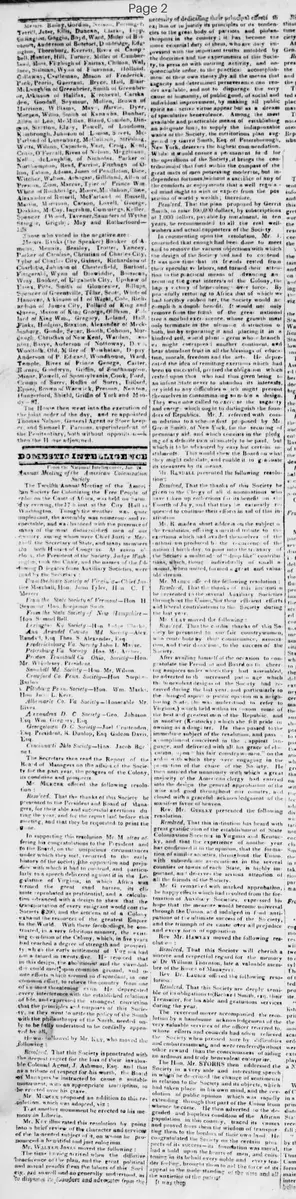
The Twelfth Annual Meeting of the American Society for Colonizing the Free People of Color on the Coast of Africa, was held on Saturday evening, the 17th inst. at the City Hall, Washington. Though the weather was quite unpleasant, the assembly was numerous, and respectable, and was honored with the presence of many of the most distinguished men of our country, among whom were Chief Justice Marshall, Mr. Adams the Secretary of State, and many members of both Houses of Congress. At seven o'clock, the President of the Society, Judge Washington, took the Chair, and the names of the following Delegates from Auxiliary Societies, were called by the Secretary.
From the State Society of Virginia—Chief Justice Marshall, Hon. John Tyler, Hon. C. T. Mercer.
From the State Society of Vermont—Hon. H. Seymour, Hon. Benjamin Swift.
From the State Society of New Hampshire—Hon. Samuel Bell.
Lexington Ky. Society—Hon. Judge Clarke.
Anne Arundel County Md. Society—Alexander Randall, Esq. Thos. S. Alexander, Esq.
Fredericksburg Va. Society—John L. Marye.
Petersburg Va. Society—Hon. Mr. Archer.
Preston Trumbull Co. Ohio, Society—Hon. Mr. Whittlesey, President.
Snowhill Md. Society—Hon. Mr. Wilson.
Crawford Co. Penn. Society—Hon. Stephen Barton.
Pittsburg Penn. Society—Hon. Wm. Marks, Hon. John L. Kerr.
Albemarle Co. Va. Society—Hon. Mr. Rives.
Alexandria D. C. Society—Geo. Johnson Esq. Wm. Gregory, Esq.
Georgetown D. C. Society—Joel B. Sutherland Esq. President, R. Dunlop, Esq. Gideon Davis, Esq.
Cincinnati Ohio Society—Hon. Jacob Burnet.
The Secretary then read the Report of the Board of Managers on the affairs of the Society for the past year, the progress of the Colony, its condition and prospects.
Mr. Mercer offered the following resolution:
Resolved, That the thanks of this Society be presented to the President and Board of Managers, for their able and successful exertions during the year, and for the report laid before this meeting, and that they be requested to print the same.
In supporting this resolution, Mr. M. after offering his congratulations to the President and to the Board, on the auspicious circumstances under which they met, recurred to the early history of the society, the opposition and prejudice with which it had to contend, and particularly to a speech delivered against it in the Legislature of Virginia, in which Africa was termed the great sand barren, its climate represented as pestilential, and a calculation advanced with a design to show that the transportation of every emigrant would cost the Society $200, and the settlement of a Colony exhaust the resources of the greatest Empire in the World. With these forebodings, he contrasted, in a very felicitous manner, the existing condition of the Colony, which, in five years had reached a degree of strength and prosperity which the early settlement of Virginia had not attained in twenty-five. He rejoiced that in this design, the abolitionist and the slaveholder could meet upon common ground, and unite efforts which seemed so discordant, in one common effort, to relieve the country from one of its most threatening evils. He deprecated every interference with the established relations of life, and expressed the strongest conviction that the principles and purposes of this Society, as they went to unite the policy of the South with the philanthropy of the North, needed only to be fully understood to be cordially approved by all.
He was followed by Mr. Clay, who moved the following:
Resolved, That this Society is penetrated with the deepest regret for the loss of their invaluable Colonial Agent, J. Ashmun, Esq. and that as a tribute of respect for his worth, the Board of Managers be instructed to cause a suitable monument, with an appropriate inscription, to be erected over his grave.
Mr. Mercer proposed an addition to this resolution, which was adopted, viz:
That another monument be erected to his memory in Liberia.
Mr. Key illustrated this resolution by going into a brief review of the character and services of the lamented subject of it, on whom he pronounced a beautiful and just eulogium.
Mr. Walter Jones moved the following:
The time having arrived when the diffusive beneficence of the plan, and the great political and moral results from the labors of this Society, are so well and so generally understood, as to dispense its founders and advocates from the necessity of dedicating their principal efforts to explain or to justify its principles or its tendencies to the great body of patriots and philanthropists in the country; it has become the more essential duty of them, who are daily impressed with the important truths unfolded by the doctrines and the experiments of this Society, to press on with untiring activity, and unquenchable ardor, to the practical accomplishment of their own theory by all the means that sagacity and determined perseverance can render available, and not to disparage the very cause of humanity, of public good, of social and individual improvement, by making all public spirit and active virtue appear but as a dream of speculative benevolence. Among the most available and practicable means of establishing an adequate fund, to supply the indispensable wants of the Society, the meritorious plan suggested by Gerrit Smith, Esq. of Petersborough, New York, deserves the highest commendation. While it would ensure a permanent fund for the operations of the Society, it brings the contributions of that fund within the compass of the great mass of men possessing moderate, but independent fortunes, without a sacrifice of any of the comforts or enjoyments that a well regulated mind ought to wish or expect from the possession of worldly wealth; therefore,
Resolved, That the plan proposed by Gerrit Smith, to raise $100,000 dollars, by subscriptions of $1,000 dollars, payable by installment, in ten years, be recommended to all the real well-wishers and actual supporters of the Society.
In commenting upon the resolution, Mr. J. contended that enough had been done to meet and to remove the various objections with which the design of the Society had had to contend. It was now time that its friends rested from their speculative labors, and turned their attention to the practical means of advancing and securing the great interests of the Colony, the happy victory of benevolence over force. By peacefully restoring to Africa that of which we had forcibly robbed her, the Society would accomplish a double benefit. It would not only remove from the trunk of the great national tree a morbid excrescence, whose growth must only terminate in the ultimate destruction of both, but by separating it and placing it in a kindred soil, would plant a germ whose branches might ever spread another continent, and bear abundant fruit in all the blessings of education, morals, freedom and the arts. He deprecated the idea of remitting exertions which had been so successful, pressed the obligation which rested upon those who had thus given being to an infant State never to abandon its interests, or yield to any difficulties which might present themselves in consummating so noble a design. They were now called to exercise the sagacity and energy which ought to distinguish the founders of Republics. Mr. J. referred with commendation to a scheme first proposed by Mr. Gerrit Smith, of New York, for the securing of pecuniary aid, and which consists in the pledging of an indefinite sum ultimately to be paid, but which is to be advanced by easy but certain installments. This would show the Board on what they might calculate, and enable it to graduate its measures by its means.
Mr. Rawle presented the following resolution:
Resolved, That the thanks of this Society be given to the Clergy of all denominations who have taken up collections for its benefit on the Fourth of July, and that they be earnestly requested to continue their efforts in aid of this institution.
Mr. Rawle made a short address on the subject of the resolution, offering a merited tribute to the exertions which had availed themselves of the enthusiasm produced by the recurrence of the nation's birth day, to pour into the treasury of the Society a multitude of "drop-like" contributions, which, though individually of small amount, when united, formed a great and valuable stream.
Mr. Mercer offered the following resolution:
Resolved, That the thanks of this institution be presented to the several Auxiliary Societies throughout the Union, for their efficient efforts and liberal contributions to the Society during the last year.
Mr. Clay moved the following:
Resolved, That the cordial thanks of this Society be presented to our fair countrywomen, who contribute by their countenance, association, and their donation, to the success of the Society.
After availing himself of the occasion to congratulate the President and Board on the cheering auspices under which they had assembled, he adverted to the increased patronage which the benevolent designs of the Society had received during the last year, and particularly to the changed aspect of public opinion in a neighboring State. (he was understood to refer to Virginia, which held within its bosom some of the best and greatest men of the Republic, and in another (Kentucky) which she felt pride in owning as a daughter. He then passed to the immediate subject of the resolution, and passed a compliment conceived in the happiest language, and delivered with all his grace of elocution, upon "his fair countrywomen," on the ardor with which they were engaging in the promotion of the cause of the Society. He then noticed the unanimity with which a great majority of the American clergy had entered into the design, the general approbation of the wise and good throughout our country, and closed with a graceful acknowledgment of the manifest favor of heaven.
Rev. Mr. Gurley presented the following resolution:
Resolved, That this institution has heard with great gratification of the establishment of State Colonization Societies in Virginia and Kentucky, and that the experience of another year has confirmed it in the opinion, that the formation of similar societies, throughout the Union, with subordinate associations in the several counties or towns of each State, is highly important, and deserves the serious attention of all the friends of the Society.
Mr. G. remarked with marked approbation, the happy effects which had resulted from the formation of Auxiliary Societies, expressed his hope that the measure would become universal through the Union, and indulged in fond anticipations of the ultimate success of the Society, and the triumph of its cause over all prejudice and every form of opposition.
Rev. Mr. Hawley moved the following resolution:
Resolved, That this Society will cherish a sincere and respectful regard for the memory of Dr. William Thornton, late a valuable member of the Board of Managers.
Rev. Dr. Laurie offered the following resolution:
Resolved, That this Society are deeply sensible of its obligations to Richard Smith, Esq. their Treasurer, for his able and gratuitous services during the year.
The reverend mover accompanied the resolution by a handsome acknowledgement of the very valuable services of the officer referred to, whose efforts and councils had often relieved the Society when pressed sore by difficulties and embarrassments and were rendered without other reward than the consciousness of aiding an arduous and truly benevolent enterprise.
The Hon. Mr. Storrs then addressed the Society in a very able and interesting speech in which he described the change of sentiments in relation to the Society and its objects, which had taken place in his own mind, and the revolution of public opinion which was rapidly extending through that part of the Union from whence he came. He then adverted to the degraded and hopeless condition of the African population in this country, traced its causes and proved from them the wisdom of transporting them to the borders of their own land. He congratulated the Society on the certain prospects of its success—its foundation was moral—had a hold upon the hearts of men, and enlisting in its behalf every noble and every tender feeling, brought them to aid the force of its appeal to the understanding of the wise and all the anxieties of the patriot.
Resolved, That the fourth article of the Constitution of the Society, be so altered that the time fixed for the annual meeting of the Society, shall be the third Monday of January.
After the President had retired, on motion by Gen. F. C. Mercer, it was
Resolved, That the thanks of this Society be presented to the Hon. Bushrod Washington, the President of the Society, for the dignified and able manner in which he has presided over the proceedings of this meeting.
The Rev. Mr. Ryland, of this city, was elected a member of the Board of Managers, in the place of Dr. Rawle. The other officers remain the same as in the last year.
The meeting broke up at a late hour, and none could retire from it without feeling an emotion of conscious joy that he was a citizen of a Republic which contained such men, and cherished such an enterprise.
What sub-type of article is it?
What keywords are associated?
What entities or persons were involved?
Where did it happen?
Domestic News Details
Primary Location
Washington
Event Date
The 17th Inst.
Key Persons
Outcome
resolutions passed thanking managers, honoring j. ashmun with monuments, recommending gerrit smith's fundraising plan, thanking clergy, auxiliaries, and women supporters; establishment of state societies noted; rev. mr. ryland elected to board of managers; annual meeting date changed to third monday in january.
Event Details
The Twelfth Annual Meeting of the American Society for Colonizing the Free People of Color on the Coast of Africa was held at City Hall in Washington despite unpleasant weather, attended by numerous respectable figures including distinguished men like Chief Justice Marshall and Secretary Adams. Judge Washington presided; delegates from various auxiliary societies were called. The Secretary read the Board's report on the society's affairs and the colony's progress. Multiple resolutions were offered and adopted, including thanks to the Board, regret for J. Ashmun's death with monument instructions, endorsement of a fundraising plan by Gerrit Smith, thanks to clergy, auxiliaries, and women, and commendation of new state societies in Virginia and Kentucky. Speeches highlighted the society's history, opposition overcome, colony's prosperity, and moral foundations. Honors were given to Dr. William Thornton and Treasurer Richard Smith. The meeting concluded with thanks to President Washington and election of Rev. Mr. Ryland to the Board.