Thank you for visiting SNEWPapers!
Sign up free
The Enquirer
Richmond, Henrico County, Virginia
What is this article about?
In a January 16 House debate, Mr. Burwell opposes renewing the Bank of the U.S. charter, citing risks of paper currency depreciation, unconstitutionality per the President, state bank abuses, and threats to commerce and manufactures, urging specie as legal tender.
Merged-components note: Continuation of congressional debate on Bank of the United States charter renewal across pages; relabel second part from domestic_news to story as it forms a full narrative article.
Clippings
1 of 2
OCR Quality
Full Text
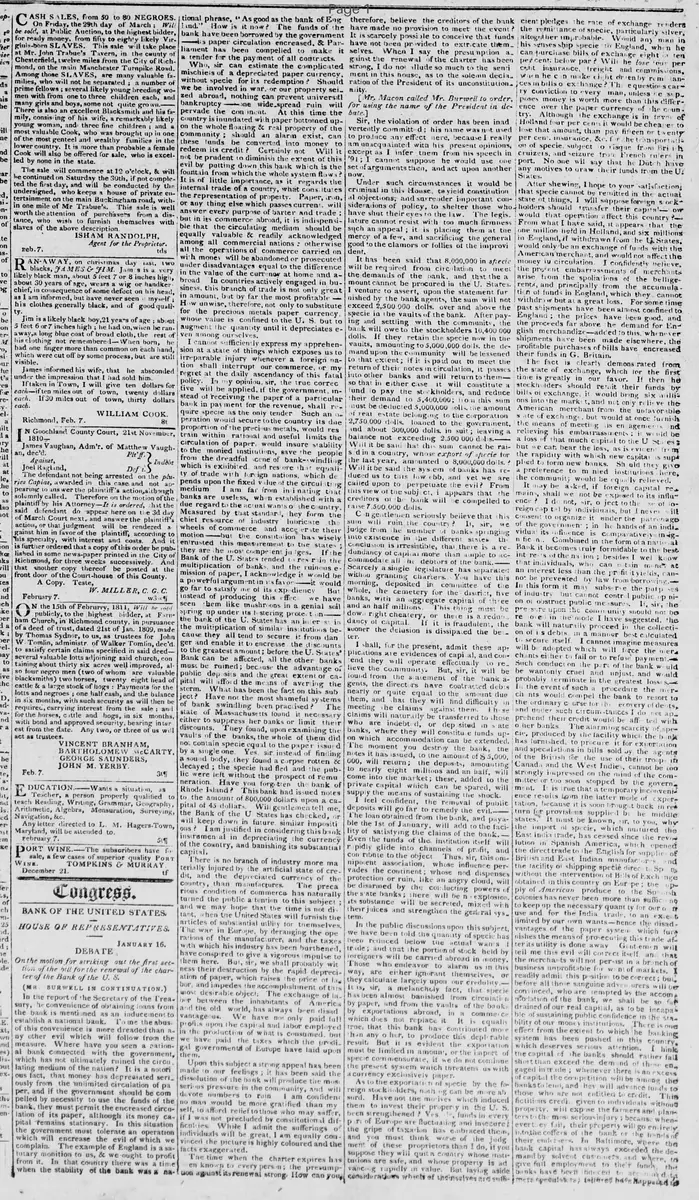
BANK OF THE UNITED STATES.
HOUSE OF REPRESENTATIVES.
January 16.
DEBATE
On the motion for striking out the first section of the bill for the renewal of the charter of the Bank of the U. S.
(MR. BURWELL IN CONTINUATION.)
In the report of the Secretary of the Treasury, the convenience of obtaining loans from the bank is mentioned as an inducement to establish a national bank. To me the abuse of this convenience is more dreaded than any other evil which will follow from the measure. Where have you seen a national bank connected with the government, which has not ultimately ruined the circulating medium of the nation? It is a notorious fact, that money has depreciated seriously from the unlimited circulation of paper, and if the government should be compelled by necessity to use the funds of the bank, they must permit the increased circulation of its paper, although its money capital remains stationary. In this situation the government must tolerate an operation which will increase the evil of which we complain. The example of England is a salutary monition to us, & we ought to profit from it. In that country there was a time when the stability of the bank was a national phrase, "As good as the bank of England." How is it now? The funds of the bank have been borrowed by the government—its paper circulation increased, & Parliament has been compelled to make it a tender for the payment of all contracts. Who, sir, can estimate the complicated mischiefs of a depreciated paper currency, without specie for its redemption? Should we be involved in war, or our property seized abroad, nothing can prevent universal bankruptcy—one wide-spread ruin will pervade the continent. At this time the country is inundated with paper bottomed upon the whole floating & real property of the community; should an alarm exist, can these funds be converted into money to redeem its credit? Certainly not. Will it not be prudent to diminish the extent of this evil by putting down this bank which is the fountain from which the whole system flows?
It is of little importance, as it regards the internal trade of a country, what constitutes the representation of property. Paper, iron, or any thing else which passes current, will answer every purpose of barter and trade; but in its commerce abroad, it is indispensable that the circulating medium should be equally valuable & readily acknowledged among all commercial nations: otherwise all the operations of commerce carried on with money will be abandoned or prosecuted under disadvantages equal to the difference in the value of the currency at home and abroad. In countries actively engaged in business, this branch of trade is not only great in amount, but by far the most profitable—How unwise, therefore, not only to substitute for the precious metals paper currency, whose value is confined to the U. S. but to augment the quantity until it depreciates even among ourselves.
I cannot sufficiently express my apprehension at a state of things which exposes us to irreparable injury whenever a foreign nation shall interrupt our commerce, or my regret at the daily ascendancy of this fatal policy. In my opinion, sir, the true corrective will be applied, if the government, instead of receiving the paper of a particular bank in payment for the revenue, shall require specie as the only tender. Such an operation would secure to the country its due proportion of the precious metals, would restrain within rational and useful limits the circulation of paper, would insure stability to the monied institutions, save the people from the dreadful scene of bank-swindling which is exhibited and restore its equality of trade with foreign nations, which depends upon the fixed value of the circulating medium.
I am far from insinuating that banks are useless, when established with a due regard to the actual wants of the country. Measured by that standard, they form the chief resource of industry, lubricate the wheels of commerce and accelerate their motion—but the constitution has wisely entrusted this measurement to the states; they are the most competent judges. If the Bank of the U. States tended to restrain the multiplication of banks, and the ruinous emission of paper, I acknowledge it would be a powerful argument in its favor—it would go far to satisfy me of its expediency. But instead of producing this effect we have seen them like mushrooms in a genial soil spring up under its fostering protection—the bank of the U. States has an interest in the multiplication of similar institutions because they all tend to secure it from danger and enable it to increase the discounts to the greatest amount; before the U. States Bank can be affected, all the other banks must be ruined; because the advantage of public deposits and the great extent of capital will afford the means of weathering the storm. What has been the fact on this subject? Have not the most shameful systems of bank swindling been practised? The state of Massachusetts found it necessary either to suppress her banks or limit their discounts. They found, upon examining the vaults of the banks, the whole of them did not contain specie equal to the paper issued by a single one. Yes, sir, instead of finding a sound body, they found a Corpse rotten & decayed; the specie had fled and the public were left without the prospect of remuneration. Have you forgotten the bank of Rhode Island? This bank had issued notes to the amount of 800,000 dollars upon a capital of 45 dollars. Will gentlemen tell me, the Bank of the U. States has checked, or will keep down in future similar impositions? I am justified in considering this bank instrumental in depreciating the currency of the country, and banishing its substantial capital.
There is no branch of industry more materially injured by the artificial state of credit, and the depreciated currency of the country, than manufactures. The precarious condition of commerce has naturally turned the public attention to this subject; and we may hope that the time is not distant, when the United States will furnish the articles of substantial utility for themselves. The war in Europe, by deranging the operations of the manufacturer, and the taxes with which his industry has been burthened, have conspired to give a vigorous impulse to them here. But, sir, we shall probably witness their destruction by the rapid depreciation of paper, which raises the price of labor, and impedes the accomplishment of this most desirable object: The exchange of labor between the inhabitants of America and the old world, has always been disadvantageous. We have not only paid full profits upon the capital and labor employed in the production of what is consumed, but we have paid the taxes which the prodigal governments of Europe have laid upon them.
Upon this subject a strong appeal has been made to our feelings; it has been said the dissolution of the bank will produce the most serious pressure in the community, and will devote numbers to ruin. I am confident no man would be more gratified than myself, to afford relief to those who may suffer, if I was not precluded by constitutional difficulties. While I admit the sufferings of individuals will be great, I am equally convinced the picture is highly coloured and the facts exaggerated.
The time when the charter expires has been known to every person; the presumption against its renewal strong. How can you therefore, believe the creditors of the bank have made no provision to meet the event? It is scarcely possible to conceive that funds have not been provided to extricate themselves. When I say the presumption against the renewal of the charter has been strong, I do not allude so much to the sentiment in this house, as to the solemn declaration of the President of its unconstitutionality.
[Mr. Macon called Mr. Burwell to order, for using the name of the President in debate.]
Sir, the violation of order has been inadvertently committed; his name was not used to produce any effect here, because I really am unacquainted with his present opinions, except as I infer them from his speech in '91; I cannot suppose he would use one set of arguments then, and act upon another now.
Under such circumstances it would be criminal in this House, to yield constitutional objections; and surrender important considerations of policy, to shelter those who have shut their eyes to the law. The legislature cannot resist with too much firmness such an appeal; it is placing them at the mercy of a few, and sacrificing the general good to the clamors or follies of the improvident.
It has been said that 8,000,000 in specie will be required from circulation to meet the demands of the bank, and that the amount cannot be procured in the U. States. I venture to assert, upon the statement furnished by the bank agents, the sum will not exceed 2,500,000 dolls. over and above the specie in the vaults of the bank. After paying and settling with the community, the bank will owe to the stockholders 10,400,000 dolls. If they retain the specie now in the vaults, amounting to 5,000,000 dols. the demand upon the community will be lessened to that extent; if it is paid out to meet the return of their notes in circulation, it passes into other banks and will return to them—so that in either case it will constitute a fund to pay the stockholders, and reduce their demand to 5,400,000; from this sum must be deducted 5,000,000 doll. the amount of real estate belonging to the corporation, 2,750,000 dolls. loaned to the government, and about 300,000 dolls. in suit; leaving a balance not exceeding 2,500,000 dols.—Will it be said that this sum cannot be raised in a country, whose export of specie for the last year, amounted to 8,000,000 dolls.? Will it be said the system of banks has reduced us to this low ebb, and yet we are called upon to perpetuate the evil? From this view of the subject, it appears that the creditors of the bank will be compelled to raise 7,500,000 dolls. Do gentlemen seriously believe that this sum will ruin the country? It, sir, we judge from the number of banks springing into existence in the different states the conclusion is irresistible, that there is a redundancy of capital more than ample to accommodate all the debtors of the bank.—Scarcely a single legislature has separated without granting charters. You have this morning, deposited in committee of the whole, the cemetery for the district, five banks, with an aggregate capital of three and an half millions. This thing must be down right cheatery, or there is a redundancy of capital. If it is fraudulent, the sooner the delusion is dissipated the better.
I shall, for the present, admit these applications are evidences of capital, and contend they will operate effectually to relieve the community. But, sir, it will be found from the statement of the bank agents, the directors have contracted debts nearly or quite equal to the amount due them, and that they will find difficulty in meeting the claims against them. These claims will naturally be transferred to those who are indebted, or deposited in state banks, where they will constitute funds upon which accommodation can be extended. The moment you destroy the bank, the notes it has issued, to the amount of 5,000,000, will return; the deposits, amounting to nearly eight millions and an half, will come into the market; these, added to the private capital which can be spared, will supply the means of sustaining the shock.
I feel confident, the removal of public deposits will go far to remedy the evil.—The loan obtained from the bank, and payable the 1st of January, will add to the facility of satisfying the claims of the bank.—Even the funds of the institution itself will rapidly glide into channels of profit, and contribute to the object. Thus, sir, this omnipotent association, whose influence pervades the continent; whose nod dispenses protection or ruin, like an angry cloud, will be disarmed by the conflicting powers of the state banks; there will be no explosion. Its substance will be secreted, mixed with their juices and strengthen the general system.
In the public discussions upon this subject, we have been told the quantity of specie has been reduced below the actual wants of trade; and that the portion of stock held by foreigners will be carried abroad in money. Those who endeavor to alarm us in this way, are either ignorant themselves, or they calculate largely upon our credulity.—It is, sir, a melancholy fact, that specie has been almost banished from circulation by paper, and from the vaults of the banks by exportations abroad, in a commerce which does not replace it. It is equally true, that this bank has contributed more than any other, to produce this deplorable result. But it is evident the exportation must be limited in amount, or the import of specie commensurate, if we do not continue the present system which threatens us with a currency exclusively paper.
As to the exportation of specie by the foreign stockholders, nothing can be more absurd. Have not the motives which induced them to invest their property in the U. S. been strengthened? Yes sir, funds in every part of Europe are fluctuating and insecure the gripe of taxation has embraced them, and you must think worse of the judgment of these proprietors than I do, if you suppose they will quit a Country whose institutions are safe, and whose property is advancing rapidly in value. But leaving aside considerations which of themselves are sufficient pledges the rate of exchange renders the remittance of specie, particularly silver, altogether improbable. Would any man in his senses ship specie to England, when he can purchase bills of exchange eight or ten percent: below par? Will he lose four per cent insurance, freight and commissions, when he can make eight or ten by remittances in bills of exchange? The questions carry conviction to every man, unless he supposes money is worth more than this difference over the paper currency of the country: Although the exchange is in favor of Holland four per cent: it would be cheaper to lose that amount, than pay fifteen or twenty per cent. insurance, &c. for the transportation of specie, subject to risque from British cruisers, and seizure from French rulers in port. No one will say that the Dutch have any motives to draw their funds from the U. States.
After shewing, I hope to your satisfaction: that specie cannot be remitted in the actual state of things, I will suppose foreign stockholders should transfer their capital—how would that operation affect this country?—From what I have said, it appears that the one million held in Holland, and six millions in England, if withdrawn from the U. States, would only be an exchange of funds with the American merchant, and would not affect the money in circulation. I confidently believe, the present embarrassments of merchants arise from the spoliations of the belligerents, and principally from the accumulation of funds in England, which they cannot withdraw but at a great loss. For some time past shipments have been almost confined to England; the prices have been good, and the proceeds far above the demand for English merchandize—added to this, whenever shipments have been made elsewhere, the profitable purchases of bills have increased their funds in G. Britain.
The fact is clearly demonstrated from the state of exchange, which for the first time is greatly in our favor. If then the stockholders should remit their funds by bills of exchange, it would bring six millions into the market, and not only relieve the American merchant from the unfavorable state of exchange: but would at once furnish the means of meeting his engagements and relieving his embarrassments: it would be a loss of that much capital to the U. States but we can bear the loss, as is evident from the rapidity with which new capital is supplied to form new banks. Should they give a preference to monied institutions here, the community would be equally relieved.
It may be asked, if foreign capital remain, shall we not be exposed to its influence? I do not, sir, object to the use of foreign capital by individuals, but I never will consent to organize it under the patronage of the government; in the hands of an individual its influence is comparatively insignificant. Combined in the form of a national Bank it becomes truly formidable to the best interests of the nation; besides I well know that individuals, who can obtain money at an interest less than the profit it yields, cannot be prevented by law from borrowing.—In this form it may subserve the purposes of industry but cannot control public opinion or obstruct public measures. If, sir; the pressure upon the community should not be relieved in the mode I have suggested, the bank will naturally proceed in the collection of its debts in a manner best calculated to secure itself. I cannot imagine measures will be adopted which will force the merchants either to fail or to refuse payment.—Such conduct on the part of the bank would be wantonly cruel and unjust, and would probably terminate in the greatest loss.—In the event of such a procedure the merchants would compel the bank to resort to the ordinary course for the recovery of debts, and under such circumstances I do not apprehend their credit would be affected with other banks. The alarming scarcity of specie, produced by the facility which the banks has furnished, to procure it for exportation and speculations in bills sold by the agents of the British for the use of their troops in Canada. and the West Indies, cannot be too strongly impressed on the mind of the committee or too soon stopped by the government. It is true that a temporary inconvenience results from the latter mode of exportation, because it is soon brought back in return for provisions supplied by the middle states. It must be known, sir, to you, why the import of specie, which nurtured the East India trade, has ceased since the revolution in Spanish America, which opened the direct trade to the English for supplies of British and East Indian manufactures and the facility of shipping specie direct Spain without the intervention of Bills of Exchange obtained in this country on Europe; the supply of American produce to the Spanish colonies has never been more than sufficient to keep up the necessary quantity for our own use and for the India trade, to an extent limited by our own wants—hence the disadvantages of the paper system, which furnishes the means of prosecuting this trade after its utility is done away. Gentlemen will tell me this evil will correct itself and that the merchants will not persist in a branch of business unprofitable from want of markets. I readily admit this position to be correct; but before all those sanguine adventurers will be convinced, who are tempted by the accommodation of the bank, we shall be so far drained of our real capital, as to be incapable of sustaining public confidence in the stability of our money institutions. There is one effect from the extent to which the banking system has been pushed in this country, which deserves serious attention. I think the capital of the banks should rather fall short than exceed the demand of those engaged in trade; whenever there is an excess of capital the competition will be among the banks to lend, and they will advance funds to those who are not entitled to credit. This fictitious credit given to individuals without property, will expose the farmers and planters to the most serious injury; because whenever they fail, their property will go entirely into the coffers of the bank or the hands of their endorsers. In Baltimore, where the bank capital has always exceeded the demand by solvent customers, and where, to give full employment to their fund, the banks have been induced to accommodate (mere speculators) tailored hide mapped u
the amount of a million without property to pay the creditors twenty cents in the dollar. This has been the effect of excessive bank capital [A gentleman from Maryland corrected Mr. Burwell, by stating that the failures had exceeded in the aggregate the sum he had mentioned, but in no single instance had the loss to creditors exceeded 600,000 dollars.]—I stand corrected, only 600,000 dollars—why, sir, this moderate sum would ruin a whole country if it had fallen upon the farmers. If the apprehensions of the public should coerce you to renew the charter at this time, I shall consider it perpetual. The same means which secured it now will not be forgotten or neglected hereafter. You may rest assured the magic terror of bankruptcy will be revived when there is occasion.
Perhaps the growing wealth of the people may hereafter raise them above the control of the bank, with ten millions capital; but if you should unfortunately adopt the favorite project of some, to establish a grand national Bank with a capital stock equal to $50,000,000 dollars; if afterwards you keep pace with the growth of the nation, you may indeed despair of all control over it in future. It will become so interwoven with the fiscal transactions of society, and so intimately blended with the existence of the government, that their duration will be coequal—the dangerous power of a bank extended over the continent, with a capital which would necessarily embrace in its funds all the individuals of wealth and influence, would produce the same effect with a national debt to that amount, and when you recollect that this machine will be controlled and managed by the executive branch of the government, you cannot but feel the most serious apprehensions of the consequences. Sir, I do not discuss this question with party feelings—I look forward to the time when the bank and government will feel in unison, and act in concert; the opposition of the bank is temporary, and will soon yield to its obvious interest. It is that period to which my fears are directed.
Who can doubt that the present misunderstanding is the result of momentary causes? Yes, sir, the quarrel is an unnatural one, explanations will take place, reconciliation will ensue, and then we may deplore their intimate friendship infinitely more than their hostility now.
Banks are commercial institutions; the first impulse of their nature is to make money and support the power which can protect their profits; the individuals concerned in them will feel political passions, and may indulge them, but they will learn from experience the wisdom of suppressing their passions when they hazard the loss of profit and patronage. I have therefore felt no disposition to know any thing about the directors or to hear the instances of political intolerance and individual favoritism.—It would be silly to found our views of the tendency of such an institution upon its conduct during a particular period. I am against giving any set of men such exorbitant power over the persons and property of the community. I am opposed to a monied aristocracy, which can hunt down whoever may be offensive to them, and not from hostility to the particular persons who now compose the bank. Sir, the time may arrive when the government may fall into the hands of men whose policy may in my estimation lead to the destruction of the constitution, and the corruption of public virtue.—Would you wish to see such men bolstered up by the influence of a national bank?—Would you be satisfied to see the good sense of the country hood-winked by money influence? A corporation, possessed of such ample funds, could control presses or establish them to support the most iniquitous men, and advocate the most detestable principles. You should bear in mind that this influence cuts both ways, and it is better to leave public opinion unfettered, trusting to the sound sense and discretion of the people, free from the operation of all extraneous power.
What would the world say if you should dismantle this bank to create another? Is there a man in the community who would not condemn you, and justly reprobate a policy so short-sighted and selfish? Such conduct would give full scope to swindling and speculation; and scenes which stain with shame the history of this republic, would be renewed. Sir, the system of paper credit, against which I have entered my protest, and to which I attribute the artificial and insecure state of this country, deserves nothing from you. You need not violate the constitution to preserve and extend it; without your fostering care, enough will remain to alarm those who prefer solid wealth to the mere appearance of it; although those who think the wealth of a nation can be augmented by printing a few reams of paper will be dissatisfied—they exult in the deception and premature prosperity which flows from public delusion, and will be overthrown the first moment your real condition may be tested by difficulties. I, sir, have been accustomed to think the wealth of a nation consisted in its productive labor, and its capital could be safely augmented only in the ratio of the difference between its consumption and productive labor. This is the true mode of acquiring capital, the process will be slow, but the advance will be permanent. It will depend upon principles of economy, industry, and steady exertions; it is incompatible with prodigality, speculation, and profligate acquisition of wealth.—Virtue is the basis of one, delusion and imposture of the other—a people thus situated, steadily exerting its powers, will furnish ample means to procure circulating medium, and prudent habits will add to it with sufficient rapidity: I have always preferred being happy to a splendid nation. Sir, I have now closed my remarks; the particular situation assigned to me by the House in relation to this subject, has compelled me to state the extent of my objections to the bill. I have carefully refrained from expressions which could wound the feelings or impeach the motives of those who differ from me in opinion. I have no disposition to say any thing about the transactions of the bank; they are all unknown to me, and I care nothing about them. My conscientious belief is, that the law was unconstitutional, and I sincerely trust we shall destroy what has so long defaced its original purity—close up the breach which has been made, and cement it by a vote upon principle. I confess the consolation I shall feel in the success of my motion will be greatly diminished if it obtains by the intervention of other motives.
What sub-type of article is it?
What themes does it cover?
What keywords are associated?
What entities or persons were involved?
Where did it happen?
Story Details
Key Persons
Location
House Of Representatives
Event Date
January 16
Story Details
Mr. Burwell continues his debate against renewing the charter of the Bank of the United States, warning of currency depreciation, unconstitutionality, bank abuses, and economic risks, advocating for specie payments and state control over banking.