Thank you for visiting SNEWPapers!
Sign up free
The Midland Journal
Rising Sun, Cecil County, Maryland
What is this article about?
Recent experiments by the Wisconsin Agricultural Experiment Station reveal that moldy silage results from ensiling over-ripe, wilted, or frozen corn, which traps air allowing mold growth, rather than poor packing. Ensiling shortly after denting prevents this. Tests with buried crates showed no spoilage.
Clipping
OCR Quality
Full Text
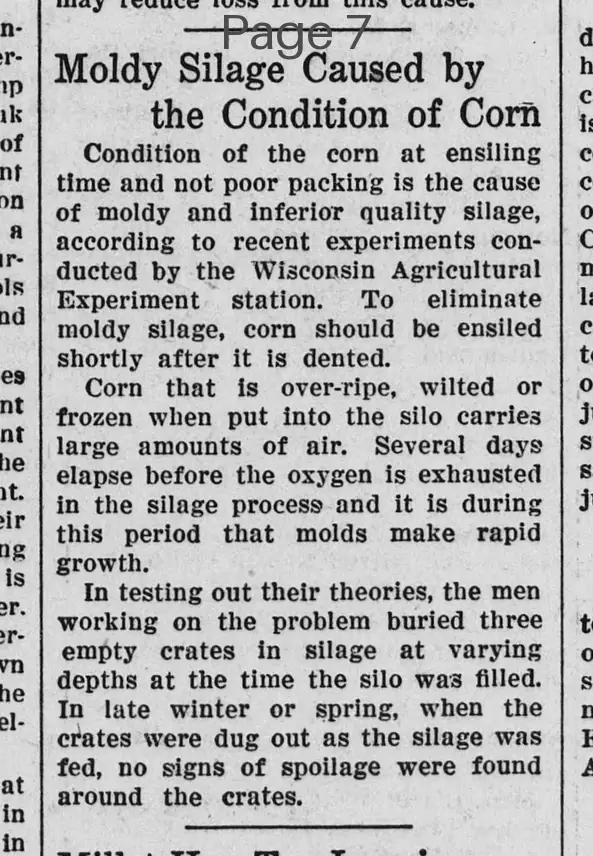
Condition of the corn at ensiling time and not poor packing is the cause of moldy and inferior quality silage, according to recent experiments conducted by the Wisconsin Agricultural Experiment station. To eliminate moldy silage, corn should be ensiled shortly after it is dented.
Corn that is over-ripe, wilted or frozen when put into the silo carries large amounts of air. Several days elapse before the oxygen is exhausted in the silage process and it is during this period that molds make rapid growth.
In testing out their theories, the men working on the problem buried three empty crates in silage at varying depths at the time the silo was filled. In late winter or spring, when the crates were dug out as the silage was fed, no signs of spoilage were found around the crates.
What sub-type of article is it?
What keywords are associated?
Where did it happen?
Domestic News Details
Primary Location
Wisconsin
Outcome
no signs of spoilage were found around the buried crates when dug out in late winter or spring.
Event Details
Condition of the corn at ensiling time and not poor packing is the cause of moldy and inferior quality silage, according to recent experiments conducted by the Wisconsin Agricultural Experiment station. To eliminate moldy silage, corn should be ensiled shortly after it is dented. Corn that is over-ripe, wilted or frozen when put into the silo carries large amounts of air. Several days elapse before the oxygen is exhausted in the silage process and it is during this period that molds make rapid growth. In testing out their theories, the men working on the problem buried three empty crates in silage at varying depths at the time the silo was filled. In late winter or spring, when the crates were dug out as the silage was fed, no signs of spoilage were found around the crates.