Thank you for visiting SNEWPapers!
Sign up free
National Gazette
Philadelphia, Philadelphia County, Pennsylvania
What is this article about?
On August 30, Paris Mayor M. Pethion addresses the French National Assembly, accusing King Louis XVI of treason, ingratitude, and aiding enemies amid war and internal threats. He demands Louis's deposition, provisional executive power by appointed ministers, and preparation for defense by freemen until a national convention decides the nation's will.
Clipping
OCR Quality
Full Text
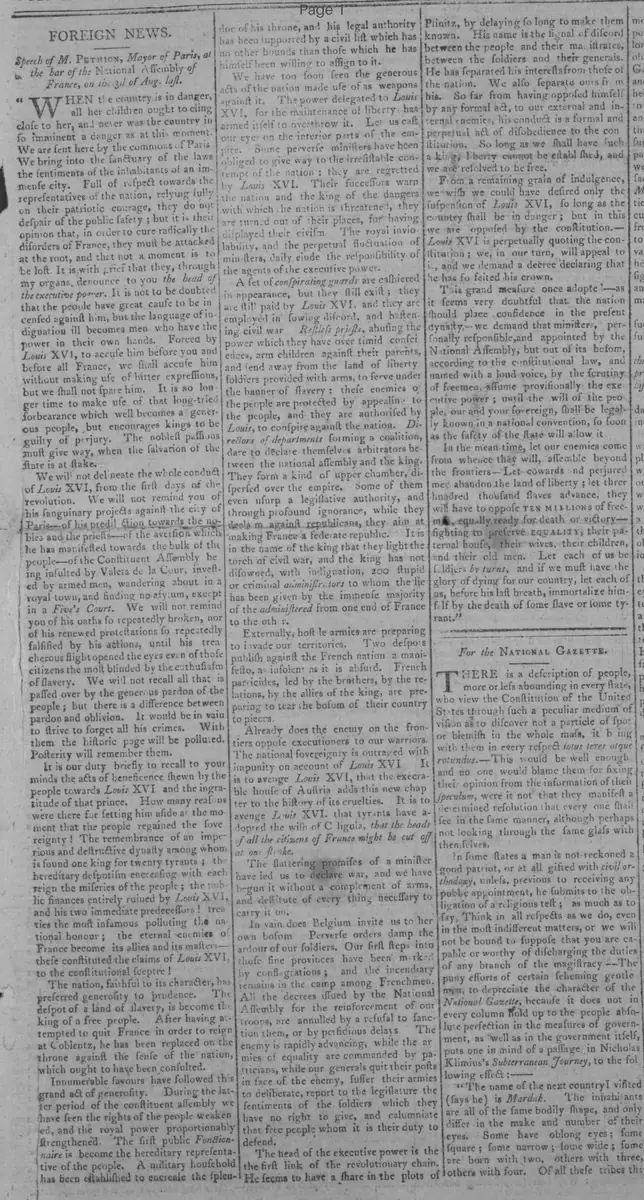
Speech of M. Pethion, Mayor of Paris, at the bar of the National Assembly of France, on 30th of Aug. last.
When the country is in danger, all her children ought to cling close to her, and never was the country in so imminent a danger as at this moment. We are sent here by the commons of Paris. We bring into the sanctuary of the laws the sentiments of the inhabitants of an immense city. Full of respect towards the representatives of the nation, relying fully on their patriotic courage, they do not despair of the public safety; but it is their opinion that, in order to cure radically the disorders of France, they must be attacked at the root, and that not a moment is to be lost. It is with grief that they, through my organs, denounce to you the head of the executive power. It is not to be doubted that the people have great cause to be offended against him, but the language of indignation ill becomes men who have the power in their own hands. Forced by Louis XVI, to accuse him before you and before all France, we shall accuse him without making use of bitter expressions, but we shall not spare him. It is no longer time to make use of that long-tried forbearance which well becomes a generous people, but encourages kings to be mutinous. We must give way, when the salvation of the state is at stake. The nobles passions of the guilty of perjury. The noblest passions state is at stake.
We will not delineate the whole conduct of Louis XVI, from the first days of the revolution. We will not remind you of his sanguinary projects against the city of Paris-of his predilection towards the nobles and the priests--of the aversion which he has manifested towards the bulk of the people-of the Constituent Assembly being insulted by Valets de la Cour, invested by armed men, wandering about in a royal town, and finding no asylum, except in a Five's Court. We will not remind you of his oaths so repeatedly broken, nor of his renewed protestations so repeatedly falsified by his actions, until his treacherous flight opened the eyes even of those citizens the most blinded by the enthusiasm of slavery. We will not recall all that is passed over by the generous pardon of the people; but there is a difference between pardon and oblivion. It would be in vain to strive to forget all his crimes. With them the historic page will be polluted. Posterity will remember them.
It is our duty briefly to recall to your minds the acts of beneficence shown by the people towards Louis XVI and the ingratitude of that prince. How many reasons were there for setting him aside at the moment that the people regained the sovereignty! The remembrance of an imperious and destructive dynasty among whom is found one king for twenty tyrants; the reign the miseries of the people; the public finances entirely ruined by Louis XVI, and his two immediate predecessors! treaties the most infamous polluting the national honour; the eternal enemies of France become its allies and its masters—these constituted the claims of Louis XVI, to the constitutional sceptre! The nation, faithful to its character, has preferred generosity to prudence. The depot of a land of slavery, is become the king of a free people. After having attempted to quit France in order to reign at Coblentz, he has been replaced on the throne against the sense of the nation, which ought to have been consulted. Innumerable favours have followed this grand act of generosity. During the latter period of the constituent assembly we have seen the rights of the people weakened, and the royal power proportionably strengthened. The list public functionnaire is become the hereditary representative of the people. A military household has been established to increase the splendour of his throne, and his legal authority has been supported by a civil list which has no other bounds than those which he himself has been willing to assign to it. We have too soon seen the generous acts of the nation made use of as weapons against it. The power delegated to Louis XVI, for the maintenance of liberty, has armed itself to overthrow it. Let us cast our eye on the interior parts of the empire. Some perverse ministers have been obliged to give way to the irresistible contempt of the nation: they are regretted by Louis XVI. Their successors warn the nation and the king of the dangers with which the nation is threatened, they are turned out of their places, for having displayed their civism. The royal inviolability, and the perpetual fluctuation of ministers, daily elude the responsibility of the agents of the executive power. A set of conspiring guards are cashiered in appearance, but they still exist; they are still paid by Louis XVI, and they are employed in sowing discord, and hastening civil war. Restless priests, abusing the power which they have over timid consciences, arm children against their parents, and send away from the land of liberty soldiers provided with arms, to serve under the banner of slavery: these enemies of the people are protected by appealing to the people, and they are authorized by Louis, to conspire against the nation. Directors of departments forming a coalition, dare to declare themselves arbitrators between the national assembly and the king. They form a kind of upper chamber, dispersed over the empire. Some of them even usurp a legislative authority, and through profound ignorance, while they declaim against republicans, they aim at making France a federate republic. It is in the name of the king that they light the torch of civil war, and the king has not disowned, with indignation, so stupid or criminal administrators to whom the lie has been given by the immense majority of the administered from one end of France to the other.
Externally, hostile armies are preparing to invade our territories. Two despots publish against the French nation a manifesto, as insolent as it is absurd. French parricides, led by the brothers, by the relations, by the allies of the king, are preparing to tear the bosom of their country to pieces. Already does the enemy on the frontiers oppose executioners to our warriors. The national sovereignty is outraged with impunity on account of Louis XVI. It is to avenge Louis XVI, that the execrable house of Austria adds this new chapter to the history of its cruelties. It is to avenge Louis XVI. that tyrants have adopted the wish of Caligula, that the heads of all the citizens of France might be cut off at one stroke.
The flattering promises of a minister have led us to declare war, and we have begun it without a complement of arms, and destitute of every thing necessary to carry it on. In vain does Belgium invite us to her own bosom. Perverse orders damp the ardour of our soldiers. Our first steps into those fine provinces have been marked by conflagrations; and the incendiary remains in the camp among Frenchmen. All the decrees issued by the National Assembly for the reinforcement of our troops, are annulled by a refusal to sanction them, or by perfidious delays. The enemy is rapidly advancing, while the armies of equality are commanded by patricians, while our generals quit their posts in face of the enemy, desert their armies to deliberate, report to the legislature the sentiments of the soldiers which they have no right to give, and calumniate that free people whom it is their duty to defend.
The head of the executive power is the first link of the revolutionary chain. He seems to have a share in the plots of Plinitz, by delaying so long to make them known. His name is the signal of discord between the people and their magistrates, between the soldiers and their generals. He has separated his interests from those of the nation. We also separate ours from his. So far from having opposed himself by any formal act, to our external and internal enemies, his conduct is a formal and perpetual act of disobedience to the constitution. So long as we shall have such a king, liberty cannot be established, and we are resolved to be free. From a remaining grain of indulgence, we wish we could have desired only the suspension of Louis XVI, so long as the country shall be in danger; but in this we are opposed by the constitution.-- Louis XVI is perpetually quoting the constitution; we, in our turn, will appeal to it, and we demand a decree declaring that he has so forfeited his crown. This grand measure once adopted, as it seems very doubtful that the nation should place confidence in the present dynasty,-we demand that ministers, personally responsible, and appointed by the National Assembly, but out of its bosom, according to the constitutional law, and named with a loud voice, by the scrutiny of freemen, assume provisionally the executive power; until the will of the people, our and your sovereign, shall be legally known in a national convention, as soon as the acts of the late will allow it. In the mean time, let our enemies come from whence they will, assemble beyond the frontiers-Let cowards and perjured men abandon the land of liberty; let three hundred thousand slaves advance, they will have to oppose TEN MILLIONS of freemen, equally ready for death or victory— fighting to preserve EQUALITY, their paternal house, their wives, their children, and their old men. Let each of us be soldiers by turns, and if we must have the glory of dying for our country, let each of us, before his last breath, immortalize himself. If by the death of some slave or some tyrant."
What sub-type of article is it?
What keywords are associated?
What entities or persons were involved?
Where did it happen?
Foreign News Details
Primary Location
Paris, France
Event Date
30th Of Aug. Last
Key Persons
Outcome
demand for decree declaring louis xvi has forfeited his crown; provisional executive power by appointed ministers until national convention; call to defend against enemies with ten million freemen.
Event Details
M. Pethion, Mayor of Paris, delivers a speech to the National Assembly denouncing Louis XVI for treason, ingratitude, aiding internal and external enemies, obstructing war efforts, and violating the constitution. He recounts the king's past actions, failed flight, and current plots, urging deposition and national defense.