Thank you for visiting SNEWPapers!
Sign up free
Story
August 23, 1838
Lynchburg Virginian
Lynchburg, Virginia
What is this article about?
Peter W. Grayson, a distinguished Texan statesman from Kentucky, committed suicide on July 6, 1837, at Bean's Station, Tennessee, due to chronic melancholy and religious skepticism, amid political nomination pressures. Details refute character smears from his Bexar involvement.
Clipping
OCR Quality
95%
Excellent
Full Text
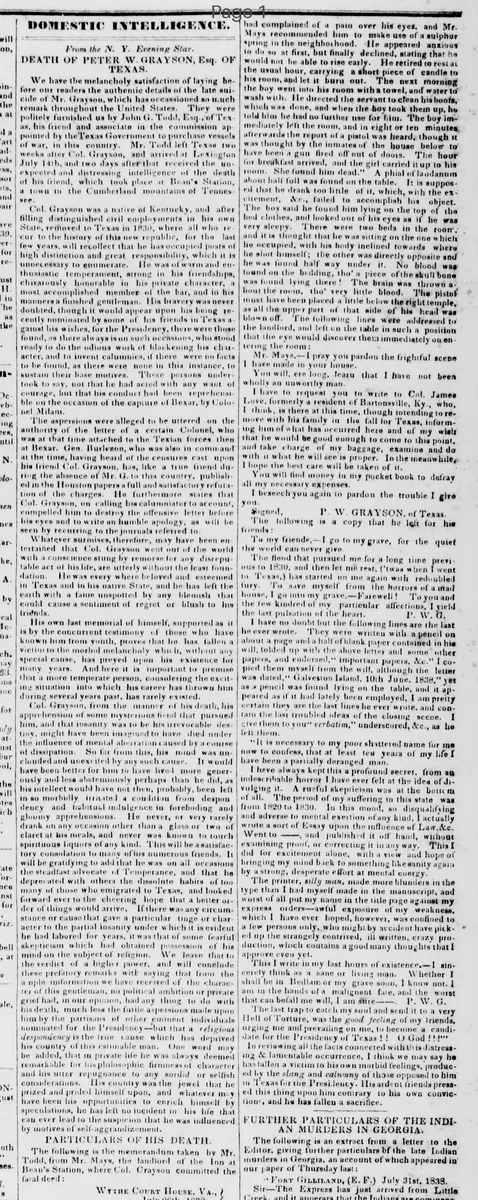
DOMESTIC INTELLIGENCE.
From the N. Y. Evening Star.
DEATH OF PETER W. GRAYSON, ESQ. OF
TEXAS.
We have the melancholy satisfaction of laying before our readers the authentic details of the late suicide of Mr. Grayson, which has occasioned so much
remark throughout the United States. They were
politely furnished us by John G. Todd, Esq., of Texas,
his friend and associate in the commission appointed by the Texas Government to purchase vessels
of war, in this country. Mr. Todd left Texas two
weeks after Col. Grayson, and arrived at Lexington
July 14th, and two days after that received the unexpected and distressing intelligence of the death
of his friend, which took place at Bean's Station,
a town in the Cumberland mountains of Tennessee.
Col. Grayson was a native of Kentucky, and after
filling distinguished civil employments in his own
State, removed to Texas in 1830, where all who recur to the history of this new republic, for the last
few years, will recollect that he has occupied posts of
high distinction and great responsibility, which it is
unnecessary to enumerate. He was of warm and enthusiastic temperament, strong in his friendships,
chivalrously honorable in his private character, a
most accomplished member of the bar, and in his
manners a finished gentleman. His bravery was never
doubted, though it would appear upon his being recently nominated by some of his friends in Texas against his wishes, for the Presidency, there were those
found, as there always is on such occasions, who stood
ready to do the odious work of blackening his character, and to invent calumnies, if there were no facts
to be found, as there were none in this instance, to
sustain their base motives. These persons undertook to say, not that he had acted with any want of
courage, but that his conduct had been reprehensible on the occasion of the capture of Bexar, by Colonel Milam.
The aspersions were alleged to be uttered on the
authority of the letter of a certain Colonel, who
was at that time attached to the Texian forces then
at Bexar. Gen. Burleson, who was also in command
at the time, having heard of the censures cast upon
his friend Col. Grayson, has, like a true friend during the absence of Mr. G. to this country, published in the Houston papers a full and satisfactory refutation of the charges. He furthermore states that
Col. Grayson, on calling his calumniator to account,
compelled him to destroy the offensive letter before
his eyes and to write an humble apology, as will be
seen by recurring to the journals referred to.
Whatever surmises, therefore, may have been entertained that Col. Grayson went out of the world
with a conscience stung by remorse for any disreputable act of his life, are utterly without the least foundation. He was everywhere beloved and esteemed
in Texas and in his native State, and he has left the
earth with a fame unspotted by any blemish that
could cause a sentiment of regret or blush to his
friends.
His own last memorial of himself, supported as it
is by the concurrent testimony of those who have
known him from youth, proves that he has fallen a
victim to the morbid melancholy which, without any
special cause, has preyed upon his existence for
many years. And here it is important to premise
that a more temperate person, considering the exciting situation into which his career has thrown him
during several years past, has rarely existed.
Col. Grayson, from the manner of his death, his
apprehension of some mysterious fiend that pursued
him, and that insanity was to be his irrevocable destiny, might have been imagined to have died under
the influence of mental aberration caused by a course
of dissipation. So far from this, his mind was unclouded and unexcited by any such cause. It would
have been better for him to have lived more generously and less abstemiously perhaps than he did, as
his intellect would have not then, probably, been left
in so morbidly irritated a condition from despondency and habitual indulgence in foreboding and
gloomy apprehensions. He never, or very rarely,
drank on any occasion other than a glass or two of
claret at his meals, and never was known to touch
spirituous liquors of any kind. This will be a satisfactory consolation to many of his numerous friends. It
will be gratifying to add that he was on all occasions
the steadfast advocate of Temperance, and that he
deprecated with others the dissolute habits of too
many of those who emigrated to Texas, and looked
forward ever to the cheering hope that a better order of things would arrive. "If there was any circumstance or cause that gave a particular tinge or character to the partial insanity under which it is evident
he had labored for years, it was that of some fearful
skepticism which had obtained possession of his
mind on the subject of religion. We leave that to
the verdict of a higher power, and will conclude
these prefatory remarks with saying that from the
ample information we have received of the character of this gentleman, no political ambition or private
grief had, in our opinion, had any thing to do with
his death, much less the futile aspersions made upon
him by the partisans of other eminent individuals
nominated for the Presidency--but that a religious
despondency is the true cause which has deprived
his country of this estimable man. One word may
be added, that in private life he was always deemed
remarkable for his philosophic firmness of character
and his utter repugnance to any sordid or selfish
considerations. His country was the jewel that he
prized and prided himself upon, and whatever may
have been his opportunities to enrich himself by
speculations, he has left no incident in his life that
can ever lead to the suspicion that he was influenced
by motives of self-aggrandizement.
PARTICULARS OF HIS DEATH.
The following is the memorandum taken by Mr.
Todd, from Mr. Mays, the landlord of the Inn at
Bean's Station, where Col. Grayson committed the
fatal deed:
"Mr. Grayson arrived at Bean's Station on the
5th inst. from Knoxville; appeared restless and impatient, as he asked two or three times for a room
before he was showed one. Came down to dinner,
but ate nothing; requested a cup of tea to be sent to
his room. In the evening he came down and conversed with Mr. Mays, and appeared composed. He
had complained of a pain over his eyes, and Mr.
Mays recommended him to make use of a sulphur
spring in the neighborhood. He appeared anxious
to do so at first, but finally declined, stating that he
would not be able to rise early. He retired to rest at
the usual hour, carrying a short piece of candle to
his room, and let it burn out. The next morning
the boy went into his room with a towel, and water to
wash with. He directed the servant to clean his boots,
which was done, and when the boy took them up, he
told him he had no further use for him. The boy immediately left the room, and in eight or ten minutes
afterwards the report of a pistol was heard, though it
was thought by the inmates of the house below to
have been a gun fired off out of doors. The hour
for breakfast arrived, and the girl carried it up to his
room. She found him dead." A phial of laudanum
about half full was found on the table. It is supposed that he drank too little of it, which, with the excitement, &c., failed to accomplish his object.
The boy said he found him lying on the top of the
bed clothes, and looked out of his eyes as if he was
very sleepy. There were two beds in the room,
and it is thought that he was sitting on the one which
he occupied, with his body inclined towards where
he shot himself; the other was directly opposite and
he was found half way under it. No blood was
found on the bedding, tho' a piece of the skull bone
was found lying there! The brain was thrown about the room, tho' very little blood. The pistol
must have been placed a little below the right temple,
as all the upper part of that side of his head was
blown off. The following lines were addressed to
the landlord, and left on the table in such a position
that the eye would discover them immediately on entering the room:
Mr. Mays.-I pray you pardon the frightful scene
I have made in your house.
You will, ere long, learn that I have not been
wholly an unworthy man.
I have to request you to write to Col. James
Love, formerly a resident of Bartonsville, Ky., who,
I think, is there at this time, though intending to remove with his family in the fall for Texas, informing him of what has occurred here and of my wish
that he would be good enough to come to this point.
and take charge of my baggage, examine and do
with it what he will see is proper. In the meanwhile,
I hope the best care will be taken of it.
You will find money in my pocket book to defray
all my necessary expenses.
I beseech you again to pardon the trouble I give
you.
Signed,
P. W. GRAYSON, of Texas.
The following is a copy that he left for his
friends:
To my friends,-I go to my grave, for the quiet
the world can never give
The fiend that pursued me for a long time previous to 1830, and then let me rest. ('Twas when I went
to Texas.) has started on me again with redoubled
fury. To save myself from the horrors of a mad
house, I go into my grave,-Farewell! To you and
the few kindred of my particular affections. I yield
the last pulsation of the heart.
P. W. G.
I have no doubt but the following lines are the last
he ever wrote. They were written with a pencil on
about a page and a half of blank paper contained in his
will, folded up with the above letter and some other
papers, and endorsed, "important papers, &c." I copied them myself from the will, although the letter
was dated, "Galveston Island, 10th June, 1838," yet
as a pencil was found lying on the table, and it appeared as if it had lately been employed, I am pretty
certain they are the last lines he ever wrote, and contain the last troubled ideas of the closing scene. I
give them to you verbatim, underscored, &c., as he
left them.
"It is necessary to my poor shattered name for me
now to confess, that at least ten years of my life I
have been a partially deranged man.
I have always kept this a profound secret, from an
indescribable horror I have ever felt at the idea of divulging it. A rueful skepticism was at the bottom
of all. The period of my suffering in this state was
from 1820 to 1830. In this mood, so disqualifying
and adverse to mental exertion of any kind, I actually
wrote a sort of Essay upon the influence of Law, &c.
Went to --, and published it off hand, without
examining proof, or correcting it in any way. This I
did for excitement alone, with a view and hope of
bringing my mind back to something like sanity again by a strong, desperate effort at mental energy.
The printer, silly man, made more blunders in the
type than I had myself made in the manuscript, and
worst of all put my name in the title page against my
express orders-awful exposure of my weakness,
which I have ever hoped, however, was confined to
a few persons only, who might by accident have picked up the strangely contrived, ill written, crazy production, which contains a good many thoughts that I
approve even yet.
This I write in my last hours of existence.-I sincerely think as a sane or living man. Whether I
shall be in Bedlam or my grave soon, I know not. I
am in the hands of a malignant fate, and the worst
that can befall me will, I am sure--. P. W. G.
The last trap to catch my soul and send it to a very
Hell of Torture, was the good feeling of my friends,
urging me and prevailing on me, to become a candidate for the Presidency of Texas !! O God !!!
In reviewing all the facts connected with this distressing & lamentable occurrence, I think we may say he
has fallen a victim to his own morbid feelings, produced by the slang and calumny of those opposed to him
in Texas for the Presidency. His ardent friends pressed this thing upon him contrary to his own conviction, and he has fallen a sacrifice."
From the N. Y. Evening Star.
DEATH OF PETER W. GRAYSON, ESQ. OF
TEXAS.
We have the melancholy satisfaction of laying before our readers the authentic details of the late suicide of Mr. Grayson, which has occasioned so much
remark throughout the United States. They were
politely furnished us by John G. Todd, Esq., of Texas,
his friend and associate in the commission appointed by the Texas Government to purchase vessels
of war, in this country. Mr. Todd left Texas two
weeks after Col. Grayson, and arrived at Lexington
July 14th, and two days after that received the unexpected and distressing intelligence of the death
of his friend, which took place at Bean's Station,
a town in the Cumberland mountains of Tennessee.
Col. Grayson was a native of Kentucky, and after
filling distinguished civil employments in his own
State, removed to Texas in 1830, where all who recur to the history of this new republic, for the last
few years, will recollect that he has occupied posts of
high distinction and great responsibility, which it is
unnecessary to enumerate. He was of warm and enthusiastic temperament, strong in his friendships,
chivalrously honorable in his private character, a
most accomplished member of the bar, and in his
manners a finished gentleman. His bravery was never
doubted, though it would appear upon his being recently nominated by some of his friends in Texas against his wishes, for the Presidency, there were those
found, as there always is on such occasions, who stood
ready to do the odious work of blackening his character, and to invent calumnies, if there were no facts
to be found, as there were none in this instance, to
sustain their base motives. These persons undertook to say, not that he had acted with any want of
courage, but that his conduct had been reprehensible on the occasion of the capture of Bexar, by Colonel Milam.
The aspersions were alleged to be uttered on the
authority of the letter of a certain Colonel, who
was at that time attached to the Texian forces then
at Bexar. Gen. Burleson, who was also in command
at the time, having heard of the censures cast upon
his friend Col. Grayson, has, like a true friend during the absence of Mr. G. to this country, published in the Houston papers a full and satisfactory refutation of the charges. He furthermore states that
Col. Grayson, on calling his calumniator to account,
compelled him to destroy the offensive letter before
his eyes and to write an humble apology, as will be
seen by recurring to the journals referred to.
Whatever surmises, therefore, may have been entertained that Col. Grayson went out of the world
with a conscience stung by remorse for any disreputable act of his life, are utterly without the least foundation. He was everywhere beloved and esteemed
in Texas and in his native State, and he has left the
earth with a fame unspotted by any blemish that
could cause a sentiment of regret or blush to his
friends.
His own last memorial of himself, supported as it
is by the concurrent testimony of those who have
known him from youth, proves that he has fallen a
victim to the morbid melancholy which, without any
special cause, has preyed upon his existence for
many years. And here it is important to premise
that a more temperate person, considering the exciting situation into which his career has thrown him
during several years past, has rarely existed.
Col. Grayson, from the manner of his death, his
apprehension of some mysterious fiend that pursued
him, and that insanity was to be his irrevocable destiny, might have been imagined to have died under
the influence of mental aberration caused by a course
of dissipation. So far from this, his mind was unclouded and unexcited by any such cause. It would
have been better for him to have lived more generously and less abstemiously perhaps than he did, as
his intellect would have not then, probably, been left
in so morbidly irritated a condition from despondency and habitual indulgence in foreboding and
gloomy apprehensions. He never, or very rarely,
drank on any occasion other than a glass or two of
claret at his meals, and never was known to touch
spirituous liquors of any kind. This will be a satisfactory consolation to many of his numerous friends. It
will be gratifying to add that he was on all occasions
the steadfast advocate of Temperance, and that he
deprecated with others the dissolute habits of too
many of those who emigrated to Texas, and looked
forward ever to the cheering hope that a better order of things would arrive. "If there was any circumstance or cause that gave a particular tinge or character to the partial insanity under which it is evident
he had labored for years, it was that of some fearful
skepticism which had obtained possession of his
mind on the subject of religion. We leave that to
the verdict of a higher power, and will conclude
these prefatory remarks with saying that from the
ample information we have received of the character of this gentleman, no political ambition or private
grief had, in our opinion, had any thing to do with
his death, much less the futile aspersions made upon
him by the partisans of other eminent individuals
nominated for the Presidency--but that a religious
despondency is the true cause which has deprived
his country of this estimable man. One word may
be added, that in private life he was always deemed
remarkable for his philosophic firmness of character
and his utter repugnance to any sordid or selfish
considerations. His country was the jewel that he
prized and prided himself upon, and whatever may
have been his opportunities to enrich himself by
speculations, he has left no incident in his life that
can ever lead to the suspicion that he was influenced
by motives of self-aggrandizement.
PARTICULARS OF HIS DEATH.
The following is the memorandum taken by Mr.
Todd, from Mr. Mays, the landlord of the Inn at
Bean's Station, where Col. Grayson committed the
fatal deed:
"Mr. Grayson arrived at Bean's Station on the
5th inst. from Knoxville; appeared restless and impatient, as he asked two or three times for a room
before he was showed one. Came down to dinner,
but ate nothing; requested a cup of tea to be sent to
his room. In the evening he came down and conversed with Mr. Mays, and appeared composed. He
had complained of a pain over his eyes, and Mr.
Mays recommended him to make use of a sulphur
spring in the neighborhood. He appeared anxious
to do so at first, but finally declined, stating that he
would not be able to rise early. He retired to rest at
the usual hour, carrying a short piece of candle to
his room, and let it burn out. The next morning
the boy went into his room with a towel, and water to
wash with. He directed the servant to clean his boots,
which was done, and when the boy took them up, he
told him he had no further use for him. The boy immediately left the room, and in eight or ten minutes
afterwards the report of a pistol was heard, though it
was thought by the inmates of the house below to
have been a gun fired off out of doors. The hour
for breakfast arrived, and the girl carried it up to his
room. She found him dead." A phial of laudanum
about half full was found on the table. It is supposed that he drank too little of it, which, with the excitement, &c., failed to accomplish his object.
The boy said he found him lying on the top of the
bed clothes, and looked out of his eyes as if he was
very sleepy. There were two beds in the room,
and it is thought that he was sitting on the one which
he occupied, with his body inclined towards where
he shot himself; the other was directly opposite and
he was found half way under it. No blood was
found on the bedding, tho' a piece of the skull bone
was found lying there! The brain was thrown about the room, tho' very little blood. The pistol
must have been placed a little below the right temple,
as all the upper part of that side of his head was
blown off. The following lines were addressed to
the landlord, and left on the table in such a position
that the eye would discover them immediately on entering the room:
Mr. Mays.-I pray you pardon the frightful scene
I have made in your house.
You will, ere long, learn that I have not been
wholly an unworthy man.
I have to request you to write to Col. James
Love, formerly a resident of Bartonsville, Ky., who,
I think, is there at this time, though intending to remove with his family in the fall for Texas, informing him of what has occurred here and of my wish
that he would be good enough to come to this point.
and take charge of my baggage, examine and do
with it what he will see is proper. In the meanwhile,
I hope the best care will be taken of it.
You will find money in my pocket book to defray
all my necessary expenses.
I beseech you again to pardon the trouble I give
you.
Signed,
P. W. GRAYSON, of Texas.
The following is a copy that he left for his
friends:
To my friends,-I go to my grave, for the quiet
the world can never give
The fiend that pursued me for a long time previous to 1830, and then let me rest. ('Twas when I went
to Texas.) has started on me again with redoubled
fury. To save myself from the horrors of a mad
house, I go into my grave,-Farewell! To you and
the few kindred of my particular affections. I yield
the last pulsation of the heart.
P. W. G.
I have no doubt but the following lines are the last
he ever wrote. They were written with a pencil on
about a page and a half of blank paper contained in his
will, folded up with the above letter and some other
papers, and endorsed, "important papers, &c." I copied them myself from the will, although the letter
was dated, "Galveston Island, 10th June, 1838," yet
as a pencil was found lying on the table, and it appeared as if it had lately been employed, I am pretty
certain they are the last lines he ever wrote, and contain the last troubled ideas of the closing scene. I
give them to you verbatim, underscored, &c., as he
left them.
"It is necessary to my poor shattered name for me
now to confess, that at least ten years of my life I
have been a partially deranged man.
I have always kept this a profound secret, from an
indescribable horror I have ever felt at the idea of divulging it. A rueful skepticism was at the bottom
of all. The period of my suffering in this state was
from 1820 to 1830. In this mood, so disqualifying
and adverse to mental exertion of any kind, I actually
wrote a sort of Essay upon the influence of Law, &c.
Went to --, and published it off hand, without
examining proof, or correcting it in any way. This I
did for excitement alone, with a view and hope of
bringing my mind back to something like sanity again by a strong, desperate effort at mental energy.
The printer, silly man, made more blunders in the
type than I had myself made in the manuscript, and
worst of all put my name in the title page against my
express orders-awful exposure of my weakness,
which I have ever hoped, however, was confined to
a few persons only, who might by accident have picked up the strangely contrived, ill written, crazy production, which contains a good many thoughts that I
approve even yet.
This I write in my last hours of existence.-I sincerely think as a sane or living man. Whether I
shall be in Bedlam or my grave soon, I know not. I
am in the hands of a malignant fate, and the worst
that can befall me will, I am sure--. P. W. G.
The last trap to catch my soul and send it to a very
Hell of Torture, was the good feeling of my friends,
urging me and prevailing on me, to become a candidate for the Presidency of Texas !! O God !!!
In reviewing all the facts connected with this distressing & lamentable occurrence, I think we may say he
has fallen a victim to his own morbid feelings, produced by the slang and calumny of those opposed to him
in Texas for the Presidency. His ardent friends pressed this thing upon him contrary to his own conviction, and he has fallen a sacrifice."
What sub-type of article is it?
Biography
Tragedy
Historical Event
What themes does it cover?
Madness
Misfortune
Tragedy
What keywords are associated?
Suicide
Peter Grayson
Texas Presidency
Melancholy
Insanity
Religious Despondency
Bean's Station
What entities or persons were involved?
Peter W. Grayson
John G. Todd
Mr. Mays
Gen. Burleson
Colonel Milam
Col. James Love
Where did it happen?
Bean's Station, Cumberland Mountains Of Tennessee
Story Details
Key Persons
Peter W. Grayson
John G. Todd
Mr. Mays
Gen. Burleson
Colonel Milam
Col. James Love
Location
Bean's Station, Cumberland Mountains Of Tennessee
Event Date
July 5 6, 1837
Story Details
Peter W. Grayson, plagued by long-term melancholy and religious skepticism, arrived at Bean's Station on July 5, attempted laudanum but failed, then shot himself the next morning, leaving notes explaining his mental torment and refuting political calumnies.