Thank you for visiting SNEWPapers!
Sign up free
The Republic
Washington, District Of Columbia
What is this article about?
The Lemmon Slave Case: Mr. Lemmon appeals Judge Paine's decision discharging his eight slaves in New York transit. Discussions on indemnity via subscription, constitutional property rights, and Fugitive Slave Law implications for Union spirit. Counsel clarifies legal grounds for appeal, dated November 19, 1852.
Clipping
OCR Quality
Full Text
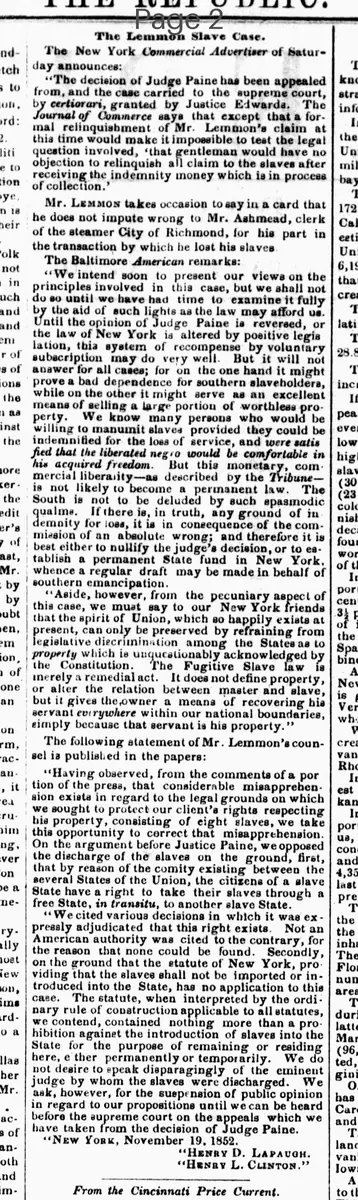
The New York Commercial Advertiser of Saturday announces:
"The decision of Judge Paine has been appealed from, and the case carried to the supreme court, by certiorari, granted by Justice Edwards. The Journal of Commerce says that except that a formal relinquishment of Mr. Lemmon's claim at this time would make it impossible to test the legal question involved, 'that gentleman would have no objection to relinquish all claim to the slaves after receiving the indemnity money which is in process of collection.'
Mr. Lemmon takes occasion to say in a card that he does not impute wrong to Mr. Ashmead, clerk of the steamer City of Richmond, for his part in the transaction by which he lost his slaves
The Baltimore American remarks:
"We intend soon to present our views on the principles involved in this case, but we shall not do so until we have had time to examine it fully by the aid of such lights as the law may afford us. Until the opinion of Judge Paine is reversed, or the law of New York is altered by positive legislation, this system of recompense 'by voluntary subscription may do very well.' But it will not answer for all cases; for on the one hand it might prove a bad dependence for southern slaveholders, while on the other it might serve as an excellent means of selling a large portion of worthless property. We know many persons who would be willing to manumit slaves provided they could be indemnified for the loss of service, and were satisfied that the liberated negro would be comfortable in his acquired freedom. 'But this monetary, commercial liberality-as described by the Tribune- is not likely to become a permanent law. The South is not to be deluded by such spasmodic qualms. If there is, in truth, any ground of indemnity for loss, it is in consequence of the commission of an absolute wrong;" and therefore it is best either to nullify the judge's decision, or to establish a permanent State fund in New York, whence a regular draft may be made in behalf of southern emancipation."
"Aside, however, from the pecuniary aspect of this case, we must say to our New York friends that the spirit of Union, which so happily exists at present, can only be preserved by refraining from legislative discrimination among the States as to property which is unquestionably acknowledged by the Constitution. The Fugitive Slave law is merely a remedial act. It does not define property, or alter the relation between master and slave, but it gives the owner a means of recovering his servant everywhere within our national boundaries, simply because that servant is his property.
The following statement of Mr. Lemmon's counsel is published in the papers:
"Having observed, from the comments of a portion of the press, that considerable misapprehension exists in regard to the legal grounds on which we sought to protect our client's rights respecting his property, consisting of eight slaves, we take this opportunity to correct that misapprehension. On the argument before Justice Paine, we opposed the discharge of the slaves on the ground, first, that by reason of the comity existing between the several States of the Union, the citizens of a slave State have a right to take their slaves through a free State, in transitu, to another slave State.
"We cited various decisions in which it was expressly adjudicated that this right exists. Not an American authority was cited to the contrary, for the reason that none could be found. Secondly, on the ground that the statute of New York, providing that the slaves shall not be imported or introduced into the State, has no application to this case. The statute, when interpreted by the ordinary rule of construction applicable to all statutes, we contend, contained nothing more than a prohibition against the introduction of slaves into the State for the purpose of remaining or residing here, either permanently or temporarily. We do not desire to speak disparagingly of the eminent judge by whom the slaves were discharged. We ask, however, for the suspension of public opinion in regard to our propositions until we can be heard before the supreme court on the appeals which we have taken from the decision of Judge Paine.
"New York, November 19, 1852.
"HENRY D. LAPaugh.
"HENRY L. CLINTON."
What sub-type of article is it?
What themes does it cover?
What keywords are associated?
What entities or persons were involved?
Where did it happen?
Story Details
Key Persons
Location
New York
Event Date
November 19, 1852
Story Details
Mr. Lemmon's eight slaves were discharged by Judge Paine in New York while in transit. The decision is appealed to the supreme court. Discussions on indemnity via subscription, legal rights under comity and New York statutes, and preserving Union spirit by recognizing constitutional property rights in slaves per Fugitive Slave Law.