Thank you for visiting SNEWPapers!
Sign up free
Richmond Enquirer
Richmond, Richmond County, Virginia
What is this article about?
Diplomatic correspondence from 1816 between US Secretary of State James Monroe and Spanish envoy Chevalier de Onis, addressing Louisiana boundaries, spoliation claims, New Orleans deposit suppression, and US neutrality in Spanish American revolutions. Includes instructions to negotiator George W. Erving and reports on enforcement in Louisiana.
Merged-components note: Direct textual continuation of the letter from the U.S. Secretary of State to the Chevalier de Onis regarding U.S.-Spain relations, boundaries of Louisiana, and neutrality issues; sequential reading order across pages.
Clippings
1 of 2
OCR Quality
Full Text
Department of State,
June 10, 1816.
SIR,
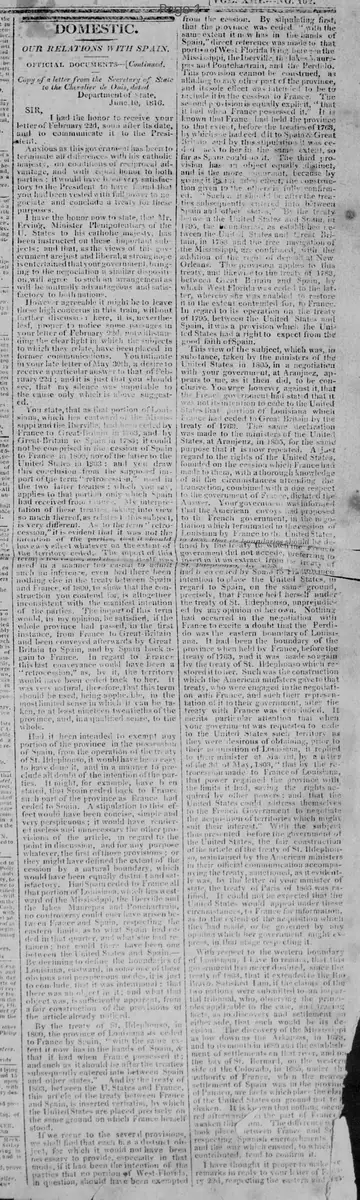
I had the honor to receive your letter of February 22d, soon after its date, and to communicate it to the President.
Anxious as this government has been to terminate all differences with his catholic majesty, on conditions of reciprocal advantage, and with equal honor to both parties; it would have been very satisfactory to the President to have found that you had been vested with full power to negotiate and conclude a treaty for these purposes.
I have the honor now to state, that Mr. Erving, Minister Plenipotentiary of the U. States to his catholic majesty, has been instructed on these important subjects; and that, as the views of this government are just and liberal, a strong hope is entertained that your government, bringing to the negotiation a similar disposition, will agree to such an arrangement as will be mutually advantageous and satisfactory to both nations.
However agreeable it might be to leave these high concerns in this train, without further discussion here, it is, nevertheless, proper to notice some passages in your letter of February 22d, notwithstanding the clear light in which the subjects to which they relate, have been placed in former communications. You intimate in your late letter of May 30th, a desire to receive a particular answer to that of February 22d: and it is just that you should see, that my silence was imputable to the cause only which is above suggested.
You state, that as that portion of Louisiana, which lies eastward of the Mississippi and the Iberville, had been ceded by France to Great-Britain in 1763, and by Great-Britain to Spain in 1783; it could not be comprised in the cession of Spain to France in 1800, nor of the latter to the United States in 1803: and you draw this conclusion from the supposed import of the term "retrocession," used in the two latter treaties: which you say, applies to that portion only which Spain had received from France. My interpretation of these treaties, taking into view so much thereof, as relates to this subject, is very different. As to the term "retrocession," it is evident that it was not the intention of the parties, that it should have any effect whatever on the extent of the territory ceded. The import of this term is too vague, and it itself was used in a manner too casual to admit such an inference, even had there been nothing else in the treaty between Spain and France, of 1800, to show that the construction you contend for, is altogether inconsistent with the manifest intention of the parties. The import of this term would, in my opinion, be satisfied, if the whole province had passed, in the first instance, from France to Great-Britain and been conveyed afterwards by Great-Britain to Spain, and by Spain back again to France. "In regard to France this last conveyance would have been a "retrocession," as, by it, the territory would have been ceded back to her. It was very natural, therefore, that this term should be used, being applicable, in the most limited sense in which it can be taken, to at least nineteen twentieths of the province, and, in a qualified sense, to the whole.
Had it been intended to exempt any portion of the province in the possession of Spain, from the operation of the treaty of St. Ildefonso, it would have been easy to have done it, and in a manner to preclude all doubt of the intention of the parties. It might, for example, have been stated, that Spain ceded back to France such part of the province as France had ceded to Spain. "A stipulation to this effect would have been concise, simple and very perspicuous: it would have rendered useless and unnecessary the other provisions of the article, in regard to the point in discussion, and for any purpose whatever. the first of those provisions: or they might have defined the extent of the cession by a natural boundary, which would have been equally distinct and satisfactory. Had Spain ceded to France all that portion of Louisiana, which lies westward of the Mississippi, the Iberville and the lakes Maurepas and Pontchartrain, no controversy could ever have arisen between France and Spain, respecting the eastern limits, as to what Spain had ceded in that quarter, and what she had retained: nor could there have been one between the United States and Spain,—
By declining to define the boundaries of Louisiana, eastward, in some one of these obvious and perspicuous modes, it is just to conclude, that it was intentional: that there was an object in it: and what that object was, is sufficiently apparent, from a fair construction of the provisions of the article already noticed.
By the treaty of St. Ildefonso, in 1800, the province of Louisiana is ceded to France by Spain, "with the same extent that it now has in the hands of Spain, & that it had when France possessed it: and such as it should be after the treaties subsequently entered into between Spain and other states." And by the treaty of 1803, between the U. States and France, this article of the treaty between France and Spain, is inserted verbatim, by which the United States are placed precisely on the same ground on which France herself stood.
If we recur to the several provisions, we shall find that each has a distinct object, for which it would not have been necessary to provide, especially in that mode, if it had been the intention of the parties that no portion of West-Florida, in question, should have been exempted from the cession. By stipulating first, that the province was ceded "with the same extent it now has in the hands of Spain," direct reference was made to that portion of West Florida lying between the Mississippi, the Iberville, the lakes Maurepas and Pontchartrain, and the Perdido. This provision cannot be construed, as alluding to any other part of the province, and its sole effect was intended to be to include it in the cession to France. The second provision is equally explicit, "that it had when France possessed it." It is known that France had held the province to that extent, before the treaties of 1763, by which she had ceded it to Spain & Great Britain and by this stipulation it was ceded back to her in the same extent, so far as Spain could do it. The third provision has an object equally distinct, and is the more so, because by giving it its intended effect, the construction given to the others is fully confirmed. "Such as it should be after the treaties subsequently entered into between Spain and other states." By the treaty between the United States and Spain, in 1795, the boundaries, as established between the United States and Great Britain, in 1783 and the free navigation of the Mississippi, are confirmed, with the addition of the right of deposit at New Orleans. This provision applies to this treaty, and likewise to the treaty of 1783, between Great Britain and Spain, by which West Florida was ceded to the latter, whereby she was enabled to restore it in the extent contended for, to France.
In regard to its operation on the treaty of 1795, between the United States and Spain, it was a provision which the United States had a right to expect from the good faith of Spain.
This view of the subject, which was, in substance, taken by the ministers of the United States in 1805, in a negotiation with your government, at Aranjuez, appears to me, as it then did, to be conclusive. You urge however against it, that the French government had stated that it was not its intention to cede to the United States that portion of Louisiana which France had ceded to Great Britain by the treaty of 1763. The same declaration was made to the ministers of the United States, at Aranjuez, in 1805, for the same purpose that it is now repeated. A just regard to the rights of the United States, founded on the cession which France had made to them, with a thorough knowledge of all the circumstances attending the transaction, combined with a due respect to the government of France, dictated the Answer. Your government was informed that the American envoys had proposed to the French government, in the negotiation which terminated in the cession of Louisiana by France to the United States, in 1803 that the boundaries should be defined by the treaty to which the French government did not accede, preferring to insert in it an extract from the treaty of St. Ildefonso, by a which it had been ceded by Spain to France the province intention to place the United States, in regard to Spain, on the same ground, precisely, that France held herself under the treaty of St. Ildefonso, unprejudiced by any opinion of her own. Nothing had occurred in the negotiation with France to excite a doubt that the Perdido was the eastern boundary of Louisiana. It had been the boundary of the province when held by France, before the treaty of 1763, and it was made so again by the treaty of St. Ildefonso which restored it to her. Such was the construction which the American ministers gave to that treaty, who were engaged in the negotiation with France, and such their representation of it to their government, after the treaty with France was concluded. It merits particular attention that when your government was requested to cede to the United States such territory as they were desirous of obtaining, prior to their acquisition of Louisiana, it replied to their minister at Madrid, by a letter of the 31st of May, 1803, "that by the retrocession made to France of Louisiana, that power regained the province with the limits it had, saving the rights acquired by other power: and that the United States could address themselves to the French Government to negotiate the acquisition of territories which might suit their interest." With the subject thus presented before the government of the United States, the fair construction of the article of the treaty of St. Ildefonso, maintained by the American ministers in their official communication accompanying the treaty, sanctioned, as it evidently was, by the letter of our minister of state, the treaty of Paris of 1803 was ratified. It could not be expected that the United States would appeal under these circumstances, to France for information, as to the extent of the acquisition which they had made, or be governed by any opinion which her government might express, in that stage respecting it.
With respect to the western boundary of Louisiana, I have to remark, that this government has never doubted, since the treaty of 1803, that it extended to the Rio Bravo. Satisfied I am, if the claims of the two nations were submitted to an impartial tribunal, who, observing the principles applicable to the case, and the facts, as to discovery and settlement on either side, that such would be its decision. The discovery of the Mississippi as low down as the Arkansas, in 1673, and to its mouth in 1682 and the establishment of settlements on that river, and on the bay of St. Bernard, on the western side of the Colorado, in 1698, under the authority of France, when the nearest settlement of Spain was in the province of Panuco, are facts which place the claim of the United States on ground not to be shaken. It is known that nothing occurred afterwards, on the part of France which weaken this claim. The differences which took place between France and Spain respecting Spanish encroachments and the war which ensued, to which France contributed, tend to confirm it.
I have thought it proper to make these remarks in reply to your letter of February 22d, respecting the eastern and western limits of Louisiana.
the boundary of Louisiana. The subject having been fully treated in several notes to your government in 1808, and particularly in those of March 8th, and April 20th of that year. I beg leave to refer you to them for a further view of the sentiments of this government on the subject. In adverting to the parts of your letter which relate to the revolted provinces of Spain in America, and the aid, which you state, the revolutionary party have derived from the U. States; I cannot avoid expressing equally my surprise and regret. I stated in my letter to you of January 15th, that no aid had ever been afforded them, either in money, manner or supplies of any kind by the government, not presuming that the gratuitous supply of provisions to the unfortunate people of Caracas, in consequence of the calamity with which they were visited, would be viewed in that light, and that aid to them from our citizens, inconsistent with the laws of the United States, and with the law of nations, had been prohibited, and that the prohibition had been enforced with care and attention. You stated in your letter of January 29th, that forces were collecting in different parts of our western and southern country, particularly in Kentucky, Tennessee and Louisiana, for the purpose of invading the Spanish provinces. I stated to you in reply, that I knew of no such collection of troops in any quarter, and that from information derived from the highest authorities, I was satisfied that none such had been made. I requested you to state at what points these troops were collected, and who were the commanders? You have sent me, in reply, extracts of letters from persons whose names are withheld, which establish none of the facts alleged as to the raising of troops in the United States, but recite only vague rumors to that effect. I have the honor to transmit to you a copy of a letter on this subject, from Mr. Dick, the attorney of the United States for the district of Louisiana, by which you will see how attentive the public authorities there have been to the execution of the laws of the United States, and to the orders of the government and how little they have deserved the charges made against them. As I cannot doubt that you have taken erroneous impressions from the misrepresentations of partial or uninformed individuals, and that you have communicated the same to your government, I rely on your candor to adopt such measures as may appear best calculated to place the whole subject before it in a true light. It is important that the effort which the President is now making to adjust our differences with Spain, should have the desired result, and it is presumable that a correct knowledge of the conduct of the United States, in these circumstances, would promote it. I have the honor to be, &c. JAMES MONROE. Copy of a letter from Mr. Dick, attorney of the U. States for the District of Louisiana, to Mr. Monroe, enclosed to Mr. Onis in the Secretary of State's letter of June 10, 1816. New-Orleans, March 1, 1816. SIR, I have just had an opportunity of perusing the letters of the Chevalier de Onis, Envoy Extraordinary and Minister Plenipotentiary of his catholic majesty, addressed to you under date of the 20th of December and the 2d of January. As these letters dwell largely upon transactions affecting the neutrality of the U. States, which are said to have occurred, or still occurring here—and as they charge the public authorities of this city with giving, in the face of the President's proclamation of the 1st of September last, protection and support to the enemies of his catholic majesty, I think it not improper to address you in relation to these charges. It is affirmed by the Chevalier de Onis, and it is, says he universally public and notorious, that a factious band of insurgents and incendiaries, continue with impunity, in the Province of Louisiana, and especially in New-Orleans and Natchitoches, the uninterrupted system of raising and arming troops to light the flame of revolution in the kingdom of New Spain. All Louisiana, he continues has witnessed these armaments—the public enlistments—the transportation of arms-rejunction of the insurgents—and the hostile and warlike march from the territory of this republic against the possessions of a friendly and neighbouring Power. No troops at present are, or at any former period were, openly raised, armed or enlisted at Natchitoches, or at New-Orleans, or at any other point within the State of Louisiana. Arms have been transported from this place by sea, and otherwise, as objects of merchandise, and probably have been disposed to some of the revolutionary governments of New Spain. It has not been supposed here that there was any law of the U. States, any provision by treaty, or any principle of national law that prohibit this species of commerce: it was considered that the purchasing and exporting, by way of merchandise, of articles termed contraband, was free alike to both belligerents: and that if our citizens engaged in it, they would be abandoned to the penalties which the laws of war authorize. What is said, too, about the injunction of the insurgents, and their hostile and warlike march from the territory of the U. States against the possessions of Spain, is unfounded. In the summer of the year 1812, a band of adventurers, without organization, and, apparently, without any definite object, made an incursion into the province of Texas, as far as San Antonio, by the way of Nacogdoches. No doubt many of the persons belonging to this party, passed by the way of Natchitoches -but separately, in no kind of military array, and under such circumstances as to preclude the interference of the civil or military authorities of the U. S. or of the State of Louisiana. What could be effected in this respect was done: twice in the years of 1811, '12, parties of adventurers, who had assembled between the Rio Hondo and the Sabine, (then neutral territory) were dispersed by the garrison of Natchitoches, their boats demolished, and their whole establishment broken up. The party that marched upon San Antonio assembled to the west of the Sabine, and the operation of our laws and orders thence carried on their operations. Far from troops, upon this occasion, assembling at different points, forming a junction within the territories of the United States, and marching thence, I am assured, by various and most respectable authorities, that, although it was, generally understood at Natchitoches, that some enterprize was on foot, it was extraordinary to see two of the persons, supposed to be engaged in it, together. The officer commanding at that time the United States at Natchitoches. (major Wolstoncraft,) offered his services to the civil authority in aid of the laws, and to preserve inviolate the neutrality they en force. In consequence, several individuals found with arms were arrested: they alleged that they were hunters, and there being no evidence to the contrary, or rather no proof of their being engaged in any illegal undertaking. they were of course discharged. So well satisfied, indeed, were the Spanish authorities of the adjoining province, that neither our government, or its agents, gave succours or countenance to this expedition, that during the time they knew it to be organized, or organizing, they applied to the garrison at Natchitoches for an escort to bring in some specie, which was immediately granted. Toledo, who, at the time of its defeat, commanded the party that penetrated to San Antonio, came to this city in the autumn of 1814, when he was immediately arrested, and recognized to answer, at the succeeding term of the federal court, to a charge of setting on foot, within the territory of the United States, a military expedition or enterprize, to be carried on from thence against the territories or dominions of the King of Spain; 6 months having passed, and no testimony whatever appearing against him, his recognizance was delivered up. After the discomfiture of the party under Toledo, no enterprize, destined to aid the revolutionists of New-Spain appears to have been set on foot from the vicinity of the United States, until late in the summer of last year, when it was rumored that a party, under a person of the name of Perry, was forming for that purpose, somewhere on the western coast of Louisiana. Upon the first intimation that this enterprize was meditated, steps were taken here to frustrate it. Nothing occurred to justify prosecutions or arrests -a large quantity of arms, however, supposed to be intended for this party, were seized on the river, and detained at the custom house for several months: and commodore Patterson, commanding naval officers on this station, instructed the officers under his command, cruising in the neighborhood of the suspected place of rendezvous, (Belle Isle, at the mouth of Bayou Peche,) to ascertain the truth of the rumours in circulation, and, if verified, to use the force under their respective commands in dispersing the persons assembled, and in frustrating their illegal intentions. In obedience to these orders, the coast, as far as the Sabine, was examined, and no persons discovered, It is now ascertained that Perry, Humbert, and their followers, inconsiderable in number, passed, Separately, through Attakapas, and assembled about two leagues to the west of the Sabine. Thence they embarked for some place on the coast of Mexico; were wrecked, dispersed, and their plans, whatever they were, totally defeated. I have, in the foregoing detail, sir, given, partly from information entitled to perfect confidence, and partly from my own knowledge, a brief and hurried outline of two fruitless attempts of a handful of restless and uninfluential individuals, stimulated by the desire of siding the cause of Mexican Independence, or that of bettering their own fortunes. These are the only military enterprises against the dominions of Spain, that have originated from Louisiana. In both, the mass of adventurers was composed of Spaniards, sons of the Spanish crown, that have from Louisiana. In both, the mass of drawn any portion of their aid or support military enterprises against the dominions Frenchmen and Italians. I need not say that these enterprizes, whether in aid of the revolutionists, or merely predatory, were not only feeble and insignificant, but that they were formed under circumstances which forbid a surmise of their being sanctioned or connived at. Every man acquainted with the state of public feeling throughout the Southern and Western sections of the United States, knows, that had our government but manifested the slightest disposition to sanction enterprizes in aid of the revolutionists of New Spain, the condition of these Provinces would not at this day be doubtful. It is said that troops have been recently enlisted, and that expeditions have been preparing, or are prepared, in this city, to invade the dominions of Spain. The enlisting of men, and the preparing of enterprizes, or the means for enterprizes, of the kind spoken of, cannot be accomplished without means, or be carried on the midst of a populous city, in solitude and silence. Yet it is known, in the first place, that neither Mr. Toledo or Mr. Herrera had or have pecuniary means for such purposes; and, in the second, so far as negative proof can go, or so far as the absence of one thing implies another, it is most certain that no enlistments have taken place, and that no expeditions, or the means of expeditions, have been prepared, or are preparing here. A regard to truth makes it necessary to say, that what is alleged respecting the arming and fitting out of vessels within the waters of Louisiana, to be employed in the service of the revolutionary governments, against the subjects or property of the king of Spain, is unfounded. At no period since the commencement of the struggle between the Spanish colonies and the mother country have vessels, to be employed in the service of the colonies, been permitted to fit out and arm, or to augment their force at New-Orleans, or elsewhere, within the state of Louisiana. On the contrary, it is notorious, that to no one point of duty have the civil and military authorities of the United States directed more strenuously, or, it is believed, more successfully, their attention, than to the discovering and suppression of all attempts to violate the laws in these respects. Attempts to violate them, by fitting out and arming, and by augmenting the force of vessels, have no doubt been frequent, but certainly in no instance successful, except where conducted under circumstances of concealment, that eluded discovery, and almost suspicion, or were carried on at some remote point of the coast, beyond the reach of detection or discovery. In every instance where it was known that these illegal acts were attempting, or where it was afterwards discovered that they had been committed, the persons engaged, as far as they were known, have been prosecuted, while the vessels fitted out, or attempted to be fitted out, have been seized and libelled, under the act of the 5th of June, 1794; and where captures have been made by vessels thus fitted out and armed, in which their force was augmented, of merchandise within our waters, where the property taken was brought within our jurisdiction, or even found upon the high seas by our cruizers, and brought in, it has been restored to the original Spanish owners, and in some instances, damages awarded against the captors. An enumeration of the cases in which individuals have been prosecuted for infringing, or attempting to infringe our neutrality, in aid of the governments of New Spain, and in which vessels have been seized and libelled, under the act of the 5th of June, 1794, together with a list of the vessels and property restored to the original Spanish owners (confining the whole of the operations of the year commencing March, 1815, and ending February, 1816,) will show more exclusively, perhaps, than anything else can, how totally without foundation are the complaints of Spain on this head. The names of individuals presented in the district court of the United States, for the Louisiana district, during the year 1815, for violating, or attempting to violate the neutrality of the United States, in aid of the governments of the United Provinces of New Grenada, and of the United Provinces of Mexico. Jose Alvarez de Toledo. Julies Caesar Amazoni. Vincent Gamble. John Robinson. Romain Very. Pierre Scemeson. Bernard Bourdin. List of the vessels libelled for illegal outfits in aid of the same governments, during the same period. Brig Flora, Americana, restored. Sch. Presidente, condemned. Petit Milan, to. Gen. Bolivar, discontinued. Eugene, alias Indiana, condemned. Two Brothers, restored. Enumeration of vessels and property brought within the Louisiana district, captured under the flags and by the authority of the governments of New Granada and of Mexico, libelled on the part of the original Spanish owners, and restored upon the ground that the capturing vessels had been fitted out and armed, or had their forces augmented within the waters of the U. States. 1. Schooner Cometa. restored April, 1815. 2. Schooner Dorada, proceeds restored 16th May. 1815, $3,050 00 3. Schooner Amiable, Maria, do. do. 3,850 00 4. Schooner Experimente, re- stored 3d August. 5. The Polacre brig de Regla, and cargo. proceeds resto- red 18th Dec. 1815. 19,209 50 6. Schooner Alesta and cargo, being the proceeds of the capture of about 18 small ressels, restored 11th Dec. 1815 62,150 05 Damages awarded to the origi- nal owners against the cap- tors in the two foregoing ca- ses, 55,272 97 7. The cargo of the schooner Petit Milan, restored Feb. 1816, 2,444 31 8. The cargo of the schooner Presidente, 1st February 1816, 10,931 15 9. Schooner Sankita and car- go, restored 1st February, 1816, 37,962 94 The preceding account of Spanish pro- perty restored to the original proprietors, after being in possession of the enemies of Spain, is defective, inasmuch as it does not comprehend the whole of the cases of restoration that have taken place within the period to which the detail is confined; the very hasty manner in which I have made this enumeration, did not admit of a more accurate statement. The principal cases, however, are included in it. In several other cases, where the pro- perty was claimed for the original spanish owners, the claims were dismissed, be- cause it did not appear that any violation of our neutrality had taken place. The capturing vessels were not armed, nor was their force augmented, within our jurisdiction; nor had the captures been made within a marine league of our shore. The principles that guided the decisions of the court, as well in restoring the property captured, where our neutral means had been used, as in declining all interference, where that was not the case, manifest, I think, a disposition to, and an exercise of, the most rigid neutrality be- tween the two parties. I have the honor to be, with sentiments of the highest consideration and respect, sir, your most obedient servant, JOHN DICK. (C.) From the Secretary of State to George W. Erving. Department of State, March 11, 1816. SIR, You will set out in discharge of the duties of your mission to Spain as soon after the receipt of this letter as circumstances will permit. Our relations with that country are, from many causes, becoming daily more and more interesting. They will require your assiduous and zealous attention, as soon as you are recognized by the Spanish government. The restoration of the diplomatic intercourse between the two countries, long interrupted by causes well known to you, presents a favourable opportunity for the settlement of every difference with that power. The President has already manifested his sincere desire to take advantage of it for that purpose, and hopes that the Spanish government cherishes a similar disposition. The primary causes of difference proceeded from spoliations on their commerce, for which Spain is held responsible, the justice of which she admitted by a convention: and from the refusal of the Spanish government to settle on just principles the boundaries of Louisiana, and to compensate, on like principles, for the injuries arising from the suppression of the deposit at N. Orleans, in breach of the treaty of 1795. The grounds of these differences have been so often discussed, and the justice of our claims so completely established, in the instructions heretofore given, and in communications with the Spanish government, that it is thought unnecessary to enter into them in this letter. Other injuries have likewise been since received from Spain, particularly in the late war with G. Britain, to which it may be proper for you to advert. I shall transmit to you herewith such papers relating to our claims in every instance, as will place their merits in a just light. In a conversation with Mr. Onis, shortly after the late correspondence with him, he intimated that his government was sincerely desirous of settling these differences, and that it might be willing to cede its claim to territory on the Eastern side of the Mississippi, in satisfaction of claims and in exchange for territory on the Western side. He expressed also a desire that the negotiation might take place at Madrid, rather than in this city. It was expected that he had been already furnished with full powers to negotiate such a treaty, and it would be more agreeable to conclude it here, if he had such powers, or might soon procure them, provided there was any ground to hope an early termination of it. But from the experience we have already had, it may be fairly apprehended that a negotiation here would lead to very extraordinary delays, which it is wished to avoid. The President will soon decide on the whole subject, after which you shall be duly instructed of the course to be pursued, and of the measures to be taken. These instructions shall be forwarded to you at Madrid by Mr. Henry B. Smith. Extract of a letter from the Secretary of State to Geo. W. Erving. Department of State, May 30, 1816. SIR, To enable you to make the experiment on which the President has again decided to settle our differences with Spain, I enclose a letter of instruction, which, being shown to the Spanish government, will be your authority for the purpose. As the justice of the claims of the United States, in every instance, has been fully established in former discussions, the documents relating to which are in your possession, I shall not enter into the subject in that view. It can hardly be presumed, that the Spanish government, after what has passed, will be desirous of resuming this discussion. Should such a disposition be manifested, those documents will enable you to place the subject in a proper light. I shall proceed, therefore, to state the conditions on which the settlement may now be made: The U. States complained in 1805 of injuries from Spain- 1st. By spoliation on their commerce. 2d. By the suppression of the deposit at N. Orleans: and 3d. By the refusal of the Spanish gov't. to settle the boundaries of Louisiana on just principles. Of spoliations there were two classes- the first consisted of seizures made of American vessels by Spanish cruisers-the second of seizures of other of our vessels by French cruisers, who carried them into Spanish ports, where they were condemned by French consuls. For the first class, provision was made by a convention between the two governments, at Madrid, bearing date on the 11th of August, 1802, which the Spanish government afterwards refused to ratify. For the second, no provision was ever made, though the claim was specially reserved in that convention. The suppression of the deposit at N. Orleans was in direct violation of an article of the treaty of 1795. By the cession of Louisiana, the United States claim, (and, as they think, have proved by a clear title) all the territory lying between the Perdido, on the Eastern side of the Mississippi, to the Rio Bravo, on the Western. They well know, that France would have claimed to the same extent, had she not made the cession; though as the French government declined defining the boundaries by the treaty, as was desired, no appeal was made to it by this government, or thought proper, afterwards, respecting them. Extract of a letter from Mr. Erving to the Secretary of State, dated "MADRID, August 29th, 1816. "Mr. Henry B. Smith arrived at Cadiz on the 26th July, and at Madrid on the 10th instant—By him I received your letters of May 30 and 31, the new cypher, the special power to negotiate, and the other papers therein referred to. It was after duly deliberating on those and the several instructions which had preceded them, that I formed my first note to Mr. Cevallos; this was sent to him on the 26th inst.—a copy of it (No. 6) is herewith submitted." [No. 6.] Mr. Erving to Mr. Cevallos. MADRID, August 26, 1816. SIR, The President is sincerely desirous of establishing the relations of amity between the United States and Spain on a solid basis, and that every obstacle to a permanent good understanding between the two countries should be removed by arrangements honourable and advantageous to both; he does not doubt of finding corresponding dispositions on the part of his Catholic majesty, therefore has readily acceded to the particular wishes of his majesty by receiving Mr. Onis, and in the same friendly confidence has ordered me to repair to this Court. I am specially instructed to discuss and to settle with your excellency, all the ancient causes of misunderstanding, as well as the questions growing out of recent occurrences, which are of a character unfavourable to the object in view. It is desirable that no matter of future contention or jealousy should remain, to put at hazard or to interrupt the good intelligence which the United States are always disposed to maintain with Spain, and to all the advantages of which his majesty's government cannot but be wholly sensible. In transactions where the parties enter with such dispositions, and such motives to accord, a frank exposition of all the grounds of complaint is at once the most just and most judicious course; for to suppress or to smother any of them in condescension to temporary considerations, is but to leave the seeds of future discord, and to substitute palliatives and expedients for satisfactory and solid arrangements. It is proper, therefore, that I should state distinctly all the points on which the United States seek for redress and indemnity, commencing with those claims which have heretofore been the subject of unsuccessful negotiation. I am well persuaded, that the whole can now be settled in a manner satisfactory to both parties, and without reviving whatever animosities they may have originally given rise to. In the present exposition, I may also forbear to enter into the details of the principal subjects to which it refers: because these have, for the most part, in some form or other, been already brought to the view of the Spanish government, and because your excellency in part possesses the most perfect knowledge of them. The first point to which I must call your attention, is the claim of my government for compensation to its citizens, on account of the ravages committed on their commerce previous to the year 1802. This is an object which the U. States never has, and never can lose sight of; indeed the justice of the claim has already been admitted by the Spanish government in a convention negotiated and signed by your excellency, on the 11th Aug. 1802. The United States still expect that this claim shall be adjusted upon principles of law and equity, which cannot be called into question by his majesty's government. In the same manner, the United States expect that compensation will be made for all the injuries done to their commerce, under the authority of the Spanish government, or within its jurisdiction, previous to the date of said convention, not embraced by it, and the claim for which was especially reserved by that convention; as well as for all similar injuries subsequent to its date. The suppression of the deposit at N. Orleans in the year 1802, violating the treaty of 1795, forms another claim of great importance. Causes of misunderstanding of a later date and of another character, accumulated principally during the war between the United-States and Great Britain. These were of so unfriendly, and in many cases of so violent a nature, as to threaten an immediate and serious rupture between the United States and Spain -but happily, the pacific policy which has uniformly characterised the conduct of the United States towards Spain, was still upheld by considerations highly honourable to the moral character of the American government; considerations growing out of the then unhappy domestic state of the Peninsula, and the miseries and disorders to which a most unjust foreign invasion had made it a prey: the American government always trusting, that Spain, on the establishment of its national independence and the restoration of regular government and tranquility, would readily attend to the just demands of the U. S. and cheerfully embrace their conciliatory proposals. It will suffice for the present, that I mention (but succinctly) the principal matters above adverted to—these are: 1st. The encouragement which was given by the Spanish authorities in E. Florida to the Indian tribes in Georgia, and generally on the Southern frontier, to make war on the U. States. 2nd. The aid given to them in that war. 3rd. The aid afforded to G. Britain by permitting supplies to be sent through E. Florida to the Indian tribes: and afterwards by allowing her to establish a place of arms in that province, for the purpose of encouraging and supporting the Indians in their savage war. These acts were evident & very important violations of the neutrality which Spain was bound to observe between the belligerents. Her duties as a neutral power were altogether lost sight of, when the U. S. frigate Essex was attacked in the bay of Valparaiso. The seizure of American property, and the imprisonment of American citizens, in various modes and under various pretexts, both in the Peninsula and in the colonies, afforded unequivocal indications of an unfriendly temper; several of these acts may hereafter require special representations on my part—my present object is to bring them generally to your view. The President relies upon the just sense which his majesty must entertain of the important crisis of our affairs, which such events are of a nature to produce, for the adoption of a policy congenial to the interests of both countries; and the President persuades himself that the same just and amicable disposition will be prompt in affording the satisfaction required for the injuries complained of, and that thus a state of lasting peace and friendly intercourse may be secured between two countries, whose relative situations and interests render that state so peculiarly desirable. Finally, the questions respecting boundaries, which have heretofore been supposed to offer some obstacles to a settlement of other differences, the American government considers as susceptible of amicable adjustment, and I am instructed to treat with your excellency on that subject. I have the honour to be &c. GEORGE W. ERVING. [To be Continued.]
What sub-type of article is it?
What keywords are associated?
What entities or persons were involved?
Where did it happen?
Foreign News Details
Primary Location
Spain
Event Date
June 10, 1816
Key Persons
Outcome
ongoing negotiations over louisiana boundaries from perdido to rio bravo, spoliation claims, new orleans deposit, and us enforcement of neutrality in spanish american revolutions with seizures and restorations of spanish property.
Event Details
US Secretary of State James Monroe responds to Spanish envoy Onis on Louisiana treaty interpretations, asserting US claims to full extent including West Florida. Addresses neutrality charges in Louisiana regarding aid to Spanish American revolutionaries, enclosing report from US Attorney Dick detailing enforcement actions, prosecutions, and restorations. Instructions to Erving for negotiations in Madrid on boundaries, spoliations, and war-related injuries. Erving's initial note to Cevallos outlines US demands for redress.