Thank you for visiting SNEWPapers!
Sign up free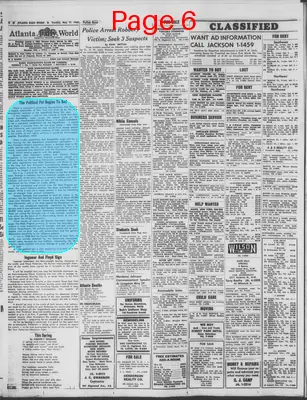
Editorial
May 17, 1960
Atlanta Daily World
Atlanta, Fulton County, Georgia
What is this article about?
Editorial speculates on 1960 Republican ticket with Nixon and Rockefeller, praises Kennedy's West Virginia primary win over Humphrey as overcoming religious bias, notes Indiana primary results, and expresses optimism about American political maturity focusing on qualifications over religion or race.
Clipping
OCR Quality
98%
Excellent
Full Text
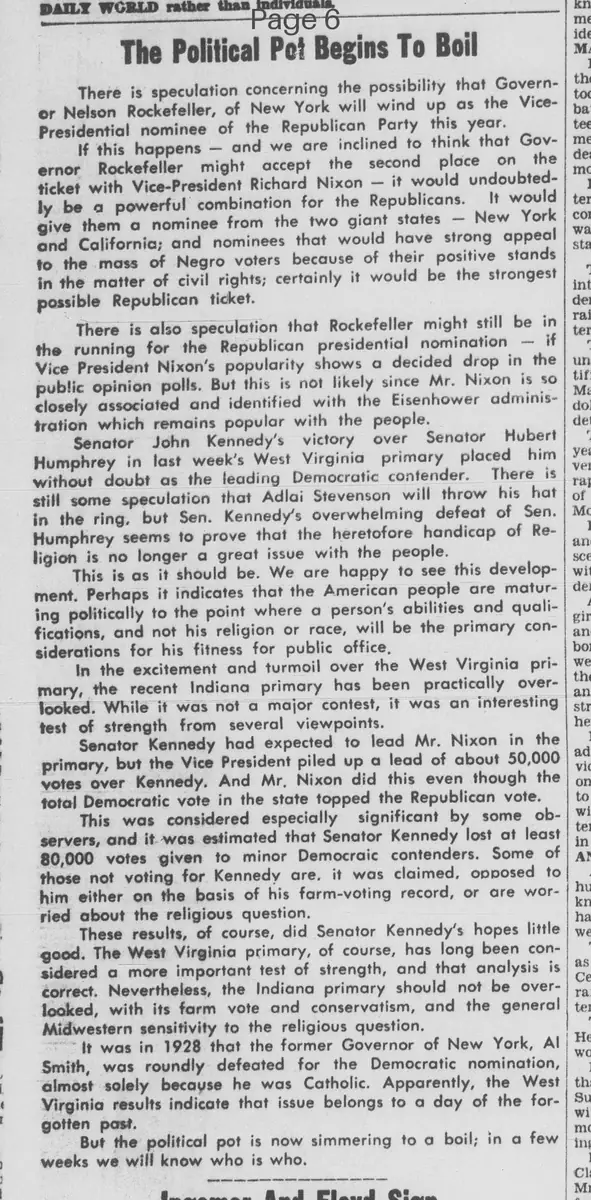
The Political Pot Begins To Boil
There is speculation concerning the possibility that Governor Nelson Rockefeller, of New York will wind up as the Vice-Presidential nominee of the Republican Party this year.
If this happens - and we are inclined to think that Governor Rockefeller might accept the second place on the ticket with Vice-President Richard Nixon - it would undoubtedly be a powerful combination for the Republicans. It would give them a nominee from the two giant states - New York and California; and nominees that would have strong appeal to the mass of Negro voters because of their positive stands in the matter of civil rights; certainly it would be the strongest possible Republican ticket.
There is also speculation that Rockefeller might still be in the running for the Republican presidential nomination - if Vice President Nixon's popularity shows a decided drop in the public opinion polls. But this is not likely since Mr. Nixon is so closely associated and identified with the Eisenhower administration which remains popular with the people.
Senator John Kennedy's victory over Senator Hubert Humphrey in last week's West Virginia primary placed him without doubt as the leading Democratic contender. There is still some speculation that Adlai Stevenson will throw his hat in the ring. but Sen. Kennedy's overwhelming defeat of Sen. Humphrey seems to prove that the heretofore handicap of Religion is no longer a great issue with the people.
This is as it should be. We are happy to see this development. Perhaps it indicates that the American people are maturing politically to the point where a person's abilities and qualifications, and not his religion or race, will be the primary considerations for his fitness for public office.
In the excitement and turmoil over the West Virginia primary, the recent Indiana primary has been practically overlooked. While it was not a major contest, it was an interesting test of strength from several viewpoints.
Senator Kennedy had expected to lead Mr. Nixon in the primary, but the Vice President piled up a lead of about 50,000 votes over Kennedy. And Mr. Nixon did this even though the total Democratic vote in the state topped the Republican vote.
This was considered especially significant by some observers, and it was estimated that Senator Kennedy lost at least 80,000 votes given to minor Democratic contenders. Some of those not voting for Kennedy are, it was claimed, opposed to him either on the basis of his farm-voting record, or are worried about the religious question.
These results, of course, did Senator Kennedy's hopes little good. The West Virginia primary, of course, has long been considered a more important test of strength, and that analysis is correct. Nevertheless, the Indiana primary should not be overlooked, with its farm vote and conservatism, and the general Midwestern sensitivity to the religious question.
It was in 1928 that the former Governor of New York, Al Smith, was roundly defeated for the Democratic nomination, almost solely because he was Catholic. Apparently, the West Virginia results indicate that issue belongs to a day of the forgotten past.
But the political pot is now simmering to a boil; in a few weeks we will know who is who.
There is speculation concerning the possibility that Governor Nelson Rockefeller, of New York will wind up as the Vice-Presidential nominee of the Republican Party this year.
If this happens - and we are inclined to think that Governor Rockefeller might accept the second place on the ticket with Vice-President Richard Nixon - it would undoubtedly be a powerful combination for the Republicans. It would give them a nominee from the two giant states - New York and California; and nominees that would have strong appeal to the mass of Negro voters because of their positive stands in the matter of civil rights; certainly it would be the strongest possible Republican ticket.
There is also speculation that Rockefeller might still be in the running for the Republican presidential nomination - if Vice President Nixon's popularity shows a decided drop in the public opinion polls. But this is not likely since Mr. Nixon is so closely associated and identified with the Eisenhower administration which remains popular with the people.
Senator John Kennedy's victory over Senator Hubert Humphrey in last week's West Virginia primary placed him without doubt as the leading Democratic contender. There is still some speculation that Adlai Stevenson will throw his hat in the ring. but Sen. Kennedy's overwhelming defeat of Sen. Humphrey seems to prove that the heretofore handicap of Religion is no longer a great issue with the people.
This is as it should be. We are happy to see this development. Perhaps it indicates that the American people are maturing politically to the point where a person's abilities and qualifications, and not his religion or race, will be the primary considerations for his fitness for public office.
In the excitement and turmoil over the West Virginia primary, the recent Indiana primary has been practically overlooked. While it was not a major contest, it was an interesting test of strength from several viewpoints.
Senator Kennedy had expected to lead Mr. Nixon in the primary, but the Vice President piled up a lead of about 50,000 votes over Kennedy. And Mr. Nixon did this even though the total Democratic vote in the state topped the Republican vote.
This was considered especially significant by some observers, and it was estimated that Senator Kennedy lost at least 80,000 votes given to minor Democratic contenders. Some of those not voting for Kennedy are, it was claimed, opposed to him either on the basis of his farm-voting record, or are worried about the religious question.
These results, of course, did Senator Kennedy's hopes little good. The West Virginia primary, of course, has long been considered a more important test of strength, and that analysis is correct. Nevertheless, the Indiana primary should not be overlooked, with its farm vote and conservatism, and the general Midwestern sensitivity to the religious question.
It was in 1928 that the former Governor of New York, Al Smith, was roundly defeated for the Democratic nomination, almost solely because he was Catholic. Apparently, the West Virginia results indicate that issue belongs to a day of the forgotten past.
But the political pot is now simmering to a boil; in a few weeks we will know who is who.
What sub-type of article is it?
Partisan Politics
What keywords are associated?
1960 Election
Republican Nomination
Democratic Primary
West Virginia Primary
Religious Issue
Civil Rights
Political Maturity
What entities or persons were involved?
Nelson Rockefeller
Richard Nixon
John Kennedy
Hubert Humphrey
Adlai Stevenson
Al Smith
Dwight Eisenhower
Editorial Details
Primary Topic
Speculation On 1960 Presidential Nominations And Primaries
Stance / Tone
Optimistic About Overcoming Religious Bias In Politics
Key Figures
Nelson Rockefeller
Richard Nixon
John Kennedy
Hubert Humphrey
Adlai Stevenson
Al Smith
Dwight Eisenhower
Key Arguments
Rockefeller Nixon Ticket Would Be Powerful For Republicans, Appealing To Large States And Civil Rights Supporters
Nixon's Association With Popular Eisenhower Administration Makes Him Strong
Kennedy's West Virginia Win Over Humphrey Shows Religion Is No Longer A Major Issue
American People Maturing To Judge Candidates On Abilities, Not Religion Or Race
Indiana Primary Showed Nixon Leading Kennedy Despite Higher Democratic Turnout
Kennedy Lost Votes Due To Farm Record And Religious Concerns In Midwest
Contrast With 1928 Al Smith Defeat Highlights Progress On Religious Prejudice