Thank you for visiting SNEWPapers!
Sign up free
Virginia Argus
Richmond, Virginia
What is this article about?
President James Madison transmits to the House of Representatives reports from Secretaries of State and Treasury on diplomatic communications to France and Britain protesting violations of US neutral commerce rights, including the Non-Intercourse Act, and information on forged papers for American vessels. Documents ordered printed.
Merged-components note: Continuation of the President's message regarding propositions to belligerents and related diplomatic documents across pages.
Clippings
1 of 2
OCR Quality
Full Text
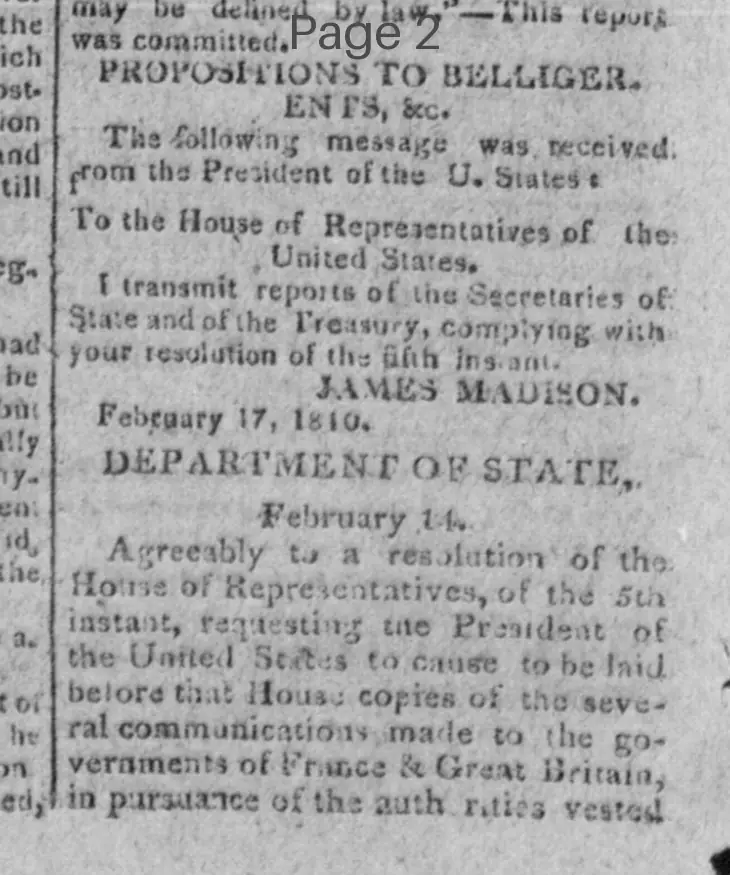
The following message was received from the President of the U. States:
To the House of Representatives of the United States.
I transmit reports of the Secretaries of State and of the Treasury, Complying with your resolution of the 5th instant.
JAMES MADISON.
February 17, 1810.
DEPARTMENT OF STATE,
February 14.
Agreeably to a resolution of the House of Representatives, of the 5th instant, requesting the President of the United States to cause to be laid before that house, copies of the several communications made to the governments of France & Great Britain, in pursuance of the authorities vested
By Congress in the Executive, will respect to the several orders and decrees of either violating the lawful commerce and neutral rights of the United States, except such parts as may, in his judgment, require secrecy; and also to communicate to the same House such information as he may have received touching the forgery of papers purporting to be those of American vessels, the Secretary of State has the honor of laying before the President the following papers, viz.
1st. Extract of a letter from Mr. Smith, Secretary of State, to General Armstrong, Minister Plenipotentiary of the U. S. at Paris, dated March 15th, 1809.
2d. Copy of a note from Gen. Armstrong to Count Champagny, Minister of exterior relations at Paris, dated 29th April, 1809.
3d. Extract of a letter from Mr. Smith to Mr. Pinkney, Minister Plenipotentiary of the U. S. at London, dated March 25th, 1809.
4th. Extracts of a letter from Mr. Pinkney to Mr. Smith, dated May 1, 1809.
A. Extracts of a letter from John M. Forbes, consul of the United States at Hamburg, to Mr. Madison, Secretary of State, dated 13th November, 1807.
B. Extracts of a letter from Mr. Lee, commercial agent of the U. S. at Bordeaux, to the same, dated Nov. 1, 1808.
C. Copy of a letter from Mr. Hackley, consul of the United States at St. Lucar, to Mr. Smith, dated Cadiz, 23d March, 1809.
D. Sundry original documents belonging to, and concerning the ship Aurora of New York.
E. Extract of a letter from Mr. Harris, consul of the United States at St. Petersburg, to Mr. Smith, dated 25th October, 1809, covering certain papers belonging to the ship called the Georgia, of New York.
F. Extracts of a letter from John M. Forbes, dated November 7, 1809, to Mr. Smith, covering the forged sea letter of the ship Argo, of Boston, dated August 21st, 1809, also a letter of the same date, signed Stephen Higginsen and company, to captain William Kempton.
G. Extract of a letter from William Kirkpatrick, consul of the U. States at Malaga, to Mr. Smith, dated Nov. 25, 1809.
It may be proper moreover to state, that various other communications have been received at this department from the agents of the United States in foreign countries, which mention that the practice prevails of forging American ships papers & documents; but as they do not afford any details, they are not included in this report, which is respectfully submitted.
R. SMITH.
Extract of a letter from the Secretary of State to gen. Armstrong minister plenipotentiary of the U. States at Paris, dated
DEPARTMENT OF STATE,
March 15, 1809.
The proceedings of Congress at their late session, combined with the Executive communications, affording, as they do, additional proofs of the pacific disposition of this government, and of its strict observance of whatever the laws of neutrality require, you will not fail to avail yourself of the just arguments thence deducible in urging the equitable claims of the United States. The 1, 2, 3, 4, 11 and 17th sections of the act interdicting our commercial intercourse with Great Britain and France, will, in that view claim your attention, and especially the 11th section authorising the Executive to renew our commerce with the nation withdrawing the operation of its illegal edicts. And you will be careful to let it be understood that the authority thus vested, will, of course, be exercised in the event stated in the law.
Genl. Armstrong to Count Champagny.
Paris, 29th April, 1809.
The undersigned, minister plenipotentiary of the United States, has the honor of presenting to his excellency the minister of exterior relations, the enclosed copy of a law recently passed by the legislature of the Union.
This law, as may be seen by the several provisions of it, has been forced upon them by the extraordinary circumstances of the times, and is to be regarded as an act of precaution, taken with the view only of protecting their own property and rights, and of once more appealing to the interest & justice of those who would disturb or destroy them.
Your excellency may be assured that as nothing has given more disquietude to the United States than the necessity which has impelled them to the adoption of this measure, so nothing will give them more satisfaction, than to see that necessity cease.
It is in the spirit and sincerity of this declaration, that the undersigned is instructed to add, that any interpretation of the Imperial decree of the twenty-first of November, 1806, and seventeenth of December 1807, which shall have the effect of leaving unimpaired the maritime rights of the Union, will be instantaneously followed by a revocation of the present act; and a reestablishment of the ordinary commercial intercourse between the two countries.
I offer to your excellency, &c. &c.
(Signed)
JOHN ARMSTRONG.
His excellency Count Champagny.
Extract of a letter from the Secretary of State to William Pinkney, esq. minister plenipotentiary of the United States in London, dated Department of State, March 15, 1809.
The proceedings of Congress at their late session, combined with the Executive communications, affording as they do, additional proofs of the pacific disposition of this government and of its strict observance of whatever the laws of neutrality require, you will not fail to avail yourself of the just arguments thence deducible in urging the equitable claims of the U. States. The 1, 2, 3, 4, 11 and 17th sections of the act interdicting our commercial intercourse with Great Britain and France, will, in that view claim your attention, and especially the 11th section, authorising the Executive to renew our commerce with the nation withdrawing the operation of its illegal edicts. And you will be careful to be understood, that the authority thus vested, will of course be exercised in the event stated in the law.
Extracts from a letter of Mr Pinkney, minister plenipotentiary of the U. S. at London, to Mr Smith, secretary of state, dated London, May 1, 1809.
Upon receipt of your letter of the 15th of March, it became my obvious duty to ask a conference with Mr Canning. It took place accordingly on Monday the 17th of April.
With a view to do justice to the character and tendency of the law of the 1st of March, I called the attention of Mr Canning in a particular manner to the 11th section, which provides for the renewal of commercial intercourse with the power revoking or so modifying its edicts as they should cease to violate the neutral commerce of the United States; and in obedience to my instructions I assured him that the authority vested in the President to proclaim such revocation or modification would not fail to be exercised as the case occurred.
I entered into a minute explanation of the law of the first of March, and in course of it availed myself of every inducement of interest which it could be supposed to furnish to his government to recall its orders in council, and of the proofs with which it abounds of the sincere desire of the American government to cultivate peace and friendship with Great Britain, even while it was repelling what it deemed encroachments and injuries the most pernicious and alarming.
Treasury Department, Feb. 16, 1810.
Sir,
I have the honor to inclose a statement transmitted by the collector of Boston, in relation to the ship Argus which entered Tonningen with a forged sea-letter.
Exclusively of the cases respecting forged marine papers which have from time to time been communicated by the Department of State, one only, has come to the knowledge of the Treasury, the particulars of which are explained by the enclosed letter from the collector of New York, and the papers accompanying the same.
I have the honor to be, &c.
ALBERT GALLATIN
The President of the U. S.
The above documents, and others accompanying the message, were ordered to be printed.
What sub-type of article is it?
What keywords are associated?
What entities or persons were involved?
Where did it happen?
Domestic News Details
Primary Location
United States
Event Date
February 17, 1810
Key Persons
Outcome
documents transmitted to congress and ordered to be printed; highlights ongoing issues with forged ship papers and diplomatic protests against french and british edicts.
Event Details
President Madison sends reports from Secretaries of State Robert Smith and Treasury Albert Gallatin to the House, complying with a resolution. Reports include diplomatic letters to France and Britain urging revocation of edicts violating US neutral rights under the Non-Intercourse Act, and details on forged papers for American vessels like the Aurora, Georgia, Argo, and Argus.