Thank you for visiting SNEWPapers!
Sign up free
Richmond Enquirer
Richmond, Richmond County, Virginia
What is this article about?
In a March 1, 1827, letter from Richmond, Alexander Smyth announces his candidacy to represent his district in the 20th Congress. He criticizes the Adams administration for corruption, press control, excessive spending, and declining revenue, endorsing Andrew Jackson for reform and direct election of the president.
Clipping
OCR Quality
Full Text
(From the Abingdon Gazette.)
Richmond, 1st March, 1827.
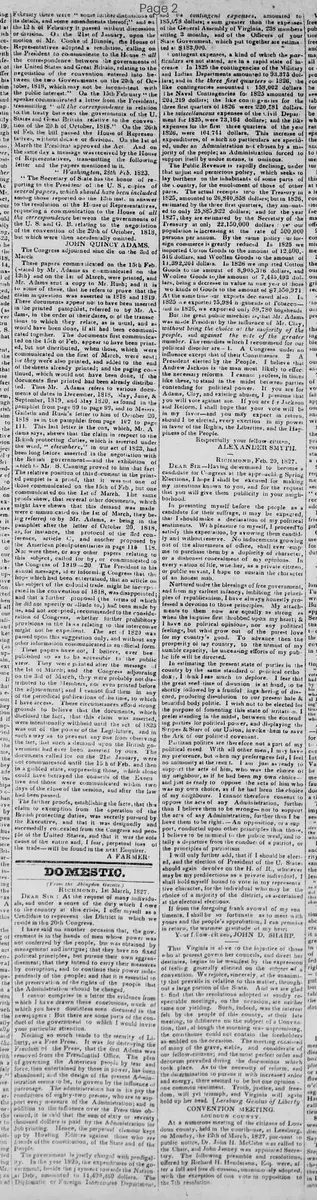
Dear Sir: At the request of many individuals, and under a sense of the duty which I owe to the country at this crisis, I offer myself as a Candidate to represent the District in which we reside in the 20th Congress.
I have said on another occasion that, the government is in the hands of men whose power was not conferred by the people, but was obtained by management and intrigue; that they have no fixed political principles, but pursue their own aggrandizement; that they intend to carry their measures by corruption, and to continue their power independently of the people: and that it is essential to the preservation of the rights of the people that the Administration should be changed.
I cannot comprise in a letter the evidence from which I have drawn these conclusions, much of which you have doubtless seen discussed in the newspapers: But there are some parts of the conduct of the government to which I would invite your particular attention.
Nothing so much tends to the security of Liberty, as a Free Press. It was for destroying the Freedom of the Press, that the first Adams was removed from the Presidential Office. The plan of governing the American people by fear and force, then entertained by those in power, has been abandoned; and the design of the present Administration seems to be, to govern by the influence of patronage. The administration has in its pay the conductors of eighty-two presses, who are to support every measure of the Administration; and in addition to the influence over the Press thus obtained, it is said that the sum of sixty or seventy thousand dollars is paid by the Administration for Job printing. Hence, the perpetual clamour kept up by Hireling Editors against those who are friends of the constitution, of the State and of the People.
The government is justly charged with prodigality. In the year 1820, the expenditures of the government, beside the payment towards the National Debt, amounted to 11,490,460 dollars. The Diplomatic or Foreign Intercourse Department, and its contingent expenses, amounted to 185,013 dollars; a sum greater than the expenses of the General Assembly of Virginia, 238 members sitting 3 months, and of the Officers of your State Government, which put together are estimated at $183,000.
Contingent expenses, a kind of which the particulars are not stated, are in a rapid state of increase. In 1825 the contingencies of the Military and Indian Departments amounted to 93,375 dollars; and in the three first quarters of 1826, the like contingencies amounted to 158,002 dollars. The Naval Contingencies for 1825 amounted to 204,219 dollars; the like contingencies for the three first quarters of 1826 were 220,681 dollars. The miscellaneous expenses of the Civil Department for 1825, were 73,164 dollars; and the like expenses for the first three quarters of the year 1826, were 101,741 dollars. This increase of expenditures, of which no particulars are specified, under an Administration not chosen by a majority of the people; an Administration forced to support itself by undue means, is ominous.
The Public Revenue is rapidly declining, under that unjust and pernicious policy, which seeks to lay burthens on the inhabitants of some parts of the Country, for the emolument of those of other parts. The actual receipts into the Treasury in 1825, amounted to 26,840,858 dollars; but in 1826, estimated by the three first quarters, they amounted to only 25,585,932 dollars; and for the year 1827, they are estimated by the Secretary of the Treasury at only 22,150,000 dollars: yet our population is increasing at the rate of 500,000 persons per annum. By the same policy our foreign commerce is greatly reduced. In 1825 we imported Cotton Goods to the amount of 12,500,516 dollars, and Woollen Goods to the amount of 11,392,204 dollars. In 1826 we imported Cotton Goods to the amount of 8,905,316 dollars, and Woollen Goods to the amount of 7,445,493 dollars, being a decrease in value in one year of those two kinds of Goods to the amount of $7,550,971. At the same time our exports decreased also. In 1825 we exported 75,984 hogsheads of Tobacco- and in 1826, we exported only 59,780 hogsheads. But the great public mischief is, that Mr. Adams was made President by the influence of Mr. Clay, without being the choice of the majority of the people, and against the vote of the greater number. The remedies which I recommend for our political disorder are-1. A Congress under no influence except that of their Constituents. 2. A President elected by the People. I believe that Andrew Jackson is the man most likely to effect the necessary reforms. I cannot profess, in times like these, to stand in the midst between parties contending for political power. If you are for Adams, Clay, and existing abuses, I presume that you will vote against me. If you are for Jackson and Reform, I shall hope that your vote will be in my favor--and you may expect in return, should I be elected, every exertion in my power in favor of the Rights, the Liberties, and the Happiness of the People.
Respectfully your fellow-citizen,
ALEXANDER SMYTH.
What sub-type of article is it?
What keywords are associated?
What entities or persons were involved?
Where did it happen?
Domestic News Details
Primary Location
Richmond
Event Date
1st March, 1827
Key Persons
Outcome
announcement of candidacy for the 20th congress; endorsement of andrew jackson for president and political reforms.
Event Details
Alexander Smyth offers himself as a candidate to represent the district in the 20th Congress, criticizes the Adams administration for obtaining power through intrigue, controlling the press via patronage, excessive spending, declining revenues, and reduced commerce, and recommends reforms including a Congress influenced only by constituents and a president elected by the people, believing Andrew Jackson can effect these changes.