Thank you for visiting SNEWPapers!
Sign up free
Editorial
February 8, 1940
Imperial Valley Press
El Centro, Imperial County, California
What is this article about?
Willis Thornton's editorial discusses women's expanded roles in WWII production in Britain and France, surpassing WWI levels, emphasizing that modern war is fought on the home front by all, including women balancing jobs and households.
Clipping
OCR Quality
95%
Excellent
Full Text
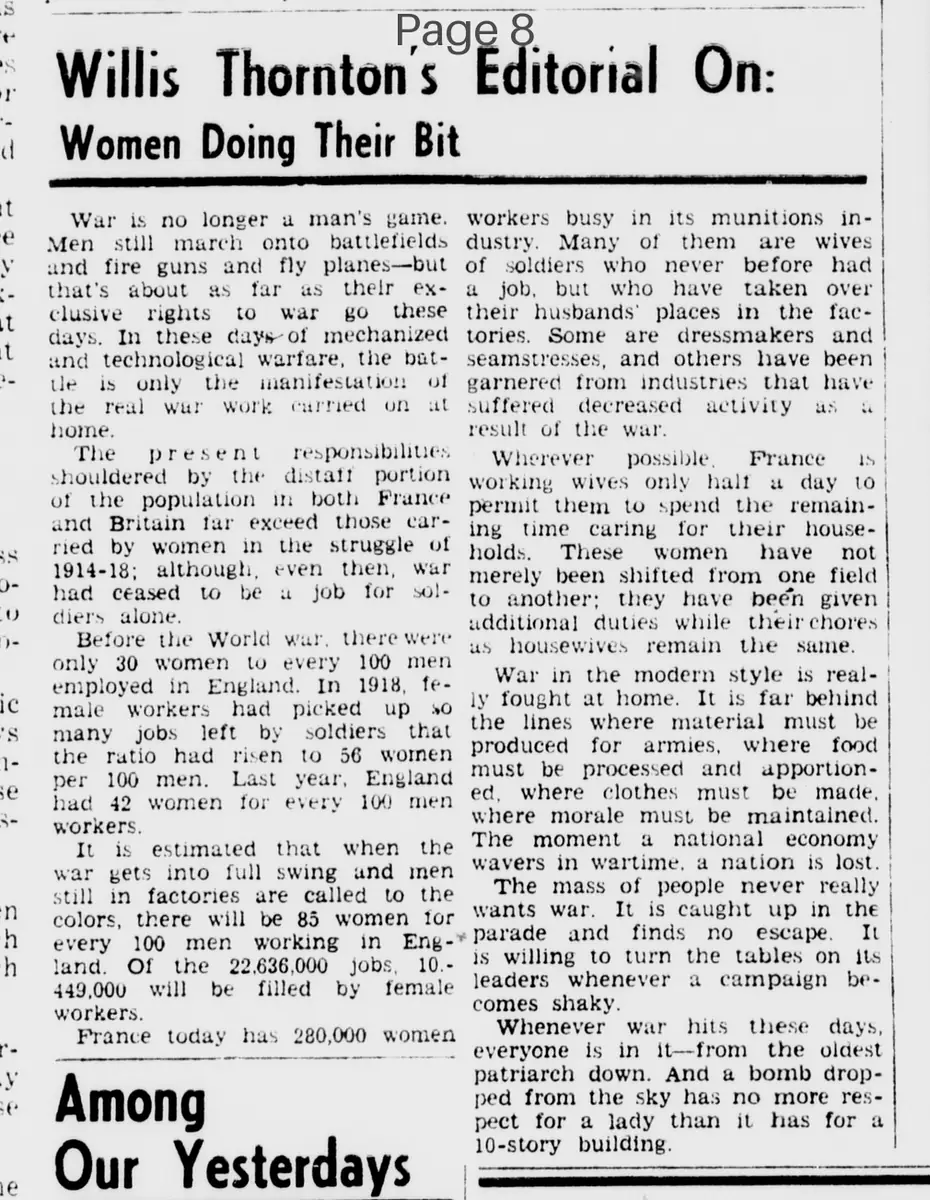
Willis Thornton's Editorial On:
Women Doing Their Bit
War is no longer a man's game.
Men still march onto battlefields and fire guns and fly planes--but that's about as far as their exclusive rights to war go these days. In these days of mechanized and technological warfare, the battle is only the manifestation of the real war work carried on at home.
The present responsibilities shouldered by the distaff portion of the population in both France and Britain far exceed those carried by women in the struggle of 1914-18; although, even then, war had ceased to be a job for soldiers alone.
Before the World war, there were only 30 women to every 100 men employed in England. In 1918, female workers had picked up so many jobs left by soldiers that the ratio had risen to 56 women per 100 men. Last year, England had 42 women for every 100 men workers.
It is estimated that when the war gets into full swing and men still in factories are called to the colors, there will be 85 women for every 100 men working in England. Of the 22,636,000 jobs, 10,449,000 will be filled by female workers.
France today has 280,000 women workers busy in its munitions industry. Many of them are wives of soldiers who never before had a job, but who have taken over their husbands' places in the factories. Some are dressmakers and seamstresses, and others have been garnered from industries that have suffered decreased activity as a result of the war.
Wherever possible, France is working wives only half a day to permit them to spend the remaining time caring for their households. These women have not merely been shifted from one field to another; they have been given additional duties while their chores as housewives remain the same.
War in the modern style is really fought at home. It is far behind the lines where material must be produced for armies, where food must be processed and apportioned, where clothes must be made, where morale must be maintained.
The moment a national economy wavers in wartime, a nation is lost.
The mass of people never really wants war. It is caught up in the parade and finds no escape. It is willing to turn the tables on its leaders whenever a campaign becomes shaky.
Whenever war hits these days, everyone is in it--from the oldest patriarch down. And a bomb dropped from the sky has no more respect for a lady than it has for a 10-story building.
Women Doing Their Bit
War is no longer a man's game.
Men still march onto battlefields and fire guns and fly planes--but that's about as far as their exclusive rights to war go these days. In these days of mechanized and technological warfare, the battle is only the manifestation of the real war work carried on at home.
The present responsibilities shouldered by the distaff portion of the population in both France and Britain far exceed those carried by women in the struggle of 1914-18; although, even then, war had ceased to be a job for soldiers alone.
Before the World war, there were only 30 women to every 100 men employed in England. In 1918, female workers had picked up so many jobs left by soldiers that the ratio had risen to 56 women per 100 men. Last year, England had 42 women for every 100 men workers.
It is estimated that when the war gets into full swing and men still in factories are called to the colors, there will be 85 women for every 100 men working in England. Of the 22,636,000 jobs, 10,449,000 will be filled by female workers.
France today has 280,000 women workers busy in its munitions industry. Many of them are wives of soldiers who never before had a job, but who have taken over their husbands' places in the factories. Some are dressmakers and seamstresses, and others have been garnered from industries that have suffered decreased activity as a result of the war.
Wherever possible, France is working wives only half a day to permit them to spend the remaining time caring for their households. These women have not merely been shifted from one field to another; they have been given additional duties while their chores as housewives remain the same.
War in the modern style is really fought at home. It is far behind the lines where material must be produced for armies, where food must be processed and apportioned, where clothes must be made, where morale must be maintained.
The moment a national economy wavers in wartime, a nation is lost.
The mass of people never really wants war. It is caught up in the parade and finds no escape. It is willing to turn the tables on its leaders whenever a campaign becomes shaky.
Whenever war hits these days, everyone is in it--from the oldest patriarch down. And a bomb dropped from the sky has no more respect for a lady than it has for a 10-story building.
What sub-type of article is it?
Feminism
War Or Peace
Labor
What keywords are associated?
Women Wartime Roles
Factory Workers
Munitions Industry
Britain France
Home Front Effort
What entities or persons were involved?
Willis Thornton
Women In Britain
Women In France
Editorial Details
Primary Topic
Women's Increased Roles In Wartime Production
Stance / Tone
Supportive Of Women's Contributions To War Effort
Key Figures
Willis Thornton
Women In Britain
Women In France
Key Arguments
War Is Fought At Home Through Production And Morale Maintenance
Women In Britain And France Exceed Wwi Employment Ratios
French Munitions Industry Employs 280,000 Women Including Soldiers' Wives
Women Balance Factory Work With Household Duties
Modern War Involves Entire Population Regardless Of Gender