Thank you for visiting SNEWPapers!
Sign up free
Story
October 16, 1884
Evening Capital
Annapolis, Anne Arundel County, Maryland
What is this article about?
Article on butter salting methods in dairying, comparing traditional paddle working with a new brine addition in the revolving churn for efficient milk removal and salting without secondary processing.
Clipping
OCR Quality
98%
Excellent
Full Text
How Should Butter be Salted.
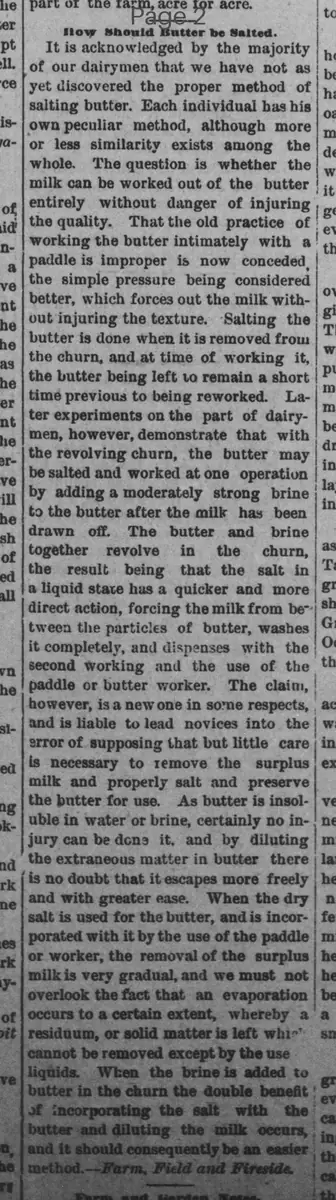
It is acknowledged by the majority of our dairymen that we have not as yet discovered the proper method of salting butter. Each individual has his own peculiar method, although more or less similarity exists among the whole. The question is whether the milk can be worked out of the butter entirely without danger of injuring the quality. That the old practice of working the butter intimately with a paddle is improper is now conceded the simple pressure being considered better, which forces out the milk without injuring the texture. Salting the butter is done when it is removed from the churn, and at time of working it the butter being left to remain a short time previous to being reworked. Later experiments on the part of dairymen, however, demonstrate that with the revolving churn, the butter may be salted and worked at one operation by adding a moderately strong brine to the butter after the milk has been drawn off. The butter and brine together revolve in the churn, the result being that the salt in a liquid state has a quicker and more direct action, forcing the milk from between the particles of butter, washes it completely, and dispenses with the second working and the use of the paddle or butter worker. The claim, however, is a new one in some respects, and is liable to lead novices into the error of supposing that but little care is necessary to remove the surplus milk and properly salt and preserve the butter for use. As butter is insoluble in water or brine, certainly no injury can be done it, and by diluting the extraneous matter in butter there is no doubt that it escapes more freely and with greater ease. When the dry salt is used for the butter, and is incorporated with it by the use of the paddle or worker, the removal of the surplus milk is very gradual, and we must not overlook the fact that an evaporation occurs to a certain extent, whereby a residuum, or solid matter is left which cannot be removed except by the use of liquids. When the brine is added to butter in the churn the double benefit of incorporating the salt with the butter and diluting the milk occurs, and it should consequently be an easier method.—Farm, Field and Fireside.
It is acknowledged by the majority of our dairymen that we have not as yet discovered the proper method of salting butter. Each individual has his own peculiar method, although more or less similarity exists among the whole. The question is whether the milk can be worked out of the butter entirely without danger of injuring the quality. That the old practice of working the butter intimately with a paddle is improper is now conceded the simple pressure being considered better, which forces out the milk without injuring the texture. Salting the butter is done when it is removed from the churn, and at time of working it the butter being left to remain a short time previous to being reworked. Later experiments on the part of dairymen, however, demonstrate that with the revolving churn, the butter may be salted and worked at one operation by adding a moderately strong brine to the butter after the milk has been drawn off. The butter and brine together revolve in the churn, the result being that the salt in a liquid state has a quicker and more direct action, forcing the milk from between the particles of butter, washes it completely, and dispenses with the second working and the use of the paddle or butter worker. The claim, however, is a new one in some respects, and is liable to lead novices into the error of supposing that but little care is necessary to remove the surplus milk and properly salt and preserve the butter for use. As butter is insoluble in water or brine, certainly no injury can be done it, and by diluting the extraneous matter in butter there is no doubt that it escapes more freely and with greater ease. When the dry salt is used for the butter, and is incorporated with it by the use of the paddle or worker, the removal of the surplus milk is very gradual, and we must not overlook the fact that an evaporation occurs to a certain extent, whereby a residuum, or solid matter is left which cannot be removed except by the use of liquids. When the brine is added to butter in the churn the double benefit of incorporating the salt with the butter and diluting the milk occurs, and it should consequently be an easier method.—Farm, Field and Fireside.
What sub-type of article is it?
Agricultural Guide
Dairy Instruction
What keywords are associated?
Butter Salting
Dairy Methods
Brine Churn
Milk Removal
Butter Quality
Story Details
Story Details
Discusses methods of salting butter, critiquing old paddle working and promoting new brine addition in revolving churn for efficient milk removal and salting in one operation.