Thank you for visiting SNEWPapers!
Sign up free
Literary
July 13, 1927
The Manning Times
Manning, Clarendon County, South Carolina
What is this article about?
Two young men drinking bootleg whiskey on a river road witness a fatal collision caused by a drunken bootlegger truck driver. One companion flees, while Edison Forbes confronts the driver, who escapes, leaving Forbes to face mistaken accusations from arriving authorities amid Prohibition-era tensions.
Clipping
OCR Quality
98%
Excellent
Full Text
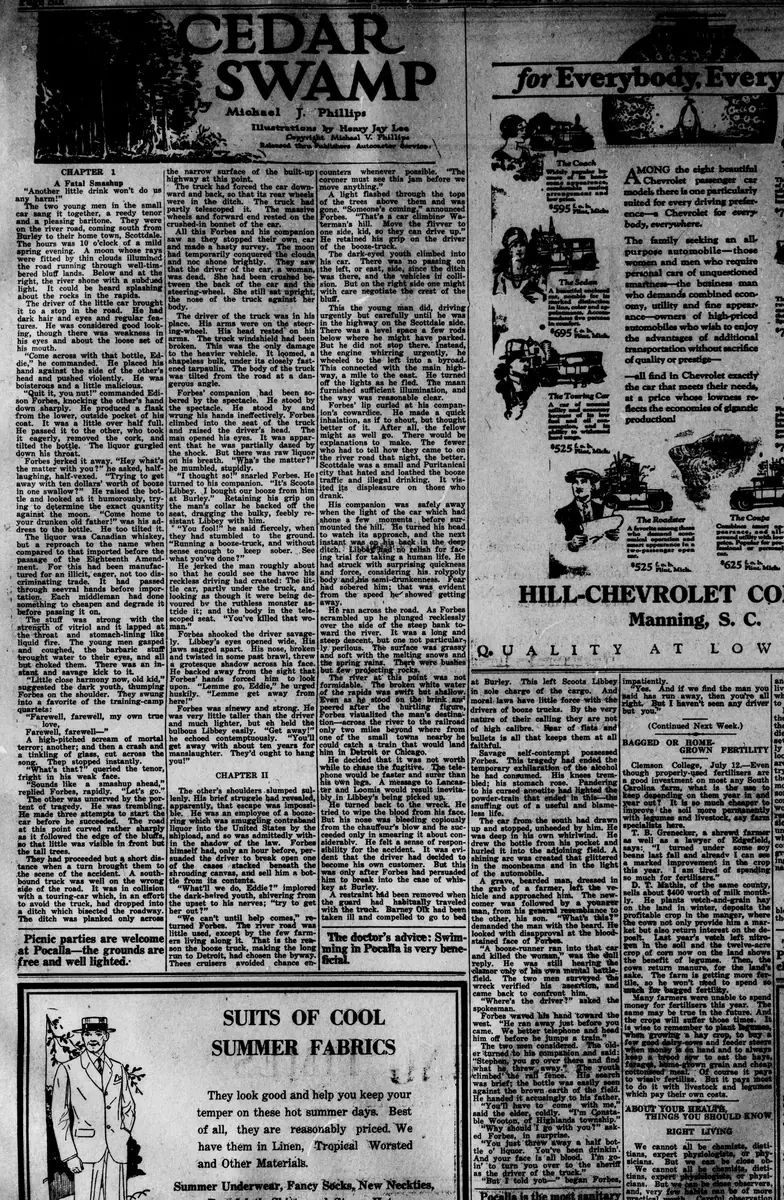
CEDAR SWAMP
By Michael J. Phillips
Illustrations by Henry Jay Lederer
Copyright 1927 Michael V. Phillips
"Another little drink won't do us any harm!"
The two young men in the small car sang it together, a reedy tenor and a pleasing baritone. They were on the river road, coming south from Burley to their home town, Scottdale. The hour was 10 o'clock of a mild spring evening. A moon whose rays were filtered by thin clouds illumined the road running through well-timbered bluff lands. Below and at the right, the river shone with a subdued light. It could be heard splashing about the rocks in the rapids.
The driver of the little car brought it to a stop in the road. He had dark hair and eyes and regular features. He was considered good looking, though there was weakness in his eyes and about the loose set of his mouth.
"Come across with that bottle, Eddie," he commanded. He placed his hand against the side of the other's head and pushed violently. He was boisterous and a little malicious.
"Quit it, you nut!" commanded Edison Forbes, knocking the other's hand down sharply. He produced a flask from the lower outside pocket of his coat. It was a little over half full. He passed it to the other, who took it eagerly, removed the cork, and tilted the bottle. The liquor gurgled down his throat.
Forbes jerked it away. "Hey what's the matter with you?" he asked, half-laughing, half-vexed. "Trying to get away with ten dollars' worth of booze in one swallow?" He raised the bottle and looked at it humorously, trying to determine the exact quantity against the moon. "Come home to your drunken old father!" was his address to the bottle. He too tilted it.
The liquor was Canadian whiskey, but a reproach to the name when compared to that imported before the passage of the Eighteenth Amendment. For this had been manufactured for an illicit, eager, not too discriminating trade. It had passed through several hands before importation. Each middleman had done something to cheapen and degrade it before passing it on.
The stuff was strong with the strength of vitriol and it lapped at the throat and stomach-lining like liquid fire. The young men gasped and coughed, the barbaric stuff brought water to their eyes, and all but choked them. There was an instant and savage kick to it.
"Little close harmony now, old kid," suggested the dark youth, thumping Forbes on the shoulder. They swung into a favorite of the training-camp quartets:
"Farewell, farewell, my own true love,
Farewell, farewell"
A high-pitched scream of mortal terror: another: and then a crash and a tinkling of glass, cut across the song. They stopped instantly.
"What's that?" queried the tenor, fright in his weak face.
"Sounds like a smashup ahead," replied Forbes, rapidly. "Let's go."
The other was unnerved by the portent of tragedy. He was trembling. He made three attempts to start the car before he succeeded. The road at this point curved rather sharply as it followed the edge of the bluffs, so that little was visible in front but the tall trees.
They had proceeded but a short distance when a turn brought them to the scene of the accident. A southbound truck was well on the wrong side of the road. It was in collision with a touring-car which, in an effort to avoid the truck, had dropped into a ditch which bisected the roadway. The ditch was planked only across the narrow surface of the built-up highway at this point.
The truck had forced the car downward and back, so that its rear wheels were in the ditch. The truck had partly telescoped it. The massive wheels and forward end rested on the crushed-in bonnet of the car.
All this Forbes and his companion saw as they stopped their own car and made a hasty survey. The moon had temporarily conquered the clouds and now shone brightly. They saw that the driver of the car, a woman, was dead. She had been crushed between the back of the car and the steering-wheel. She still sat upright, the nose of the truck against her body.
The driver of the truck was in his place. His arms were on the steering-wheel. His head rested on his arms. The truck windshield had been broken. This was the only damage to the heavier vehicle. It loomed, a shapeless bulk under its closely fastened tarpaulin. The body of the truck was tilted from the road at a dangerous angle.
Forbes' companion had been sobered by the spectacle. He stood by and wrung his hands ineffectively. Forbes climbed into the seat of the truck and raised the driver's head. The man opened his eyes. It was apparent that he was partially dazed by the shock. But there was raw liquor on his breath. "Wha's the matter?" he mumbled, stupidly.
"I thought so!" snarled Forbes. He turned to his companion. "It's Scoots Libbey. I bought our booze from him at Burley." Retaining his grip on the man's collar he backed off the seat, dragging the bulky, feebly resistant Libbey with him.
"You fool!" he said fiercely, when they had stumbled to the ground. "Running a booze-truck, and without sense enough to keep sober....See what you've done?"
He jerked the man roughly about so that he could see the havoc his reckless driving had created: The little car, partly under the truck, and looking as though it were being devoured by the ruthless monster astride it; and the body in the telescoped seat. "You've killed that woman."
Forbes shook the driver savagely. Libbey's eyes opened wide. His jaws sagged apart. His nose, broken and twisted in some past brawl, threw a grotesque shadow across his face. He backed away from the sight that Forbes' hands forced him to look upon. "Lemme go, Eddie," he urged huskily. "Lemme get away from here!"
Forbes was sinewy and strong. He was very little taller than the driver and much lighter, but he held the bulbous Libbey easily. "Get away!" he echoed contemptuously. "You'll get away with about ten years for manslaughter. They'd ought to hang you!"
The other's shoulders slumped sullenly. His brief struggle had revealed, apparently, that escape was impossible. He was an employee of a booze ring which was smuggling contraband liquor into the United States by the shipload, and so was admittedly within the shadow of the law. Forbes himself had, only an hour before, persuaded the driver to break open one of the cases stacked beneath the shrouding canvas, and sell him a bottle from its contents.
"What'll we do, Eddie?" implored the dark-haired youth, shivering from the upset to his nerves; "try to get her out?"
"We can't until help comes," returned Forbes. The river road was little used, except by the few farmers living along it. That is the reason the booze truck, making the long run to Detroit, had chosen the byway. These cruisers avoided chance encounters whenever possible. "The coroner must see this jam before we move anything."
A light flashed through the tops of the trees above them and was gone. "Someone's coming," announced Forbes. "That's a car climbing Waterman's hill. Move the flivver to one side, kid, so they can drive up."
He retained his grip on the driver of the booze-truck.
The dark-eyed youth climbed into his car. There was no passing on the left, or east, side, since the ditch was there, and the vehicles in collision. But on the right side one might with care negotiate the crest of the bluff.
This the young man did, driving urgently but carefully until he was in the highway on the Scottdale side. There was a level space a few rods below where he might have parked. But he did not stop there. Instead, the engine whirring urgently, he wheeled to the left into a byroad.
This connected with the main highway, a mile to the east. He turned off the lights as he fled. The moon furnished sufficient illumination, and the way was reasonably clear.
Forbes' lip curled at his companion's cowardice. He made a quick inhalation, as if to shout, but thought better of it. After all, the fellow might as well go. There would be explanations to make. The fewer who had to tell how they came to be on the river road that night, the better. Scottdale was a small and Puritanical city that hated and loathed the booze traffic and illegal drinking. It visited its displeasure on those who drank.
His companion was safely away when the light of the car which had shone a few moments before surmounted the hill. He turned his head to watch its approach, and the next instant was on his back in the deep ditch. Libbey had no relish for facing trial for taking a human life. He had struck with surprising quickness and force, considering his rolypoly body and his semi-drunkenness. Fear had sobered him; that was evident from the speed he showed getting away.
He ran across the road. As Forbes scrambled up he plunged recklessly over the side of the steep bank toward the river. It was a long and steep descent, but one not particularly perilous. The surface was grassy and soft with the melting snows and the spring rains. There were bushes but few projecting rocks.
The river at this point was not formidable. The broken white water of the rapids was swift but shallow. Even as he stood on the brink and peered after the hurtling figure, Forbes visualized the man's destination-across the river to the railroad only two miles beyond where from one of the small towns nearby he could catch a train that would land him in Detroit or Chicago.
He decided that it was not worth while to chase the fugitive. The telephone would be faster and surer than his own legs. A message to Lancaster and Loomis would result inevitably in Libbey's being picked up.
He turned back to the wreck. He tried to wipe the blood from his face. But his nose was bleeding copiously from the chauffeur's blow and he succeeded only in smearing it about considerably. He felt a sense of responsibility for the accident. It was evident that the driver had decided to become his own customer. But this was only after Forbes had persuaded him to break into the case of whiskey at Burley.
A restraint had been removed when the guard had habitually traveled with the truck. Barney Olk had been taken ill and compelled to go to bed. This left Scoots Libbey in sole charge of the cargo. And moral laws have little force with the drivers of booze trucks. By the very nature of their calling they are not of high calibre. Fear of fists and bullets is all that keeps them at all faithful.
Savage self-contempt possessed Forbes. This tragedy had ended the temporary exhilaration of the alcohol he had consumed. His knees trembled; his stomach rose. Pandering to his cursed appetite had lighted the powder-train that ended in this--the snuffing out of a useful and blameless life.
The car from the south had drawn up and stopped, unheeded by him. He was deep in his own whirlwind. He drew the bottle from his pocket and hurled it into the adjoining field. A shining arc was created that glittered in the moonbeams and in the light of the automobile.
A grave, bearded man, dressed in the garb of a farmer, left the vehicle and approached him. The newcomer was followed by a younger man, from his general resemblance to the other, his son.
"What's this?" demanded the man with the beard. He looked with disapproval at the blood-stained face of Forbes.
"A booze-runner ran into that car and killed the woman," was the dull reply. He was still hearing the clamor only of his own mental battlefield. The two men surveyed the wreck verified his assertion, and came back to confront him.
"Where's the driver?" asked the spokesman.
Forbes waved his hand toward the west. "He ran away just before you came. We better telephone and head him off before he dumps a train."
The two men considered. The older turned to his companion and said: "Stephen, you go over there and find what he threw away." The youth climbed the rail fence. His search was brief; the bottle was easily seen against the brown earth of the field. He handed it accusingly to his father.
"You'll have to come with me," said the elder, coldly. "I'm Constable Wooton, of Highlands township."
"Why should I go with you?" asked Forbes, in surprise.
"You just threw away a half bottle o' liquor. You've been drinkin'. And your face is all blood. I'm going to turn you over to the sheriff as the driver of the truck."
"But I told you " began Forbes, impatiently.
"Yes. And if we find the man you said has run away, then you're all right. But I haven't seen any driver but you."
(Continued Next Week.)
By Michael J. Phillips
Illustrations by Henry Jay Lederer
Copyright 1927 Michael V. Phillips
"Another little drink won't do us any harm!"
The two young men in the small car sang it together, a reedy tenor and a pleasing baritone. They were on the river road, coming south from Burley to their home town, Scottdale. The hour was 10 o'clock of a mild spring evening. A moon whose rays were filtered by thin clouds illumined the road running through well-timbered bluff lands. Below and at the right, the river shone with a subdued light. It could be heard splashing about the rocks in the rapids.
The driver of the little car brought it to a stop in the road. He had dark hair and eyes and regular features. He was considered good looking, though there was weakness in his eyes and about the loose set of his mouth.
"Come across with that bottle, Eddie," he commanded. He placed his hand against the side of the other's head and pushed violently. He was boisterous and a little malicious.
"Quit it, you nut!" commanded Edison Forbes, knocking the other's hand down sharply. He produced a flask from the lower outside pocket of his coat. It was a little over half full. He passed it to the other, who took it eagerly, removed the cork, and tilted the bottle. The liquor gurgled down his throat.
Forbes jerked it away. "Hey what's the matter with you?" he asked, half-laughing, half-vexed. "Trying to get away with ten dollars' worth of booze in one swallow?" He raised the bottle and looked at it humorously, trying to determine the exact quantity against the moon. "Come home to your drunken old father!" was his address to the bottle. He too tilted it.
The liquor was Canadian whiskey, but a reproach to the name when compared to that imported before the passage of the Eighteenth Amendment. For this had been manufactured for an illicit, eager, not too discriminating trade. It had passed through several hands before importation. Each middleman had done something to cheapen and degrade it before passing it on.
The stuff was strong with the strength of vitriol and it lapped at the throat and stomach-lining like liquid fire. The young men gasped and coughed, the barbaric stuff brought water to their eyes, and all but choked them. There was an instant and savage kick to it.
"Little close harmony now, old kid," suggested the dark youth, thumping Forbes on the shoulder. They swung into a favorite of the training-camp quartets:
"Farewell, farewell, my own true love,
Farewell, farewell"
A high-pitched scream of mortal terror: another: and then a crash and a tinkling of glass, cut across the song. They stopped instantly.
"What's that?" queried the tenor, fright in his weak face.
"Sounds like a smashup ahead," replied Forbes, rapidly. "Let's go."
The other was unnerved by the portent of tragedy. He was trembling. He made three attempts to start the car before he succeeded. The road at this point curved rather sharply as it followed the edge of the bluffs, so that little was visible in front but the tall trees.
They had proceeded but a short distance when a turn brought them to the scene of the accident. A southbound truck was well on the wrong side of the road. It was in collision with a touring-car which, in an effort to avoid the truck, had dropped into a ditch which bisected the roadway. The ditch was planked only across the narrow surface of the built-up highway at this point.
The truck had forced the car downward and back, so that its rear wheels were in the ditch. The truck had partly telescoped it. The massive wheels and forward end rested on the crushed-in bonnet of the car.
All this Forbes and his companion saw as they stopped their own car and made a hasty survey. The moon had temporarily conquered the clouds and now shone brightly. They saw that the driver of the car, a woman, was dead. She had been crushed between the back of the car and the steering-wheel. She still sat upright, the nose of the truck against her body.
The driver of the truck was in his place. His arms were on the steering-wheel. His head rested on his arms. The truck windshield had been broken. This was the only damage to the heavier vehicle. It loomed, a shapeless bulk under its closely fastened tarpaulin. The body of the truck was tilted from the road at a dangerous angle.
Forbes' companion had been sobered by the spectacle. He stood by and wrung his hands ineffectively. Forbes climbed into the seat of the truck and raised the driver's head. The man opened his eyes. It was apparent that he was partially dazed by the shock. But there was raw liquor on his breath. "Wha's the matter?" he mumbled, stupidly.
"I thought so!" snarled Forbes. He turned to his companion. "It's Scoots Libbey. I bought our booze from him at Burley." Retaining his grip on the man's collar he backed off the seat, dragging the bulky, feebly resistant Libbey with him.
"You fool!" he said fiercely, when they had stumbled to the ground. "Running a booze-truck, and without sense enough to keep sober....See what you've done?"
He jerked the man roughly about so that he could see the havoc his reckless driving had created: The little car, partly under the truck, and looking as though it were being devoured by the ruthless monster astride it; and the body in the telescoped seat. "You've killed that woman."
Forbes shook the driver savagely. Libbey's eyes opened wide. His jaws sagged apart. His nose, broken and twisted in some past brawl, threw a grotesque shadow across his face. He backed away from the sight that Forbes' hands forced him to look upon. "Lemme go, Eddie," he urged huskily. "Lemme get away from here!"
Forbes was sinewy and strong. He was very little taller than the driver and much lighter, but he held the bulbous Libbey easily. "Get away!" he echoed contemptuously. "You'll get away with about ten years for manslaughter. They'd ought to hang you!"
The other's shoulders slumped sullenly. His brief struggle had revealed, apparently, that escape was impossible. He was an employee of a booze ring which was smuggling contraband liquor into the United States by the shipload, and so was admittedly within the shadow of the law. Forbes himself had, only an hour before, persuaded the driver to break open one of the cases stacked beneath the shrouding canvas, and sell him a bottle from its contents.
"What'll we do, Eddie?" implored the dark-haired youth, shivering from the upset to his nerves; "try to get her out?"
"We can't until help comes," returned Forbes. The river road was little used, except by the few farmers living along it. That is the reason the booze truck, making the long run to Detroit, had chosen the byway. These cruisers avoided chance encounters whenever possible. "The coroner must see this jam before we move anything."
A light flashed through the tops of the trees above them and was gone. "Someone's coming," announced Forbes. "That's a car climbing Waterman's hill. Move the flivver to one side, kid, so they can drive up."
He retained his grip on the driver of the booze-truck.
The dark-eyed youth climbed into his car. There was no passing on the left, or east, side, since the ditch was there, and the vehicles in collision. But on the right side one might with care negotiate the crest of the bluff.
This the young man did, driving urgently but carefully until he was in the highway on the Scottdale side. There was a level space a few rods below where he might have parked. But he did not stop there. Instead, the engine whirring urgently, he wheeled to the left into a byroad.
This connected with the main highway, a mile to the east. He turned off the lights as he fled. The moon furnished sufficient illumination, and the way was reasonably clear.
Forbes' lip curled at his companion's cowardice. He made a quick inhalation, as if to shout, but thought better of it. After all, the fellow might as well go. There would be explanations to make. The fewer who had to tell how they came to be on the river road that night, the better. Scottdale was a small and Puritanical city that hated and loathed the booze traffic and illegal drinking. It visited its displeasure on those who drank.
His companion was safely away when the light of the car which had shone a few moments before surmounted the hill. He turned his head to watch its approach, and the next instant was on his back in the deep ditch. Libbey had no relish for facing trial for taking a human life. He had struck with surprising quickness and force, considering his rolypoly body and his semi-drunkenness. Fear had sobered him; that was evident from the speed he showed getting away.
He ran across the road. As Forbes scrambled up he plunged recklessly over the side of the steep bank toward the river. It was a long and steep descent, but one not particularly perilous. The surface was grassy and soft with the melting snows and the spring rains. There were bushes but few projecting rocks.
The river at this point was not formidable. The broken white water of the rapids was swift but shallow. Even as he stood on the brink and peered after the hurtling figure, Forbes visualized the man's destination-across the river to the railroad only two miles beyond where from one of the small towns nearby he could catch a train that would land him in Detroit or Chicago.
He decided that it was not worth while to chase the fugitive. The telephone would be faster and surer than his own legs. A message to Lancaster and Loomis would result inevitably in Libbey's being picked up.
He turned back to the wreck. He tried to wipe the blood from his face. But his nose was bleeding copiously from the chauffeur's blow and he succeeded only in smearing it about considerably. He felt a sense of responsibility for the accident. It was evident that the driver had decided to become his own customer. But this was only after Forbes had persuaded him to break into the case of whiskey at Burley.
A restraint had been removed when the guard had habitually traveled with the truck. Barney Olk had been taken ill and compelled to go to bed. This left Scoots Libbey in sole charge of the cargo. And moral laws have little force with the drivers of booze trucks. By the very nature of their calling they are not of high calibre. Fear of fists and bullets is all that keeps them at all faithful.
Savage self-contempt possessed Forbes. This tragedy had ended the temporary exhilaration of the alcohol he had consumed. His knees trembled; his stomach rose. Pandering to his cursed appetite had lighted the powder-train that ended in this--the snuffing out of a useful and blameless life.
The car from the south had drawn up and stopped, unheeded by him. He was deep in his own whirlwind. He drew the bottle from his pocket and hurled it into the adjoining field. A shining arc was created that glittered in the moonbeams and in the light of the automobile.
A grave, bearded man, dressed in the garb of a farmer, left the vehicle and approached him. The newcomer was followed by a younger man, from his general resemblance to the other, his son.
"What's this?" demanded the man with the beard. He looked with disapproval at the blood-stained face of Forbes.
"A booze-runner ran into that car and killed the woman," was the dull reply. He was still hearing the clamor only of his own mental battlefield. The two men surveyed the wreck verified his assertion, and came back to confront him.
"Where's the driver?" asked the spokesman.
Forbes waved his hand toward the west. "He ran away just before you came. We better telephone and head him off before he dumps a train."
The two men considered. The older turned to his companion and said: "Stephen, you go over there and find what he threw away." The youth climbed the rail fence. His search was brief; the bottle was easily seen against the brown earth of the field. He handed it accusingly to his father.
"You'll have to come with me," said the elder, coldly. "I'm Constable Wooton, of Highlands township."
"Why should I go with you?" asked Forbes, in surprise.
"You just threw away a half bottle o' liquor. You've been drinkin'. And your face is all blood. I'm going to turn you over to the sheriff as the driver of the truck."
"But I told you " began Forbes, impatiently.
"Yes. And if we find the man you said has run away, then you're all right. But I haven't seen any driver but you."
(Continued Next Week.)
What sub-type of article is it?
Prose Fiction
What themes does it cover?
Temperance
Moral Virtue
Political
What keywords are associated?
Prohibition
Bootlegging
Drunk Driving
Car Accident
Temperance
Moral Reckoning
What entities or persons were involved?
By Michael J. Phillips
Literary Details
Title
Cedar Swamp
Author
By Michael J. Phillips
Key Lines
"Another Little Drink Won't Do Us Any Harm!"
"Farewell, Farewell, My Own True Love, Farewell, Farewell"
A High Pitched Scream Of Mortal Terror: Another: And Then A Crash And A Tinkling Of Glass, Cut Across The Song.
"You've Killed That Woman."
Savage Self Contempt Possessed Forbes. This Tragedy Had Ended The Temporary Exhilaration Of The Alcohol He Had Consumed.