Thank you for visiting SNEWPapers!
Sign up free
Editorial
August 22, 1811
Alexandria Daily Gazette, Commercial & Political
Alexandria, Virginia
What is this article about?
An opinion piece from the Fredericktown Herald defends Samuel Smith's pamphlet accusing President Madison of partiality toward France, critiques the administration's abusive response lacking arguments, affirms Smith's credible testimony as former Secretary of State, and calls for electing better rulers to remedy the issue.
Clipping
OCR Quality
98%
Excellent
Full Text
From the Fredericktown Herald.
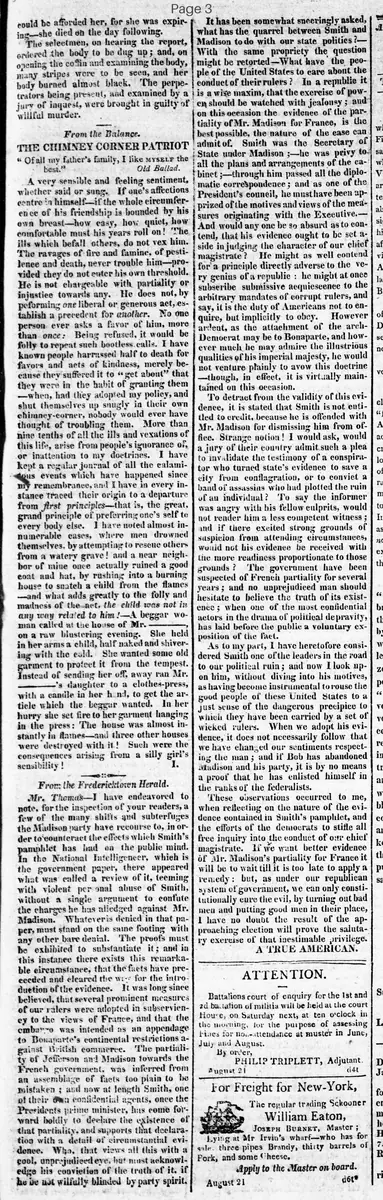
Mr. Thomas--I have endeavored to note, for the inspection of your readers, a few of the many shifts and subterfuges the Madison party have recourse to, in order to counteract the effects which Smith's pamphlet has had on the public mind. In the National Intelligencer, which is the government paper, there appeared what was called a review of it, teeming with violent personal abuse of Smith, without a single argument to confute the charges he has alleged against Mr. Madison. Whatever is denied in that paper, must stand on the same footing with any other bare denial. The proofs must be exhibited to substantiate it; and in this instance there exists this remarkable circumstance, that the facts have preceded and cleared the way for the introduction of the evidence. It was long since believed, that several prominent measures of our rulers were adopted in subserviency to the views of France, and that the embargo was intended as an appendage to Bonaparte's continental restrictions against British commerce. The partiality of Jefferson and Madison towards the French government, was inferred from an assemblage of facts too plain to be mistaken; and now at length Smith, one of their own confidential agents, once the President's prime minister, has come forward boldly to declare the existence of that partiality, and supports that declaration with a detail of circumstantial evidence. Who, that views all this with a cool, unprejudiced eye, but must acknowledge his conviction of the truth of it, if he be not wilfully blinded by party spirit.
It has been somewhat sneeringly asked, what has the quarrel between Smith and Madison to do with our state politics?-- With the same propriety the question might be retorted--What have the people of the United States to care about the conduct of their rulers? In a republic it is a wise maxim, that the exercise of power should be watched with jealousy; and on this occasion the evidence of the partiality of Mr. Madison for France, is the best possible, the nature of the case can admit of. Smith was the Secretary of State under Madison;--he was privy to all the plans and arrangements of the cabinet;--through him passed all the diplomatic correspondence; and as one of the President's council, he must have been apprised of the motives and views of the measures originating with the Executive.-- And would any one be so absurd as to contend, that his evidence ought to be set aside in judging the character of our chief magistrate? He might as well contend for a principle directly adverse to the very genius of a republic: he might at once subscribe submissive acquiescence to the arbitrary mandates of corrupt rulers, and say, it is the duty of Americans not to enquire, but implicitly to obey. However ardent as the attachment of the arch-Democrat may be to Bonaparte, and however much he may admire the illustrious qualities of his imperial majesty, he would not venture plainly to avow this doctrine --though, in effect, it is virtually maintained on this occasion.
To detract from the validity of this evidence, it is stated that Smith is not entitled to credit, because he is offended with Mr. Madison for dismissing him from office. Strange notion! I would ask, would a jury of their country admit such a plea to invalidate the testimony of a conspirator who turned state's evidence to save a city from conflagration, or to convict a band of assassins who had plotted the ruin of an individual? To say the informer was angry with his fellow culprits, would not render him a less competent witness; and if there existed strong grounds of suspicion from attending circumstances, would not his evidence be received with the more readiness proportionate to those grounds? The government have been suspected of French partiality for several years; and no unprejudiced man should hesitate to believe the truth of its existence; when one of the most confidential actors in the drama of political depravity: has laid before the public a voluntary exposition of the fact.
As to my part, I have heretofore considered Smith one of the leaders in the road to our political ruin; and now I look upon him, without diving into his motives, as having become instrumental to rouse the good people of these United States to a just sense of the dangerous precipice to which they have been carried by a set of wicked rulers. When we adopt his evidence, it does not necessarily follow that we have changed our sentiments respecting the man; and if Bob has abandoned Madison and his party, it is by no means a proof that he has enlisted himself in the ranks of the federalists.
These observations occurred to me, when reflecting on the nature of the evidence contained in Smith's pamphlet, and the efforts of the democrats to stifle all free inquiry into the conduct of our chief magistrate. If we want better evidence of Mr. Madison's partiality for France it will be to wait till it is too late to apply a remedy: but, as under our republican system of government, we can only constitutionally cure the evil, by turning out bad men and putting good men in their place, I have no doubt the result of the approaching election will prove the salutary exercise of that inestimable privilege.
A TRUE AMERICAN.
Mr. Thomas--I have endeavored to note, for the inspection of your readers, a few of the many shifts and subterfuges the Madison party have recourse to, in order to counteract the effects which Smith's pamphlet has had on the public mind. In the National Intelligencer, which is the government paper, there appeared what was called a review of it, teeming with violent personal abuse of Smith, without a single argument to confute the charges he has alleged against Mr. Madison. Whatever is denied in that paper, must stand on the same footing with any other bare denial. The proofs must be exhibited to substantiate it; and in this instance there exists this remarkable circumstance, that the facts have preceded and cleared the way for the introduction of the evidence. It was long since believed, that several prominent measures of our rulers were adopted in subserviency to the views of France, and that the embargo was intended as an appendage to Bonaparte's continental restrictions against British commerce. The partiality of Jefferson and Madison towards the French government, was inferred from an assemblage of facts too plain to be mistaken; and now at length Smith, one of their own confidential agents, once the President's prime minister, has come forward boldly to declare the existence of that partiality, and supports that declaration with a detail of circumstantial evidence. Who, that views all this with a cool, unprejudiced eye, but must acknowledge his conviction of the truth of it, if he be not wilfully blinded by party spirit.
It has been somewhat sneeringly asked, what has the quarrel between Smith and Madison to do with our state politics?-- With the same propriety the question might be retorted--What have the people of the United States to care about the conduct of their rulers? In a republic it is a wise maxim, that the exercise of power should be watched with jealousy; and on this occasion the evidence of the partiality of Mr. Madison for France, is the best possible, the nature of the case can admit of. Smith was the Secretary of State under Madison;--he was privy to all the plans and arrangements of the cabinet;--through him passed all the diplomatic correspondence; and as one of the President's council, he must have been apprised of the motives and views of the measures originating with the Executive.-- And would any one be so absurd as to contend, that his evidence ought to be set aside in judging the character of our chief magistrate? He might as well contend for a principle directly adverse to the very genius of a republic: he might at once subscribe submissive acquiescence to the arbitrary mandates of corrupt rulers, and say, it is the duty of Americans not to enquire, but implicitly to obey. However ardent as the attachment of the arch-Democrat may be to Bonaparte, and however much he may admire the illustrious qualities of his imperial majesty, he would not venture plainly to avow this doctrine --though, in effect, it is virtually maintained on this occasion.
To detract from the validity of this evidence, it is stated that Smith is not entitled to credit, because he is offended with Mr. Madison for dismissing him from office. Strange notion! I would ask, would a jury of their country admit such a plea to invalidate the testimony of a conspirator who turned state's evidence to save a city from conflagration, or to convict a band of assassins who had plotted the ruin of an individual? To say the informer was angry with his fellow culprits, would not render him a less competent witness; and if there existed strong grounds of suspicion from attending circumstances, would not his evidence be received with the more readiness proportionate to those grounds? The government have been suspected of French partiality for several years; and no unprejudiced man should hesitate to believe the truth of its existence; when one of the most confidential actors in the drama of political depravity: has laid before the public a voluntary exposition of the fact.
As to my part, I have heretofore considered Smith one of the leaders in the road to our political ruin; and now I look upon him, without diving into his motives, as having become instrumental to rouse the good people of these United States to a just sense of the dangerous precipice to which they have been carried by a set of wicked rulers. When we adopt his evidence, it does not necessarily follow that we have changed our sentiments respecting the man; and if Bob has abandoned Madison and his party, it is by no means a proof that he has enlisted himself in the ranks of the federalists.
These observations occurred to me, when reflecting on the nature of the evidence contained in Smith's pamphlet, and the efforts of the democrats to stifle all free inquiry into the conduct of our chief magistrate. If we want better evidence of Mr. Madison's partiality for France it will be to wait till it is too late to apply a remedy: but, as under our republican system of government, we can only constitutionally cure the evil, by turning out bad men and putting good men in their place, I have no doubt the result of the approaching election will prove the salutary exercise of that inestimable privilege.
A TRUE AMERICAN.
What sub-type of article is it?
Partisan Politics
Foreign Affairs
What keywords are associated?
Smith Pamphlet
Madison France Partiality
Political Evidence
Republican Scrutiny
Election Remedy
What entities or persons were involved?
Mr. Madison
Smith
Jefferson
Bonaparte
Madison Party
Federalists
Editorial Details
Primary Topic
Defense Of Samuel Smith's Accusations Against Madison's Pro French Partiality
Stance / Tone
Strongly Critical Of Madison Administration And Supportive Of Smith's Revelations
Key Figures
Mr. Madison
Smith
Jefferson
Bonaparte
Madison Party
Federalists
Key Arguments
Smith's Pamphlet Provides Credible Evidence Of Madison's Partiality To France Based On His Insider Knowledge
Government Review In National Intelligencer Offers Only Personal Abuse Without Counterarguments
Dismissing Smith Due To Personal Offense Does Not Invalidate His Testimony, Akin To Turning State's Evidence
Republican Vigilance Requires Scrutinizing Rulers' Conduct, Especially Foreign Policy Biases
Upcoming Election Offers Constitutional Remedy By Replacing Bad Rulers With Good Ones