Thank you for visiting SNEWPapers!
Sign up free
Daily National Intelligencer
Washington, District Of Columbia
What is this article about?
Patriotic address by H. Carroll on July 4, 1817, in the Representatives Chamber, celebrating American independence, reviewing the Revolution, War of 1812 victories, constitutional blessings, and future prospects, concluding with the Declaration of Independence.
Clipping
OCR Quality
Full Text
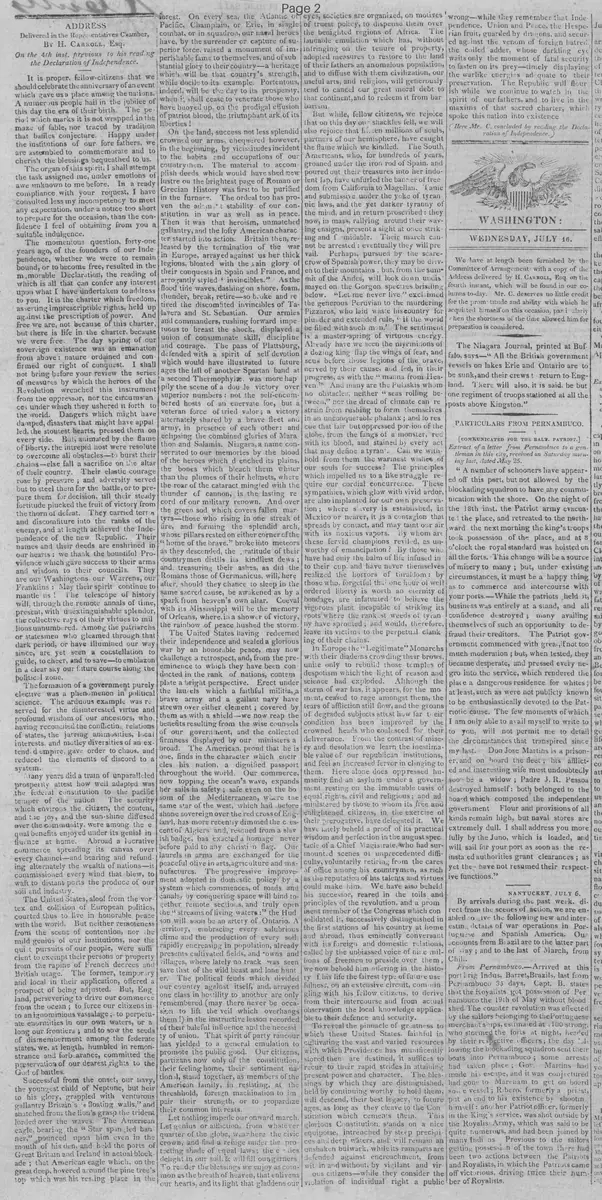
Delivered in the Representatives Chamber,
By H. CARROLL, Esq.
On the 4th inst. previous to his reading the Declaration of Independence,
It is proper, fellow-citizens, that we should celebrate the anniversary of an event which gave us a place among the nations. A numerous people hail in the jubilee of this day the era of their birth. The period which marks it is not wrapped in the maze of fable, nor traced by tradition that baffles conjecture. Happy under the institutions of our forefathers, we are assembled to commemorate and to cherish the blessings bequeathed to us.
The organ of this spirit, I shall attempt the task assigned me, under emotions of awe unknown to me before. In a ready compliance with your request, I have consulted less my incompetency to meet any expectation, under a notice too short to prepare for the occasion, than the confidence I feel of obtaining from you a suitable indulgence.
The momentous question, forty-one years ago, of the founders of our Independence, whether we were to remain bound, or to become free, resulted in the memorable Declaration, the reading of which is all that can confer any interest upon what I have undertaken to address to you. It is the charter which freedom, asserting imprescriptible rights, held up against the prescription of power. And free we are, not because of this charter, but there is life in the charter because we were free. The day spring of our sovereign existence was an emanation from above: nature ordained and confirmed our right of conquest. I shall not bring before your review the series of measures by which the heroes of the Revolution wrenched this instrument from the oppressor, nor the circumstances under which they ushered it forth to the world. Dangers which might have damped, disasters that might have appalled, the stoutest hearts, pressed them on every side. But, animated by the flame of liberty, the intrepid host were resolute to overcome all obstacles--to burst their chains--else fall a sacrifice on the altar of their country. Their elastic courage rose by pressure; and adversity served but to steel them for the battle, or to prepare them for decision, till their steady fortitude plucked the fruit of victory from the thorn of defeat. They carried terror and discomfiture into the ranks of the enemy, and at length achieved the Independence of the new Republic. Their names and their deeds are enshrined in our hearts: we thank the bountiful Providence which gave success to their arms and wisdom to their councils. They are our Washingtons, our Warrens, our Franklins: May their spirit continue to mantle us! The telescope of history will, through the remote annals of time, present, with unextinguishable splendor, the collective rays of their virtues to millions unnumbered. Among the patriarchs or statesmen who gleamed through that dark period, or have illumined our way since, are yet seen a constellation to guide, to cheer, and to save—to emblazon in a clear sky our future course along the political zone.
The formation of a government purely elective was a phenomenon in political science. The arduous example was reserved for the disinterested virtue and profound wisdom of our ancestors, who, having reconciled the conflicting relations of states, the jarring animosities, local interests, and motley diversities of an extended empire, gave order to chaos, and reduced the elements of discord to a system.
Many years did a train of unparalleled prosperity attest how well adapted was the federal constitution to the pacific temper of the nation. The security which environs the citizen, the content, and the joy, and the sunshine diffused over the Community, were among the equal benefits enjoyed under its genial influence at home. Abroad a lucrative commerce spreading its canvas over every channel—and bearing and refunding alternately the wealth of nations—it commissioned every wind that blew, to waft to distant ports the produce of our soil and industry.
The United States, aloof from the vortex and collision of European politics, courted thus to live in honorable peace with the world. But neither remoteness from the scene of contention, nor the mild genius of our institutions, nor the quiet pursuits of our people, were sufficient to exempt their persons or property from the rapine of French decrees and British usage. The former, temporary and local in their application, offered a prospect of being adjusted. But, England, persevering to drive our commerce from the ocean; to force our citizens into an ignominious vassalage; to perpetuate enormities in our own waters, or along our frontiers; and to sow the seeds of dismemberment among the federate states, we, at length, humbled in remonstrance and forbearance, committed the preservation of our dearest rights to the God of battles.
Successful from the onset, our navy, the youngest child of Neptune, but heir to his glory, grappled with venturous gallantry Britain's floating walls, and snatched from the lion's grasp the trident lorded over the waves. The American eagle, bearing the Star spangled banner, pounced upon him even in the mouth of his den, and held the ports of Great Britain and Ireland in actual blockade; that American eagle which, on the great deep, hovered around the pine tree's ion which was his resting place in the forest. On every sea, the Atlantic or Pacific, Champlain, or Erie, in single combat, or in squadron, our naval heroes have, by the surrender or capture of superior force, raised a monument of imperishable fame to themselves, and of substantial glory to their country—a heritage which will be that country's strength, while docile to its example. Portentous, indeed, will be the day to its prosperity when it shall cease to venerate those who have buoyed up, on the prodigal effusion of patriot blood, the triumphant ark of its liberties!
On the land, success not less splendid crowned our arms, chequered however, in the beginning, by vicissitudes incident to the habits and occupations of our countrymen. The material to accomplish deeds which would have shed new lustre on the brightest page of Roman or Grecian History was first to be purified in the furnace. The ordeal too has proved the admirable stability of our constitution in war as well as in peace. Then it was that heroism, unmatched gallantry, and the lofty American character started into action. Britain then, released by the termination of the war in Europe, arrayed against us her thick legions, bloated with the again glory of their conquests in Spain and France, and arrogantly styled invincibles. As the flood tide waves, dashing on shore, foam, thunder, break, retire—so broke and retired the discomfited invincibles of Talavera and St. Sebastian. Our armies and commanders, rushing forward impetuous to breast the shock, displayed a union of consummate skill, discipline and courage. The pass of Plattsburg, defended with a spirit of self devotion which would have illustrated to future ages the fall of another Spartan band at a second Thermopylae, was more happily the scene of a double victory over superior numbers: not the self-encumbered hosts of an enervate foe, but a veteran force of tried valor; a victory alternately shared by a brave fleet and army, in presence of each other: and eclipsing the combined glories of Marathon and Salamis. Niagara, a name consecrated to our memories by the blood of the heroes which drenched its plains the bones which bleach them whiter than the plumes of their helmets, where the roar of the cataract mingled with the thunder of cannon, is the lasting record of our military renown. And over the green sod which covers fallen martyrs—those who rising in one streak of fire, and forming the splendid arch, whose pillars rested on either corner of the home of the brave, broke into meteors as they descended, the gratitude of their countrymen distils its kindliest dews: and, treasuring their ashes, as did the Romans those of Germanicus, will, hereafter, should they chance to sleep in the same sacred cause, be awakened as by a spark from heaven's own altar. Coeval with its Mississippi will be the memory of Orleans, where, in a shower of victory, the rainbow of peace hushed the storm.
The United States having redeemed their independence and sealed a glorious war by an honorable peace, may now challenge a retrospect, and, from the pre-eminence to which they have been conducted in the rank of nations, contemplate a bright perspective. Erect under the laurels which a faithful militia, a brave army and a gallant navy have strewn over either element; covered by them as with a shield—we now reap the benefits resulting from the wise counsels of our government, and the collected firmness displayed by our ministers abroad. The American, proud that he is one, finds in the character which encircles his nation, a dignified passport throughout the world. Our commerce, now topping the ocean's wave, expands her sails in safety; safe even on the bosom of the Mediterranean, where the same star of the west, which had before shone sovereign over the red cross of England, has more recently dimmed the crescent of Algiers and, rescued from a slavish badge, has exacted a homage never before paid to any Christian flag. Our laurels in arms are exchanged for the peaceful olive in arts, agriculture and manufactures. The progressive improvement adopted in domestic policy by a system which commences, of roads and canals, by conquering space will bind together remote sections, and truly open the streams of living waters: the Hudson will soon be an artery of Ontario. A territory, embracing every salubrious clime and the production of every soil rapidly increasing in population, already presents cultivated fields, towns and villages, where lately no track was seen save that of the wild beast and lone hunter. The political feuds which divided our country against itself, and arrayed one class in hostility to another are only remembered (may there never be occasion to lift the veil which overhangs them!) in the instructive lesson recorded of their baleful influence and the necessity of union. That spirit of party rancour has yielded to a general emulation to promote the public good. Our citizens, partisans now only of the constitution, their feelings at home, their sentiment national, stand together, as members of the American family, in resisting, at the threshold, foreign machination to impair their strength, or to jeopardize their common interests.
Let nothing impede our onward march Let genius or affliction, from whatever quarter of the globe, wear here the civic crown, and find a refuge under the protecting shade of equal laws; the elves delight in our soil, & will fill our garners To render the blessings we enjoy as common as the breath of heaven, that enlivens our hearts, and its light that gladdens our eyes of truest policy, to dispense them over the benighted regions of Africa. The laudable emulation which has, without infringing on, the tenure of property, adopted measures to restore to the land of their fathers an anomalous population, and to diffuse with them civilization, our useful arts, and religion, will generously tend to cancel our great moral debt to that continent, and to redeem it from barbarism.
But while, fellow citizens, we rejoice that on this day our shackles fell, we will also rejoice that fifteen millions of souls, partners of our hemisphere, have caught the flame which we kindled. The South Americans, who, for hundreds of years, groaned under the iron rod of Spain, and poured out their treasures into her indolent lap, have unfurled the banner of freedom from California to Magellan. Tame and submissive under the yoke of tyrannic laws, and the yet darker tyranny of the mind, and in return proscribed: they now, in mass, rallying around their waving ensigns, present a sight at once striking and formidable. Their march cannot be arrested: eventually they will prevail. Perhaps, pursued by the scare-crow of Spanish power, they may be driven to their mountains, but, from the summit of the Andes, will look down undismayed on the Gorgon spears bristling below. "Let me never live," exclaimed the generous Peruvian to the murdering Pizzaros, who laid waste his country for plunder and extended rule, "if the world be filled with such men." The sentiment is a master-spring of virtuous energy. Already have we seen the myrmidons of a dozing king flap the wings of fear, and scud before those legions of the brave, nerved by their cause, and led, in their progress, as with the "manna from Heaven" And many are the Pulaskis whom no obstacles, neither "seas rolling between," nor the dread of climate can restrain from rushing to form themselves in an unconquerable phalanx; and to rescue that fair but oppressed portion of the globe, from the fangs of a monster, red with its blood, and stained by every act that may define a tyrant. Call we withhold from them the warmest wishes of our souls for success? The principles which impelled us to a like struggle require our cordial concurrence. These sympathies, which glow with vivid ardor, are also implanted for our own preservation; where slavery is established, in Mexico or nearer, it is a contagion that spreads by contact, and may taint our air with its noxious vapors. By whom are these fervid champions reviled, as unworthy of emancipation? By those who have had only the balm of life infused into their cup, and have never themselves realized the horrors of thraldom: by those who, forgetful that one hour of well ordered liberty is worth an eternity of bondage, are infatuated to believe the vigorous plant incapable of striking its roots where the rankest weeds of tyranny have sprouted; and would, therefore, leave its victims to the perpetual clanking of their chains.
In Europe the "Legitimate" Monarchs with their diadems crowding their brows, unite only to rebuild those temples of despotism which the light of reason and science had exploded. Although the storm of war has, it appears, for the moment, ceased to rage amongst them, the tears of affliction still flow, and the groans of degraded subjects attest how far their condition has been improved by the crowned heads who coalesced for their deliverance. From the contrast of misery and desolation we learn the inestimable value of our republican institutions, and feel an increased fervor in clinging to them. Here alone does oppressed humanity find an asylum under a government resting on the immutable basis of equal rights, civil and religious; and administered by those to whom its free and enlightened citizens, in the exercise of their prerogative, have delegated it. We have lately beheld a proof of its practical wisdom and perfection in the august spectacle of a Chief Magistrate, who had surmounted scenes of unprecedented difficulty, voluntarily retiring from the cares of office among his countrymen, as rich as the reputation of his talents and virtues could make him. We have also beheld his successor, reared in the toils and principles of the revolution, and a prominent member of the Congress which consolidated it, successively distinguished in the first stations of his country at home and abroad, thus eminently conversant with its foreign and domestic relations, called by the unbiassed voice of the millions of freemen to preside over them, we now behold him offering in the history of his life the fairest type of future usefulness, on an extensive circuit, commingling with his fellow citizens, to derive from their intercourse and from actual observation the local knowledge applicable to their defence and security.
To reveal the pinnacle of greatness to which these United States, faithful in cultivating the vast and varied resources with which Providence has munificently stored them, are destined, it suffices to recur to their rapid strides in attaining present power and character. The blessings by which they are distinguished, held by continuing worthy to hold them, will descend, their best legacy, to future ages, as long as they cleave to the Constitution which cements them. This glorious Constitution stands on a nice equipoise, intrenched by steep precipices and deep waters, and will remain an unshaken bulwark, while its ramparts are defended against encroachment, from within and without, by vigilant and virtuous citizens—while they consider the violation of individual right a public wrong—while they remember that Independence, Union and Peace, the Hesperian fruit, guarded by dragons, and secured against the venom of foreign hatred the coiled adder, whose darkling eye waits only the moment of fatal security to fasten on its prey—timely displaying the warlike energies adequate to their preservation. The Republic will flourish while we continue to watch in the spirit of our fathers, and to live in the maxims of that sacred charter, which spoke this nation into existence (Here Mr. C. concluded by reading the Declaration of Independence.)
What sub-type of article is it?
What themes does it cover?
What keywords are associated?
What entities or persons were involved?
Where did it happen?
Story Details
Key Persons
Location
Representatives Chamber
Event Date
On The 4th Inst.
Story Details
H. Carroll delivers a patriotic oration on the anniversary of independence, recounting the Revolution's heroes and victories, the formation of the Constitution, prosperity, the War of 1812's triumphs on sea and land, current blessings, support for South American independence, contrast with European despotism, and praise for republican institutions, concluding with the Declaration.