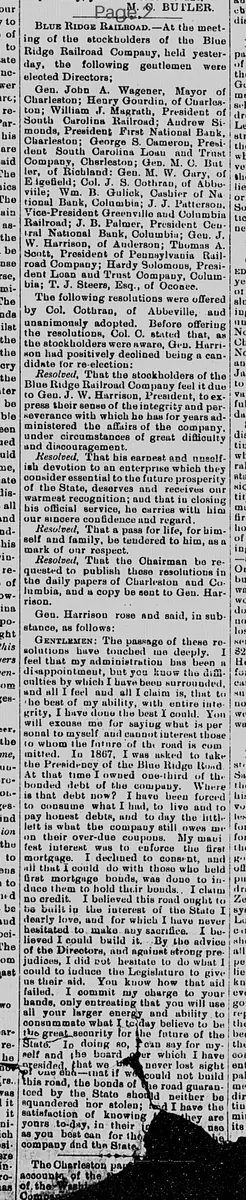
Blue Ridge Railroad.—At the meeting of the stockholders of the Blue Ridge Railroad Company, held yesterday, the following gentlemen were elected Directors: Gen. John A. Wagener, Mayor of Charleston; Henry Gourdin, of Charleston; William J. Magrath, President of South Carolina Railroad; Andrew Simmons, President First National Bank, Charleston; George S. Cameron, President South Carolina Loan and Trust Company, Charleston; Gen. M. C. Butler, of Richland; Gen. M. W. Gary, of Edgefield; Col. J. S. Cothran, of Abbeville; Wm. B. Gulick, Cashier of National Bank, Columbia; J. J. Patterson, Vice-President Greenville and Columbia Railroad; J. B. Palmer, President Central National Bank, Columbia; Gen. J. W. Harrison, of Anderson; Thomas A. Scott, President of Pennsylvania Railroad Company; Hardy Solomons, President Loan and Trust Company, Columbia; T. J. Steers, Esq., of Oconee. The following resolutions were offered by Col. Cothran, of Abbeville, and unanimously adopted. Before offering the resolutions, Col. C. stated that, as the stockholders were aware, Gen. Harrison had positively declined being a candidate for re-election: Resolved, That the stockholders of the Blue Ridge Railroad Company feel it due to Gen. J. W. Harrison, President, to express their sense of the integrity and perseverance with which he has for years administered the affairs of the company, under circumstances of great difficulty and discouragement. Resolved, That his earnest and unselfish devotion to an enterprise which they consider essential to the future prosperity of the State, deserves and receives our warmest recognition; and that in closing his official service, he carries with him our sincere confidence and regard. Resolved, That a pass for life, for himself and family, be tendered to him, as a mark of our respect. Resolved, That the Chairman be requested to publish these resolutions in the daily papers of Charleston and Columbia, and a copy be sent to Gen. Harrison. Gen. Harrison rose and said, in substance, as follows: Gentlemen: The passage of these resolutions have touched me deeply. I feel that my administration has been a disappointment, but you know the difficulties by which I have been surrounded and all I feel and all I claim is, that to the best of my ability, with entire integrity, I have done the best I could. You will excuse me for saying what is personal to myself and cannot interest those to whom the future of the road is committed. In 1867, I was asked to take the Presidency of the Blue Ridge Road. At that time I owned one-third of the bonded debt of the company. Where is that debt now? I have been forced to consume what I had, to live and to pay honest debts, and to-day the little that the company still owes me is on their over-due coupons. My manifest interest was to enforce the first mortgage. I declined to consent, and all that I could do with those who held first mortgage bonds, was done to induce them to hold their bonds. I claim no credit. I believed this road ought to be built in the interest of the State I dearly love, and for which I have never hesitated to make any sacrifice. I believed I could build it. By the advice of the Directors, and against strong prejudices, I did not hesitate to do what I could to induce the Legislature to give us their aid. You know how that aid failed. I commit my charge to your hands, only entreating that you will use all your larger energy and ability to consummate what I to-day believe to be the great security for the future of the State. In doing so, I can say for myself and the board over which I have presided, that we believe—that if we could not build this road, the bonds of the road guaranteed by the State should neither be squandered nor stolen; and I have the satisfaction of knowing they are yours to-day, in their use as you best can for the company and the State. The Charleston papers accounts of the