Thank you for visiting SNEWPapers!
Sign up free
Story
September 26, 1865
New York Daily Tribune
New York, New York County, New York
What is this article about?
Report on machinery accident halting USS Algonquin in docked naval endurance race against Winooski; Algonquin led in coal efficiency but lagged in revolutions; highlights safety risks from high steam and suggests open-sea trials first. (218 characters)
Clipping
OCR Quality
95%
Excellent
Full Text
THE NAVAL RACERS.
The Accident to The Algonquin-Statement of Results up to the Time She Stopped-The Algonquin Slightly Ahead on Coal-The Winooski Ahead on Revolutions.
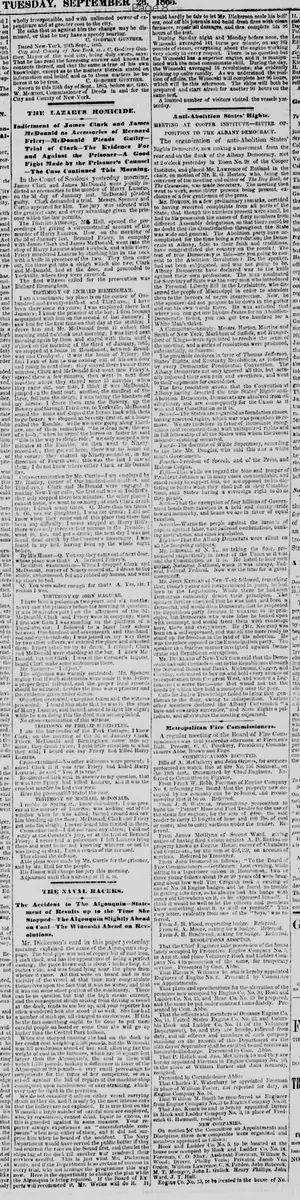
Mr. Dickerson's card in this paper yesterday morning, explained the cause of the Algonquin's stop. The feed pipe was not of copper but of cast iron, one inch thick, and has the appearance of being a perfect casting; the piece blown out is about 7 inches long, 6 inches wide, and was found lying near the place from whence it came. All that were on board and in the vicinity of the vessel at that time may congratulate themselves upon the fact that it was no worse, and that it was not some other portion of the machinery. There can be no question but that the high steam current and the consequent strain arising from driving a vessel at the dock, tends to use her up, and your reporter has often wondered how she stood it so well. She has had a number of mishaps, all charged to carelessness. If this be the fact something ought to be done to put more careful people on board or some time she will go up higher than the Central Park balloon.
When she stopped running she had on the dock to her credit coal weighing 2,826 pounds, but the Winooski was 337 revolutions ahead of her, and, allowing her the weight of coal in the furnaces, which are 8 square feet larger than the Algonquin's, the coal in them will weigh 1,569 pounds, making a difference in favor of the Algonquin of 257 pounds-a very small percentage to compensate for the turns of her competitor, or as a set-off against the bill of repairs at the machine-shop consequent upon carelessness or over-straining, whichever may be right in the premises.
We do not consider it safe on either vessel carrying steam as they do, and it is only by the most intense care that the boilers are not exploded. It is true that on the Winooski a large number of careful men are employed, who, by regulations, cannot drink liquor to excess, so this is guarded against in some measure.
Your reporter always experiences an "uncomfortable composure" when near either of them, and it did not surprise him when he heard of the accident. The Navy Department would have served the public better if they had ordered the race on the Sound first, and then let the ships tug at the dock till another war rendered their services needful. This is just what Mr. Dickerson wants, and if the Department is so certain of success in every trial, why not arrange the programme this way now. Here is the opportunity to change the plan while the Algonquin is being repaired. If the Board of Experts will recommend it, Mr. Welles will do it. It would hardly be fair to let Mr. Dickerson scale his boilers, cool off his journals and build fresh fires with clean furnaces, repair all damages, and then complete his 96 hours of the test.
During Sunday night and Monday before noon, the Winooski averaged 14 turns per minute, on say 160 pounds of steam, everything about the engine working very nicely in every respect. There is no question but the Winooski has a superior engine, and it is manipulated with the most consummate skill. During the day, the Winooski averaged 16 revolutions; she evidently picking up quite rapidly. As we understand the position of affairs, the Winooski will complete her 96 hours, which will be this afternoon. The ships will both be prepared and start afresh for another 96 hours on the same test.
A limited number of visitors visited the vessels yesterday.
The Accident to The Algonquin-Statement of Results up to the Time She Stopped-The Algonquin Slightly Ahead on Coal-The Winooski Ahead on Revolutions.
Mr. Dickerson's card in this paper yesterday morning, explained the cause of the Algonquin's stop. The feed pipe was not of copper but of cast iron, one inch thick, and has the appearance of being a perfect casting; the piece blown out is about 7 inches long, 6 inches wide, and was found lying near the place from whence it came. All that were on board and in the vicinity of the vessel at that time may congratulate themselves upon the fact that it was no worse, and that it was not some other portion of the machinery. There can be no question but that the high steam current and the consequent strain arising from driving a vessel at the dock, tends to use her up, and your reporter has often wondered how she stood it so well. She has had a number of mishaps, all charged to carelessness. If this be the fact something ought to be done to put more careful people on board or some time she will go up higher than the Central Park balloon.
When she stopped running she had on the dock to her credit coal weighing 2,826 pounds, but the Winooski was 337 revolutions ahead of her, and, allowing her the weight of coal in the furnaces, which are 8 square feet larger than the Algonquin's, the coal in them will weigh 1,569 pounds, making a difference in favor of the Algonquin of 257 pounds-a very small percentage to compensate for the turns of her competitor, or as a set-off against the bill of repairs at the machine-shop consequent upon carelessness or over-straining, whichever may be right in the premises.
We do not consider it safe on either vessel carrying steam as they do, and it is only by the most intense care that the boilers are not exploded. It is true that on the Winooski a large number of careful men are employed, who, by regulations, cannot drink liquor to excess, so this is guarded against in some measure.
Your reporter always experiences an "uncomfortable composure" when near either of them, and it did not surprise him when he heard of the accident. The Navy Department would have served the public better if they had ordered the race on the Sound first, and then let the ships tug at the dock till another war rendered their services needful. This is just what Mr. Dickerson wants, and if the Department is so certain of success in every trial, why not arrange the programme this way now. Here is the opportunity to change the plan while the Algonquin is being repaired. If the Board of Experts will recommend it, Mr. Welles will do it. It would hardly be fair to let Mr. Dickerson scale his boilers, cool off his journals and build fresh fires with clean furnaces, repair all damages, and then complete his 96 hours of the test.
During Sunday night and Monday before noon, the Winooski averaged 14 turns per minute, on say 160 pounds of steam, everything about the engine working very nicely in every respect. There is no question but the Winooski has a superior engine, and it is manipulated with the most consummate skill. During the day, the Winooski averaged 16 revolutions; she evidently picking up quite rapidly. As we understand the position of affairs, the Winooski will complete her 96 hours, which will be this afternoon. The ships will both be prepared and start afresh for another 96 hours on the same test.
A limited number of visitors visited the vessels yesterday.
What sub-type of article is it?
Historical Event
Curiosity
What themes does it cover?
Misfortune
Triumph
What keywords are associated?
Naval Race
Algonquin Accident
Winooski
Endurance Test
Boiler Failure
Navy Department
What entities or persons were involved?
Mr. Dickerson
Mr. Welles
Where did it happen?
At The Dock
Story Details
Key Persons
Mr. Dickerson
Mr. Welles
Location
At The Dock
Story Details
During a 96-hour naval endurance test at the dock, the Algonquin suffered a feed pipe failure, stopping her run; she led slightly in coal consumption but trailed in revolutions; safety concerns raised about high steam pressure; Winooski performed superiorly and will complete the test, with plans for a restart.