Thank you for visiting SNEWPapers!

Sign up free
Page thumbnail for The Providence Journal, And Town And Country Advertiser
Foreign News August 26, 1801

The Providence Journal, And Town And Country Advertiser

Providence, Providence County, Rhode Island

What is this article about?

The British House of Commons debated the eligibility of clergymen to sit in Parliament, stemming from the election of Mr. John Horne Tooke for Old Sarum. Historical precedents showed clergymen were summoned separately and never granted seats in the Commons. A bill was introduced to exclude them.

Clipping
OCR Quality

92% Excellent

Full Text

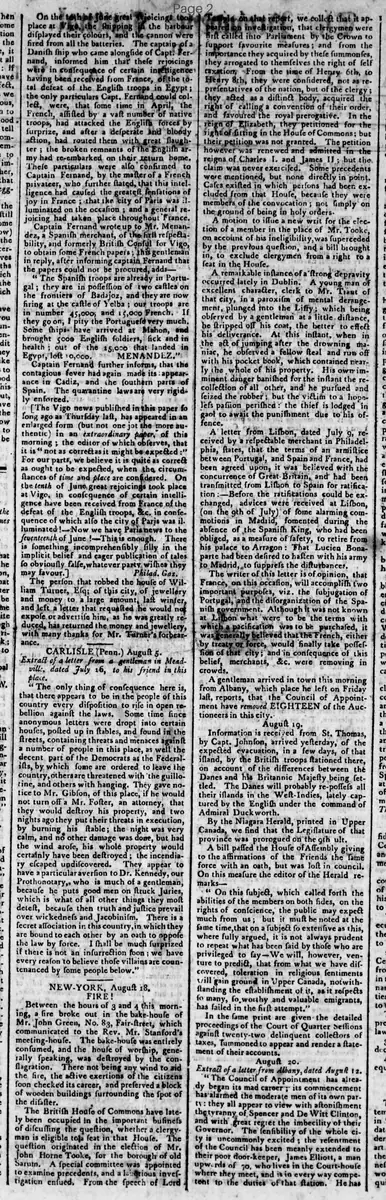
The British House of Commons have lately been occupied in the important business of discussing the question, whether a clergyman is eligible to a seat in that House. The question originated in the election of Mr. John Horne Tooke, for the borough of Old Sarum. A special committee was appointed to examine precedents, and a laborious investigation ensued. From the speech of Lord Onslow on that report, we collect that it appeared on investigation, that clergymen were first called into Parliament by the Crown to support favourite measures; and from the importance they acquired by these summons, they arrogated to themselves the right of self-taxation. From the time of Henry 6th, to Henry 8th, they were considered, not as representatives of the nation, but of the clergy; they acted as a distinct body, acquired the right of calling a convention of their order, and favoured the royal prerogative. In the reign of Elizabeth, they petitioned for the right of sitting in the House of Commons; but their petition was not granted. The petition however was renewed and admitted in the reigns of Charles I. and James II: but the claim was never exercised. Some precedents were mentioned, but none directly in point. Cases existed in which persons had been excluded from that House, because they were members of the convocation; not simply on the ground of being in holy orders.

A motion to issue a new writ for the election of a member in the place of Mr. Tooke, on account of his ineligibility, was superseded by the previous question, and a bill brought in, to exclude clergymen from a right to a seat in the House.

What sub-type of article is it?

Political

What keywords are associated?

House Of Commons Clergyman Eligibility John Horne Tooke Old Sarum Election Parliamentary Precedents Historical Petitions

What entities or persons were involved?

John Horne Tooke Lord Onslow

Where did it happen?

Old Sarum

Foreign News Details

Primary Location

Old Sarum

Event Date

Lately

Key Persons

John Horne Tooke Lord Onslow

Outcome

a bill brought in to exclude clergymen from a right to a seat in the house of commons.

Event Details

The House of Commons discussed whether a clergyman is eligible for a seat, originating from the election of Mr. John Horne Tooke for Old Sarum. A committee examined precedents, revealing historical summons of clergymen by the Crown, their role as representatives of the clergy from Henry VI to Henry VIII, petitions in Elizabeth's reign denied, and renewals under Charles I and James II not exercised. No direct precedents found; exclusions based on convocation membership. A motion for a new writ was superseded, leading to a bill excluding clergymen.

Are you sure?