Thank you for visiting SNEWPapers!
Sign up free
Editorial
April 16, 1897
The News & Observer
Raleigh, Wake County, North Carolina
What is this article about?
Editorial from Washington discusses Democratic optimism post-Jefferson banquet, praises Gen. Wm. R. Cox, and criticizes the Southern Railway's domination over federal patronage and judgeship appointments in North Carolina, highlighting corporate influence in politics.
Clipping
OCR Quality
98%
Excellent
Full Text
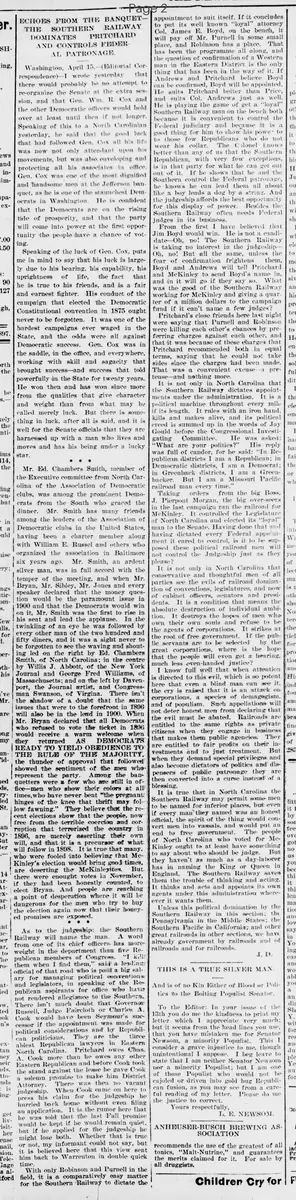
ECHOES FROM THE BANQUET—THE SOUTHERN RAILWAY DOMINATES PRITCHARD AND CONTROLS FEDERAL PATRONAGE.
Washington, April 15.—(Editorial Correspondence)—I wrote yesterday that there would probably be no attempt to re-organize the Senate at the extra session, and that Gen. Wm. R. Cox and the other Democratic officers would hold over at least until then if not longer.
Speaking of this to a North Carolinian yesterday, he said that the good luck that had followed Gen. Cox all his life was now not only attendant upon his movements, but was also enveloping and protecting all his associates in office.
Gen. Cox was one of the most dignified and handsome men at the Jefferson banquet, as he is one of the staunchest Democrats in Washington. He is confident that the Democrats are on the rising tide of prosperity, and that the party will come into power at the first opportunity the people have a chance of voting.
Speaking of the luck of Gen. Cox, puts me in mind to say that his luck is largely due to his bearing, his capability, his uprightness of life, the fact that he is true to his friends, and is a fair and earnest fighter. His conduct of the campaign that elected the Democratic Constitutional convention in 1875 ought never to be forgotten. It was one of the hardest campaigns ever waged in the State, and the odds were all against Democratic success. Gen. Cox was in the saddle, in the office, and everywhere, working with skill and sagacity that brought success—and success that told powerfully in the State for twenty years.
He won then and has won since more from the qualities that give character and weight than from what may be called merely luck. But there is something in luck, after all is said, and it is well for the Senate officials that they are harnessed up with a man who lives and moves and has his being under a lucky star.
Mr. Ed. Chambers Smith, member of the Executive committee from North Carolina of the Association of Democratic clubs, was among the prominent Democrats from the South who graced the dinner. Mr. Smith has many friends among the leaders of the Association of Democratic clubs in the United States, having been a charter member along with William E. Russell and others who organized the association in Baltimore six years ago. Mr. Smith, an ardent silver man, was in full accord with the temper of the meeting, and when Mr. Bryan, Mr. Sibley, Mr. Jones and every speaker declared that the money question would be the paramount issue in 1900 and that the Democrats would win on it, Mr. Smith was the first to rise in his seat and lead the applause. In the twinkling of an eye he was followed by every other man of the two hundred and fifty diners, and it was a sight never to be forgotten to see the waving and shouting led on the right by Ed. Chambers Smith, of North Carolina; in the centre by Willis J. Abbott, of the New York Journal and George Fred Williams, of Massachusetts; and on the left by Davenport, the Journal artist, and Congressman Swanson, of Virginia. There isn't the shadow of a doubt that the same issues that were to the forefront in 1896 will also be in the lead in 1900. When Mr. Bryan declared that all Democrats who refused to vote the ticket in 1896 would receive a warm welcome when they returned AS DEMOCRATS READY TO YIELD OBEDIENCE TO THE RULE OF THE MAJORITY, the thunder of approval that followed showed the sentiment of the men who represent the party. Among the banqueters were a few who are still in office—men who show their colors at all times, who have never bent "the pregnant hinges of the knee that thrift may follow fawning." They believe that the recent elections show that the people, now free from the terrible coercion and corruption that terrorized the country in 1896, are merely asserting their own will, and that it is a precursor of what will follow in 1898. It is true that many who were fooled into believing that McKinley's election would bring good times are deserting the McKinleyites. But there were enough votes in November, if they had been honestly counted, to elect Bryan. And people are reaching a point of desperation where it will be dangerous for the men who try to buy the election again now that their honeyed promises are exposed.
As to the judgeship: the Southern Railway will name the man. A word from one of its chief officers has more weight in the department than five Republican members of Congress. "I kill them when I find them," said a leading official of that road who is paid a big salary for managing political conventions and legislators, in speaking of the Republican aspirants for office who have not rendered allegiance to the Southern. There isn't much doubt that Governor Russell, Judge Faircloth or Charles A. Cook would have been Seymour's successor if the appointment was made for Democratic politicians. They are the three ablest Republican lawyers in Eastern North Carolina. Pritchard owes Chas. A. Cook more than he owes any other Eastern Republican and before Cook took the stand against the lease he gave Cook a solemn promise to make him District Attorney. There was then no vacant judgeship. When Cook came on here to press his claim for the judgeship he hurried back home without even filing an application. It is the rumor here that he was told that the last fall promise would be kept if he would remain quiet, but if he applied for the judgeship he might lose both. Whether that is true or not, my informant could not say, but it is believed here that this view sent him back to Warrenton in double quick time.
With only Robinson and Purnell in the field, it is a comparatively easy matter for the Southern Railway to dictate the appointment to suit itself. If it concludes to put its well known "loyal" attorney Col. James E. Boyd, on the bench, it will pay off Mr. Purnell in some small place, and Robinson has a place. That has been the programme all along, and the question of confirmation of a Western man in the Eastern District is the only thing that has been in the way of it. If Andrews and Pritchard believe Boyd can be confirmed, Boyd will be appointed. He suits Pritchard better than Price, and suits Col. Andrews just as well. He is playing the game of get a "loyal" Southern Railway man on the bench both because it is convenient to control the Federal judiciary and because it is a good thing for him to show his power to those few Republicans who do not wear his collar. The Colonel knows better than any of us that the Southern Republican, with very few exceptions, is in that party for what he can get out of it. If he shows that he and the Southern control the Federal patronage, he knows he can lead them all about like a boy leads a dog by a string. And the judgeship affords the best opportunity for this display of power. Besides the Southern Railway often needs Federal judges in its business.
From the first I have believed that Jim Boyd would win. He is not a candidate—Oh, no! The Southern Railway is taking no interest in the judgeship—Oh, no! But all the same, unless the fear of confirmation frightens them, Boyd and Andrews will tell Pritchard and McKinley to send Boyd's name in, and in it will go if they say so. What was the good of the Southern Railway working for McKinley and giving a quarter of a million dollars to the campaign fund if it can't name a few judges?
Pritchard's close friends here last night were saying that Purnell and Robinson were killing each other's chances by preferring charges against each other, and that it was because of these charges that Pritchard recommended both in equal terms, saying that he could not take sides since the charges had been made. That was a convenient excuse—a pretense and nothing more.
It is not only in North Carolina that the Southern Railway dictates appointments under the administration. It is a political machine throughout every mile of its length. It rules with an iron hand, kills and makes alive, and its political creed is summed up in the words of Jay Gould before the Congressional Investigating Committee. He was asked "What are your politics?" His reply was full of candor, for he said: "In Republican districts I am a Republican; in Democratic districts, I am a Democrat; in Greenback districts, I am a Greenbacker. But I am a Missouri Pacific railroad man every time."
Taking orders from the big Boss. J. Pierpont Morgan, the big over-seers in the last campaign ran the railroad for McKinley. It controlled the Legislature of North Carolina and elected its "loyal" man to the Senate. Having done that and having dictated every Federal appointment it cared to control, is it to be supposed these political railroad men will not control the Judgeship just as they please?
It is not only in North Carolina that conservative and thoughtful men of all parties see the evils of railroad domination of conventions, legislatures, and now of cabinet officers, senators and presidents. It is a condition that means the absolute destruction of individual ambition. It destroys the hopes of men who own their own souls and refuse to be the agents of corporations. It strikes at the root of free government. If the public servants are to be selected by the great corporations, where is the hope that the people will even get a bearing, much less even-handed justice?
I know full well that when attention is directed to this evil, which is so potent here that even a blind man can see it, the cry is raised that it is an attack on corporations, a species of demagogism, and of populism. Such appellations will not deter honest men from declaring that the evil must be abated. Railroads are entitled to the same rights as private citizens when they engage in business that makes them public agencies. They are entitled to fair profits on their investments and to just treatment. But when they demand special privileges and also become dictators of politics and dispensers of public patronage they are then converted into a curse instead of a blessing.
It is true that in North Carolina the Southern Railway may permit some men to be named for inferior places, but even if every man they named was an honest official, the spirit of the thing would convert men into vassals, and would put an end to free government. The people of North Carolina who voted for McKinley ought to at least have something to say about who should be judge. But they haven't as much as a day-laborer has in naming the King or Queen in England. The Southern Railway saves them the trouble of thinking and acting. It thinks and acts and appoints its own agents under this administration wherever it wants them.
Unless this political domination by the Southern Railway in this section; the Pennsylvania in the Middle States; the Southern Pacific in California; and other great railroads in other sections, we have already government by railroads and of railroads and for railroads.
J. D.
Washington, April 15.—(Editorial Correspondence)—I wrote yesterday that there would probably be no attempt to re-organize the Senate at the extra session, and that Gen. Wm. R. Cox and the other Democratic officers would hold over at least until then if not longer.
Speaking of this to a North Carolinian yesterday, he said that the good luck that had followed Gen. Cox all his life was now not only attendant upon his movements, but was also enveloping and protecting all his associates in office.
Gen. Cox was one of the most dignified and handsome men at the Jefferson banquet, as he is one of the staunchest Democrats in Washington. He is confident that the Democrats are on the rising tide of prosperity, and that the party will come into power at the first opportunity the people have a chance of voting.
Speaking of the luck of Gen. Cox, puts me in mind to say that his luck is largely due to his bearing, his capability, his uprightness of life, the fact that he is true to his friends, and is a fair and earnest fighter. His conduct of the campaign that elected the Democratic Constitutional convention in 1875 ought never to be forgotten. It was one of the hardest campaigns ever waged in the State, and the odds were all against Democratic success. Gen. Cox was in the saddle, in the office, and everywhere, working with skill and sagacity that brought success—and success that told powerfully in the State for twenty years.
He won then and has won since more from the qualities that give character and weight than from what may be called merely luck. But there is something in luck, after all is said, and it is well for the Senate officials that they are harnessed up with a man who lives and moves and has his being under a lucky star.
Mr. Ed. Chambers Smith, member of the Executive committee from North Carolina of the Association of Democratic clubs, was among the prominent Democrats from the South who graced the dinner. Mr. Smith has many friends among the leaders of the Association of Democratic clubs in the United States, having been a charter member along with William E. Russell and others who organized the association in Baltimore six years ago. Mr. Smith, an ardent silver man, was in full accord with the temper of the meeting, and when Mr. Bryan, Mr. Sibley, Mr. Jones and every speaker declared that the money question would be the paramount issue in 1900 and that the Democrats would win on it, Mr. Smith was the first to rise in his seat and lead the applause. In the twinkling of an eye he was followed by every other man of the two hundred and fifty diners, and it was a sight never to be forgotten to see the waving and shouting led on the right by Ed. Chambers Smith, of North Carolina; in the centre by Willis J. Abbott, of the New York Journal and George Fred Williams, of Massachusetts; and on the left by Davenport, the Journal artist, and Congressman Swanson, of Virginia. There isn't the shadow of a doubt that the same issues that were to the forefront in 1896 will also be in the lead in 1900. When Mr. Bryan declared that all Democrats who refused to vote the ticket in 1896 would receive a warm welcome when they returned AS DEMOCRATS READY TO YIELD OBEDIENCE TO THE RULE OF THE MAJORITY, the thunder of approval that followed showed the sentiment of the men who represent the party. Among the banqueters were a few who are still in office—men who show their colors at all times, who have never bent "the pregnant hinges of the knee that thrift may follow fawning." They believe that the recent elections show that the people, now free from the terrible coercion and corruption that terrorized the country in 1896, are merely asserting their own will, and that it is a precursor of what will follow in 1898. It is true that many who were fooled into believing that McKinley's election would bring good times are deserting the McKinleyites. But there were enough votes in November, if they had been honestly counted, to elect Bryan. And people are reaching a point of desperation where it will be dangerous for the men who try to buy the election again now that their honeyed promises are exposed.
As to the judgeship: the Southern Railway will name the man. A word from one of its chief officers has more weight in the department than five Republican members of Congress. "I kill them when I find them," said a leading official of that road who is paid a big salary for managing political conventions and legislators, in speaking of the Republican aspirants for office who have not rendered allegiance to the Southern. There isn't much doubt that Governor Russell, Judge Faircloth or Charles A. Cook would have been Seymour's successor if the appointment was made for Democratic politicians. They are the three ablest Republican lawyers in Eastern North Carolina. Pritchard owes Chas. A. Cook more than he owes any other Eastern Republican and before Cook took the stand against the lease he gave Cook a solemn promise to make him District Attorney. There was then no vacant judgeship. When Cook came on here to press his claim for the judgeship he hurried back home without even filing an application. It is the rumor here that he was told that the last fall promise would be kept if he would remain quiet, but if he applied for the judgeship he might lose both. Whether that is true or not, my informant could not say, but it is believed here that this view sent him back to Warrenton in double quick time.
With only Robinson and Purnell in the field, it is a comparatively easy matter for the Southern Railway to dictate the appointment to suit itself. If it concludes to put its well known "loyal" attorney Col. James E. Boyd, on the bench, it will pay off Mr. Purnell in some small place, and Robinson has a place. That has been the programme all along, and the question of confirmation of a Western man in the Eastern District is the only thing that has been in the way of it. If Andrews and Pritchard believe Boyd can be confirmed, Boyd will be appointed. He suits Pritchard better than Price, and suits Col. Andrews just as well. He is playing the game of get a "loyal" Southern Railway man on the bench both because it is convenient to control the Federal judiciary and because it is a good thing for him to show his power to those few Republicans who do not wear his collar. The Colonel knows better than any of us that the Southern Republican, with very few exceptions, is in that party for what he can get out of it. If he shows that he and the Southern control the Federal patronage, he knows he can lead them all about like a boy leads a dog by a string. And the judgeship affords the best opportunity for this display of power. Besides the Southern Railway often needs Federal judges in its business.
From the first I have believed that Jim Boyd would win. He is not a candidate—Oh, no! The Southern Railway is taking no interest in the judgeship—Oh, no! But all the same, unless the fear of confirmation frightens them, Boyd and Andrews will tell Pritchard and McKinley to send Boyd's name in, and in it will go if they say so. What was the good of the Southern Railway working for McKinley and giving a quarter of a million dollars to the campaign fund if it can't name a few judges?
Pritchard's close friends here last night were saying that Purnell and Robinson were killing each other's chances by preferring charges against each other, and that it was because of these charges that Pritchard recommended both in equal terms, saying that he could not take sides since the charges had been made. That was a convenient excuse—a pretense and nothing more.
It is not only in North Carolina that the Southern Railway dictates appointments under the administration. It is a political machine throughout every mile of its length. It rules with an iron hand, kills and makes alive, and its political creed is summed up in the words of Jay Gould before the Congressional Investigating Committee. He was asked "What are your politics?" His reply was full of candor, for he said: "In Republican districts I am a Republican; in Democratic districts, I am a Democrat; in Greenback districts, I am a Greenbacker. But I am a Missouri Pacific railroad man every time."
Taking orders from the big Boss. J. Pierpont Morgan, the big over-seers in the last campaign ran the railroad for McKinley. It controlled the Legislature of North Carolina and elected its "loyal" man to the Senate. Having done that and having dictated every Federal appointment it cared to control, is it to be supposed these political railroad men will not control the Judgeship just as they please?
It is not only in North Carolina that conservative and thoughtful men of all parties see the evils of railroad domination of conventions, legislatures, and now of cabinet officers, senators and presidents. It is a condition that means the absolute destruction of individual ambition. It destroys the hopes of men who own their own souls and refuse to be the agents of corporations. It strikes at the root of free government. If the public servants are to be selected by the great corporations, where is the hope that the people will even get a bearing, much less even-handed justice?
I know full well that when attention is directed to this evil, which is so potent here that even a blind man can see it, the cry is raised that it is an attack on corporations, a species of demagogism, and of populism. Such appellations will not deter honest men from declaring that the evil must be abated. Railroads are entitled to the same rights as private citizens when they engage in business that makes them public agencies. They are entitled to fair profits on their investments and to just treatment. But when they demand special privileges and also become dictators of politics and dispensers of public patronage they are then converted into a curse instead of a blessing.
It is true that in North Carolina the Southern Railway may permit some men to be named for inferior places, but even if every man they named was an honest official, the spirit of the thing would convert men into vassals, and would put an end to free government. The people of North Carolina who voted for McKinley ought to at least have something to say about who should be judge. But they haven't as much as a day-laborer has in naming the King or Queen in England. The Southern Railway saves them the trouble of thinking and acting. It thinks and acts and appoints its own agents under this administration wherever it wants them.
Unless this political domination by the Southern Railway in this section; the Pennsylvania in the Middle States; the Southern Pacific in California; and other great railroads in other sections, we have already government by railroads and of railroads and for railroads.
J. D.
What sub-type of article is it?
Partisan Politics
Legal Reform
Infrastructure
What keywords are associated?
Southern Railway
Federal Patronage
Judgeship Appointment
Democratic Clubs
Corporate Influence
North Carolina Politics
Mckinley Administration
Silver Issue
What entities or persons were involved?
Gen. Wm. R. Cox
Ed. Chambers Smith
Southern Railway
J. Elwood Cox
William Jennings Bryan
Jeter Pritchard
Col. James E. Boyd
Charles A. Cook
Mckinley Administration
Editorial Details
Primary Topic
Southern Railway's Domination Of Federal Patronage And Judgeship In North Carolina
Stance / Tone
Critical Of Corporate Political Influence, Supportive Of Democratic Resurgence
Key Figures
Gen. Wm. R. Cox
Ed. Chambers Smith
Southern Railway
J. Elwood Cox
William Jennings Bryan
Jeter Pritchard
Col. James E. Boyd
Charles A. Cook
Mckinley Administration
Key Arguments
Democrats Are Poised For Victory On Silver Issue In 1900
Southern Railway Controls Federal Appointments In North Carolina
Corporate Railroad Influence Undermines Free Government
Pritchard And Republicans Are Puppets Of The Southern Railway
Judgeship Will Go To Loyal Southern Railway Attorney Col. James E. Boyd
Railroads Should Not Dictate Politics Or Patronage