Thank you for visiting SNEWPapers!
Sign up free
Sistersville Daily Oil Review
Sistersville, Tyler County, West Virginia
What is this article about?
The U.S. Supreme Court reversed a lower court decision in the Interstate Commerce Commission vs. Baird case, favoring the commission's claims of railroad discrimination in anthracite coal transport from Pennsylvania, as alleged by W. R. Hearst of New York. Justice Day delivered the opinion.
Clipping
OCR Quality
Full Text
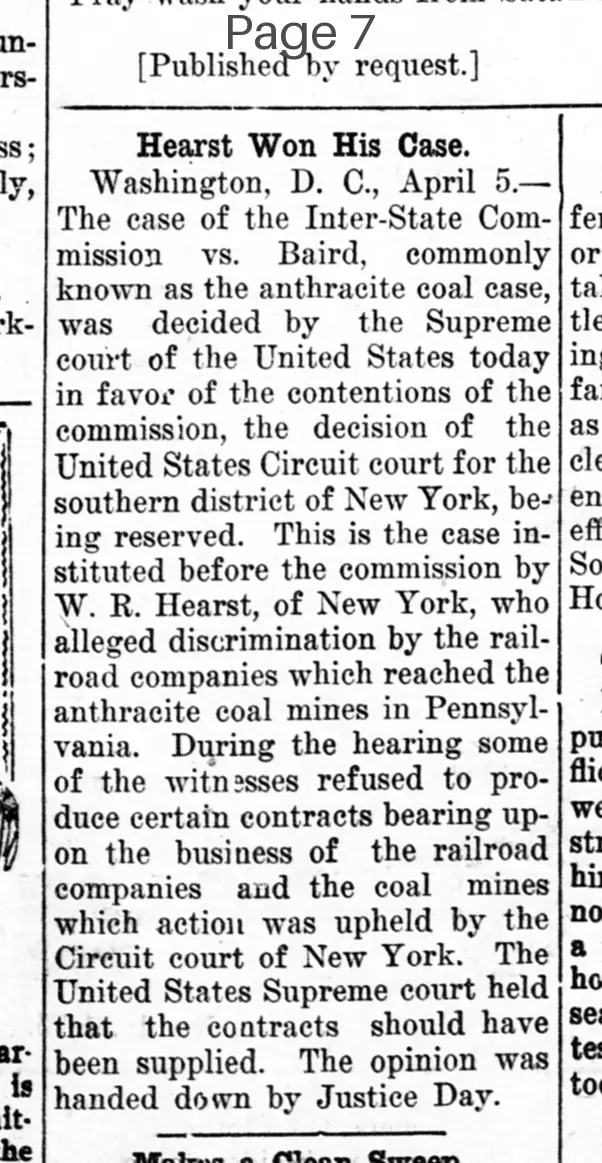
Hearst Won His Case.
Washington, D. C., April 5.—
The case of the Inter-State Commerce Commission vs. Baird, commonly known as the anthracite coal case, was decided by the Supreme Court of the United States today in favor of the contentions of the commission, the decision of the United States Circuit Court for the southern district of New York, being reversed. This is the case instituted before the commission by W. R. Hearst, of New York, who alleged discrimination by the railroad companies which reached the anthracite coal mines in Pennsylvania. During the hearing some of the witnesses refused to produce certain contracts bearing upon the business of the railroad companies and the coal mines which action was upheld by the Circuit Court of New York. The United States Supreme Court held that the contracts should have been supplied. The opinion was handed down by Justice Day.
What sub-type of article is it?
What keywords are associated?
What entities or persons were involved?
Where did it happen?
Domestic News Details
Primary Location
Washington, D. C.
Event Date
April 5
Key Persons
Outcome
supreme court reversed the u.s. circuit court decision for the southern district of new york in favor of the interstate commerce commission, holding that certain contracts should have been supplied.
Event Details
The Supreme Court decided the Interstate Commerce Commission vs. Baird case, known as the anthracite coal case, in favor of the commission. The case was instituted by W. R. Hearst alleging discrimination by railroads reaching Pennsylvania anthracite coal mines. Witnesses had refused to produce contracts, upheld by the New York Circuit Court, but the Supreme Court ruled they should have been supplied.