Thank you for visiting SNEWPapers!
Sign up free
Staunton Spectator, And General Advertiser
Staunton, Virginia
What is this article about?
Mr. White of Kentucky defends Henry Clay against revived 1825 'bargain and corruption' accusations in the House, citing testimonies from opponents like Benton, Buchanan, Beverly, and participants like Lafayette and Adams to prove Clay's innocence and early intent to support Adams.
Clipping
OCR Quality
Full Text
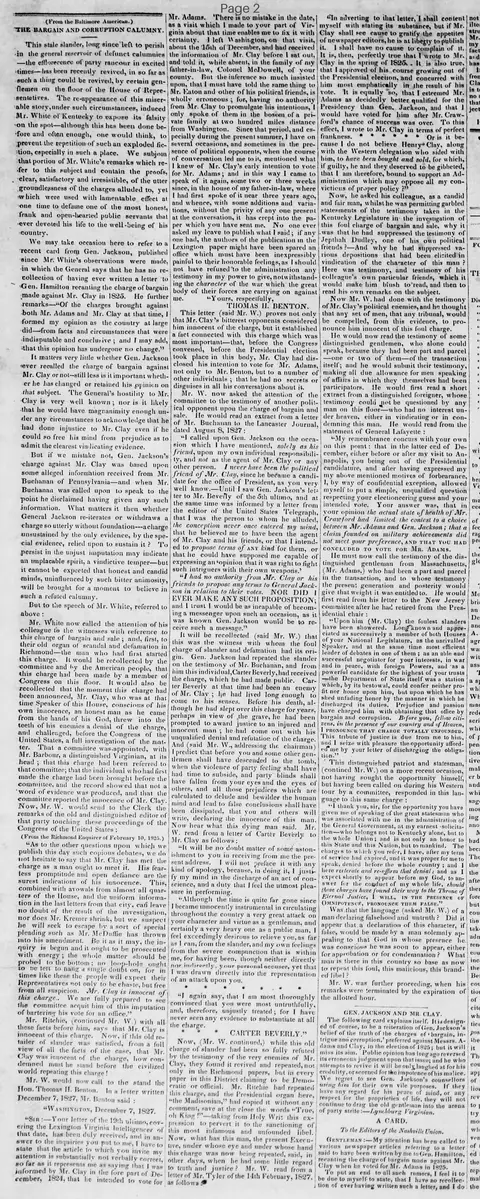
THE BARGAIN AND CORRUPTION CALUMNY.
This stale slander, long since left to perish in the general reservoir of defunct calumnies—the efflorescence of party rancour in excited times—has been recently revived, in so far as such a thing could be revived, by certain gentlemen on the floor of the House of Representatives. The re-appearance of this miserable story, under such circumstances, induced Mr. White of Kentucky to expose its falsity on the spot—although this has been done before and often enough, one would think, to prevent the repetition of such an exploded fiction, especially in such a place. We subjoin that portion of Mr. White's remarks which refer to this subject and contain the proof, clear, satisfactory and irresistible, of the utter groundlessness of the charges alluded to, yet which were used with lamentable effect at one time to defame one of the most honest, frank and open-hearted public servants that ever devoted his life to the well-being of his country.
We may take occasion here to refer to a recent card from Gen. Jackson, published since Mr. White's observations were made, in which the General says that he has no recollection of having ever written a letter to Gen. Hamilton recanting the charge of bargain made against Mr. Clay in 1825. He further remarks—“Of the charges brought against both Mr. Adams and Mr. Clay at that time, I formed my opinion as the country at large did—from facts and circumstances that were indisputable and conclusive; and I may add, that this opinion has undergone no change.”
It matters very little whether Gen. Jackson ever recalled the charge of bargain against Mr. Clay or not—still less is it important whether he has changed or retained his opinion on that subject. The General's hostility to Mr. Clay is very well known; nor is it likely that he would have magnanimity enough under any circumstances to acknowledge that he had done injustice to Mr. Clay even if he could so free his mind from prejudice as to admit the clearest vindicating evidence.
But if we mistake not, Gen. Jackson's charge against Mr. Clay was based upon some alleged information received from Mr. Buchanan of Pennsylvania—and when Mr. Buchanan was called upon to speak to the point he disclaimed having given any such information. What matters it then whether General Jackson re-iterates or withdraws a charge so utterly without foundation—a charge unsustained by the only evidence, by the special evidence, relied upon to sustain it? To persist in the unjust imputation may indicate an implacable spirit, a vindictive temper but it cannot be expected that honest and candid minds, uninfluenced by such bitter animosity, will be brought for a moment to believe in such a refuted calumny.
But to the speech of Mr. White, referred to above:
Mr. White now called the attention of his colleague to the witnesses with reference to this charge of bargain and sale; and, first, to their old organ of scandal and defamation in Richmond—the man who had first started this charge. It would be recollected by the committee and by the American people, that this charge had been made by a member of Congress on this floor. It would also be recollected that the moment this charge had been announced, Mr. Clay, who was at that time Speaker of this House, conscious of his own innocence, an honest man as he came from the hands of his God, threw into the teeth of his enemies a denial of the charge, and challenged, before the Congress of the United States, a full investigation of the matter. That a committee was appointed, with Mr. Barbour, a distinguished Virginian, at its head; that this charge had been referred to that committee; that the individual who had first made the charge had been brought before the committee, and the record showed that not a word of evidence was produced, and that the committee reported the innocence of Mr. Clay.
Now, Mr. W. would send to the Clerk the remarks of the old and distinguished editor of that party touching these proceedings of the Congress of the United States:
(From the Richmond Enquirer of February 10, 1825.)
“As to the other questions upon which we publish this day such copious debates, we do not hesitate to say that Mr. Clay has met the charge as a man ought to meet it. His fearless promptitude and open defiance are the surest indications of his innocence. This, combined with avowals from almost all quarters of the House, and the uniform information in the last letters from that city, can leave no doubt of the result of the investigation, nor does Mr. Kremer shrink, but we suspect he will seek to escape by a sort of special pleading such as Mr. McDuffie has thrown into his amendment. Be it as it may, the inquiry is begun and it ought to be prosecuted with energy; the whole matter should be probed to the bottom; no loop-hole ought to be left to hang a single doubt on, for in times like these the people will expect their Representatives not only to be chaste, but free from all suspicion. Mr. Clay is innocent of this charge. We are fully prepared to see the committee acquit him of this imputation of bartering his vote for an office.”
Mr. Ritchie, (continued Mr. W.) with all these facts before him, says that Mr. Clay is innocent of this charge. Now, if this old retailer of slander was satisfied, from a full view of all the facts of the case, that Mr. Clay was innocent of the charge, how condemned must he stand before the civilized world repeating this charge!
Mr. W. would now call to the stand the Hon. Thomas H. Benton. In a letter written December 7, 1827, Mr. Benton said:
“WASHINGTON, December 7, 1827.
“SIR:—Your letter of the 19th ultimo, covering the Lexington Virginia Intelligencer of that date, has been duly received, and in answer to the inquiries you put to me, I have to state that the article to which you invite my attention is substantially not verbally correct so far as it represents me as saying that I was informed by Mr. Clay in the fore part of December, 1824, that he intended to vote for Mr. Adams. There is no mistake in the date, as a visit which I made to your part of Virginia about that time enables me to fix it with certainty. I left Washington, on that visit about the 15th of December, and had received the information of Mr. Clay before I set out, and told it, while absent, in the family of my father-in-law, Colonel McDowell, of your county. But the inference so much insisted upon, that I must have told the same thing to Mr. Eaton and other of his political friends, is wholly erroneous; for, having no authority from Mr. Clay to promulgate his intentions, I only spoke of them in the bosom of a private family at two hundred miles distance from Washington. Since that period, and especially during the present summer, I have on several occasions, and sometimes in the presence of political opponents, when the course of conversation led me to it, mentioned what I knew of Mr. Clay's early intention to vote for Mr. Adams; and in this way I came to speak of it again, some two or three weeks since, in the house of my father-in-law, where I had first spoke of it near three years ago, and whence, with some additions and variations, without the privity of any one present at the conversation, it has crept into the paper which you have sent me. No one ever asked my leave to publish what I said; if any one had, the authors of the publication in the Lexington paper might have been spared an office which must have been inexpressibly painful to their honorable feelings, as I should not have refused to the administration any testimony in my power to give, notwithstanding the character of the war which the great body of their forces are carrying on against me.
“Yours, respectfully,
THOMAS H. BENTON.”
This letter (said Mr. W.) proves not only that Mr. Clay's bitterest opponents considered him innocent of the charge, but it established a fact connected with this charge which was most important—that, before the Congress convened, before the Presidential election took place in this body, Mr. Clay had disclosed his intention to vote for Mr. Adams, not only to Mr. Benton, but to a number of other individuals; that he had no secrets or disguises in all his conversations about it.
Mr. W. now asked the attention of the committee to the testimony of another political opponent upon the charge of bargain and sale. He would read an extract from a letter of Mr. Buchanan to the Lancaster Journal, dated August 8, 1827:
“I called upon Gen. Jackson on the occasion which I have mentioned, solely as his friend, upon my own individual responsibility, and not as the agent of Mr. Clay or any other person. I never have been the political friend of Mr. Clay, since he became a candidate for the office of President, as you very well know.—Until I saw Gen. Jackson's letter to Mr. Beverly of the 5th ultimo, and at the same time was informed by a letter from the editor of the United States Telegraph, that I was the person to whom he alluded, the conception never once entered my mind, that he believed me to have been the agent of Mr. Clay and his friends, or that I intended to propose terms of any kind for them, or that he could have supposed me capable of expressing an opinion that it was right to fight such intriguers with their own weapons.?
“I had no authority from Mr. Clay or his friends to propose any terms to General Jackson in relation to their votes. NOR DID I EVER MAKE ANY SUCH PROPOSITION; and I trust I would be as incapable of becoming a messenger upon such an occasion, as it was known Gen. Jackson would be to receive such a message.”
It will be recollected (said Mr. W.) that this was the witness with whom the foul charge of slander and defamation had its origin. Gen. Jackson had repeated the slander on the testimony of Mr. Buchanan, and from him this individual, Carter Beverly, had received the charge, which he had made public. Carter Beverly at that time had been an enemy of Mr. Clay; he had lived long enough to come to his senses. Before his death, although he had slept over this charge for years, perhaps in view of the grave, he had been prompted to award justice to an injured and innocent man; he had come out with his unqualified denial and refutation of the charge.
And (said Mr. W., addressing the chairman) I predict that before you and some other gentlemen shall have descended to the tomb, when the violence of party feeling shall have had time to subside, and party blinds shall have fallen from your eyes and the eyes of others, and all those prejudices which are calculated to delude and bewilder the human mind and lead to false conclusions shall have been dissipated, that you and others will write, declaring the innocence of this man.
Now hear what this dying man said. Mr. W. read from a letter of Carter Beverly to Mr. Clay as follows:
“It will be no doubt matter of some astonishment to you in receiving from me the present address. I will not preface it with any kind of apology, because, in doing it, I justify my mind in the discharge of an act of conscience, and a duty that I feel the utmost pleasure in performing.
“Although the time is quite far gone since I became innocently instrumental in circulating throughout the country a very great attack on your character and virtue as a gentleman, and certainly a very heavy one as a public man, I feel exceedingly desirous to relieve you, as far as I can, from the slander, and my own feelings from the severe compunction that is within me, for having been, though neither directly nor indirectly, your personal accuser, yet that I was drawn directly into the representation of an attack upon you.
“I again say, that I am most thoroughly convinced that you were most untruthfully, and, therefore, unjustly treated; for I have never seen any evidence to substantiate at all the charge.
CARTER BEVERLY.”
Now, (Mr. W. continued,) while this old charge of slander had been so fully refuted by the testimony of the very enemies of Mr. Clay, they found it revived and repeated, not only in the Richmond papers, but in every paper in this District claiming to be Democratic or official. Mr. Ritchie had repeated this charge, and the Presidential organ here, "the Madisonian," had copied it without any comment, save at the close the words "True, oh King!"—taking from Holy Writ this expression to pervert it to the sanctioning of this most infamous and unfounded libel.
Now, what has this man, the present Executive, under whose eye and under whose hand this charge was now being repeated, said, in other days, when he had some little regard to truth and justice? Mr. W. read from a letter of Mr. Tyler of the 14th February, 1827, as follows
“In adverting to that letter, I shall content myself with stating its substance, but if Mr. Clay shall see cause to gratify the appetites of newspaper editors, he is at liberty to publish it. I shall have no cause to complain of it.
It is, then, perfectly true that I wrote to Mr. Clay in the spring of 1825. It is also true, that I approved of his course growing out of the Presidential election, and concurred with him most emphatically in the result of his vote. It is equally so, that I esteemed Mr. Adams as decidedly better qualified for the Presidency than Gen. Jackson, and that I would have voted for him after Mr. Crawford's chance of success was over. To this effect, I wrote to Mr. Clay in terms of perfect frankness.
Or is it because I do not believe Henry Clay, along with the Western delegation who sided with him, to have been bought and sold, for which, if guilty, he and they deserved to be gibbeted, that I am therefore, bound to support an Administration which may oppose all my convictions of proper policy ?"
Now, he asked his colleague, as a candid and fair man, whilst he was permitting garbled statements of the testimony taken in the Kentucky Legislature in the investigation of this foul charge of bargain and sale, why it was that he had suppressed the testimony of Jepthah Dudley, one of his own political friends ?—And why he had suppressed various depositions that had been elicited in vindication of the character of this man ?
Here was testimony, and testimony of his colleague's own particular friends, which it would make him blush to read, and then to read his own remarks on the subject.
Now Mr. W. had done with the testimony of Mr. Clay's political enemies, and he thought that any set of men, that any tribunal, would be compelled, from this evidence, to pronounce him innocent of this foul charge.
He would now read the testimony of some distinguished gentlemen, who alone could speak, because they had been part and parcel—one or two of them—of the transaction itself; and he would submit their testimony, making all due allowance for men speaking of affairs in which they themselves had been participators. He would first read a short extract from a distinguished foreigner, whose testimony could not be questioned by any man on this floor—who had no interest under heaven, either in vindicating or in condemning this man. He would read from the statement of General Lafayette:
“My remembrance concurs with your own on this point: that in the latter end of December, either before or after my visit to Annapolis, you being out of the Presidential candidature, and after having expressed my above mentioned motives of forbearance, I, by way of confidential exception, allowed myself to put a simple, unqualified question respecting your electioneering guess and your intended vote. Your answer was, that in your opinion the actual state of health of Mr. Crawford had limited the contest to a choice between Mr. Adams and Gen. Jackson; that a claim founded on military achievements did not meet your preference, AND THAT YOU HAD CONCLUDED TO VOTE FOR MR. ADAMS.”
He must now call the testimony of the distinguished gentleman from Massachusetts, (Mr. Adams.) who had been a part and parcel in the transaction, and to whose testimony the present generation and posterity would give that weight it was entitled to. He would first read from his letter to the New Jersey committee after he had retired from the Presidential chair:
“Upon him (Mr. Clay) the foulest slanders have been showered. Long known and appreciated as successively a member of both Houses of your National Legislature, as the unrivalled Speaker, and at the same time most efficient leader of debates in one of them; as an able and successful negotiator for your interests, in war and in peace, with foreign Powers, and as a powerful candidate for the highest of your trusts—the Department of State itself was a station which, by its bestowal, could confer neither profit nor honor upon him, but upon which he has shed unfading honor by the manner in which he discharged its duties. Prejudice and passion have charged him with obtaining that office by bargain and corruption. Before you, fellow citizens, in the presence of our country and of Heaven, I PRONOUNCE THAT CHARGE TOTALLY UNFOUNDED.
This tribute of justice is due from me to him, and I seize with pleasure the opportunity afforded me by your letter of discharging the obligation.”
This distinguished patriot and statesman, (continued Mr. W.) on a more recent occasion, not having sought the opportunity himself, but having been called on during his Western tour by a committee, responded in this language to this same charge:
“I thank you, sir, for the opportunity you have given me of speaking of the great statesman who was associated with me in the administration of the General Government, at my earnest solicitation—who belongs not to Kentucky alone, but to the whole Union; and is not only an honor to this State and this Nation, but to mankind. The charges to which you refer, I have, after my term of service had expired, and it was proper for me to speak, denied before the whole country; and I here reiterate and re-affirm that denial; and as I expect shortly to appear before my God, to answer for the conduct of my whole life, should those charges have found their way to the Throne of Eternal Justice, I WILL, IN THE PRESENCE OF OMNIPOTENCE, PRONOUNCE THEM FALSE.”
Was that the language (asked Mr. W.) of a man declaring falsehood and untruth? Did it appear that a declaration of this character, if false, would be made by a man solemnly appealing to that God in whose presence he was conscious he was soon to appear, either for approbation or for condemnation? What man is there in this country so base as now to repeat this foul, this malicious, this branded libel?
Mr. W. was further proceeding, when his remarks were terminated by the expiration of the allotted hour.
What sub-type of article is it?
What themes does it cover?
What keywords are associated?
What entities or persons were involved?
Where did it happen?
Story Details
Key Persons
Location
Washington, D.C.
Event Date
1825
Story Details
Mr. White refutes the 'bargain and corruption' charge against Henry Clay in the 1825 presidential election by presenting letters and testimonies from Clay's opponents and allies, including Benton confirming Clay's early intent to support Adams, Buchanan denying agency, Beverly retracting the accusation, Lafayette recalling Clay's decision, and Adams declaring the charge unfounded.