Thank you for visiting SNEWPapers!
Sign up free
Kentucky Gazette
Lexington, Fayette County, Kentucky
What is this article about?
In the U.S. House of Representatives on February 2, Mr. Spencer introduced a resolution to withdraw public deposits from the Bank of the United States by July 1 and issue a scire facias unless the bank accepts 12 propositions modifying its charter. Debate ensued, and the resolution was laid on the table.
Clipping
OCR Quality
Full Text
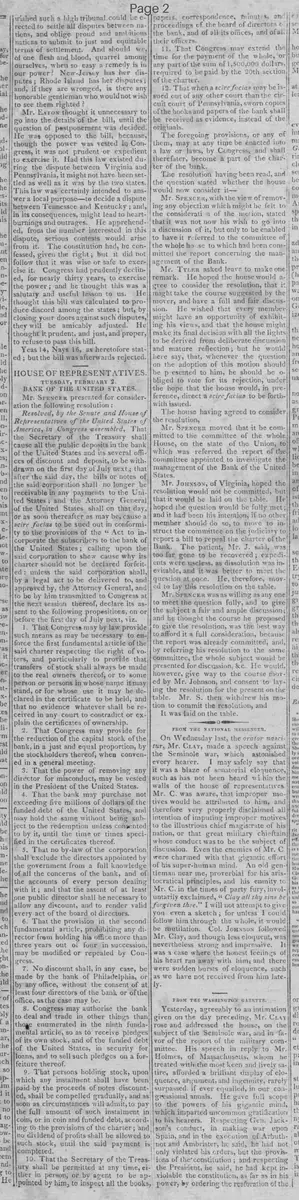
TUESDAY, FEBRUARY 2.
BANK OF THE UNITED STATES.
Mr. Spencer presented for consideration the following resolution:
Resolved, by the Senate and House of Representatives of the United States of America, in Congress assembled, That the Secretary of the Treasury shall cause all the public deposits in the bank of the United States and its several offices of discount and deposit, to be withdrawn on the first day of July next; that after the said day, the bills or notes of the said corporation shall no longer be receivable in any payments to the United States: and the Attorney General of the United States shall on that day, or as soon thereafter as may be, cause a scire facias to be sued out in conformity to the provisions of the "Act to incorporate the subscribers to the bank of the United States;" calling upon the said corporation to shew cause why its charter should not be declared forfeited: unless the said corporation shall by a legal act to be delivered to, and approved by, the Attorney General, and to be by him transmitted to Congress at the next session thereof, declare its assent to the following propositions, on or before the first day of July next, viz.
1. That Congress may by law provide such means as may be necessary to enforce the first fundamental article of the said charter respecting the right of voters, and particularly to provide that transfers of stock shall always be made to the real owners thereof, or to some person or persons in whose name it may stand, or for whose use it may be declared in the certificate to be held, and that no evidence whatever shall be received in any court to contradict or explain the certificates of ownership.
2. That Congress may provide for the reduction of the capital stock of the bank, in a just and equal proportion, by the stockholders thereof, when convened in a general meeting.
3. That the power of removing any director for misconduct, may be vested in the President of the United States.
4. That the bank may purchase not exceeding five millions of dollars of the funded debt of the United States, and may hold the same without being subject to the redemption unless consented to by it, until the time or times specified in the certificates thereof.
5. That no by-law of the corporation shall exclude the directors appointed by the government from a full knowledge of all the concerns of the bank, and of the accounts of every person dealing with it; and that the assent of at least one public director shall be necessary to allow any discount, and to render valid every act of the board of directors.
6. That the provision in the second fundamental article, prohibiting any director from holding his office more than three years out of four in succession, may be modified or repealed by Congress.
7. No discount shall, in any case, be made by the bank of Philadelphia, or by any office, without the consent of at least four directors of the bank or of the office, as the case may be.
8. Congress may authorise the bank to deal and trade in other things than those enumerated in the ninth fundamental article, so as to receive pledges of its own stock, and of the funded debt of the United States, in security for loans, and to sell such pledges on a forfeiture thereof.
9. That persons holding stock, upon which any instalment shall have been paid by the proceeds of notes discounted, shall be compelled gradually, and as soon as circumstances will admit, to pay the full amount of such instalment in coin, or in coin and funded debt, according to the provisions of the charter: and no dividend of profits shall be allowed to such stock, until the said payment is completed.
10. That the Secretary of the Treasury shall be permitted at any time, either in person, or by agent to be appointed by him, to inspect all the books, papers, correspondence, minutes, and proceedings of the board of directors of the bank, and of all its offices, and of all their officers.
11. That Congress may extend the time for the payment of the whole, or any part of the sum of 1,500,000 dollars, required to be paid by the 20th section of the charter.
12. That when a scire facias may be issued out of any other court than the circuit court of Pennsylvania, sworn copies of the books and papers of the bank shall be received as evidence, instead of the originals.
The foregoing provisions, or any of them, may at any time be enacted into a law or laws, by Congress, and shall thereafter become a part of the charter of the bank.
The resolution having been read, and the question stated whether the house would now consider it
Mr. Spencer, with the view of removing any objection which might be felt to the consideration of the motion, stated that it was not now his wish to go into a discussion of it, but only to be enabled to have it referred to the committee of the whole house to which had been committed the report concerning the management of the Bank.
Mr. Tyler asked leave to make one remark. He hoped the house would agree to consider the resolution, that it might take the course suggested by the mover, and have a full and fair discussion. He wished that every member might have an opportunity of exhibiting his views, and that the house might make its final decision with all the lights to be derived from deliberate discussion and mature reflection; but he would here say, that, whenever the question on the adoption of this motion should be presented to him, he should be obliged to vote for its rejection, under the hope that the house would, in preference, direct a scire facias to be forthwith issued.
The house having agreed to consider the resolution,
Mr. Spencer moved that it be committed to the committee of the whole House, on the state of the Union, to which was referred the report of the committee appointed to investigate the management of the Bank of the United States.
Mr. Johnson, of Virginia, hoped the resolution would not be committed, but that it would be laid on the table. He hoped the question would be fully met; and it had been his intention, if no other member should do so, to move to instruct the committee on the judiciary to report a bill to repeal the charter of the Bank. The patient, Mr. J. said, was too far gone to be recovered: expedients were useless, as dissolution was inevitable, and it was better to meet the question at once. He, therefore, moved to lay this resolution on the table.
Mr. Spencer was as willing as any one to meet the question fully, and to give the subject a fair and ample discussion: and he thought the course he proposed to give the resolution, was the best way to afford it a full consideration, because the report was already committed, and, by referring his resolution to the same committee, the whole subject would be presented for discussion, &c. He would, however, give way to the course now moved by Mr. Johnson, and consent to laying the resolution for the present on the table. Mr. S. then withdrew his motion to commit the resolution, and
It was laid on the table.
What sub-type of article is it?
What keywords are associated?
What entities or persons were involved?
Domestic News Details
Event Date
Tuesday, February 2
Key Persons
Outcome
the resolution was laid on the table after debate.
Event Details
Mr. Spencer presented a resolution to withdraw public deposits from the Bank of the United States on July 1 next and to issue a scire facias for charter forfeiture unless the bank assents to 12 specified propositions modifying its charter. The House agreed to consider it, but after motions to commit or lay on the table, it was laid on the table.