Thank you for visiting SNEWPapers!
Sign up free
The Union County Journal
Marysville, Union County, Ohio
What is this article about?
Dr. Robert A. Vogel, Health Commissioner, shares findings from Dr. Leonard S. Fosdick's study at Northwestern University: brushing teeth after meals reduces cavities by 50-60% in college students over two years. Recommends brushing after every meal and biannual dentist visits.
Clipping
OCR Quality
Full Text
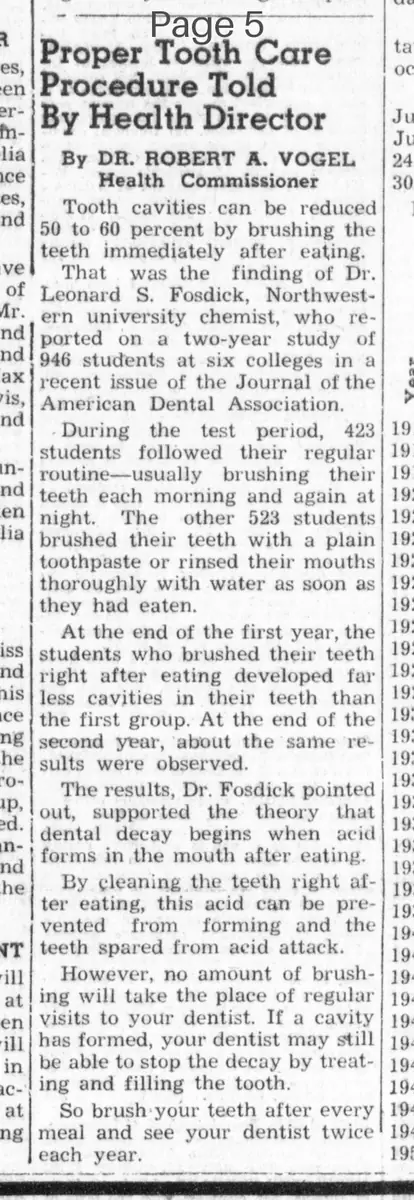
By DR. ROBERT A. VOGEL Health Commissioner
Tooth cavities can be reduced 50 to 60 percent by brushing the teeth immediately after eating. That was the finding of Dr. Leonard S. Fosdick, Northwestern university chemist, who reported on a two-year study of 946 students at six colleges in a recent issue of the Journal of the American Dental Association.
During the test period, 423 students followed their regular routine-usually brushing their teeth each morning and again at night. The other 523 students brushed their teeth with a plain toothpaste or rinsed their mouths thoroughly with water as soon as they had eaten.
At the end of the first year, the students who brushed their teeth right after eating developed far less cavities in their teeth than the first group. At the end of the second year, about the same results were observed.
The results, Dr. Fosdick pointed out, supported the theory that dental decay begins when acid forms in the mouth after eating. By cleaning the teeth right after eating, this acid can be prevented from forming and the teeth spared from acid attack.
However, no amount of brushing will take the place of regular visits to your dentist. If a cavity has formed, your dentist may still be able to stop the decay by treating and filling the tooth.
So brush your teeth after every meal and see your dentist twice each year.
What sub-type of article is it?
What keywords are associated?
What entities or persons were involved?
Domestic News Details
Key Persons
Outcome
tooth cavities reduced 50 to 60 percent by brushing immediately after eating
Event Details
Tooth cavities can be reduced 50 to 60 percent by brushing the teeth immediately after eating, according to a two-year study of 946 students at six colleges by Dr. Leonard S. Fosdick of Northwestern university. 423 students followed regular routine of brushing morning and night, while 523 brushed or rinsed after eating. The latter group developed far fewer cavities. Results support theory that dental decay begins with acid formation after eating, prevented by immediate cleaning. Brushing does not replace regular dentist visits twice a year.