Thank you for visiting SNEWPapers!
Sign up free
Richmond Enquirer
Richmond, Richmond County, Virginia
What is this article about?
Report of U.S. House debates on Dec. 28-29, 1819, on navy appropriations exceeding estimates, enforcement of anti-slave trade act, executive fund transfers, and spending accountability. Speakers include Mercer, Clay, Randolph, Lowndes, Trimble. On Jan. 10, 1820, petitions, resolutions on vaccines, pensions, lands, and messages are handled.
Merged-components note: These components form a continuous report on congressional debates in the House of Representatives, spanning multiple columns and pages; merged into a single coherent story.
Clippings
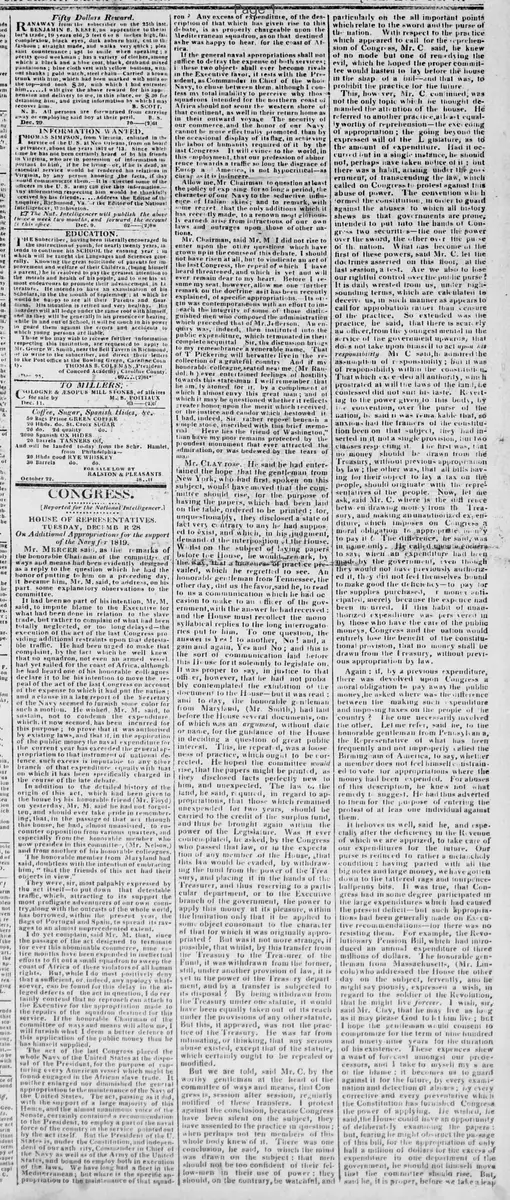
1 of 2
OCR Quality
Full Text
[Reported for the National Intelligencer.]
HOUSE OF REPRESENTATIVES.
TUESDAY, DECEMBER 28
On Additional Appropriations for the support of the Navy for 1819.
Mr. MERCER said, as the remarks of the honorable Chairman of the committee of ways and means had been evidently designed as a reply to the question which he had the honor of putting to him on a preceding day, it became him, Mr. M. said, to address, on his part, some explanatory observations to the committee.
It had been no part of his intention, Mr. M. said, to impute blame to the Executive for what had been done in relation to the slave trade, but rather to complain of what had been totally neglected, or too long delayed—the execution of the act of the last Congress providing additional restraints upon that detestable traffic. He had been urged to make that complaint, by the fact which he well knew that no squadron, not even an armed vessel had yet sailed for the coast of Africa, although he had heard one of his honorable colleagues declare it to be his intention to move the repeal of the act of the last Congress on account of the expense to which it had put the nation; and a clause in a late report of the Secretary of the Navy seemed to furnish some color for such a motion. He wished, Mr. M. said, to sustain, not to condemn the expenditure which, it now seemed, has been incurred for this purpose; to prove that it was authorized by existing laws, and that it, in the application of the public money the naval expenditure for the current year has exceeded the general appropriation to that instrument of national defence, such excess is imputable to any other branch of that expenditure equally with that on which it has been specifically charged in the course of the late debate.
In addition to the detailed history of the origin of this act, which had been given to the house by his honorable friend (Mr. Floyd) on yesterday, Mr. M. said he had not forgotten, and should ever take pride in remembering, that, in the passage of that act through this house, he had, almost unassisted, to encounter opposition from various quarters, and especially from the honorable member who now presides in this committee, (Mr. Nelson,) and from another of his honorable colleagues.
'The honorable member from Maryland had said, doubtless with the intention of embracing him, "that the friends of this act had their objects in view."
They were, sir, most palpably expressed by the act itself—to put down that detestable traffic, which, attracting to its support the most profligate adventurers of our own country, along with the outcasts of the whole world, has borrowed, within the present year, the flags of Portugal and Spain, to spread its ravages to an almost unprecedented extent.
I do yet complain, said Mr. M. that, since the passage of the act designed to terminate for ever this abominable commerce, nine entire months have been expended in ineffectual efforts to fit out a small squadron to sweep the coast of Africa of these violators of all human rights. But, while I do most positively deny that a sufficient, or, indeed, any apology whatever, can be found for this delay in the alleged defects of the act in question, I do certainly contend that no reproach can attach to the Executive for the appropriation made to the repairs of the squadron destined for this service. If the honorable Chairman of the committee of ways and means will allow me, I will furnish what I deem a better defence of this application of the public money than he has himself supplied.
The act of the last Congress placed the whole Navy of the United States at the disposal of the President, for the purpose of capturing every American vessel which might be found engaged in the African slave trade. It neither enlarged nor diminished the general appropriation to the maintenance of the Navy of the United States. The act, passing as it did, with the support of a large majority of this House, and the almost unanimous voice of the Senate, certainly contained a recommendation to the President, to employ a part of the naval force of the country in the service pointed out by the act itself. But the President of the U. States is, under the Constitution, and independent of our authority, Commander in Chief of the Navy as well as of the Army of the United States, and bound to employ both in execution of the laws. We have long had a fleet in the Mediterranean; but where is the specific appropriation to the maintenance of that squadron?
Any excess of expenditure, of the description of that which has given rise to this debate, is as properly chargeable upon the Mediterranean squadron, as on that destined, as he was happy to hear, for the coast of Africa.
If the general naval appropriations shall not suffice to defray the expense of both services; if these two objects shall ever become rivals in the Executive favor, it rests with the President, as Commander in Chief of the whole Navy, to choose between them, although I confess my total inability to perceive why those squadrons intended for the northern coast of Africa should not scour the western shore of that continent, as well in their return home as in their outward voyage The security of our commerce, and the honor of our Navy cannot be more effectually promoted, than by the occasional display of its flag, in achieving the labor of humanity required of it by the last Congress It will evince to the world, in this employment, that our profession of abhorrence towards a traffic so long the disgrace of Europe and America, is not hypocritical—as cheap as it is insincere
Allow me, Mr Chairman to question at least the policy of exposing for so long a period, the character of our Navy to the seductive influence of Italian skies; and to remark, with some regret that the only additions which it has recently made, to a renown most gloriously earned arise from infractions, of our own laws and outrages upon those of other nations.
Mr. Chairman, said Mr. M I did not rise to enter upon the other questions which have grown up in the course of this debate. I should not have risen at all, but to vindicate an act of the last Congress, the repeal of which I have heard threatened, and which is yet and will ever remain dear to my heart. Before I resume my Seat, however, allow me one further remark on the doctrine —as it has been recently explained, of specific appropriations.—Its origin was contemporaneous with an effort to impeach the integrity of some of those distinguished men who composed the administration which preceded that of Mr. Jefferson. An inquiry was, indeed, then instituted into the public expenditure, which terminated in their complete acquittal Sir, the discussion brings to my remembrance a venerable name. That of T. Pickering will hereafter live in the recollection of a grateful country And if my honorable colleague seated near me, (Mr. Randolph,) ever entertained feelings of hostility towards this statesman I well remember that he amply atoned for it, by a compliment to which I almost envy this great man; and of which it may be questioned whether it reflects greater honor—upon the merit which received, or the justice and candor which bestowed it
I had, indeed, Sir rather repose beneath a simple stone, inscribed with this brief memorial Here lies the friend of Washington, than have my poor remains protected by the proudest monument that ever attracted the admiration, or was bedewed by the tears of man
Mr. CLAY rose. He said he had entertained the hope that the gentleman from New York, who had first spoken on this subject, would have moved that the committee should rise, for the purpose of having the papers, which had been laid on the table, ordered to be printed; for, unquestionably, they disclosed a state of fact very contrary to any he had supposed to exist, and which, in his judgment, demanded the interposition of the House.
Whilst on the subject of laying papers before the House, he would remark, by the way, that a looseness of practice prevailed, which he regretted to see. An honorable gentleman from Tennessee, the other day, did us the favor, said he, to read to us a communication which he had occasion to make to an officer of the government, with the answer he had received: and the House must recollect the monosyllabical replies to the long interrogatories put to him. To one question, the answer is Yes! to another, No! and, again and again, Yes and No: and this is the sort of communication laid before this House for it solemnly to legislate on.
It was proper to say, in justice to that other, however, that he had not probably contemplated the exhibition of the document to the House—but it was read: and to day, the honorable gentleman from Maryland, (Mr. Smith,) had laid before the House several documents, one of which was an argument, without date or name, for the guidance of the House in deciding a question of great public interest. This, he repeated, was a looseness of practice, which ought to be corrected. He hoped the committee would rise, that the papers might be printed, as they disclosed facts perfectly new to him, and unexpected. The law of the land, he said, required, in regard to appropriations, that those which remained unexpended for two years, should be carried to the credit of the surplus fund, and thus be brought again within the power of the Legislature. Was it ever contemplated, he asked, by the Congress who passed that law, or to the expectation of any member of the House, that this law would be evaded, by withdrawing the fund from the power of the Treasury, and placing it in the hands of the Treasurer, and thus reserving to a particular department, or to the Executive branch of the government, the power to apply this money at its pleasure, within the limitation only that it be applied to some object consonant to the character of that for which it was originally appropriated? But was it not more strange, if possible, that whilst, by thus transfer from the Treasury to the Treasurer of the Fund, it was withdrawn from the former, still, under another provision of law, it is yet in the power of the Treasury department, and by a transfer is subjected to its disposal? By being withdrawn from the Treasury under one statute, it would have been equally taken out of its reach under the provisions of any other statute. But this, it appeared, was not the practice of the Treasury. He was far from insinuating, or thinking, that any serious abuse existed, except that of the statute, which certainly ought to be repealed or modified.
But we are told, said Mr. C. by the worthy gentleman at the head of the committee of ways and means, that Congress is, session after session, regularly notified of these transfers. I protest against the conclusion, because Congress have been silent on the subject, they have assented to the practice in question; when perhaps not ten members of this whole body knew of it. There was one conclusion, he said, to which the mind was drawn on the subject: that men should not be too confident of their fellow-men in their use of power: they should, on the contrary, be watchful, and particularly on the all important points which relate to the sword and the purse of the nation. With respect to the practice which appeared to call for the reprehension of Congress, Mr. C. said, he knew of no mode but one of remedying the evil, which he hoped the proper committee would hasten to lay before the house in the shape of a bill—and that was, to prohibit the practice for the future
This, however, Mr. C. continued, was not the only topic which he thought demanded the attention of the house. He referred to another practice, at least equally worthy of reprehension—the exceeding of appropriation: the going beyond the expressed will of the Legislature; as to the amount of expenditure. Had it occurred but in a single instance, he should not, perhaps have taken notice of it: but there was a habit, arising under the government, of transcending the law, which called on Congress to protest against this abuse of power. The convention which formed the constitution, in order to guard against the abuses to which all history shews us that governments are prone; intended to put into the hands of Congress two securities—the one the power over the sword, the other over the purse of the nation. What has become of the first of these powers, said Mr. C. let the doctrines asserted on this floor, at the last session, attest. Are we also to lose our rightful control over the public purse?
It is daily wrested from us, under high-sounding terms, which are calculated to deceive us, in such manner as appears to call for approbation rather than censure of the practice. So extended was the practice, he said, that there is scarcely an officer, from the youngest menial in the service of the government upwards, that does not take upon himself to act upon his responsibility Mr C said, had admired the assumption of responsibility; but it was of responsibility within the constitution That which exceeded all authority, which prostrated at will the laws of the land, the confessed did not suit his taste. Respecting the power given to this body, by the convention, over the purse of the nation, he said it was remarkable that, so anxious had the framers of the constitution been on that subject, they had inserted in it not a single provision, in two clauses respecting it. The first was, that no money should be drawn from the Treasury, without previous appropriation by law; the other was, that all bills having for their object to lay a tax on the people, should originate with the representatives of the people. Now, let me ask, said Mr. C. where is the difference between drawing money from the Treasury, and making an unauthorized expenditure, which imposes on Congress a moral obligation to appropriate money to pay it?" The difference, he said, was in name only. He called upon his honorable friends to say, when an expenditure had been made by the government, even though they would not have previously authorized it, they did not feel themselves bound to make good the deficiency—to pay for the supplies purchased, not anticipated, merely because the expense had been incurred. This habit of unauthorized expenditure was persevered in by those who have the care of the public moneys. Congress and the nation would entirely lose the benefit of the constitutional provision, that no money shall be drawn from the treasury, without previous appropriation by law.
Again: if, by a previous expenditure, there was devolved upon Congress a moral obligation to pay away the public money, he asked where was the difference between the making such expenditure and imposing taxes on the people of the country? The one necessarily involved the other. Let me refer, said he, to the honorable gentleman from Pennsylvania, the Representative of what has been frequently and not improperly called the Birmingham of America, to say, whether a member does not feel himself constrained to vote for appropriations where the money had been expended. For abuses of this description, he knew not what remedy to suggest. He had thus adverted to them for the purpose of entering the protest of at least one individual against them.
It behooves us well, said he, and especially after the deficiency in the Revenue of which we are apprised, to take care of our expenditures for the future. Our purse is reduced to rather a melancholy condition: having parted with all the big notes and large money, we have gotten down to the tattered rags and fourpence-halfpenny bits. It was true, that Congress had in some degree participated in the large expenditures which had caused the present deficit—but such appropriations had been generally made on Executive recommendations—for there was no resisting them. For example, the Revolutionary Pension Bill, which had introduced an annual expenditure of three millions of dollars. The honorable gentleman from Massachusetts, (Mr. Lincoln) who addressed the House the other day on the subject, fervently, and he might say piously, expressed a wish, in regard to the soldier of the Revolution, that he might live forever. I wish, sir, said Mr. Clay, that he may live as long as it may please God to let him live; but I hope the gentleman would consent to compromise for the term of nine hundred and ninety-nine years for the duration of his existence. These expenses shew a want of forecast amongst our predecessors, and I take to myself my share of the blame: it becomes us to guard against it for the future, by every examination and detection of abuses; by every corrective and every preventative which the Constitution has furnished Congress the power of applying. He wished, he said, the House could have an opportunity of deliberately examining the papers: but, fearing he might obstruct the passage of this bill, for the appropriation of only half a million of dollars for the excess of expenditure in one department of the government, he should not himself move that the committee should rise. But, said he, it is proper, before we take a leap
In the dark, to know on what ground we stand.
Mr. Randolph then moved that the committee should rise. It was no part of his purpose, he said, to enter into the merits, or demerits, more correctly speaking, of the question now before the house: but to state a fact, which he hoped every member of the committee would bear in mind throughout the whole of this discussion: that this abuse, which had been so eloquently exposed to the house, had not extended as far back as the administration of Thomas Jefferson: during the whole of which no such practice had obtained at the treasury or elsewhere. The practice, he said, grew out of that celebrated law of March 3d, 1809, which had before referred to in debate: that famous—or, to speak freely, but correctly, that iniquitous law, which without any fear of contradiction, from any side of the house, he pronounced to have been the offspring of a dirty intrigue. During the whole of the administration of Thomas Jefferson, there had been no occasion to resort to any such law; and, at that period, no such practice prevailed as had since grown out of that statute. During the greater part of that period, Mr. R. said, such was the access which he had to the treasury, and such the duties imposed upon him by this house, he spoke of his own knowledge, and fearlessly, in saying, the expenditures had been generally within the appropriations; no sum appropriated to one object had ever been diverted to another—but, at the end of two years after its date, every appropriation, for reasons to be found in the constitution itself, did, by the operation of the act of 1799, cease and determine.
Mr. R. said he rose to state this fact, and to request, whatever censure gentlemen might choose to throw on the financial administration of the nation, he hoped they would except that period—a period in which the nation had made one of its most expensive acquisitions, by the purchase of Louisiana; and, if his memory did not much deceive him, the Secretary of War contrived, without any of this hocus pocus legerdemain and transferring appropriations, to take possession of the country without any extraordinary expenditure in the military department. At that time, Mr. R. said, we maintained about three thousand men, at an expense of about $900,000 dollars per annum.—Compare the expenditures at that time, with the expenditures on the same objects now; and, making every allowance for the advance in the price of the articles of subsistence, &c.—in other words, for the depreciation of our miserable paper money, a large amount might be carried to the credit of the administration of which he spoke.
Mr. Lowndes made a number of remarks on the subject of the practice of the government in regard to appropriations &c. He also touched on the point of relative expenditures of the period of Mr. Jefferson's administration, and those of the present day: and denied that the contrast between them was such as had been represented. It is not so much the misfortune of the Reporter as of his readers, that his position in the hall was such as to prevent him from hearing Mr. Lowndes, with sufficient accuracy to warrant him in attempting even a sketch of his remarks.
Mr. Trimble, of Kentucky, rose for the purpose of giving some explanations on a point which, if the house separated without any explanation, might be misunderstood. It was not his object to justify the manner in which the public moneys had been expended by transfers from one item of appropriation to another, but to show that the fault originated not in the departments of the government, but in this house: and, there, some excuse at least would be found for the practices elsewhere, which had been complained of. It was almost impossible for the departments to make their estimates for the expenditures of the following year, or to show the balances in hand, unless the period at which these returns were made was changed. Owing to the circumstance of warrants being drawn for expenditures in distant parts, Orleans, Mobile, St. Louis, &c. it was impossible to do it; neither could the balances in hand be distinctly ascertained until the amount of expenditure was known. If gentlemen desired a remedy, it must be by having the estimates made out at the last of February, instead of December, in each year. By that time most of the warrants drawn under the various heads of appropriation would have been brought in: and the balances in hand could be ascertained, and the estimates for the future made up, with a reasonable certainty, which might satisfy the house.
It had been said, in reference to the bill before the house, that the estimates ought to be made out somewhat more correctly than they appear to have been heretofore. At the commencement of the year, when the appropriation for the service of the navy for the current year was made, Congress had appropriated less, by $404,000, than the amount estimated by the department. If the whole amount asked had been then appropriated, there would have been no deficiency. It was not very reasonable, therefore, to complain so bitterly now of that deficiency. The only incorrectness which he could discover in the practice of the government, if any, was in the mode of making transfers. For other things to which exception had been taken the fault lay with this house, as he had already said, and not with the officers of the government.
It had been observed, that the relative expenditures of the Military Department, &c. had been much increased since the period of Mr. Jefferson's administration. Upon a very close comparison of the expenditures, it would be found that, if in some respects the rate of expenditure is increased, much is gained by its distribution in others. For example, during that very period, Mr. T. said the military establishment was so organized that there was one officer to every twelve men composing it: at this time, there was but one officer to every fifteen men. The expense was therefore greater in proportion to the numerical strength, than as required. The gentleman from Virginia shakes his head, said Mr. T. I am perfectly certain I am not mistaken, because I have the authority of the Secretary of War to state so. But, suppose it were the reverse a given number of dollars would not purchase the same quantity of clothing, subsistence, &c. now as then under the impression, however, unless corrected, that the military for the army was proper.
Mr. L., said, he did not see the logic of the objections to the transfers at appropriations. To familiarize the matter, suppose an officer of the army had in one of his pockets money for the pay of his command, and in another for his subsistence. The money for pay is unexpended: and funds for subsistence were wanting. What was the officer to do, having money in one hand, but not in the other? Was the public service to stop, until he balanced his accounts, and drew more money for the object that was deficient?
Mr. T. repeated, that the only remedy for the real evil (the difficulty of making accurate estimates of the amount necessary to be appropriated,) was to be found in a provision, by Congress, for having the estimates made up at a later period of the session than at present.
Mr. Randolph made some remarks in reply to what had fallen from Mr. Lowndes, for whom, he said, great respect was a sentiment so general in the house, that it would be a supererogatory act to declare it. Having concluded his remarks in reply to Mr. Lowndes and others, Mr. Randolph said that gentlemen entirely mistook him, if they supposed that, knight errant like, he had come tilting here, to break a spear with powers and principalities. Nothing was further from his intention. But he said, there were certain signs in the political horizon which he hailed with some degree of pleasure. He had some hopes that the term of twenty years is our political cycle; and that we are coming back to the good old times of responsibility and specification. Mr. R. concluded his observations by a few remarks on what had fallen from Mr. Trimble; in the course of which, he denied, that provisions and the great staples of the country bore a higher price now than at the period of 1802, &c.
At this stage of the proceedings, the committee rose, reported progress, and obtained leave to sit again.
WEDNESDAY, DEC. 29.
The house being again in committee, on this subject, an amendment was moved by Mr. Storrs, in the following words:
"And be it enacted, That the sums appropriated by this act shall be solely applied to the objects for which they are respectively appropriated and to no other, notwithstanding the authority vested in the President of the United States by the first section of the act entitled 'An act further to amend the several acts for the establishment and regulation of the Treasury, War, and Navy Departments,' passed on the 3d day of March, 1809."
This amendment was agreed to, 65 to 95.
Some remarks were then made, pro and con, by Mr. Randolph and Mr. Smith, respecting the origin of the law of March 3d, 1809, which contains the provision for transfers of appropriations, and respecting the difference of opinion which existed between the Senate and House of Representatives concerning it. Among other things, Mr. Randolph said, he spoke from personal knowledge when he said, there existed, on the part of the then Secretary of the Treasury, the most decided repugnance to the provision respecting transfers of appropriations: and he trusted, notwithstanding what had fallen from the gentleman from South Carolina (Mr. Lowndes) on the subject, the time would come, if it had not now arrived, when it would be struck from the statute-book.
Mr. Cannon, of Tennessee, spoke in explanation of an allusion made by Mr. Clay to the letter from the Paymaster General, which he had quoted in the debate the other day. It was due to that officer to say, that the answers which he had given to Mr. Clay's questions, were such as he wished, and such as time permitted—and made in a manner, so far from reflecting discredit on that officer, perfectly correct and satisfactory to Mr. Cannon.
The committee having rose and reported the bill to the house, with the amendment which had been introduced on the motion of Mr. Storrs: and the question being on agreeing to that amendment—
Mr. Brush, of Ohio, said he hoped the house would not concur in the amendment which had been made in committee. It is, said he, obviously unnecessary.—The appropriation contemplated by the bill is for specific sums, to meet expenditures which have exceeded the appropriations for the last year. The excess became necessary in consequence of service required to be performed, and duties enjoined, by law for which no adequate means were provided.
A little attention to dates, and the language used in the acts referred to in debate, as the ground of objection to the bill and the cause for introducing this amendment, will manifest that gentlemen are mistaken in their construction of those laws. They seem to imagine it to be now the duty of the Secretary of the Treasury to carry to the surplus fund unexpended balances of moneys or appropriations already drawn from the Treasury, and in a course of expenditure in the Department. The act of 1790 making further provision for the support of public credit, and for the redemption of the public debt, does not reach this case.—It is the 10th section which relates to the subject, and provides for carrying the unexpended balances of appropriations to the surplus fund in these words:
"that, in regard to any sum which shall have remained unexpended upon any appropriation (other than, &c.) for more than two years after the expiration of the calendar year in which the act of appropriation' shall have been passed, such appropriation shall be deemed to have ceased and been determined; and the sum so unexpended shall be carried to an account on the books of the Treasury, to be denominated the surplus fund." The Secretary of the Treasury must perform this duty, and execute the legislative will in this particular, by carrying the sums so long unexpended to that fund. The first section of the act of 1809, "further to amend the several acts for the establishment and regulation of the Treasury, War and Navy Departments," declares "that all warrants drawn by the Secretary of the Treasury, or of War, or of the Navy, upon the Treasurer of the United States, shall specify the particular appropriation or appropriations to which the same should be charged. The moneys paid by virtue of such warrants shall, in conformity therewith, be charged to such appropriation or appropriations, in the books kept in the office of the Comptroller of the Treasury, in the case of warrants drawn by the Secretary of the Treasury, and in the books of the accountants of the War and Navy Departments, respectively, in the case of warrants drawn by the Secretary of War, or by the Secretary of the Navy: and the officers, agents, or other persons who may be receivers of public moneys, shall render distinct accounts of the application of such moneys, according to the appropriation or appropriations under which the same shall have been drawn; and the Secretary of War, and of the Navy, shall, on the 1st of January, in each and every year, severally report to Congress a distinct account of the expenditure and application of all such sums of money as may, prior to the 30th Sept. preceding, have been by them respectively drawn from the treasury in virtue of the appropriation law of the preceding year; and the sums appropriated by law for each branch of expenditure, in the several Departments, shall be solely applied to the objects for which they are respectively appropriated, and to no other."
Upon this change of the policy in relation to specific appropriations, and the specific application of them to definite objects, and the alteration made by this law as to the manner of drawing the sums appropriated from the treasury by warrants, and charging the moneys so drawn in the books of the accountants of the departments respectively, and by requiring the head of each to render and report accounts and their administration of these funds, the conclusion was inevitable—it was the only one which could be made—that, as by so drawing the moneys from the treasury, they would be removed and taken from the power and control of the Secretary of that Department, his authority of carrying the unexpended balances of such appropriations to the surplus fund was withdrawn in all cases where the moneys had been so drawn from the treasury by warrants from the other departments. Such moneys were not then unexpended in the treasury. Drawn out, they were in a course of expenditure, as much so as if paid over to any subordinate officer—the paymaster, for instance—of either department, to be disbursed in payment to the army or navy. If a balance remained unexpended in the hands of a paymaster, could the secretary carry that to the surplus fund? How should he know the fact, and the amount? The secretary adopted the correct principle of considering the money expended when thus drawn from the treasury; and the practice of disbursing the same, as agent of the departments, upon their orders, was convenient and administrative, according to the spirit and letter of the law. He could not officially know that the money, or any portion of it, remaining in his hands, as such agent, was unexpended. The law did not authorize him so to consider it. The expenditure could only be known in the department to which the money belonged. It would be expended by engagements made or debts contracted, though not actually paid, in fulfillment of such engagements, or to the satisfaction of such debts, being bound for that object. It is impossible, therefore, the Secretary of the Treasury could know when the money was expended, or what remained unexpended, otherwise than by the warrant in virtue of which it was drawn from the treasury. With that, his responsibility and duty terminated, and his authority and control over the money ended. Moreover, the officers respectively were directed to report to Congress, from time to time, the situation of those funds, that, if their pleasure, they might translate the application to other objects. In the recess, the President is very properly vested with that authority, by the proviso to that 1st section of the act—now called infamous in the law, as having been improperly obtained. "Be that as it may, I think it a good provision, necessary to the attainment of the legislative intent, and the accomplishment of their objects. Wisely and discreetly exercised as that discretionary power seems to have been by the executive—at least the contrary is not suggested—I am utterly unable to perceive the danger which gentlemen apprehend, that by it a fund may be accumulated for illicit or ambitious projects.
[Report to be continued.]
MONDAY, JANUARY 10.
Numerous petitions were this morning presented, and referred to the consideration of various committees.
VACCINE INSTITUTION.
Mr. Kent, from the select committee to whom the consideration of the petition on the subject had been referred, reported a bill to incorporate the Managers of the National Vaccine Institution: which was twice read and committed.
Mr. Southard, from the committee on Indian Affairs, to whom was referred the petition of sundry inhabitants of St. Louis, in Missouri, praying to be incorporated to carry on the fur trade, made a report unfavorable to the said petition, which was read and ordered to lie on the table.
The following message was received from the President of the U. States, by the hands of Mr. J. J. Monroe:
To the House of Representatives of the United States.
In compliance with a resolution of the House of Representatives, of the 14th of December, 1819, requesting me "to cause to be laid before it any information I may possess respecting certain executions which have been inflicted on the army of the United States since the year 1815, contrary to the laws and regulations provided for by the government of the same."
I transmit a report from the Secretary of War, containing a detailed account in relation to the object of the said resolution.
JAMES MONROE.
Washington, Jan. 8, 1820.
Accompanying the message was transmitted to the House the report from the War Department, referred to, and sundry documents; all of which were read and ordered to be printed.
Mr. Cannon, of Tennessee, offered for consideration the following resolution:
Resolved, That the committee on Revolutionary Pensions be instructed to enquire into the expediency of amending the law on the subject, so as to place soldiers and officers on an equality, by allowing to each an equal portion of the bounty of the Government.
The House having agreed, by a bare majority, to consider the resolution.
Mr. Cannon perceiving, from this vote, that there was much objection to the proposition, made a few remarks in support of it. During active service, he admitted that the compensation ought to be in some degree proportioned to rank; but, where the bounty of the government was dispensed, to relieve the necessities of those who had served it, he thought the principle of equality should be established, and that he that served as an officer and he who served as a private should be considered as having been restored, on quitting the public service, to the grade of citizens from which they had sprung. These general principles, Mr. C. enforced by a number of remarks, all tending to the same point.
Mr. Strother enquired of the member, whether his object was to raise the pension of the privates to that of the officers, or to reduce the pension of the officers to the same amount as that of the privates?
Mr. Cannon said that would be a question for the committee to determine, should the resolution pass, and which their report upon the subject would hereafter bring before this House for its decision.
The question was then taken on the adoption of the resolution, and decided in the negative, 74 to 70.
On motion of Mr. Hendricks, it was
Resolved, That the Secretary of the Treasury be instructed to lay before this House an annual statement of the number of acres of land sold at the several land offices from their institution to the 30th Sept. 1819; of the monies accruing and the monies received from such sales; of the sums due the government and unpaid, and of the sales or forfeitures for non-payment—keeping separate that part of the statement which relates to the states of Ohio, Indiana, and Illinois, formerly the North Western territory.
Mr. Brevard, of South Carolina, offered a resolution, with a preamble explanatory of its object, for directing the judiciary committee to enquire into the expediency of making further provision by law for giving to the judicial proceedings, &c. of each state, the same effect in all the states, as in that in which they originated.
A motion was made by Mr. Livermore to strike out the preamble, and decided in the negative.
The house having divided on the adoption of the resolve, the votes for and against it were equally divided: and the Speaker voted against it, solely on the ground of form and practice, neither of which were in favor of prefixing preambles to resolutions of enquiry.
So the resolution did not pass.
On motion of Mr. Fuller of Massachusetts, it was
Resolved, That the committee on Naval Affairs be instructed to consider the expediency of so far modifying the act, establishing a Board of Commissioners of the Navy, as to make the Secretary of the Navy, for the time being, the presiding officer of that Board: and also of so limiting the tenor of the commissions of the members thereof, as to secure the accumulating experience and talents of our Naval commanders in that Department, by a periodical rotation in office.
On motion of Mr. Cocke, of Tennessee, it was
Resolved, That the Secretary of War be directed to report to this house the terms on which the contract had been made for furnishing transportation to the troops ordered on the expedition to the Mandan villages on the Missouri river, and also if any, and what other terms may have been proposed for furnishing the same, and by whom made.
The bill from the Senate for establishing a circuit court in and for the District of Maine, was twice read. Mr. Holmes wished it, as being wholly unobjectionable, to be ordered at once to have a third reading: But Mr. Lowndes objected, that the bill was of too much importance to justify the house with dispensing, in regard to it, with the usual forms of proceeding. The bill was then, without opposition, referred to a committee of the whole.
What sub-type of article is it?
What themes does it cover?
What keywords are associated?
What entities or persons were involved?
Where did it happen?
Story Details
Key Persons
Location
Washington, House Of Representatives
Event Date
December 28, 1819; December 29, 1819; January 10, 1820
Story Details
Debate on additional navy appropriations for 1819, defending anti-slave trade act enforcement, criticizing delays in sending squadron to Africa, discussing executive fund transfers and exceeding appropriations, with speeches on constitutional controls over purse and sword; amendment passed limiting appropriations; on Jan. 10, handling of petitions, bills, resolutions on vaccines, pensions, lands, judiciary, navy board, military contracts, and Maine circuit court bill.