Thank you for visiting SNEWPapers!
Sign up free
Domestic News
May 7, 1830
Richmond Enquirer
Richmond, Richmond County, Virginia
What is this article about?
A congressional speech advocating for federal constitutional power to fund and construct internal improvements like roads and canals, citing presidents Jefferson, Madison, and Monroe, and arguing it promotes national prosperity without infringing state rights. References historical precedents and counters objections on jurisdiction.
Clipping
OCR Quality
95%
Excellent
Full Text
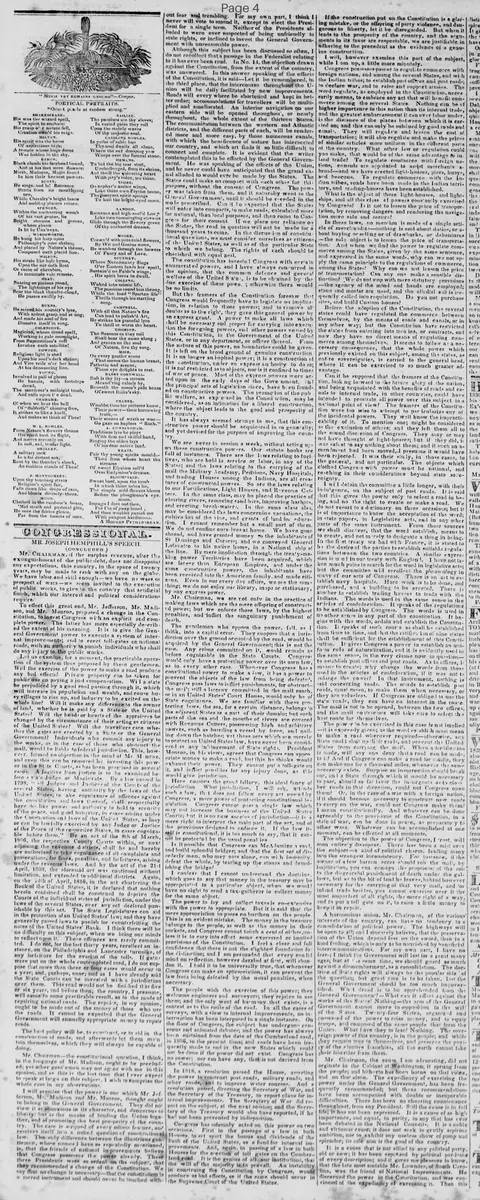
Mr. CHAIRMAN, if the surplus revenue, after the extinguishment of the public debt, does not disappoint our expectations, this country, in the space of twenty years, may be made to rank with any on the globe. We have labor and skill enough—we have no wars or prospect of wars—we seem invited to the execution of public works, to give to the country that artificial finish, which our interest and political considerations require.
To effect this great end, Mr. Jefferson, Mr. Madison, and Mr. Monroe, proposed a change in the Constitution, to invest Congress with an explicit and complete power. The latter has more especially described the extent of his meaning. It is to give the General Government power to execute a system of internal improvements; and to erect toll-gates on national roads, with an authority to punish individuals who shall do any injury to the public works.
Let us examine, for a moment, the practicable operation of the system thus proposed by these gentlemen. Will the exercise of the power to make a road produce any bad effects? Private property can be taken for public use on paying a just compensation. Will a state be prejudiced by a good road passing through it, which will increase its population and wealth, and cause busy villages to rise up, and industry to be excited on the whole line? Will it make any difference to the owner of land, whether he is paid by a State or the United States? Will the heads or hearts of the appraisers be changed by the circumstance of their acting as citizens of the United States? Will the travellers care whether the gates are erected by a State or the General Government? Individuals who commit any injury to the works, as in the case of those who obstruct the mail, would be liable to federal jurisdiction. This, however, formed no objection in the mind of Mr. Monroe. and even this can be removed by investing this power in the State Courts, as has been practised in several cases. A fugitive from justice is to be examined before a state Judge or Magistrate. By a law passed in 1793, "all Judges and Justices of the Courts of the several States, having authority by the laws of the United States, to take cognizance of offences against the constitution and laws thereof, shall respectfully have the like power and authority to hold to security of the peace, and good behavior, in cases arising under the Constitution and laws of the United States, as may or can be lawfully exercised by any Judge or Justice of the Peace of the respective States, in cases cognizable before them." By an act of the 3d of March, 1803, the respective County Courts within, or next adjoining the revenue districts, shall be and hereby are authorized to take cognizance of all complaints and prosecutions, for fines, penalties, and forfeitures, arising under the revenue laws. And by the act of the 21st April, 1806, the aforesaid act was continued without limitation, and extended to additional districts. Again, on the 10th of April, 1816, in the act chartering the Bank of the United States, it is declared that nothing herein contained shall be construed to deprive the Courts of the individual states of jurisdiction, under the laws of the several States, over any act declared punishable by this act. The State Legislatures can aid in the protection of an United States' law; and they have generally passed laws to punish for counterfeiting the notes of the United States' Bank. I think there will be no difficulty on this subject, when we bring our minds to reflect upon it. These offences are rarely committed. I do not, for the last thirty years, recollect an instance, on the Philadelphia and Lancaster turnpike, of any forfeiture for the evasion of the tolls. If gates were put on the whole contemplated road, I do not suppose that more than three or four cases would occur in a year; and, perhaps, none; and as I have already said the State Courts can be invested with a jurisdiction over them. This road would not be finished this five or six years, and before then, the country, I presume, will come to some practicable result, as to the mode of repairing national roads. The repairs, in my opinion, ought to be made out of the money of those who use the roads. It cannot be expected that the General Government will annually appropriate money to repair roads.
The best policy will be, to construct, or to aid in the construction of roads, and afterwards let them maintain themselves, which they will always be capable of doing.
Mr. Chairman—the constitutional question, I think, in the language of Mr. Madison, ought to be precluded; yet other gentlemen may not agree with me in this opinion, and as this is the last time that I ever expect to speak at large on this subject, I wish to comprise the whole case in my observation.
I will premise that the power is one which Mr. Jefferson, Mr. Madison and Mr. Monroe, thought ought to belong to the General Government. They did not view it as obnoxious in its character, and dangerous to liberty: but as the means of binding the Union together, and of promoting the best prosperity of the country. The case is stripped of every odious feature, and resolves itself into a naked question of constitutional law. The only difference between the illustrious gentlemen, whose names I have so repeatedly mentioned, and, that the friends of national improvements believe that Congress possesses the power already. These three Presidents were so ardent on the subject, that they recommended a change of the Constitution. We say that no change is necessary—that the constitution is a sacred instrument and should never be touched without fear and trembling. For my own part, I think I never will vote to amend it, except to elect the President for a single term. Neither of the Presidents alluded to were ever suspected of being unfriendly to state rights, or inclined to invest the General Government with unreasonable power.
Although this subject has been discussed so often, I do not recollect that a passage in the Federalist relating to it has ever been read. In No. 14, the objection drawn against the Constitution, from the extent of the country, was answered. In this answer speaking of the effects of the Constitution, it is said—Let it be remembered, in the third place, that the intercourse throughout the Union will be daily facilitated by new improvements. Roads will every where be shortened and kept in better order; accommodations for travellers will be multiplied and ameliorated. An interior navigation on our eastern side will be opened throughout, or nearly throughout, the whole extent of the thirteen States. The communication between the western and Atlantic districts, and the different parts of each, will be rendered more and more easy, by those numerous canals, with which the beneficence of nature has intersected our country, and which art finds it so little difficult to connect and complete. It is evident that the writer contemplated this to be effected by the General Government. He was speaking of the effects of the Union, and he never could have anticipated that the grand canal alluded to would ever be made by the States. The States could make no compact with each other for this purpose, without the consent of Congress. The power was taken from them. and it naturally went to the General Government, until it should be ceded in the mode prescribed. Can it be expected that the States will enter into compacts, to make roads. calculated more for national, than local purposes, and then come to Congress for their consent. if we place our reliance on the States, the road in question will not be made for a thousand years to come. In the discussion of constitutional questions, we must consider ourselves as citizens of the United States, as well as of the particular State to which we belong. The rights of each should be cherished with equal zeal.
The constitution has invested Congress with certain enumerated powers, and I have always concurred in the opinion. that the common defence and general welfare of the United States, is to be obtained by the due exercise of these powers; otherwise there would be no limits.
But the framers of the Constitution foresaw that Congress would frequently have to legislate on implication, in relation to those powers; and to remove all doubts as to the right, they gave this general power by an express grant. A power to make all laws which shall be necessary and proper for carrying into execution the foregoing powers, and other powers vested by this Constitution, in the Government of the United States, or in any department, or officer thereof. From the nature of this power, no boundaries could be given. It is left on the broad ground of genuine construction. It is no longer an implied power; it is a construction of the constitution, under an express authority to do so; it is not restricted as to objects, nor is it confined to times of war or peace. Most of the express powers were acted upon in the early days of the Government. in the principal acts of legislation since, have been founded on constructive powers. The promotion of the public welfare, as expressed in the Constitution, may be considered, as an intimation for a liberal construction, where the object leads to the good and prosperity of the country.
It has always seemed strange to me, that this constructive power should be acquiesced in so generally; and yet denied for the purpose of improving the country We are never in session a week, without acting upon these constructive powers. Our statute books are full of instances. There are the laws relating to fugitives, who are held to service or labor, in any of the States; and the laws relating to the carrying of the mail the Military Academy, Pensions, Navy Hospitals, and trading houses among the Indians, are all creatures of constructed powers. So are the laws relating to our Fortifications, Light Houses, and Revenue Cutters. In the same class, may be placed the practice of clearing rivers, removing sand bars, improving harbors, and erecting break-waters. In the same class also, may be considered the laws concerning vaccinations, the cultivation of the vine, and grants of land for education. I cannot remember but a small part of them. We do not confine ourselves at home. We have gone abroad, and have granted money to the inhabitants of St Domingo and Caracas; and we conveyed General Lafayette to his native home. in a National ship of the line. By mere implication through, the treaty-making power Territories have been acquired, which are larger than European Empires, and under the same constructive powers. the inhabitants have been received into the American family,and made citizens. Even in our every day affairs, we see the same thing;we do not enjoy our library, maps or stationary, by any express power.
Mr. Chairman. we are not only in the practice of making laws which are the mere offspring of constructed power; but we enforce those laws, by the highest penalties, and inflict the sanguinary punishment of death.
The gentlemen who oppose the power, fall. as I think, into a capital error. They suppose that a jurisdiction over the ground occupied by the road, would be acquired by the General Government; this is not the case. Any crime committed on it, would remain as before cognizable in the State Courts. Congress would only have a protecting power over its own law, as in every other case. Whenever Congress has a constitutional power to make a law, it has a power to prevent the objects of the law from being defeated. Congress passes laws to inflict punishments. for obstructing the mail: till a larceny committed in the mail coach, or in an United States' Court House, would only be of State cognizance. We are familiar with these protecting laws. the sea, for a certain distance, belongs to the adjacent States as a part of their domain; but such parts of the sea and the mouths of rivers are covered with Revenue Cutters, possessing high and arbitrary powers,such as boarding a vessel by force. and nailing down the hatches; yet these acts which are merely to protect an United States law, have never been considered as any infringement of State rights. President Monroe, in his views, agrees that Congress can appropriate money to make a road, but this he thinks would exhaust their power. They cannot put a toll-gate on it, and inflict penalties for any injury done, as this would give jurisdiction.
Here consists the grand fallacy, this ideal fancy of jurisdiction. What jurisdiction, I will ask, attends such a law, that does not follow every act passed by Congress, a mere power of protecting constitutional legislation Congress cannot pass a single law which may not increase the business of the United States Courts; but it is no new species of jurisdiction-it is a mere right to interpret the main part of the act, and of the provisions designed to enforce it. If the law itself is constitutional, it is too much to say, that it cannot be protected by the usual penalties
Is it possible that Congress can macadamize a road and build splendid bridges; and that the first set of disorderly men. who may pass along, can with impunity defeat the whole, by tearing up the stones and demolishing the bridge?
I confess that I cannot understand this doctrine. which goes to say that money in the treasury may be appropriated to a particular object, when we would have no right to send a tax-gatherer to collect money for the same object.
The power to lay and collect taxes is co-extensive with the power to appropriate. But it is said that the mere appropriation imposes no burthen on the people. This is an evident mistake. The money in the treasury belongs to the people, as well as the money in their pockets, and Congress cannot touch a cent of either, unless it is to carry into effect some expressed or implied provisions of the Constitution. I feel a clear and full confidence that there is not the slightest foundation for the distinction; and I am persuaded that every candid mind on reflection, however dazzled at first, will abandon it. I hold it to be universally true, that whenever Congress can make an appropriation, it can prevent the law from being defeated by the usual penalties, when necessary.
The people wish the exercise of this power; they welcome engineers and surveyors; they rejoice to see them; and the only want of harmony that exists, is a contest as to the route of the road. In all the cases of surveys, with a view to internal improvements, no interruption has been interposed in a single instance. On the floor of Congress, the subject has undergone generous and animated debate; and the power has always been sustained from the date of the Cumberland road, in 1806, to the present time; and roads have been frequently made to and in the new States which could not be done if the power did not exist. Congress has no power; nor can have any, that is not derived from the Constitution.
In 1817, a resolution passed the House, asserting the power to construct post-roads, military roads, and other roads, and to improve water courses. And a resolution passed, directing the Secretary of War, and the Secretary of the Treasury, to report plans for internal improvements. The Secretary of War did report on the subject, at the next session; and the Secretary of the Treasury would also have reported, if he had not been prevented by indisposition.
Congress has solemnly acted on this power on two occasions. First in the passage of a law in both Houses. to set apart the bonus and dividends of the bank of the United States, as a fund for internal improvements. And, again. in passing of a law in both Houses for the erection of toll gates on the Cumberland road. It is the genius of all our institutions, that the will of the majority is to prevail. An instability in construing the Constitution by Congress, would produce as bad effects, as if the same should occur in The Supreme Court of the United States.
If the construction put on the Constitution is a glaring mistake, or the offspring of party violence, and dangerous to liberty, let it be disregarded. But when it leads to the prosperity of the country, and the arguments in its favor are respectable, we are justifiable in adhering to the precedent as the evidence of a genuine construction.
I will, however examine this part of the subject, while I am up, a little more minutely. Congress possesses power to regulate commerce with foreign nations, and among the several States, and with the Indian tribes; to establish post offices and post roads; to declare war, and to raise and support armies. The word regulate, as employed in the Constitution, necessarily means, to embrace any act that will benefit commerce among the several States. Nothing can be of higher importance to this nation than its internal trade, and the greatest embarrassment it can ever labor under, is the distance of the places between which it is carried on; and this can only be subdued by good roads and canals. They will regulate and lessen the cost of transportation; it will also regulate and make the prices of similar articles more uniform in the different parts of the country. What other law or regulation could you make, that would be of the same advantage to inland trade? To regulate commerce with foreign nations, consuls are appointed to assist merchants abroad—and we have erected light-houses, piers, buoys. and beacons. To regulate commerce with the Indian tribes, roads have been made in the Indian territory, and trading-houses have been established. What is the object of these light-houses, and light-ships, and all this class of powers constantly exercised by Congress? Is it not to lessen the price of transportation, by removing dangers. and rendering the navigation more safe and secure?
In these laws, no mention is made of a single article of merchandise—nothing is said about duties, or about buying or selling or of drawbacks, or debentures -the sole object is to lessen the price of transportation. And when we find the power to regulate commerce among the States, given by the same sentence, and expressed in the same words, why can we not apply the same principle to the regulations of commerce, among the States? Why can we not lessen the price of transportation? Can any one make a sensible distinction? We do not stop with mere statutory provisions -the agency of the mind and hands are employed: stone and mortar are used, and the alluvial soil is frequently called into requisition. Do you not purchase sites, and build Customhouses?
Before the adoption of the Constitution, the several states could have regulated the commerce between themselves, by the means of roads and canals, or in any other way; but the Constitution has restricted the states from entering into treaties, or contracts, and now they have no direct means of regulating commerce among themselves. It seems to follow as a necessary consequence, that the whole power which previously existed on this subject, among the states, as entire sovereignties, is carried to the general head, where it can be exercised to so much greater advantage.
Can it be supposed that the framers of the Constitution. looking forward to the future glory of the nation, and being acquainted with the benefits of roads and canals to internal trade, in other countries, could have intended to prostrate all power over this subject in a national point of view? The framers of the Constitution were too wise to attempt to particularize any of the incidental powers. They well know the impracticability of it. To mention one; might be considered as the exclusion of others; and they left them all to the sound discretion of Congress. They may or may not have thought of light-houses; but if they did, it was safest to say nothing about them; and if such an amendment had been moved, I presume it would have been rejected. It was their study, in those cases, to the general, and not particular. The objects which clothed Congress with power must be national, and reaching in their considerations beyond state sovereignty.
I will detain the committee a little longer, with their indulgence. on the subject of post roads. It is said that this gives the power only to select a road in being, and not the right to create or make a road. We do not resort to a dictionary on these occasions; but it is of importance to know the acceptation of the word; in state papers, in Legislative acts, and in any other parts of the same instrument. From these sources we shall discover, that the word establish, means to create, and not merely to designate a thing in being. In the first treaty we had with France, it is stated to be the desire of the parties to establish suitable regulations between the two countries. A similar expression is used in our treaty with England. I have not taken much pains to search for the word in legislative acts; but the committee will recollect the phraseology in many of our acts of Congress. There is an act to establish navy hospitals. Here work is to be done, and purchased, and a building to be erected. There is another to establish trading houses to trade with the Indians. The word is used in the same sense in the articles of confederation. It speaks of the regulations to be established by Congress. The word is used in no other sense in any part of the constitution. It begins with the words, ordain and establish the Constitution. It speaks of such courts as shall be established from time to time, and that the ratification of nine states shall be sufficient for the establishment of this Constitution. It gives Congress a power to establish an uniform rule of naturalization, and it is evidently used in the same sense, in the very clause now in question— to establish post offices and post roads. As to offices, it means to create; why change the words from those used in the articles of confederation, if it was not to enlarge the power? In that instrument, nothing is said concerning roads. The words to establish post roads, must mean, to make them when necessary, or they are valueless. If Congress are obliged to use the state roads, they can have no interest in the route The mail is not to be opened, between the two offices, and the mail contractors will take care to select the best route for themselves.
The power to be exercised in this case is not implied -it is expressly given; as the word establish must mean to make a road wherever required-otherwise, any State could shut up their road, and prevent the United States from carrying the mail. When a fortification is made, will any one deny that a road can be made, to it? And if Congress can make a road for a mile, they can make one for a thousand miles, whenever the same necessity exists. Suppose an insurrection should break out, and a State through which it would be necessary to pass, should so far favor the insurgents as to close her roads in that direction, could not Congress open them? Or, in the case of a war with a foreign nation, if it should become necessary to construct new roads to carry on the war, could not Congress make them? I mean constitutionally. And whatever can be done agreeably to the provisions of the Constitution, in a state of war, can be done in peace, a preparatory to other wars. Whatever can be accomplished at one moment, can be effected at all moments.
The objection to the power of Congress, I trust, will soon entirely disappear. There has been a mist over the subject-a kind of political charm, leading many into the strangest inconsistency. For instance, if the owner of a few barren acres should rob the mail, by implication, you can consign the proprietor of the soil to the disgraceful punishment of death under the gallows, but as to the bit of land he leaves, behind however necessary for the carrying of that very mail, and for inland trade besides, you cannot exercise over it the most imperfect of all rights, the mere right of a way. and to put a toll gate on it, to raise a little money to keep it in repair.
A harmonious union, Mr. Chairman, of the various interests of the country, can have no tendency to a consolidation of political power. The highways will be open to all; and I sincerely believe, that the preservation of the Union depends less on the sword, than in a kind feeling. which is only to be nourished by beneficial intercommunications. For my own part, I have no fears; I think the Government will last for a great many ages; but at the same time, we should guard as much against a dismemberment, as a consolidation. The doctrine of State rights will always be the popular side of the question; but great care is to be taken, lest the General Government should be too much impoverished. What dread is to be apprehended from the General Government?-What can it effect against the works of the States? Nothing-the arm of the General Government cannot move in opposition to the will of the States. Twenty-four States, organized and roused of the power to raise money, and to equip troops, and composed of the same people that form the Union. What have they to fear? Nothing. The sovereign power of this country, is in the people; and while they remain true to themselves, and preserve the purity of the elective franchise, all the earth cannot take their liberties from them.
Mr. Chairman, the cause I am advocating, did not originate in the Cabinet at Washington; it sprung from the people; and hitherto has been borne on that voice. and on that alone. The expediency of exercising the power under the General Government, has been frequently recommended; but these recommendations have been accompanied with doubts or insuperable difficulties. There has been no cheering countenance throughout, from any President. Still the cause is in full life; it has not been repressed. It is a cause of as high importance, and equal, in purity, to any that has ever been debated in the National Council. It is a noble and virtuous cause; it does not seek to gratify aspiring ambition, nor to exhibit any useless show of pomp and splendor; its sole aim is the good of the country.
It is a cause that is not allied to any political party. old or new; it has been espoused by political partisans of every description; and it gives me pleasure to know. that the late most amiable Mr. Lowndes,of South Carolina, was the friend of National Improvements. He discerned the power in the Constitution, and was convinced of the expediency of exercising it. Than this distinguished citizen, none in the Union was more admired for integrity of character and clearness of intellect.
It gives me pleasure, too, to know, that his Excellency the Governor of Pennsylvania, in his official character, has recognised the power.
On the fate of this bill, Mr. Chairman. in my humble judgment, depends a large portion of the prosperity and glory of this country, for a long time to come. From this point we are destined to advance, or to retrograde; and I most solemnly invoke the friends of the cause, to act from a spirit of conciliation. and not to suffer the bill to be entangled with other objects of improvements, or to be separated into parts.
I made a similar and successful appeal on a former occasion; it was in the case of the Chesapeake and Delaware Canal: that interesting and highly rational object. had undergone the ordeal of Congressional inquiry, for twenty years, succeeding alternately in one House or the other, but always defeated in the end, by a connection with other subjects.
Many objects of a national character have been presented to this committee, but all cannot be acted on at once. When the question is fairly settled, the different sections of the country will know, that their turn will come as soon as practicable. In the mean time. the state of the public mind, will be in readiness for more enlarged operations. a soon as the national debt shall be extinguished. We have selected the road in question, as the most fit for the peculiar moment; it combines in a high degree, the object of war, intelligence, and inland trade-the three fountains from which the power flows. It commences in the regions where the last war began; it passes by the Seat of the General Government; and it ends where the liberties and independence of our country were so gallantly maintained, in the person of our present chief magistrate and his brave little army.
The cause, Mr. Chairman, is magnifying every day in importance, and if the rail road system does not succeed, as its friends anticipate, and if the power of steam can by applied. as many imagine, and as some experiments seem to prove, the most comprehensive mind cannot foresee the prodigiously improved condition of the country which may be effected in the next twenty years.
Distances will become more slight inconveniences to the pleasure and industry of the country; and the modes of conveyance over the whole civilized world will be changed.
Mr. Chairman, patriotic excitements are salutary to a society of people. They delight in noble achievements; the example of the United States may produce an influence on the rest of the world. When we are known to be inclined to reconcile national differences rather than to excite wars, and are seen devoting ourselves to the happiness of the people, in the promotion of such public undertakings as will advance this interest and go down to posterity as the best evidence of our solicitude for the permanency of our republic. We can never expect to see a fairer moment than the present, to commence the internal improvements of the country, on a scale worthy of their importance and of the public spirit and enterprize of this great nation.
To effect this great end, Mr. Jefferson, Mr. Madison, and Mr. Monroe, proposed a change in the Constitution, to invest Congress with an explicit and complete power. The latter has more especially described the extent of his meaning. It is to give the General Government power to execute a system of internal improvements; and to erect toll-gates on national roads, with an authority to punish individuals who shall do any injury to the public works.
Let us examine, for a moment, the practicable operation of the system thus proposed by these gentlemen. Will the exercise of the power to make a road produce any bad effects? Private property can be taken for public use on paying a just compensation. Will a state be prejudiced by a good road passing through it, which will increase its population and wealth, and cause busy villages to rise up, and industry to be excited on the whole line? Will it make any difference to the owner of land, whether he is paid by a State or the United States? Will the heads or hearts of the appraisers be changed by the circumstance of their acting as citizens of the United States? Will the travellers care whether the gates are erected by a State or the General Government? Individuals who commit any injury to the works, as in the case of those who obstruct the mail, would be liable to federal jurisdiction. This, however, formed no objection in the mind of Mr. Monroe. and even this can be removed by investing this power in the State Courts, as has been practised in several cases. A fugitive from justice is to be examined before a state Judge or Magistrate. By a law passed in 1793, "all Judges and Justices of the Courts of the several States, having authority by the laws of the United States, to take cognizance of offences against the constitution and laws thereof, shall respectfully have the like power and authority to hold to security of the peace, and good behavior, in cases arising under the Constitution and laws of the United States, as may or can be lawfully exercised by any Judge or Justice of the Peace of the respective States, in cases cognizable before them." By an act of the 3d of March, 1803, the respective County Courts within, or next adjoining the revenue districts, shall be and hereby are authorized to take cognizance of all complaints and prosecutions, for fines, penalties, and forfeitures, arising under the revenue laws. And by the act of the 21st April, 1806, the aforesaid act was continued without limitation, and extended to additional districts. Again, on the 10th of April, 1816, in the act chartering the Bank of the United States, it is declared that nothing herein contained shall be construed to deprive the Courts of the individual states of jurisdiction, under the laws of the several States, over any act declared punishable by this act. The State Legislatures can aid in the protection of an United States' law; and they have generally passed laws to punish for counterfeiting the notes of the United States' Bank. I think there will be no difficulty on this subject, when we bring our minds to reflect upon it. These offences are rarely committed. I do not, for the last thirty years, recollect an instance, on the Philadelphia and Lancaster turnpike, of any forfeiture for the evasion of the tolls. If gates were put on the whole contemplated road, I do not suppose that more than three or four cases would occur in a year; and, perhaps, none; and as I have already said the State Courts can be invested with a jurisdiction over them. This road would not be finished this five or six years, and before then, the country, I presume, will come to some practicable result, as to the mode of repairing national roads. The repairs, in my opinion, ought to be made out of the money of those who use the roads. It cannot be expected that the General Government will annually appropriate money to repair roads.
The best policy will be, to construct, or to aid in the construction of roads, and afterwards let them maintain themselves, which they will always be capable of doing.
Mr. Chairman—the constitutional question, I think, in the language of Mr. Madison, ought to be precluded; yet other gentlemen may not agree with me in this opinion, and as this is the last time that I ever expect to speak at large on this subject, I wish to comprise the whole case in my observation.
I will premise that the power is one which Mr. Jefferson, Mr. Madison and Mr. Monroe, thought ought to belong to the General Government. They did not view it as obnoxious in its character, and dangerous to liberty: but as the means of binding the Union together, and of promoting the best prosperity of the country. The case is stripped of every odious feature, and resolves itself into a naked question of constitutional law. The only difference between the illustrious gentlemen, whose names I have so repeatedly mentioned, and, that the friends of national improvements believe that Congress possesses the power already. These three Presidents were so ardent on the subject, that they recommended a change of the Constitution. We say that no change is necessary—that the constitution is a sacred instrument and should never be touched without fear and trembling. For my own part, I think I never will vote to amend it, except to elect the President for a single term. Neither of the Presidents alluded to were ever suspected of being unfriendly to state rights, or inclined to invest the General Government with unreasonable power.
Although this subject has been discussed so often, I do not recollect that a passage in the Federalist relating to it has ever been read. In No. 14, the objection drawn against the Constitution, from the extent of the country, was answered. In this answer speaking of the effects of the Constitution, it is said—Let it be remembered, in the third place, that the intercourse throughout the Union will be daily facilitated by new improvements. Roads will every where be shortened and kept in better order; accommodations for travellers will be multiplied and ameliorated. An interior navigation on our eastern side will be opened throughout, or nearly throughout, the whole extent of the thirteen States. The communication between the western and Atlantic districts, and the different parts of each, will be rendered more and more easy, by those numerous canals, with which the beneficence of nature has intersected our country, and which art finds it so little difficult to connect and complete. It is evident that the writer contemplated this to be effected by the General Government. He was speaking of the effects of the Union, and he never could have anticipated that the grand canal alluded to would ever be made by the States. The States could make no compact with each other for this purpose, without the consent of Congress. The power was taken from them. and it naturally went to the General Government, until it should be ceded in the mode prescribed. Can it be expected that the States will enter into compacts, to make roads. calculated more for national, than local purposes, and then come to Congress for their consent. if we place our reliance on the States, the road in question will not be made for a thousand years to come. In the discussion of constitutional questions, we must consider ourselves as citizens of the United States, as well as of the particular State to which we belong. The rights of each should be cherished with equal zeal.
The constitution has invested Congress with certain enumerated powers, and I have always concurred in the opinion. that the common defence and general welfare of the United States, is to be obtained by the due exercise of these powers; otherwise there would be no limits.
But the framers of the Constitution foresaw that Congress would frequently have to legislate on implication, in relation to those powers; and to remove all doubts as to the right, they gave this general power by an express grant. A power to make all laws which shall be necessary and proper for carrying into execution the foregoing powers, and other powers vested by this Constitution, in the Government of the United States, or in any department, or officer thereof. From the nature of this power, no boundaries could be given. It is left on the broad ground of genuine construction. It is no longer an implied power; it is a construction of the constitution, under an express authority to do so; it is not restricted as to objects, nor is it confined to times of war or peace. Most of the express powers were acted upon in the early days of the Government. in the principal acts of legislation since, have been founded on constructive powers. The promotion of the public welfare, as expressed in the Constitution, may be considered, as an intimation for a liberal construction, where the object leads to the good and prosperity of the country.
It has always seemed strange to me, that this constructive power should be acquiesced in so generally; and yet denied for the purpose of improving the country We are never in session a week, without acting upon these constructive powers. Our statute books are full of instances. There are the laws relating to fugitives, who are held to service or labor, in any of the States; and the laws relating to the carrying of the mail the Military Academy, Pensions, Navy Hospitals, and trading houses among the Indians, are all creatures of constructed powers. So are the laws relating to our Fortifications, Light Houses, and Revenue Cutters. In the same class, may be placed the practice of clearing rivers, removing sand bars, improving harbors, and erecting break-waters. In the same class also, may be considered the laws concerning vaccinations, the cultivation of the vine, and grants of land for education. I cannot remember but a small part of them. We do not confine ourselves at home. We have gone abroad, and have granted money to the inhabitants of St Domingo and Caracas; and we conveyed General Lafayette to his native home. in a National ship of the line. By mere implication through, the treaty-making power Territories have been acquired, which are larger than European Empires, and under the same constructive powers. the inhabitants have been received into the American family,and made citizens. Even in our every day affairs, we see the same thing;we do not enjoy our library, maps or stationary, by any express power.
Mr. Chairman. we are not only in the practice of making laws which are the mere offspring of constructed power; but we enforce those laws, by the highest penalties, and inflict the sanguinary punishment of death.
The gentlemen who oppose the power, fall. as I think, into a capital error. They suppose that a jurisdiction over the ground occupied by the road, would be acquired by the General Government; this is not the case. Any crime committed on it, would remain as before cognizable in the State Courts. Congress would only have a protecting power over its own law, as in every other case. Whenever Congress has a constitutional power to make a law, it has a power to prevent the objects of the law from being defeated. Congress passes laws to inflict punishments. for obstructing the mail: till a larceny committed in the mail coach, or in an United States' Court House, would only be of State cognizance. We are familiar with these protecting laws. the sea, for a certain distance, belongs to the adjacent States as a part of their domain; but such parts of the sea and the mouths of rivers are covered with Revenue Cutters, possessing high and arbitrary powers,such as boarding a vessel by force. and nailing down the hatches; yet these acts which are merely to protect an United States law, have never been considered as any infringement of State rights. President Monroe, in his views, agrees that Congress can appropriate money to make a road, but this he thinks would exhaust their power. They cannot put a toll-gate on it, and inflict penalties for any injury done, as this would give jurisdiction.
Here consists the grand fallacy, this ideal fancy of jurisdiction. What jurisdiction, I will ask, attends such a law, that does not follow every act passed by Congress, a mere power of protecting constitutional legislation Congress cannot pass a single law which may not increase the business of the United States Courts; but it is no new species of jurisdiction-it is a mere right to interpret the main part of the act, and of the provisions designed to enforce it. If the law itself is constitutional, it is too much to say, that it cannot be protected by the usual penalties
Is it possible that Congress can macadamize a road and build splendid bridges; and that the first set of disorderly men. who may pass along, can with impunity defeat the whole, by tearing up the stones and demolishing the bridge?
I confess that I cannot understand this doctrine. which goes to say that money in the treasury may be appropriated to a particular object, when we would have no right to send a tax-gatherer to collect money for the same object.
The power to lay and collect taxes is co-extensive with the power to appropriate. But it is said that the mere appropriation imposes no burthen on the people. This is an evident mistake. The money in the treasury belongs to the people, as well as the money in their pockets, and Congress cannot touch a cent of either, unless it is to carry into effect some expressed or implied provisions of the Constitution. I feel a clear and full confidence that there is not the slightest foundation for the distinction; and I am persuaded that every candid mind on reflection, however dazzled at first, will abandon it. I hold it to be universally true, that whenever Congress can make an appropriation, it can prevent the law from being defeated by the usual penalties, when necessary.
The people wish the exercise of this power; they welcome engineers and surveyors; they rejoice to see them; and the only want of harmony that exists, is a contest as to the route of the road. In all the cases of surveys, with a view to internal improvements, no interruption has been interposed in a single instance. On the floor of Congress, the subject has undergone generous and animated debate; and the power has always been sustained from the date of the Cumberland road, in 1806, to the present time; and roads have been frequently made to and in the new States which could not be done if the power did not exist. Congress has no power; nor can have any, that is not derived from the Constitution.
In 1817, a resolution passed the House, asserting the power to construct post-roads, military roads, and other roads, and to improve water courses. And a resolution passed, directing the Secretary of War, and the Secretary of the Treasury, to report plans for internal improvements. The Secretary of War did report on the subject, at the next session; and the Secretary of the Treasury would also have reported, if he had not been prevented by indisposition.
Congress has solemnly acted on this power on two occasions. First in the passage of a law in both Houses. to set apart the bonus and dividends of the bank of the United States, as a fund for internal improvements. And, again. in passing of a law in both Houses for the erection of toll gates on the Cumberland road. It is the genius of all our institutions, that the will of the majority is to prevail. An instability in construing the Constitution by Congress, would produce as bad effects, as if the same should occur in The Supreme Court of the United States.
If the construction put on the Constitution is a glaring mistake, or the offspring of party violence, and dangerous to liberty, let it be disregarded. But when it leads to the prosperity of the country, and the arguments in its favor are respectable, we are justifiable in adhering to the precedent as the evidence of a genuine construction.
I will, however examine this part of the subject, while I am up, a little more minutely. Congress possesses power to regulate commerce with foreign nations, and among the several States, and with the Indian tribes; to establish post offices and post roads; to declare war, and to raise and support armies. The word regulate, as employed in the Constitution, necessarily means, to embrace any act that will benefit commerce among the several States. Nothing can be of higher importance to this nation than its internal trade, and the greatest embarrassment it can ever labor under, is the distance of the places between which it is carried on; and this can only be subdued by good roads and canals. They will regulate and lessen the cost of transportation; it will also regulate and make the prices of similar articles more uniform in the different parts of the country. What other law or regulation could you make, that would be of the same advantage to inland trade? To regulate commerce with foreign nations, consuls are appointed to assist merchants abroad—and we have erected light-houses, piers, buoys. and beacons. To regulate commerce with the Indian tribes, roads have been made in the Indian territory, and trading-houses have been established. What is the object of these light-houses, and light-ships, and all this class of powers constantly exercised by Congress? Is it not to lessen the price of transportation, by removing dangers. and rendering the navigation more safe and secure?
In these laws, no mention is made of a single article of merchandise—nothing is said about duties, or about buying or selling or of drawbacks, or debentures -the sole object is to lessen the price of transportation. And when we find the power to regulate commerce among the States, given by the same sentence, and expressed in the same words, why can we not apply the same principle to the regulations of commerce, among the States? Why can we not lessen the price of transportation? Can any one make a sensible distinction? We do not stop with mere statutory provisions -the agency of the mind and hands are employed: stone and mortar are used, and the alluvial soil is frequently called into requisition. Do you not purchase sites, and build Customhouses?
Before the adoption of the Constitution, the several states could have regulated the commerce between themselves, by the means of roads and canals, or in any other way; but the Constitution has restricted the states from entering into treaties, or contracts, and now they have no direct means of regulating commerce among themselves. It seems to follow as a necessary consequence, that the whole power which previously existed on this subject, among the states, as entire sovereignties, is carried to the general head, where it can be exercised to so much greater advantage.
Can it be supposed that the framers of the Constitution. looking forward to the future glory of the nation, and being acquainted with the benefits of roads and canals to internal trade, in other countries, could have intended to prostrate all power over this subject in a national point of view? The framers of the Constitution were too wise to attempt to particularize any of the incidental powers. They well know the impracticability of it. To mention one; might be considered as the exclusion of others; and they left them all to the sound discretion of Congress. They may or may not have thought of light-houses; but if they did, it was safest to say nothing about them; and if such an amendment had been moved, I presume it would have been rejected. It was their study, in those cases, to the general, and not particular. The objects which clothed Congress with power must be national, and reaching in their considerations beyond state sovereignty.
I will detain the committee a little longer, with their indulgence. on the subject of post roads. It is said that this gives the power only to select a road in being, and not the right to create or make a road. We do not resort to a dictionary on these occasions; but it is of importance to know the acceptation of the word; in state papers, in Legislative acts, and in any other parts of the same instrument. From these sources we shall discover, that the word establish, means to create, and not merely to designate a thing in being. In the first treaty we had with France, it is stated to be the desire of the parties to establish suitable regulations between the two countries. A similar expression is used in our treaty with England. I have not taken much pains to search for the word in legislative acts; but the committee will recollect the phraseology in many of our acts of Congress. There is an act to establish navy hospitals. Here work is to be done, and purchased, and a building to be erected. There is another to establish trading houses to trade with the Indians. The word is used in the same sense in the articles of confederation. It speaks of the regulations to be established by Congress. The word is used in no other sense in any part of the constitution. It begins with the words, ordain and establish the Constitution. It speaks of such courts as shall be established from time to time, and that the ratification of nine states shall be sufficient for the establishment of this Constitution. It gives Congress a power to establish an uniform rule of naturalization, and it is evidently used in the same sense, in the very clause now in question— to establish post offices and post roads. As to offices, it means to create; why change the words from those used in the articles of confederation, if it was not to enlarge the power? In that instrument, nothing is said concerning roads. The words to establish post roads, must mean, to make them when necessary, or they are valueless. If Congress are obliged to use the state roads, they can have no interest in the route The mail is not to be opened, between the two offices, and the mail contractors will take care to select the best route for themselves.
The power to be exercised in this case is not implied -it is expressly given; as the word establish must mean to make a road wherever required-otherwise, any State could shut up their road, and prevent the United States from carrying the mail. When a fortification is made, will any one deny that a road can be made, to it? And if Congress can make a road for a mile, they can make one for a thousand miles, whenever the same necessity exists. Suppose an insurrection should break out, and a State through which it would be necessary to pass, should so far favor the insurgents as to close her roads in that direction, could not Congress open them? Or, in the case of a war with a foreign nation, if it should become necessary to construct new roads to carry on the war, could not Congress make them? I mean constitutionally. And whatever can be done agreeably to the provisions of the Constitution, in a state of war, can be done in peace, a preparatory to other wars. Whatever can be accomplished at one moment, can be effected at all moments.
The objection to the power of Congress, I trust, will soon entirely disappear. There has been a mist over the subject-a kind of political charm, leading many into the strangest inconsistency. For instance, if the owner of a few barren acres should rob the mail, by implication, you can consign the proprietor of the soil to the disgraceful punishment of death under the gallows, but as to the bit of land he leaves, behind however necessary for the carrying of that very mail, and for inland trade besides, you cannot exercise over it the most imperfect of all rights, the mere right of a way. and to put a toll gate on it, to raise a little money to keep it in repair.
A harmonious union, Mr. Chairman, of the various interests of the country, can have no tendency to a consolidation of political power. The highways will be open to all; and I sincerely believe, that the preservation of the Union depends less on the sword, than in a kind feeling. which is only to be nourished by beneficial intercommunications. For my own part, I have no fears; I think the Government will last for a great many ages; but at the same time, we should guard as much against a dismemberment, as a consolidation. The doctrine of State rights will always be the popular side of the question; but great care is to be taken, lest the General Government should be too much impoverished. What dread is to be apprehended from the General Government?-What can it effect against the works of the States? Nothing-the arm of the General Government cannot move in opposition to the will of the States. Twenty-four States, organized and roused of the power to raise money, and to equip troops, and composed of the same people that form the Union. What have they to fear? Nothing. The sovereign power of this country, is in the people; and while they remain true to themselves, and preserve the purity of the elective franchise, all the earth cannot take their liberties from them.
Mr. Chairman, the cause I am advocating, did not originate in the Cabinet at Washington; it sprung from the people; and hitherto has been borne on that voice. and on that alone. The expediency of exercising the power under the General Government, has been frequently recommended; but these recommendations have been accompanied with doubts or insuperable difficulties. There has been no cheering countenance throughout, from any President. Still the cause is in full life; it has not been repressed. It is a cause of as high importance, and equal, in purity, to any that has ever been debated in the National Council. It is a noble and virtuous cause; it does not seek to gratify aspiring ambition, nor to exhibit any useless show of pomp and splendor; its sole aim is the good of the country.
It is a cause that is not allied to any political party. old or new; it has been espoused by political partisans of every description; and it gives me pleasure to know. that the late most amiable Mr. Lowndes,of South Carolina, was the friend of National Improvements. He discerned the power in the Constitution, and was convinced of the expediency of exercising it. Than this distinguished citizen, none in the Union was more admired for integrity of character and clearness of intellect.
It gives me pleasure, too, to know, that his Excellency the Governor of Pennsylvania, in his official character, has recognised the power.
On the fate of this bill, Mr. Chairman. in my humble judgment, depends a large portion of the prosperity and glory of this country, for a long time to come. From this point we are destined to advance, or to retrograde; and I most solemnly invoke the friends of the cause, to act from a spirit of conciliation. and not to suffer the bill to be entangled with other objects of improvements, or to be separated into parts.
I made a similar and successful appeal on a former occasion; it was in the case of the Chesapeake and Delaware Canal: that interesting and highly rational object. had undergone the ordeal of Congressional inquiry, for twenty years, succeeding alternately in one House or the other, but always defeated in the end, by a connection with other subjects.
Many objects of a national character have been presented to this committee, but all cannot be acted on at once. When the question is fairly settled, the different sections of the country will know, that their turn will come as soon as practicable. In the mean time. the state of the public mind, will be in readiness for more enlarged operations. a soon as the national debt shall be extinguished. We have selected the road in question, as the most fit for the peculiar moment; it combines in a high degree, the object of war, intelligence, and inland trade-the three fountains from which the power flows. It commences in the regions where the last war began; it passes by the Seat of the General Government; and it ends where the liberties and independence of our country were so gallantly maintained, in the person of our present chief magistrate and his brave little army.
The cause, Mr. Chairman, is magnifying every day in importance, and if the rail road system does not succeed, as its friends anticipate, and if the power of steam can by applied. as many imagine, and as some experiments seem to prove, the most comprehensive mind cannot foresee the prodigiously improved condition of the country which may be effected in the next twenty years.
Distances will become more slight inconveniences to the pleasure and industry of the country; and the modes of conveyance over the whole civilized world will be changed.
Mr. Chairman, patriotic excitements are salutary to a society of people. They delight in noble achievements; the example of the United States may produce an influence on the rest of the world. When we are known to be inclined to reconcile national differences rather than to excite wars, and are seen devoting ourselves to the happiness of the people, in the promotion of such public undertakings as will advance this interest and go down to posterity as the best evidence of our solicitude for the permanency of our republic. We can never expect to see a fairer moment than the present, to commence the internal improvements of the country, on a scale worthy of their importance and of the public spirit and enterprize of this great nation.
What sub-type of article is it?
Politics
Infrastructure
What keywords are associated?
Internal Improvements
Constitutional Power
National Roads
Congressional Debate
Cumberland Road
Toll Gates
What entities or persons were involved?
Mr. Jefferson
Mr. Madison
Mr. Monroe
Mr. Lowndes
General Lafayette
Governor Of Pennsylvania
Domestic News Details
Key Persons
Mr. Jefferson
Mr. Madison
Mr. Monroe
Mr. Lowndes
General Lafayette
Governor Of Pennsylvania
Event Details
Speech in Congress arguing for constitutional authority to fund national roads and internal improvements, countering objections on jurisdiction and state rights, referencing historical precedents and presidential views.