Thank you for visiting SNEWPapers!
Sign up free
Mohave County Miner
Mineral Park, Mohave County, Arizona
What is this article about?
In the Oatman-North Star mine, manager R.R. Moore is advancing two drifts and a crosscut on the 400-foot level to access three promising ore bodies: extensions of the main ledge with high values and a parallel rhyolite dyke similar to the United Western, expected to reveal rich ore.
Clipping
OCR Quality
Full Text
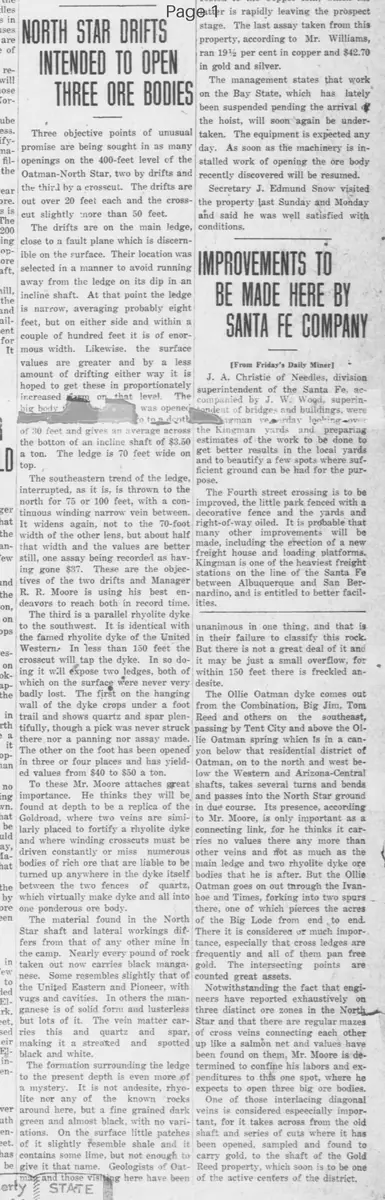
Three objective points of unusual promise are being sought in as many openings on the 400-feet level of the Oatman-North Star, two by drifts and the third by a crosscut. The drifts are out over 20 feet each and the crosscut slightly more than 50 feet.
The drifts are on the main ledge, close to a fault plane which is discernible on the surface. Their location was selected in a manner to avoid running away from the ledge on its dip in an incline shaft. At that point the ledge is narrow, averaging probably eight feet, but on either side and within a couple of hundred feet it is of enormous width. Likewise, the surface values are greater and by a less amount of drifting either way it is hoped to get these in proportionately increased form on that level. The big body was opened out to a depth of 30 feet and gives an average across the bottom of an incline shaft of $3.50 a ton. The ledge is 70 feet wide on top.
The southeastern trend of the ledge, interrupted, as it is, is thrown to the north for 75 or 100 feet, with a continuous winding narrow vein between. It widens again, not to the 70-foot width of the other lens, but about half that width and the values are better still, one assay being recorded as having gone $37. These are the objectives of the two drifts and Manager R. R. Moore is using his best endeavors to reach both in record time.
The third is a parallel rhyolite dyke to the southwest. It is identical with the famed rhyolite dyke of the United Western. In less than 150 feet the crosscut will tap the dyke. In so doing it will expose two ledges, both of which on the surface were never very badly lost. The first on the hanging wall of the dyke crops under a foot trail and shows quartz and spar plentifully, though a pick was never struck there nor a panning nor assay made. The other on the foot has been opened in three or four places and has yielded values from $40 to $50 a ton.
To these Mr. Moore attaches great importance. He thinks they will be found at depth to be a replica of the Goldroad, where two veins are similarly placed to fortify a rhyolite dyke and where winding crosscuts must be driven constantly or miss numerous bodies of rich ore that are liable to be turned up anywhere in the dyke itself between the two fences of quartz, which virtually make dyke and all into one ponderous ore body.
The material found in the North Star shaft and lateral workings differs from that of any other mine in the camp. Nearly every pound of rock taken out now carries black manganese. Some resembles slightly that of the United Eastern and Pioneer, with vugs and cavities. In others the manganese is of solid form and lusterless but lots of it. The vein matter carries this and quartz and spar, making it a streaked and spotted black and white.
The formation surrounding the ledge to the present depth is even more of a mystery. It is not andesite, rhyolite nor any of the known rocks around here, but a fine grained dark green and almost black, with no variations. On the surface little patches of it slightly resemble shale and it contains some lime, but not enough to give it that name. Geologists of Oatman and those visiting here have been unanimous in one thing, and that is in their failure to classify this rock. But there is not a great deal of it and it may be just a small overflow, for within 150 feet there is freckled andesite.
The Ollie Oatman dyke comes out from the Combination, Big Jim, Tom Reed and others on the southeast, passing by Tent City and above the Ollie Oatman spring which is in a canyon below that residential district of Oatman, on to the north and west below the Western and Arizona-Central shafts, takes several turns and bends and passes into the North Star ground in due course. Its presence, according to Mr. Moore, is only important as a connecting link, for he thinks it carries no values there any more than other veins and not as much as the main ledge and two rhyolite dyke ore bodies that he is after. But the Ollie Oatman goes on out through the Ivanhoe and Times, forking into two spurs there, one of which pierces the acres of the Big Lode from end to end. There it is considered of much importance, especially that cross ledges are frequently and all of them pan free gold. The intersecting points are counted great assets.
Notwithstanding the fact that engineers have reported exhaustively on three distinct ore zones in the North Star and that there are regular mazes of cross veins connecting each other up like a salmon net and values have been found on them, Mr. Moore is determined to confine his labors and expenditures to this one spot, where he expects to open three big ore bodies.
One of those interlacing diagonal veins is considered especially important, for it takes across from the old shaft and series of cuts where it has been opened, sampled and found to carry gold, to the shaft of the Gold Reed property, which soon is to be one of the active centers of the district.
What sub-type of article is it?
What keywords are associated?
What entities or persons were involved?
Where did it happen?
Domestic News Details
Primary Location
Oatman
Key Persons
Outcome
ongoing development expected to open three major ore bodies with high gold values, including assays up to $37 per ton.
Event Details
Manager R. R. Moore is directing two drifts over 20 feet each on the main ledge and a crosscut over 50 feet on the 400-foot level of the Oatman-North Star mine to reach three promising ore bodies: southeastern and northwestern extensions of the narrow ledge with widths up to 70 feet and values from $3.50 to $37 per ton, and a southwest parallel rhyolite dyke identical to the United Western, expected to expose two ledges with surface values up to $50 per ton, potentially forming a large ore body like the Goldroad.