Thank you for visiting SNEWPapers!
Sign up free
Midland Cooperator
Minneapolis, Hennepin County, Minnesota
What is this article about?
Joe Gilbert analyzes two 1945 revolutions: the atomic bomb's destructive and productive potential, ushering an era of abundance if adapted to, and the British Labor Party's electoral victory over Churchill's Conservatives, advancing socialist reforms for modern society.
Clipping
OCR Quality
Full Text
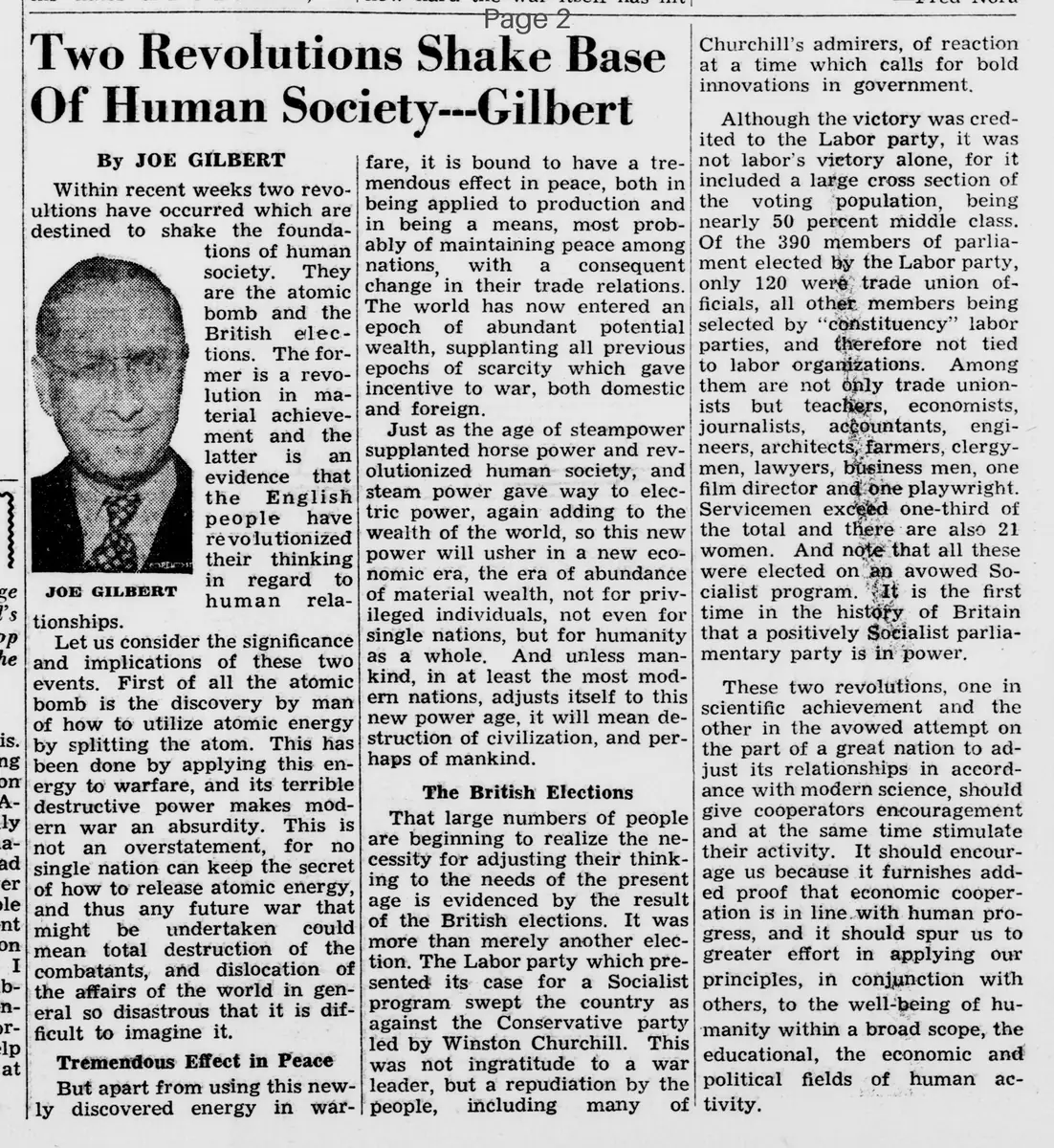
By JOE GILBERT
Within recent weeks two revolutions have occurred which are destined to shake the foundations of human society. They are the atomic bomb and the British elections. The former is a revolution in material achievement and the latter is an evidence that the English people have revolutionized their thinking in regard to human relationships.
Let us consider the significance and implications of these two events. First of all the atomic bomb is the discovery by man of how to utilize atomic energy by splitting the atom. This has been done by applying this energy to warfare, and its terrible destructive power makes modern war an absurdity. This is not an overstatement, for no single nation can keep the secret of how to release atomic energy, and thus any future war that might be undertaken could mean total destruction of the combatants, and dislocation of the affairs of the world in general so disastrous that it is difficult to imagine it.
Tremendous Effect in Peace
But apart from using this newly discovered energy in warfare, it is bound to have a tremendous effect in peace, both in being applied to production and in being a means, most probably of maintaining peace among nations with a consequent change in their trade relations. The world has now entered an epoch of abundant potential wealth, supplanting all previous epochs of scarcity which gave incentive to war, both domestic and foreign.
Just as the age of steampower supplanted horse power and revolutionized human society, and steam power gave way to electric power, again adding to the wealth of the world, so this new power will usher in a new economic era, the era of abundance of material wealth, not for privileged individuals, not even for single nations, but for humanity as a whole. And unless mankind, in at least the most modern nations, adjusts itself to this new power age, it will mean destruction of civilization, and perhaps of mankind.
The British Elections
That large numbers of people are beginning to realize the necessity for adjusting their thinking to the needs of the present age is evidenced by the result of the British elections. It was more than merely another election. The Labor party which presented its case for a Socialist program swept the country as against the Conservative party led by Winston Churchill. This was not ingratitude to a war leader, but a repudiation by the people, including many of Churchill's admirers, of reaction at a time which calls for bold innovations in government.
Although the victory was credited to the Labor party, it was not labor's victory alone, for it included a large cross section of the voting population, being nearly 50 percent middle class. Of the 390 members of parliament elected by the Labor party, only 120 were trade union officials, all other members being selected by "constituency" labor parties, and therefore not tied to labor organizations. Among them are not only trade unionists but teachers, economists, journalists, accountants, engineers, architects, farmers, clergymen, lawyers, business men, one film director and one playwright. Servicemen exceed one-third of the total and there are also 21 women. And note that all these were elected on "an avowed Socialist program." It is the first time in the history of Britain that a positively Socialist parliamentary party is in power.
These two revolutions, one in scientific achievement and the other in the avowed attempt on the part of a great nation to adjust its relationships in accordance with modern science, should give cooperators encouragement and at the same time stimulate their activity. It should encourage us because it furnishes added proof that economic cooperation is in line with human progress, and it should spur us to greater effort in applying our principles, in conjunction with others, to the well-being of humanity within a broad scope, the educational, the economic and political fields of human activity.
What sub-type of article is it?
What themes does it cover?
What keywords are associated?
What entities or persons were involved?
Where did it happen?
Story Details
Key Persons
Location
Britain
Event Date
Within Recent Weeks
Story Details
Two revolutions: the atomic bomb's discovery enabling atomic energy release for warfare and peace, promising abundance but risking destruction if not adapted to; and the British elections where the Labor party won on a Socialist program, defeating Conservatives led by Churchill, signaling a shift in societal thinking toward modern human relationships.