Thank you for visiting SNEWPapers!
Sign up free
Literary
August 8, 1889
Copiah Signal
Hazlehurst, Wesson, Copiah County, Mississippi
What is this article about?
Biographical essay from Youth's Companion on Ralph Waldo Emerson's tolerance and courtesy, illustrated by anecdotes of his patient dealings with eccentric reformers and a rude visitor from Russia, emphasizing his moral virtues without condoning rudeness.
Clipping
OCR Quality
95%
Excellent
Full Text
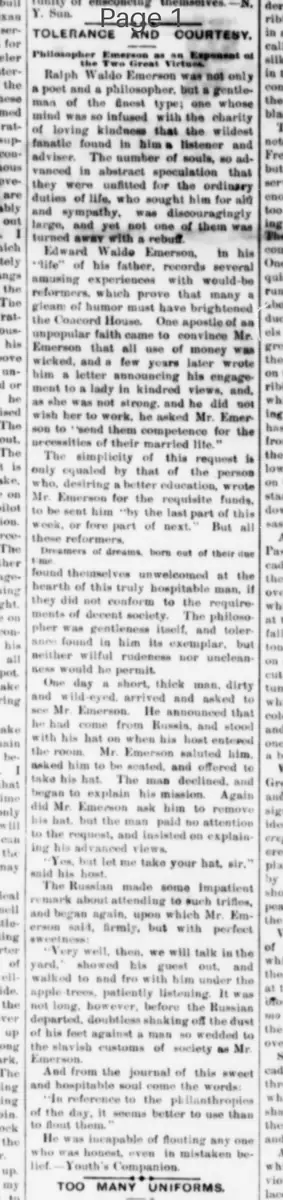
TOLENANCE AND COURTESY.
Philosopher Emerson as an Exponent of the Two Great Virtues.
Ralph Waldo Emerson was not only a poet and a philosopher, but a gentleman of the finest type; one whose mind was so infused with the charity of loving kindness that the wildest fanatic found in him a listener and adviser. The number of souls, so advanced in abstract speculation that they were unfitted for the ordinary duties of life, who sought him for aid and sympathy, was discouragingly large, and yet not one of them was turned away with a rebuke. Edward Waldo Emerson, in his "Life" of his father, records several amusing experiences with would-be reformers, which prove that many a gleam of humor must have brightened the Concord House. One apostle of an unpopular faith came to convince Mr. Emerson that all use of money was wicked, and a few years later wrote him a letter announcing his engagement to a lady in kindred views, and, as she was not strong, and he did not wish her to work, he asked Mr. Emerson to "send them competence for the necessities of their married life." The simplicity of this request is only equaled by that of the person who, desiring a better education, wrote Mr. Emerson for the requisite funds, to be sent him "by the last part of this week, or fore part of next." But all these reformers—
Dreamers of dreams
Born out of their due time—
found themselves unwelcomed at the hearth of this truly hospitable man, if they did not conform to the requirements of decent society. The philosopher was gentleness itself, and tolerance found in him its exemplar, but neither willful rudeness nor uncleanness would he permit. One day a short, thick man, dirty and wild-eyed, arrived and asked to see Mr. Emerson. He announced that he had come from Russia, and stood with his hat on when his host entered the room. Mr. Emerson saluted him, asked him to be seated, and offered to take his hat. The man declined, and began to explain his mission. Again did Mr. Emerson ask him to remove his hat, but the man paid no attention to the request, and insisted on explaining his advanced views. "Yes, but let me take your hat, sir," said his host. The Russian made some impatient remark about attending to such trifles, and began again, upon which Mr. Emerson said, firmly, but with perfect sweetness: "Very well, then, we will talk in the yard," shoved his guest out, and walked to and fro with him under the apple trees, patiently listening. It was not long, however, before the Russian departed, doubtless shaking off the dust of his feet against a man so wedded to the slavish customs of society as Mr. Emerson. And from the journal of this sweet and hospitable soul come the words in reference to the philanthropies of the day: "It seems better to use than to flout them." He was incapable of flouting any one who was honest, even in mistaken belief.—Youth's Companion.
Philosopher Emerson as an Exponent of the Two Great Virtues.
Ralph Waldo Emerson was not only a poet and a philosopher, but a gentleman of the finest type; one whose mind was so infused with the charity of loving kindness that the wildest fanatic found in him a listener and adviser. The number of souls, so advanced in abstract speculation that they were unfitted for the ordinary duties of life, who sought him for aid and sympathy, was discouragingly large, and yet not one of them was turned away with a rebuke. Edward Waldo Emerson, in his "Life" of his father, records several amusing experiences with would-be reformers, which prove that many a gleam of humor must have brightened the Concord House. One apostle of an unpopular faith came to convince Mr. Emerson that all use of money was wicked, and a few years later wrote him a letter announcing his engagement to a lady in kindred views, and, as she was not strong, and he did not wish her to work, he asked Mr. Emerson to "send them competence for the necessities of their married life." The simplicity of this request is only equaled by that of the person who, desiring a better education, wrote Mr. Emerson for the requisite funds, to be sent him "by the last part of this week, or fore part of next." But all these reformers—
Dreamers of dreams
Born out of their due time—
found themselves unwelcomed at the hearth of this truly hospitable man, if they did not conform to the requirements of decent society. The philosopher was gentleness itself, and tolerance found in him its exemplar, but neither willful rudeness nor uncleanness would he permit. One day a short, thick man, dirty and wild-eyed, arrived and asked to see Mr. Emerson. He announced that he had come from Russia, and stood with his hat on when his host entered the room. Mr. Emerson saluted him, asked him to be seated, and offered to take his hat. The man declined, and began to explain his mission. Again did Mr. Emerson ask him to remove his hat, but the man paid no attention to the request, and insisted on explaining his advanced views. "Yes, but let me take your hat, sir," said his host. The Russian made some impatient remark about attending to such trifles, and began again, upon which Mr. Emerson said, firmly, but with perfect sweetness: "Very well, then, we will talk in the yard," shoved his guest out, and walked to and fro with him under the apple trees, patiently listening. It was not long, however, before the Russian departed, doubtless shaking off the dust of his feet against a man so wedded to the slavish customs of society as Mr. Emerson. And from the journal of this sweet and hospitable soul come the words in reference to the philanthropies of the day: "It seems better to use than to flout them." He was incapable of flouting any one who was honest, even in mistaken belief.—Youth's Companion.
What sub-type of article is it?
Essay
What themes does it cover?
Moral Virtue
Social Manners
What keywords are associated?
Emerson
Tolerance
Courtesy
Reformers
Hospitality
What entities or persons were involved?
—Youth's Companion.
Literary Details
Title
Tolenance And Courtesy. Philosopher Emerson As An Exponent Of The Two Great Virtues.
Author
—Youth's Companion.
Subject
Ralph Waldo Emerson's Tolerance And Courtesy Towards Reformers And Visitors
Key Lines
Dreamers Of Dreams
Born Out Of Their Due Time—
It Seems Better To Use Than To Flout Them.