Thank you for visiting SNEWPapers!
Sign up free
The Arkansas Advocate
Little Rock, Pulaski County, Arkansas
What is this article about?
A detailed account of the Black Hawk War's peaceful resolution in 1832, where U.S. forces under Generals Gaines and Atkinson, aided by Illinois militia and Governor Reynolds, compelled the Sac British Band to relocate west of the Mississippi via treaty, averting a broader Indian confederacy.
Merged-components note: Short domestic news item introduces and refers to the detailed letter to the editor on the Black Hawk Indian incident; dateline is part of the letter.
Clipping
OCR Quality
Full Text
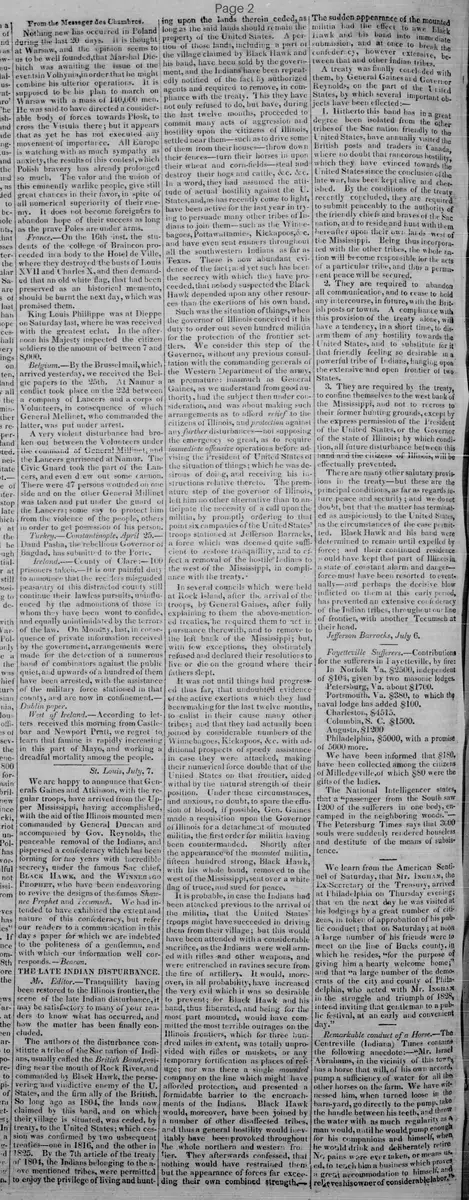
We are happy to announce that Generals Gaines and Atkinson, with the regular troops, have arrived from the Upper Mississippi, having accomplished, with the aid of the Illinois mounted men commanded by General Duncan and accompanied by Gov. Reynolds, the peaceable removal of the Indians, and dispersed a confederacy which has been forming for two years with incredible secrecy, under the famous Sac chief BLACK HAWK, and the Winnebago Prophet, who have been endeavoring to revive the designs of the famous Shawnee Prophet and Tecumseh. We had intended to have exhibited the extent and nature of this confederacy, but refer our readers to a communication in this day's paper to which we are indebted to the politeness of a gentleman, and with which our information well corresponds.—Beacon.
Mr. Editor.—Tranquillity having been restored to the Illinois frontier, the scene of the late Indian disturbance, it may be satisfactory to many of your readers to know what has occurred, and how the matter has been finally concluded.
The authors of the disturbance constitute a tribe of the Sac nation of Indians, usually called the British Band, residing near the mouth of Rock River, and commanded by Black Hawk, the persevering and vindictive enemy of the U. States, and the firm ally of the British. So long ago as 1804, the lands now claimed by this band, and on which their village is situated, was ceded, by treaty, to the United States: which cession was confirmed by two subsequent treaties—one in 1816, and the other in 1825. By the 7th article of the treaty of 1804, the Indians belonging to the above mentioned tribes, were permitted to enjoy the privilege of living and hunting upon the lands therein ceded, as long as the said lands should remain the property of the United States. A portion of those lands, including a part of the village claimed by Black Hawk and his band, have been sold by the government, and the Indians have been repeatedly notified of the fact by authorized agents and required to remove, in compliance with the treaty. This they have not only refused to do, but have, during the last twelve months, proceeded to commit many acts of aggression and hostility upon the citizens of Illinois, settled near them—such as to drive some of them from their houses—throw down their fences—turn their horses in upon their wheat and corn-fields—steal and destroy their hogs and cattle, &c. &c. In a word, they had assumed the attitude of actual hostility against the U. States, and, as has recently come to light, have been active for the last year in trying to persuade many other tribes of Indians to join them—such as the Winnebagoes, Pottawattamies, Kickapoos, &c. and have even sent runners throughout all the southwestern Indians as far as Texas. There is now abundant evidence of the fact; and yet such has been the secrecy with which they have proceeded, that nobody suspected the Black Hawk depended upon any other resources than the exertions of his own band.
Such was the situation of things, when the governor of Illinois conceived it his duty to order out seven hundred militia for the protection of the frontier settlers. We consider this step of the Governor, without any previous consultation with the commanding generals of the Western Department of the army, as premature: inasmuch as General Gaines, as we understand from good authority, had the subject then under consideration, and was about making such arrangements as to afford relief to the citizens of Illinois, and protection against any further disturbances—not supposing the emergency so great, as to require immediate offensive operations before advising the President of United States of the situation of things; which he was desirous of doing, and receiving his instructions relative thereto. The premature step of the governor of Illinois, left him no other alternative than to anticipate the necessity of a call upon the militia, by promptly ordering to that point six companies of the United States troops stationed at Jefferson Barracks, a force which was deemed quite sufficient to restore tranquillity, and to effect a removal of the hostile Indians to the west of the Mississippi, in compliance with the treaty.
In several councils which were held at Rock Island, after the arrival of the troops, by General Gaines, after fully explaining to them the above-mentioned treaties, he required them to act in pursuance therewith, and to remove to the left bank of the Mississippi; but, with few exceptions, they obstinately refused and declared their resolutions to live or die on the ground where their fathers slept.
It was not until things had progressed thus far, that undoubted evidence of the active exertions which they had been making for the last twelve months, to enlist in their cause many other tribes; and that they had actually been joined by considerable numbers of the Winnebagoes, Kickapoos, &c. with additional prospects of speedy assistance in case they were attacked, making their numerical force double that of the United States on that frontier, aided withal by the natural strength of their position. Under these circumstances, and anxious, no doubt, to spare the effusion of blood, if possible, Gen. Gaines made a requisition upon the Governor of Illinois for a detachment of mounted militia, the first order for militia having been countermanded. Shortly after the appearance of the mounted militia, fifteen hundred strong, Black Hawk, with his whole band, removed to the west of the Mississippi, sent over a white flag of truce, and sued for peace.
It is probable, in case the Indians had been attacked previous to the arrival of the militia, that the United States troops might have succeeded in driving them from their village; but this would have been attended with a considerable sacrifice, as the Indians were well armed with rifles and other weapons, and were entrenched in ravines secure from the fire of artillery. It would, moreover, in all probability, have increased the very evil which it was so desirable to prevent; for Black Hawk and his band, thus liberated, and being of the most part mounted, would have committed the most terrible outrages on the Illinois frontiers, which for three hundred miles in extent, was totally unprovided with rifles or muskets, or any temporary fortification as places of refuge; nor was there a single mounted company on the line which might have afforded protection, and presented a formidable barrier to the encroachments of the Indians. Black Hawk would, moreover, have been joined by a number of other disaffected tribes, and thus a general hostility would inevitably have been provoked throughout the whole northern and western frontier. They afterwards confessed, that nothing would have restrained them but the appearance of forces far exceeding their own combined strength.
The sudden appearance of the mounted militia had the effect to awe Black Hawk and his band into immediate submission, and at once to break the confederacy, however extensive, between that and other Indian tribes.
A treaty was finally concluded with them, by General Gaines and Governor Reynolds, on the part of the United States, by which several important objects have been effected:-
1. Hitherto this band has in a great degree been isolated from the other tribes of the Sac nation friendly to the United States, have annually visited the British posts and traders in Canada, where no doubt that rancorous hostility, which they have evinced towards the United States since the conclusion of the late war, has been kept alive and cherished. By the conditions of the treaty recently concluded, they are required to submit peaceably to the authority of the friendly chiefs and braves of the Sac nation, and to reside and hunt with them hereafter upon their own lands west of the Mississippi. Being thus incorporated with the other tribes, the whole nation will become responsible for the acts of a particular tribe, and thus a permanent peace will be secured.
2. They are required to abandon all communication, and to cease to hold any intercourse, in future, with the British posts or towns. A compliance with this provision of the treaty alone, will have a tendency, in a short time, to disarm them of any hostility towards the United States, and to substitute for it that friendly feeling so desirable in a powerful tribe of Indians, hanging upon the extensive and open frontier of two States.
3. They are required by the treaty, to confine themselves to the west bank of the Mississippi, and not to recross to their former hunting grounds, except by the express permission of the President of the United States, or the Governor of the state of Illinois; by which condition, all future disturbance between this band and the citizens of Illinois, will be effectually prevented.
There are many other salutary provisions in the treaty—but these are the principal conditions, as far as regards future peace and security; and we do not doubt, but that the matter has terminated as auspiciously to the United States, as the circumstances of the case permitted. Black Hawk and his band were determined to remain until expelled by force; and their continued residence would have kept that part of Illinois in a state of constant alarm and danger—force must have been resorted to eventually—and perhaps the decisive blow inflicted on them at this early period, has prevented an extensive confederacy of the Indian tribes, throughout our line of frontier, with another Tecumseh at their head.
Jefferson Barracks, July 6.
What sub-type of article is it?
What themes does it cover?
What keywords are associated?
What entities or persons were involved?
Letter to Editor Details
Recipient
Mr. Editor
Main Argument
the black hawk band's violations of treaties and aggressions led to u.s. military and militia intervention, resulting in their peaceful removal west of the mississippi via a treaty that dispersed their confederacy and secured frontier peace.
Notable Details